The Cellular Archive: Tan Mu's Embryo and the Magnification of Origin
The human embryo is a site of maximum information density and minimum physical scale. In its earliest stages, life is less an object than a program: a sequence of divisions, a migration of nuclei, a folding of membranes that anticipates the architecture of the body. Historically, the visualization of this process was prohibited by the limits of optics. The first week of life was a dark continent, accessible only through the speculative drawings of nineteenth-century anatomists. Today, imaging technologies have illuminated this void. Confocal microscopy and time-lapse embryology allow us to witness the zygote’s first cleavage in real time. Tan Mu’s Embryo (2022) enters this illuminated space to perform an act of painterly witness. By translating the fleeting, digital evidence of the cleanroom into the heavy, slow medium of oil on linen, she archives the origins of life in the language of the museum.
Embryo (2022) is oil on linen, measuring one hundred two by ninety-one centimeters. The composition is dominated by a central, spherical form that registers the weight and pressure of early cellular development. The palette is a sophisticated range of transparent and opaque layers: titanium white and flake white highlights suggest the pearlescent surface of the zona pellucida, while deep umbers and Payne's gray provide a ground that evokes both the darkness of the womb and the aseptic void of the laboratory. The brushwork is disciplined but evocative, capturing the sense of a form in transition. The painting does not merely depict a cell; it registers the emergence of a system. It is a work that occupies the threshold between biological data and somatic presence, marking a significant evolution in Tan Mu's investigation of the invisible structures that underpin existence.
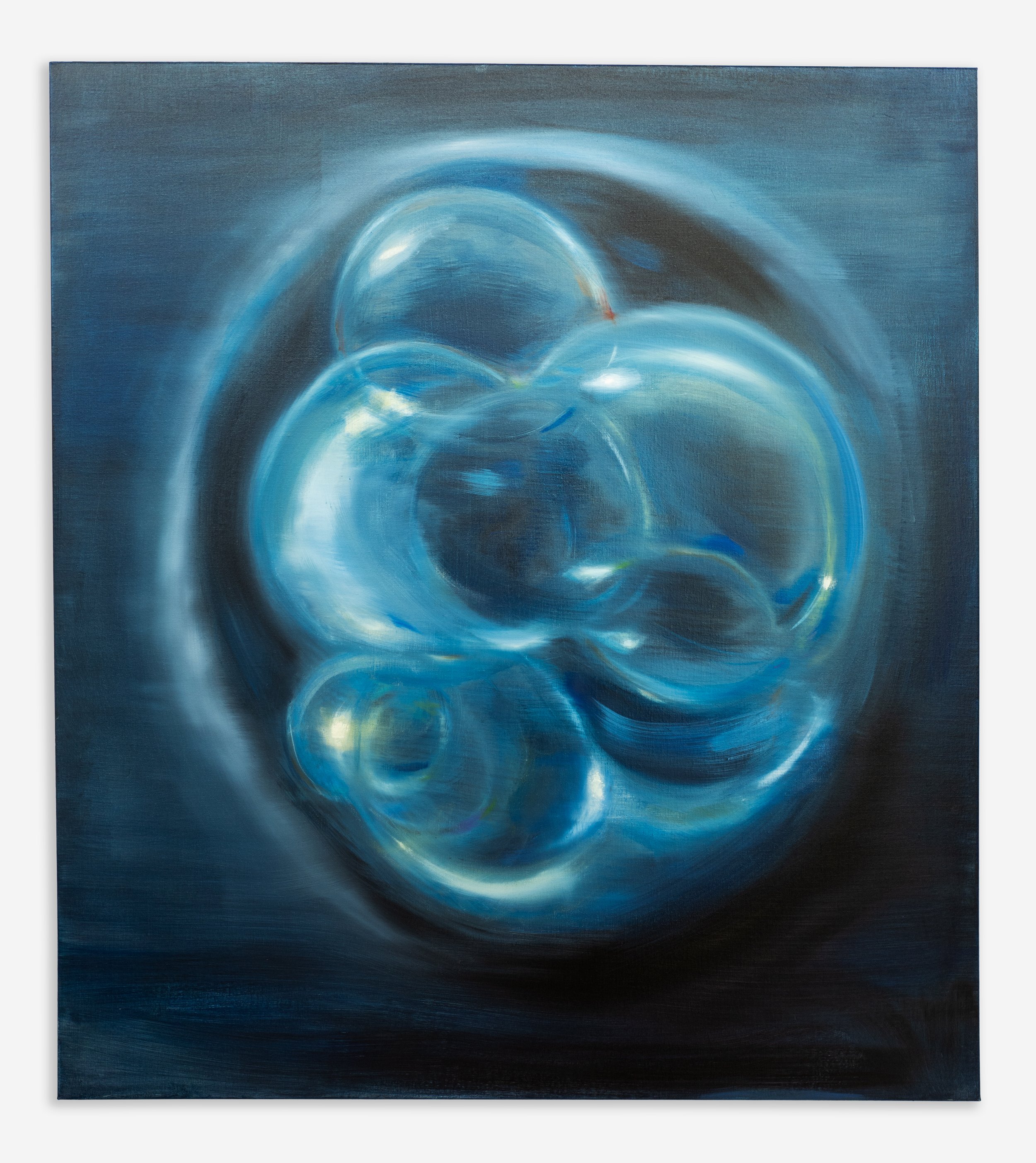
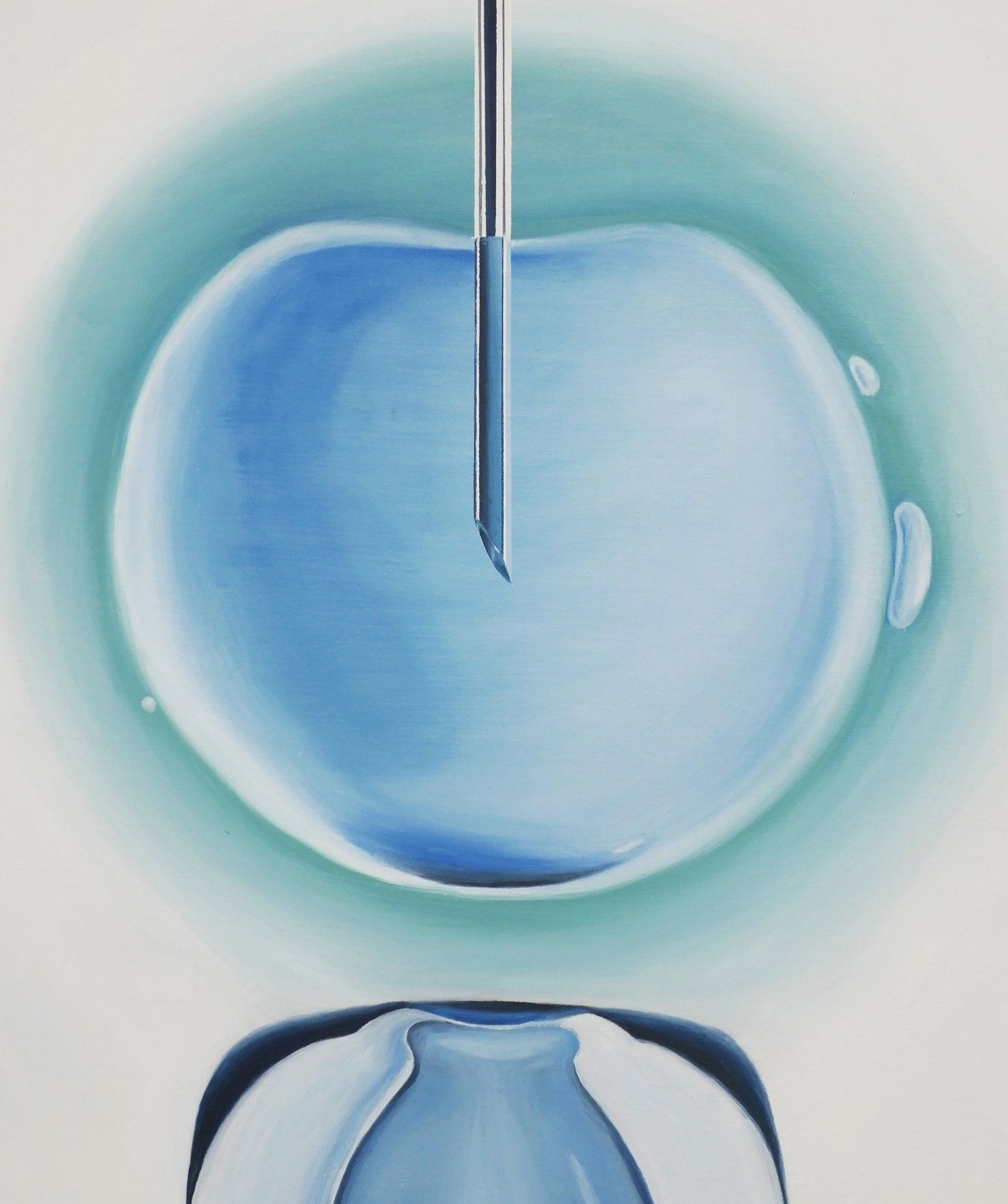
The relationship between Embryo and the preceding work IVF (2020) maps a progression within Tan Mu’s investigation of reproductive technology. IVF addresses the assisted conception event at the cellular level - the embryo created outside the body, the technological mediation of fertilisation itself. Embryo moves one stage further, into the developmental sequence that follows. Together the two paintings form a diptych of threshold moments: the instant of creation and the instant of becoming. The formal registers differ accordingly. IVF tends toward a stark, high-key clarity; Embryo toward atmospheric density. The shift in handling mirrors the shift in biological condition, from the clarity of the clinical event to the pressured obscurity of early development.
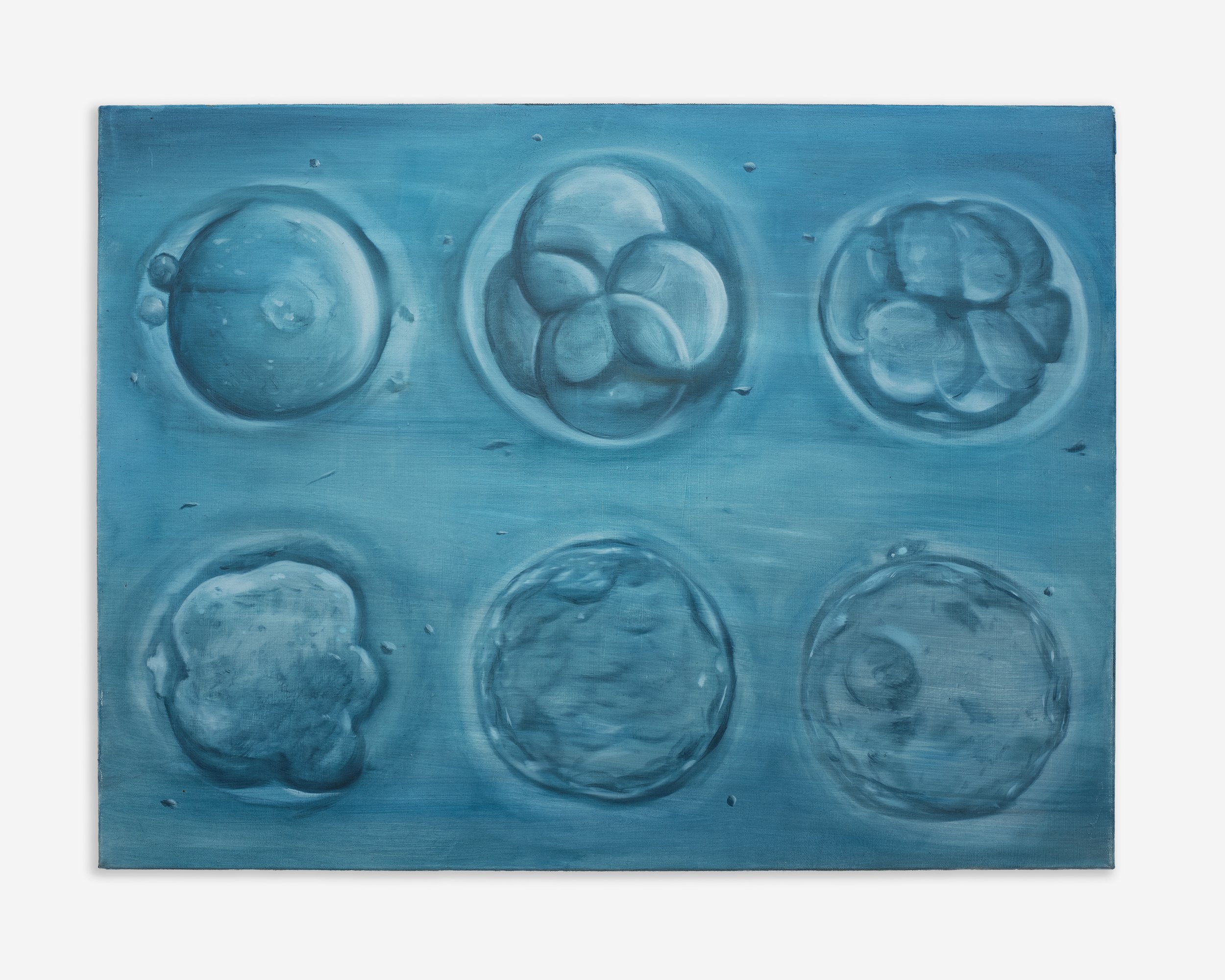
This series deep dive traces the development from First Week (2022), which maps the chronological progression of fertilization, to the singular focus of Embryo. While First Week employs a more systematic, almost diagrammatic approach, depicting the transition from zygote to blastocyst across multiple panels, Embryo isolates a specific, intense moment of potentiality. Tan Mu has noted that imaging technologies have fundamentally changed her approach to painting, enabling her to study processes that are silent yet immensely powerful. By incorporating these scientific perspectives, she extends painting beyond surface appearance and into realms shaped by biology and invisible logic. Her work functions as what she calls an "archaeology of the present," a visual record of how contemporary science models the fundamental nature of being.
The precedent of Leonardo da Vinci’s anatomical drawings (c. 1510-15) provides a vital methodological anchor for this discussion. Leonardo was among the first artists to treat the human body not as a finished form, but as a mechanism to be understood through dissection and observation. His drawings of embryos in the womb are foundational acts of biological witness, attempting to reconcile the seen with the unseen. Tan Mu’s Embryo functions as a twenty-first-century successor to this tradition. Where Leonardo used the quill and the knife to reveal the hidden architecture of life, Tan Mu uses the microscope and the brush. Both artists are driven by a desire to archive the structural logic of the human form at its inception. The comparison reveals how painting can serve as a bridge across centuries, connecting the speculative anatomy of the Renaissance with the technological imaging of the digital age.
In her 2022 conversations, Tan Mu reflects on how technology functions both as a tool and as a conceptual framework. In works like Embryo, the camera’s gaze is not peripheral; it is constitutive. The painting registers the specific visual artifacts of contemporary imaging, the chromatic aberration at the edge of the lens, the flattening effect of the focal plane, the artificial luminosity of the contrast-enhanced subject. By painting these artifacts, Tan Mu acknowledges that our perception of the origin of life is always mediated. We do not see the embryo directly; we see the technological model of the embryo. Her work is a record of this mediation, capturing the aesthetic of discovery as much as the subject of discovery itself.
The formal strategy of Embryo relies on the tension between the defined center and the blurred periphery. This mirrors the optical reality of microscopy, where the depth of field is measured in microns. Only one narrow slice of the subject is in focus at any given moment. In the painting, this translates into a sense of volume and pressure, where the "liveness" of the center is intensified by the dissolution of the edges. This "blur" is not a stylistic flourish; it is an epistemological statement. It registers the limits of the human eye and the technological lens. Painting at this threshold, Tan Mu acknowledges that our models of reality are always partial, always mediated, and always beautiful in their insufficiency. The canvas becomes a site where the precision of the data meets the sensitivity of the hand.
Helen Chadwick’s Unnatural Selection (2000), a series of Cibachrome prints created from IVF embryos that failed to implant, offers a provocative art historical parallel. Chadwick worked with actual human embryos, transforming the microscopic, often-discarded cells into large, floral-like compositions that blur the boundary between the biological and the aesthetic. Her work insists on the literal presence of the biological material; the prints are not just representations of life, but traces of life itself. Tan Mu’s Embryo operates through a different strategy of presence. She does not use biological material; she uses the material of painting to create a somatic equivalent of life. Where Chadwick uses the medium of the photogram to amplify the scale of the cell, Tan Mu uses the medium of the icon. Her oil on linen support, with its expected lifespan of centuries, transforms the fleeting cellular event into a permanent presence. This archival intent is central to her practice: she is fixing the digital signal into the durable substrate of art, creating a ledger of our time for future observers.
The "spherical forms that encapsulate information" are a recurring theme that Tan Mu identifies across her practice. Whether it is the circular form of an embryo, the pathways of submarine cables, or the geometry of the observable universe, these shapes represent fundamental patterns that repeat across scales. In Embryo, the circle is not just a container; it is a force. It embodies the pressure of the genetic information as it replicates. This visual rhyming is not merely coincidental; it reflects a deep-seated interest in how we model reality through distribution and vectors. By using the circle as a foundational motif, Tan Mu connects the microscopic origin of the individual with the macroscopic structure of the collective. The embryo is a microcosm that contains the blueprint for the entire system.
The precedent of Robert Hooke’s Micrographia (1665) is equally essential for understanding the lineage of Embryo. Hooke’s meticulous copperplate engravings of insects and plants viewed through the newly invented microscope were the first to show the world the "cells" of biological life. Like Tan Mu, Hooke was translating the revelation of a technological apparatus into a lasting visual record. His engravings were not just scientific illustrations; they were acts of wonder that expanded the boundaries of what was considered a valid subject for art. Tan Mu’s usage of oil paint to render the embryo performs a similar expansion. She takes the clinically precise images of twenty-first-century embryology and grants them the material weight and cultural authority that Hooke granted his microscopic specimens. Both artists use their respective technologies to archive the invisible architecture of the natural world.
In her conversation "Between Submarine Cable and Ocean Waves" (2025), Tan Mu speaks about the "quiet humility" found in these biological forms. They remind her of balance, transience, and resilience in nature. This nature-based aesthetic allows her to connect timeless structural patterns with contemporary human experience, offering a sense of calm and continuity within the accelerated conditions of modern life. In Embryo, this humility is evident in the refusal of spectacularization. The subject is not presented as a "miracle" but as a system, a complex, beautiful, and deeply integrated architecture. The painting honors the embryo not by sentimentalizing it, but by paying it the compliment of rigorous, disciplined attention.
The contemporary practice of Suzanne Anker provide a further art historical context. Anker’s work, which often uses PCR amplification and 3D printing of biological structures, investigates the intersection of the genetic and the artistic. Her MRI Butterfly prints and her laboratory-based installations address the same "technological gaze" that Tan Mu registers in Embryo. However, where Anker often employs the actual tools of science to create her work, Tan Mu’s insistence on the traditional medium of oil painting creates a different kind of tension. By painting these digital revelations by hand, she introduces a somatic duration that is absent from Anker’s more immediate, machine-mediated processes. Tan Mu’s work suggests that the most profound way to witness the origin of life is through the slow, deliberative act of painting.
This somatic quality is informed by Tan Mu's experience as a competitive freediver. For an artist who understands the physical limits of the body and the experience of pressure in the deep ocean, the cellular origin is not an abstract concept. The silence and the specific visual distortions of the deep ocean have a direct formal parallel in the way she handles paint. The "void" in Embryo, the dark ground of Payne’s gray, is not just empty space; it has a material density, like water at depth. The glowing center of the embryo is like the sun viewed from thirty meters below the surface, a distant, radiating presence that is the only source of orientation. This embodied knowledge informs her approach to biological imaging. She paints the embryo not as a scholar, but as a witness to the fundamental pressure of being.
The material facts of Tan Mu’s process reinforce this archival intent. She uses oil on linen, a support with an expected lifespan of centuries. By choosing this medium to depict the most cutting-edge discoveries of contemporary science, whether it be the internal structure of a cryostat, the pathways of submarine cables, or the mechanics of cellular division, she is performing a deliberate act of translation. She is taking the fleeting, digital evidence produced by our instruments and fixing it in the slow, permanent material of art. This is what makes her work a "cellular archive." She is creating a visual record of how we see the world now, preserving it for a future that will likely see it very differently. The painting is a site where the fleeting and the permanent meet.
At one hundred two by ninety-one centimeters, Embryo gives the earliest stage of human development a scale it never occupies in life. A blastocyst is smaller than the period at the end of this sentence. The painting makes it the size of a torso. That enlargement is not dramatization. It is the condition under which the structure becomes legible, the point at which the cell walls and inner mass become available to the eye rather than the microscope. What the painting preserves is not the embryo itself but the specific historical moment when IVF made this image possible, when the interior of conception became a photograph rather than a mystery. The linen will outlast the clinical context. The image will remain after the technology that produced it has been replaced by something the painting cannot anticipate.
The temporal dimension of Embryo deserves particular attention. In clinical embryology, the developmental timeline of the first week is measured in hours. The zygote divides at approximately thirty hours after fertilisation. By day three, the embryo has become a morula, a solid cluster of sixteen cells. By day five, it has hollowed into a blastocyst, the form in which it will implant in the uterine wall. This entire sequence unfolds over a period during which the embryo is smaller than the period at the end of this sentence. Tan Mu’s painting compresses and arrests this timeline. It does not depict the sequence; it depicts a moment within it, chosen for its visual and conceptual weight. The arrested quality of the image, the sense of a form caught in the act of becoming, is one of its most distinctive formal achievements.
This temporality connects to a broader question that runs through Tan Mu’s practice: the relationship between biological time and human time. The submarine cables she paints carry data at the speed of light; the embryo she paints operates at the speed of cellular chemistry. Both of these temporalities are radically other to the human scale of experience. We cannot feel the data moving through the cable, and we cannot feel the cell dividing in the early embryo. What we can do is construct images of these processes, and then construct paintings of those images. This double mediation, from event to data to image to paint, is the site where Tan Mu works. Each translation introduces a slowing, a thickening, a return toward the human scale. The final painting is not fast like light or slow like geology; it is human, made at the pace of a hand moving across a linen surface, registered by eyes accustomed to the scale of rooms and bodies.
Li Yizhuo’s essay for the “Constellations” exhibition at BEK Forum Vienna (2025) describes Tan Mu’s practice as engaged with “invisible architectures that organise contemporary life.” Among the works in that exhibition, Embryo stands as the most intimate example of this concern. The invisible architecture here is not physical infrastructure but biological programming: the genetic instructions that govern the first divisions of a fertilised egg, the molecular gradients that establish the body axes, the signalling pathways that decide which cells will become the inner cell mass and which the trophoblast. These are architectures of becoming, written in chemistry and time. Tan Mu’s painting does not illustrate them. It registers their consequence: the visible, glowing form of the early embryo as it appears to the instruments we have built to see it. In doing so, it adds this foundational invisible architecture to the visual ledger she has been compiling across years of work, linking the origin of the body to the origin of the digital network, the quantum processor, and the fissile nucleus.
The question of scale governs the entire enterprise. At one hundred two by ninety-one centimeters, Embryo is a monumental painting of a subject that is, in biological reality, 0.1 millimetres in diameter. This is a magnification factor of roughly one thousand. Tan Mu is not painting what the eye sees; she is painting what the instrument reveals, and then amplifying it further through the conventions of large-format oil painting. The effect is to force a confrontation between the viewer’s body and the depicted body’s origin. Standing before Embryo, the viewer cannot adopt the detached, analytical stance that a scientific image permits. The painting is too large, too materially present, too much a part of the room. The subject fills the canvas the way a portrait fills a canvas: with the demand to be acknowledged as a presence.
This scalar violence is not incidental. It is the condition under which the painting achieves its ethical claim. The embryo, in the context of contemporary reproductive medicine, is frequently discussed as an object of legal status, clinical assessment, and genetic screening. It is weighed, measured, graded, and selected. Tan Mu’s painting refuses this objectification by reversing the proportional relationship. In the IVF clinic, the human being looms over the embryo; in the gallery, the embryo looms over the human being. The painting does not argue a position in the ethical debates surrounding assisted reproduction. It simply insists, through the brute fact of its scale, that the embryo is a subject large enough to deserve the kind of sustained attention that painting uniquely provides.
The connection to Tan Mu’s broader practice is structural, not merely thematic. Across her work, she returns consistently to sites where technology mediates the relationship between the human body and invisible natural processes. In the submarine cable paintings, the cables are the mediating infrastructure; in the Quantum Computer series, the cryostat is the mediating architecture; in Embryo, the confocal microscope and the IVF laboratory constitute the mediating system. In each case, painting performs the same function: it takes the outputs of these technological mediations and restores to them the weight, duration, and sensory richness that the original digital images lack. It insists on presence where the instrument produces only data. This is not a critique of technology. It is a completion of technology, an acknowledgment that data alone cannot satisfy the human requirement for witness.