Harnessing the Star: Tan Mu's Dyson Sphere and the Architecture of Unlimited Power
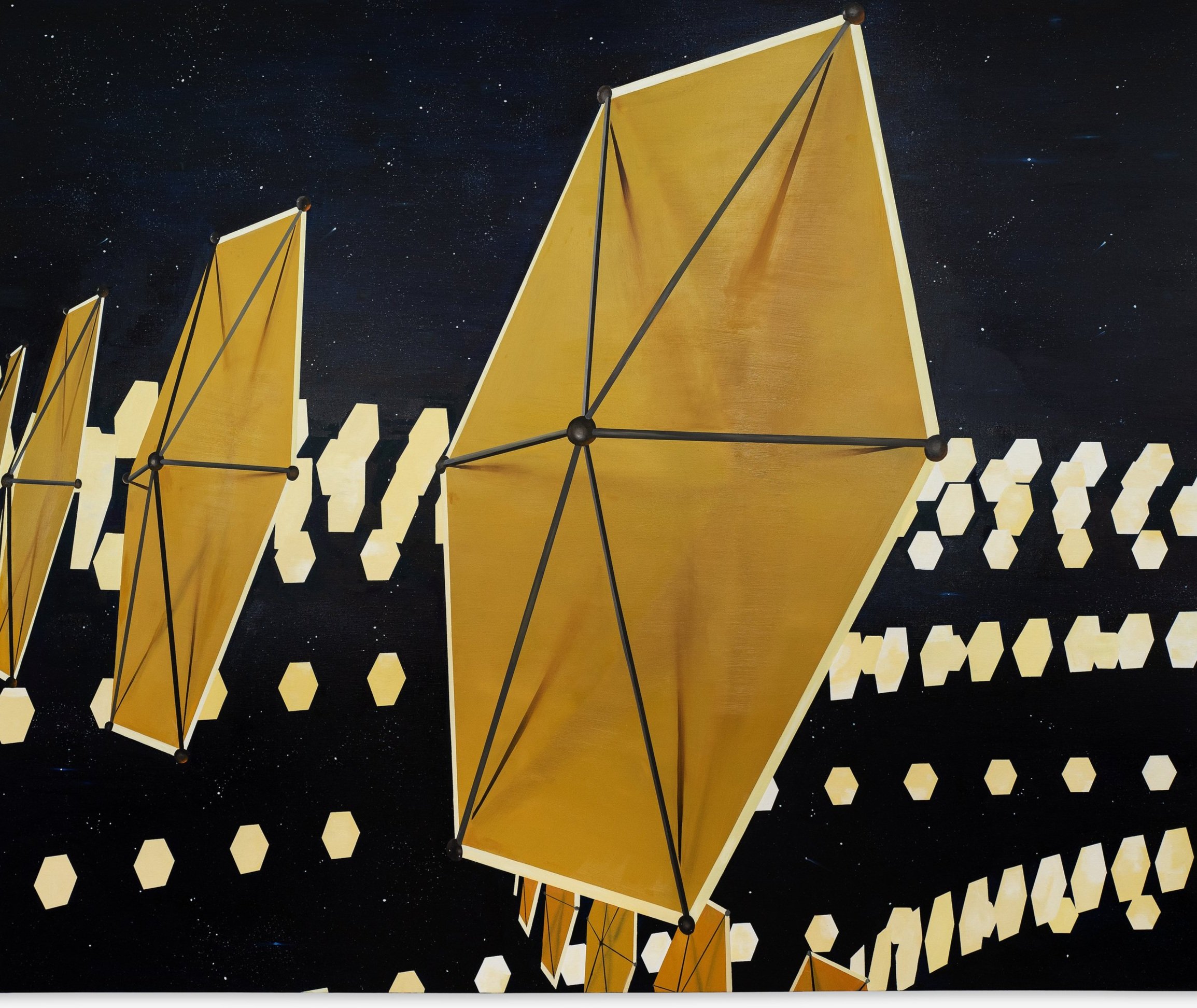
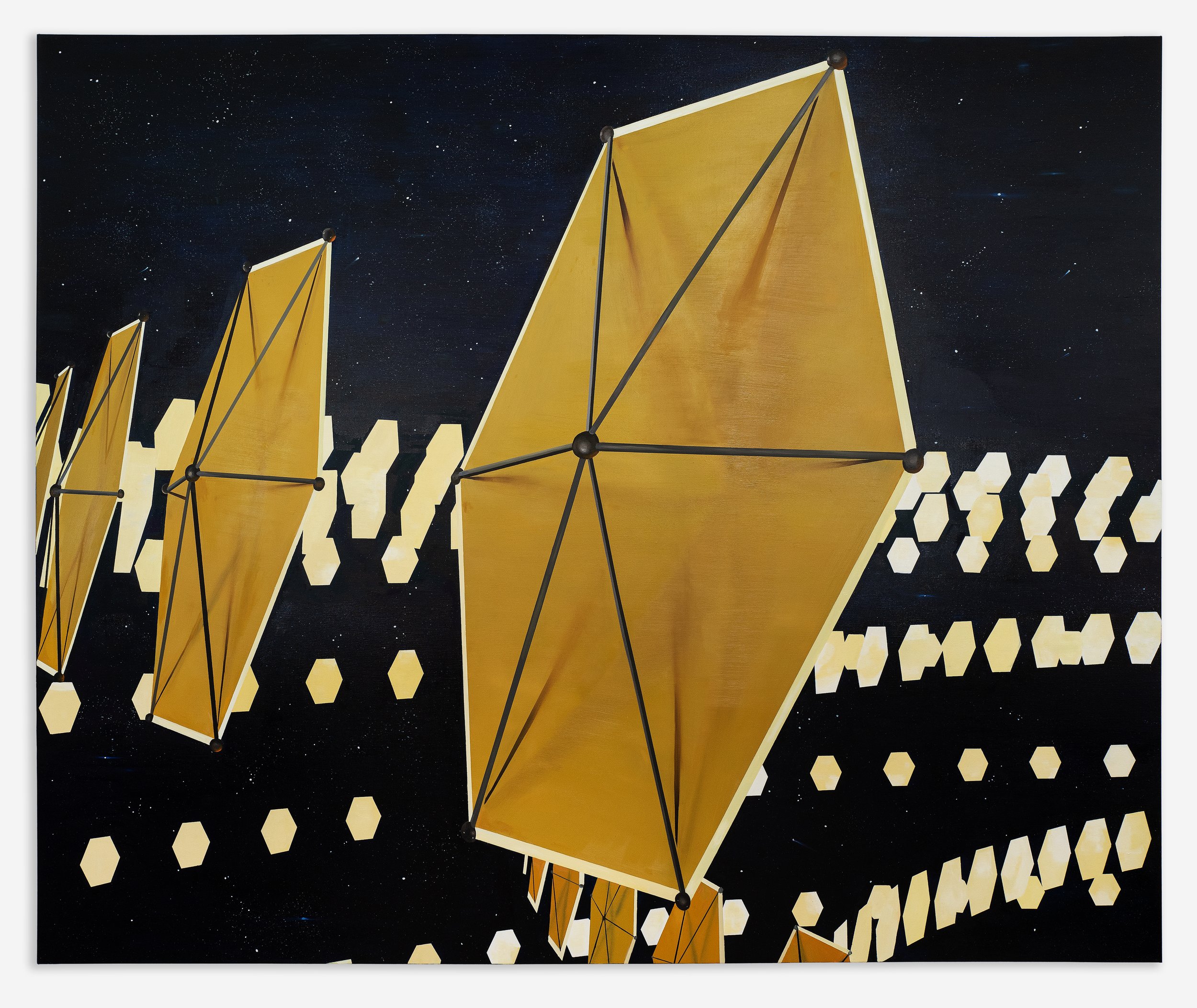
In 1960, the physicist Freeman Dyson proposed a structure so vast it would have to be built by a civilization that had outgrown its home planet. This transition from a Type I to a Type II civilization on the Kardashev scale is marked by the ability to harness the entire energy output of a home star. Tan Mu’s Dyson Sphere (2023) enters this speculative space to perform a material investigation of this invisible power. Through oil on linen, she translates the abstract mathematics of cosmic energy into the heavy, slow language of paint, registering the bridge between our current terrestrial constraints and a future of boundless potential. The painting shows a golden orb, a constellation of points surrounding a central fire. It is not a diagram but a vision of ambition, a representation of the ultimate human desire to master the stars. The work captures the tension between scientific fact and poetic imagination, the promise of limitless energy and the danger of unchecked power. It is a portrait of a future that may never arrive, rendered in the timeless medium of oil and gold.
Dyson's original paper, "Search for Artificial Stellar Sources of Infra-Red Radiation," published in *Science*, was not a blueprint for a physical object but a method for detecting advanced extraterrestrial life. He argued that a civilization with increasing energy needs would eventually construct a shell around its star, radiating waste heat in the infrared spectrum. While the engineering challenges of such a structure are currently insurmountable, the concept has taken on a life of its own in popular culture and scientific discourse. It represents a point where economics, physics, and philosophy converge. The energy of a star is not just a resource; it is the currency of the future. By painting this concept, Tan Mu is not just illustrating a scientific theory; she is engaging with the economic and ethical implications of a post-scarcity future, where the limits of growth are defined not by our planet, but by our sun.
The Kardashev scale, which classifies civilizations based on their energy consumption, provides a useful framework for understanding the magnitude of the Dyson Sphere. A Type I civilization can use all the energy available on its home planet. A Type II civilization can use all the energy of its home star. We are currently a Type 0.7 civilization, still heavily reliant on fossil fuels and struggling with the environmental consequences of our energy use. The Dyson Sphere, then, is not just a technological possibility; it is a testament to the scale of human imagination. It represents a future where we have overcome our current limitations and learned to live in harmony with the cosmos. Tan Mu's painting captures this sense of hope, but also the anxiety that comes with such a vast undertaking. The sphere is a symbol of our potential, but also of our responsibility. The painting asks us to consider what kind of civilization we want to be, and what kind of legacy we want to leave for the future. In the end, the Dyson Sphere is not just a structure; it is a choice.
Dyson Sphere (2023) is a monumental work, measuring one hundred fifty-two by one hundred eighty-three centimeters. This scale is essential to its effect, echoing the vastness of the structure it depicts. The composition is centered on a star, rendered as a radiating field of golden tones, cadmium yellow, Naples yellow, and lemon yellow, around which a swarm of energy panels orbits in a complex, rotating posture. The palette is a sophisticated investigation of light and heat: the star’s radiance is captured through thick, impasto layers of oil that catch the gallery light, while the panels are rendered in cooler, more reflective tones that suggest a mechanical origin. The brushwork is dynamic, registering a sense of continuous motion and accumulation that mirrors the kinetic reality of an orbital swarm. It is a work that captures the beauty of theoretical science through a rigorous, disciplined application of color and surface, a portrait of power on a cosmic scale.
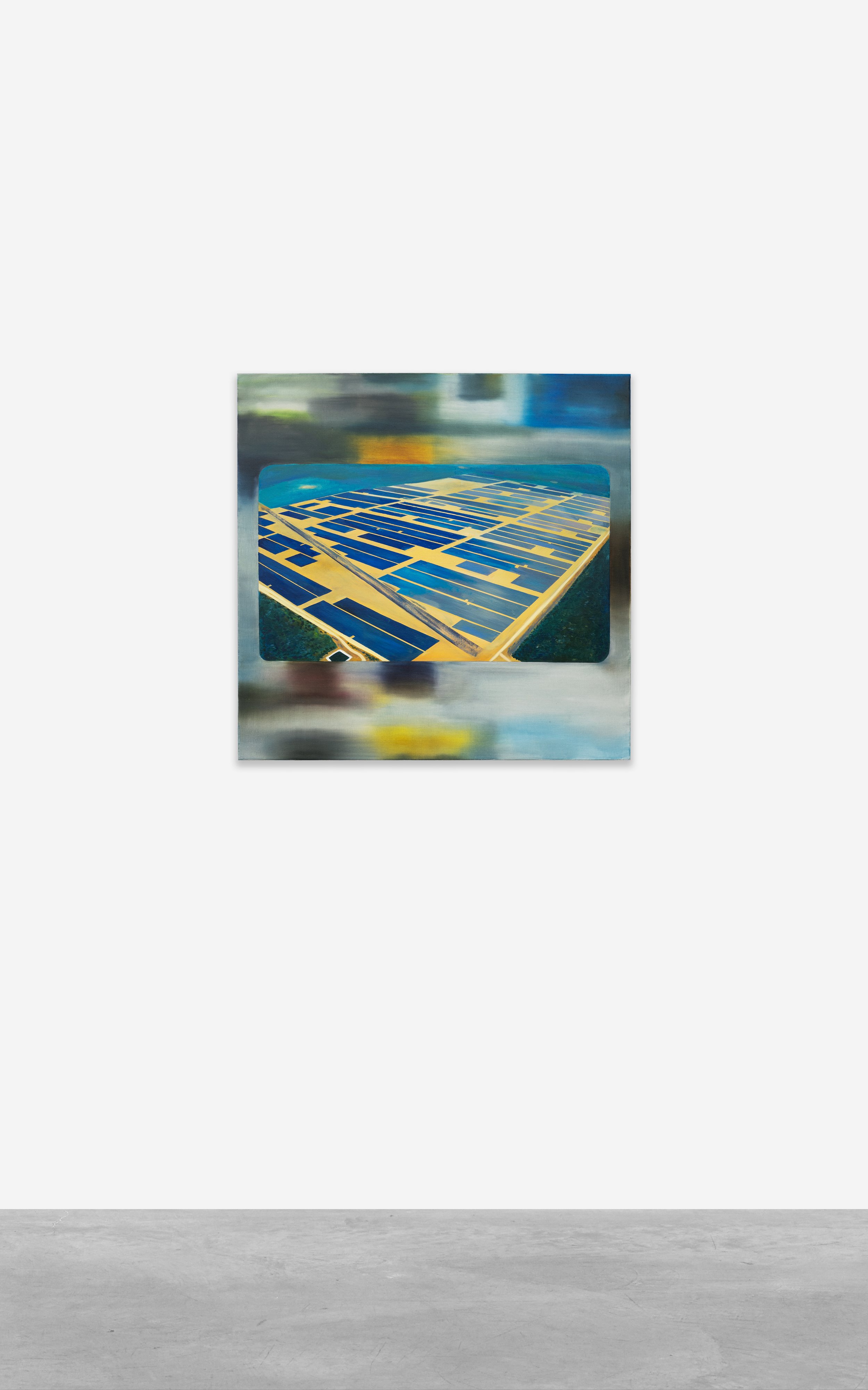
This investigation moves across time, tracing the development of energy production from the terrestrial to the cosmic. Throughout her practice, Tan Mu has documented the evolution of energy infrastructure, nuclear power in Bikini Atoll (2020), solar energy in Solar Farm (2022), and the speculative future in Dyson Sphere. These works reflect how changes in energy are inseparable from technological transformation and the political systems built around them. The scale of the Dyson Sphere, which would require resources far beyond our present capacity, embodies both human ambition and the wonder of the unknown. Similar to her paintings of the Stanford Torus (2020), Dyson Sphere reflects a desire to expand beyond Earth’s limits, imagining alternative futures where humanity’s aspirations for cosmic expansion are unlocked at the scale of the star.
The precedent of Olafur Eliasson’s *Little Sun* project (2012) provides a vital methodological anchor for this discussion. Eliasson created a small, sun-shaped LED lamp powered by solar cells, designed to bring light to off-grid communities. The project was a way of making the vast, impersonal energy of the sun tangible and personal, a tool for social and environmental change. Tan Mu’s Dyson Sphere functions as a twenty-first-century successor to this tradition. Where Eliasson uses light to reveal the potential of renewable energy, Tan Mu uses it to reveal the potential of technological ambition. Both artists are interested in the point where the celestial becomes the personal, where the sun is not just a star but a source of life and power. The comparison reveals how art can archive the evolution of our relationship with energy, from the personal scale of the lamp to the cosmic scale of the sphere.
Eliasson's work is deeply rooted in the idea of "socially engaged art," using his practice to raise awareness about climate change and energy poverty. Tan Mu's work, while less explicitly political, shares this concern with the ethical implications of technology. The Dyson Sphere, as a concept, raises questions about inequality and access on a galactic scale. Who would control such a vast source of energy? Who would benefit from it? By rendering the sphere in oil on linen, Tan Mu brings these abstract questions into the realm of human experience, forcing the viewer to confront the ethical dimensions of our technological dreams. In both works, light is not just a visual element but a moral one, a symbol of both hope and responsibility, and a reminder of our shared stake in the future of our planet and our star.
In her 2023 conversations, Tan Mu reflects on the relationship between energy development and computational power. As systems become faster and more complex, their demand for energy increases dramatically. Data centers, quantum computers, and digital networks rely on continuous, large-scale flows. In Dyson Sphere, she examines how technological progress accelerates this consumption, raising questions about control and responsibility. Who governs energy in contemporary society, and who bears its costs? Energy is never neutral; it transforms landscapes, reorganizes power, and reshapes human relationships. By painting the ultimate energy source, Tan Mu registers the tension between our rational search for power and our emotional intuition of its potential consequences.
The formal strategy of Dyson Sphere relies on the tension between the luminous center and the dark expanse of the starry sky. This work marked Tan Mu’s first large-scale use of dense points to represent stars, a visual language that has become foundational in her later work. The sky is not a background but a symbol of expanded perception. In the Horizons series (2024-2025), these starry skies encourage viewers to reconsider humanity’s place within a vast system. In the Signal series, the stars echo the routes of submarine cables that transmit data across the globe. By using the same point-based language across biological, technological, and cosmic scales, Tan Mu connects the microscopic with the macroscopic. The starry sky becomes a bridge between the digital constellation under the sea and the physical constellation above.
Gerhard Richter’s Atlas (1962-ongoing), a collection of thousands of photographs and diagrams used as source material for paintings, offers a provocative art historical parallel. Richter’s system is a way of organizing heterogeneous visual information to reveal underlying structures. Tan Mu’s energy series functions similarly as a visual archive of human perception. Each painting registers a specific moment in the history of our understanding of power, from the atomic flash to the solar panel to the orbital array. Both artists occupy the tension between documentation and interpretation. Tan Mu is not illustrating a scientific kit; she is archiving what it feels like to witness the revelation of a new energy regime. Her work is a record of the aesthetic of discovery, capturing the wonder that science offers but often lacks the language to express.
The somatic quality of Dyson Sphere is informed by Tan Mu’s experience as a competitive freediver. For an artist who understands the physical limits of the body and the experience of pressure in the deep ocean, the vacuum of space is not an abstract concept. The silence and the specific visual distortions of the deep ocean have a direct formal parallel in the way she handles the void of the starry sky. The "darkness" in Dyson Sphere, the ground of Payne’s gray and raw umber, has a material density, like water at depth. The radiance of the star is like the sun viewed from thirty meters below the surface, a distant, vibrating presence that is the only source of orientation. This embodied knowledge informs her approach to speculative science. She paints the megastructure not as a scholar, but as a witness to the fundamental pressure of existence.
The precedent of Agnes Martin’s grid drawings (1960s-2000s) provides another essential methodological comparison. Martin worked with obsessive precision to capture abstract emotional states, an "innocence" or "perfection" beyond the physical world. Her lines, though systematic, were always executed by hand, resulting in subtle variations that made the work human. Tan Mu’s Dyson Sphere uses a similar geometric foundation, the orbits and the panels, to approach a subject that is ultimately beyond our grasp. Both artists use a disciplined, repetitive process to approach the absolute. For Martin, it was the perfection of the mind; for Tan Mu, it is the perfection of the stellar engine. The comparison illuminates how painting can serve as a bridge between human perception and the fundamental structures that exist outside of it.
In her conversation "Between Submarine Cable and Ocean Waves" (2025), Tan Mu speaks about the "quiet humility" found in these structural forms. They remind her of balance and resilience in nature. This nature-based aesthetic allows her to connect timeless patterns with contemporary experience, offering a sense of calm within the accelerated conditions of modern life. In Dyson Sphere, this humility is evident in the transition from technical certainty to poetic imagination. The painting does not aim for a literal blueprint; it aims for a visual analogy of energy being gathered and stored over time. The layered brushstrokes capture this accumulation, honoring the complexity of the subject by paying it the compliment of rigorous, disciplined attention.
The material facts of Tan Mu’s process reinforce this archival intent. She uses oil on linen, a support with an expected lifespan of centuries. By choosing this medium to depict the most cutting-edge discovery or speculative idea, whether it be the internal structure of a cryostat or the mechanics of a Dyson swarm, she is performing a deliberate act of translation. She is taking the fleeting, digital evidence of our instruments and fixing it in the slow, permanent material of art. This is what makes her work an "archaeology of the present." She is creating a visual record of how we see the world now, preserving it for a future that will likely see it differently. The painting is a site where the speculative and the permanent meet.
The surface of Dyson Sphere is a complex field of gold and amber hues, layered to create a sense of both depth and luminosity. The central sphere is not a flat circle but a textured mass of impasto, catching the light and suggesting the immense heat of the star within. Surrounding it are thousands of tiny points, each one a panel in the swarm, painted with a precision that borders on the obsessive. The background is a deep, velvety black, a void that makes the golden sphere glow with an inner fire. This contrast between the bright, active center and the dark, passive surround creates a visual tension that mirrors the conceptual tension of the work. It is a painting about the limits of human knowledge and the boundless nature of human desire. The gold is not just a color; it is a symbol of value, of the preciousness of energy in a world of scarcity. By using it to depict a post-scarcity future, Tan Mu is asking us to reconsider our current economic and ethical systems. The painting is a mirror, reflecting our own anxieties and hopes back at us.
The painting measures one hundred twenty-two by one hundred fifty-three centimeters, large enough to occupy the viewer's peripheral vision but not so large as to become architectural. That scale is deliberate. A Dyson Sphere, if built, would be approximately three hundred million kilometers in diameter. The painting reduces it to an object you could reach out and touch, a ring of light on linen, warm and close and impossible. The warmth is the point. Tan Mu's oil medium gives the sphere a surface temperature it would not have in engineering diagrams, a glow that belongs to painting rather than to physics. The sphere remains unbuilt. The painting exists. That gap between the imagined and the actual is where the work lives, and it is a gap that will widen as the decades pass and the sphere remains, as it has always been, a beautiful calculation that no one has started to construct.