The Three-Pound Universe: Tan Mu's MRI and the Architecture of Memory
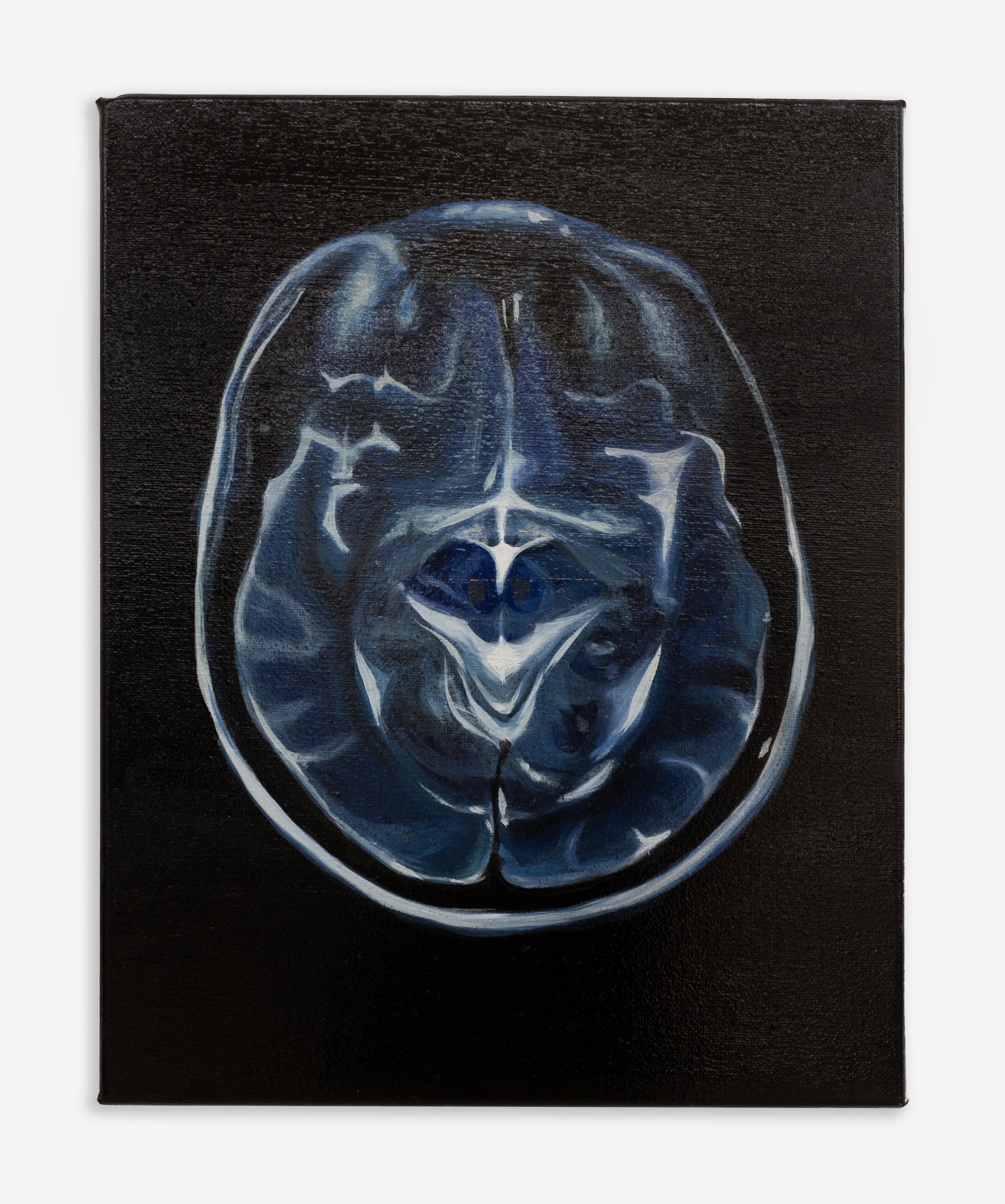
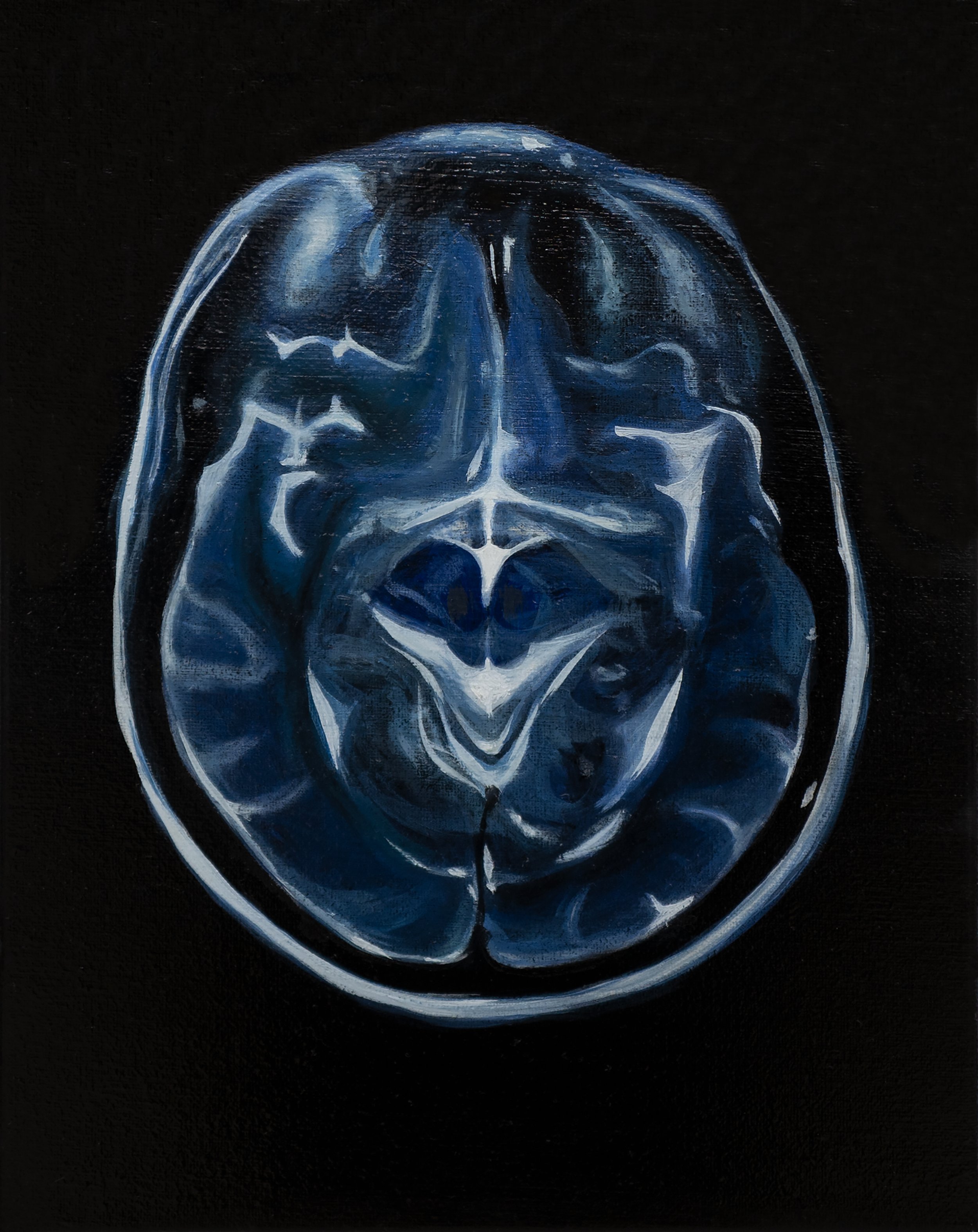
In 2019, during a deep freediving session, Tan Mu experienced an episode of cerebral hypoxia. The temporary lack of oxygen to the brain likely affected her hippocampus, disrupting the formation and recall of memory. This somatic failure, a momentary glitch in the biological hardware of consciousness, led her to an intensive study of the brain and nervous system. She became obsessed with the organ not as a site of medical pathology, but as a container for memory, a biological data center that mirrors the complex structures of the cosmos. This obsession culminated in MRI (2021), a small but intense painting that registers the architecture of the human mind through the language of magnetic resonance imaging. By translating the clinically precise, digital cross-section into the heavy material of oil on linen, she archives the seat of personal experience in the permanent ledger of art history.
MRI (2021) is oil on linen, measuring thirty-six by twenty-eight centimeters. The painting depicts a sagittal cross-section of the human brain, its intricate structures, the cerebral cortex, the cerebellum, the corpus callosum, rendered with a disciplined, almost clinical focus. The palette is a sophisticated range of transparent and opaque layers: titanium white and Naples yellow highlights suggest the luminous density of neural activity, while deep umbers and Payne's gray provide a ground that evokes both the darkness of the skull and the clinical void of the scanner. The brushwork is precise, capturing the organic complexity of the organ without resorts to decorative flourish. The painting does not merely illustrate a scan; it registers the weight and pressure of memory. It is a work that marks a significant junction in Tan Mu's practice, where personal trauma is translated into a universal structural inquiry.
The title of Judith Hooper and Dick Teresi’s book The Three-Pound Universe (1986) provides a vital conceptual framework for this painting. The authors argue that the human brain is a microcosm that mirrors the structure of the cosmos itself, a conceptual architecture that links disparate scales of existence. This line of thinking is constitutive of Tan Mu’s broader project. Across her practice, she depicts atoms, cells, embryos, MRI scans, and views of the observable universe. These are not isolated subjects, but interconnected layers of a single system. In MRI, the brain is treated as a cellular archive, a structural system that spans from the microscopic scale of the synapse to the macroscopic scale of human knowledge. The painting maps these connections visually, revealing the hidden patterns that shape how we perceive and understand the world.
The precedent of Leonardo da Vinci’s anatomical drawings (c. 1510-15) offers a foundational methodological anchor for this discussion. Leonardo was among the first artists to treat the brain not as a site of the soul, but as an object to be understood through observation and drawing. His studies of the ventricles and the optic nerves were acts of biological witness, attempting to reconcile the seen surface with the hidden internally. Tan Mu’s MRI functions as a twenty-first-century successor to this tradition. Where Leonardo used the quill and the knife to reveal the hidden architecture of consciousness, Tan Mu uses the resonance of magnets and the brush. Both artists are driven by a desire to archive the structural logic of the human form. The comparison reveals how painting can serve as a bridge across centuries, connecting speculative anatomy with technological imaging.
In her 2021 conversations, Tan Mu reflects on how technology functions as an extension of the body and an externalization of memory. She notes that tools such as MRI scanners, smartphones, and microscopes function as external organs, expanding our ability to see across scales. This technological extension allows artists access to realities that were previously invisible. In MRI, the scanner's gaze is not peripheral; it is productive. The painting registers the specific visual artifacts of MRI technology, the banding of the signal, the grayscale gradients of tissue density, the clinical framing of the subject. By painting these artifacts, Tan Mu acknowledges that our perception of our own interior is always mediated. We do not see our minds directly; we see the technological model of our minds. This mediation is the core of her contemporary practice, recognizing that we inhabit a world where biology and technology are no longer distinct categories but intertwined layers of a singular reality.
The work of Andreas Gursky, especially his large-format photographs of industrial and technological infrastructure such as Kamiokande (2007) and Tokyo, Stock Exchange (1990), provides a relevant contemporary parallel. Gursky’s images are characterized by an overwhelming density of information and a relentless focus on the system over the individual. His work registers the shift from the singular human perspective to the vast, distributed logic of global systems. Tan Mu’s MRI operates with a similar systemic focus, but it turns that gaze inward. The brain is presented not as a unique biological identity, but as a site of information processing, a biological counterpart to Gursky’s server farms or stock exchanges. Where Gursky uses the camera to document the macroscopic machinery of the modern world, Tan Mu uses the brush to document the microscopic machinery of the body. Both artists identify the same underlying structure: a world made of sequences, distributions, and circuits. The comparison highlights how Tan Mu’s painting maps the internal infrastructure of the mind with the same rigor that Gursky maps the external infrastructure of the global economy.
Gerhard Richter’s photo-paintings, specifically the October 18, 1977 series (1988) depicting the Baader-Meinhof group, offer a provocative art historical parallel. Richter’s work uses the "blur" as an epistemological strategy to address history and memory. His images of the dead prisoners are derived from news photographs, and the blurred application of paint registers the distance between the event and its representation. Tan Mu’s MRI operates through a different strategy. She does not use the blur to address political history, but she uses the medium's inherent duration to address biological history. The precision of her application mirrors the clinical nature of her source imagery, but the material of the paint introduces a sense of duration and somatic weight that the digital scan lacks. Where Richter flattens history into a surface, Tan Mu thickens the biological signal into an archive. Her work registers the shift from the photographic record to the structural record, capturing the moment where the body becomes a legible text of its own history.
The formal strategy of MRI relies on the tension between the defined structure and the dark periphery. This mirrors the experience of the MRI scanner itself, where the subject is isolated in a narrow, high-intensity field. In the painting, this translates into a sense of intensity and pressure, where the "liveness" of the brain is contrasted with the void of the ground. This "void" is not just empty space; it has a material density, like water at depth. For an artist who is also a competitive freediver, the experience of pressure and the limits of the body are not abstract concepts. The silence and the specific visual distortions of the deep ocean have a direct formal parallel in the way she handles paint. The luminous structures of the brain are like the bioluminescence of the deep ocean, a distant, radiating presence that is the only source of orientation in the dark. This somatic knowledge of depth and pressure informs the very way the oil paint is applied, creating a surface that feels as much like an environment as a representation.
Vija Celmins’ ocean surfaces and star fields (1968-ongoing) provide another essential methodological comparison. Celmins works with obsessive precision, spending months on a single graphite drawing to capture a vast phenomena on an intimate surface. Her work is a meditation on the act of looking and the duration of attention. Tan Mu’s MRI operates with a similar sense of disciplined focus. By spending months painting a subject that exists for only seconds in the scanner, she performs an inversion of time. The rapid, invisible process of neural circulation is granted a monumental, static duration. The painting becomes a record of the artist’s gaze, a sustained act of attention that honors the complexity of the mind. Celmins documents the human encounter with the sublime landscape; Tan Mu documents the human encounter with the internal landscape. Both artists choose subjects that are too vast or too complex to be comprehended at once, finding a path to understanding through the slow, iterative process of making.
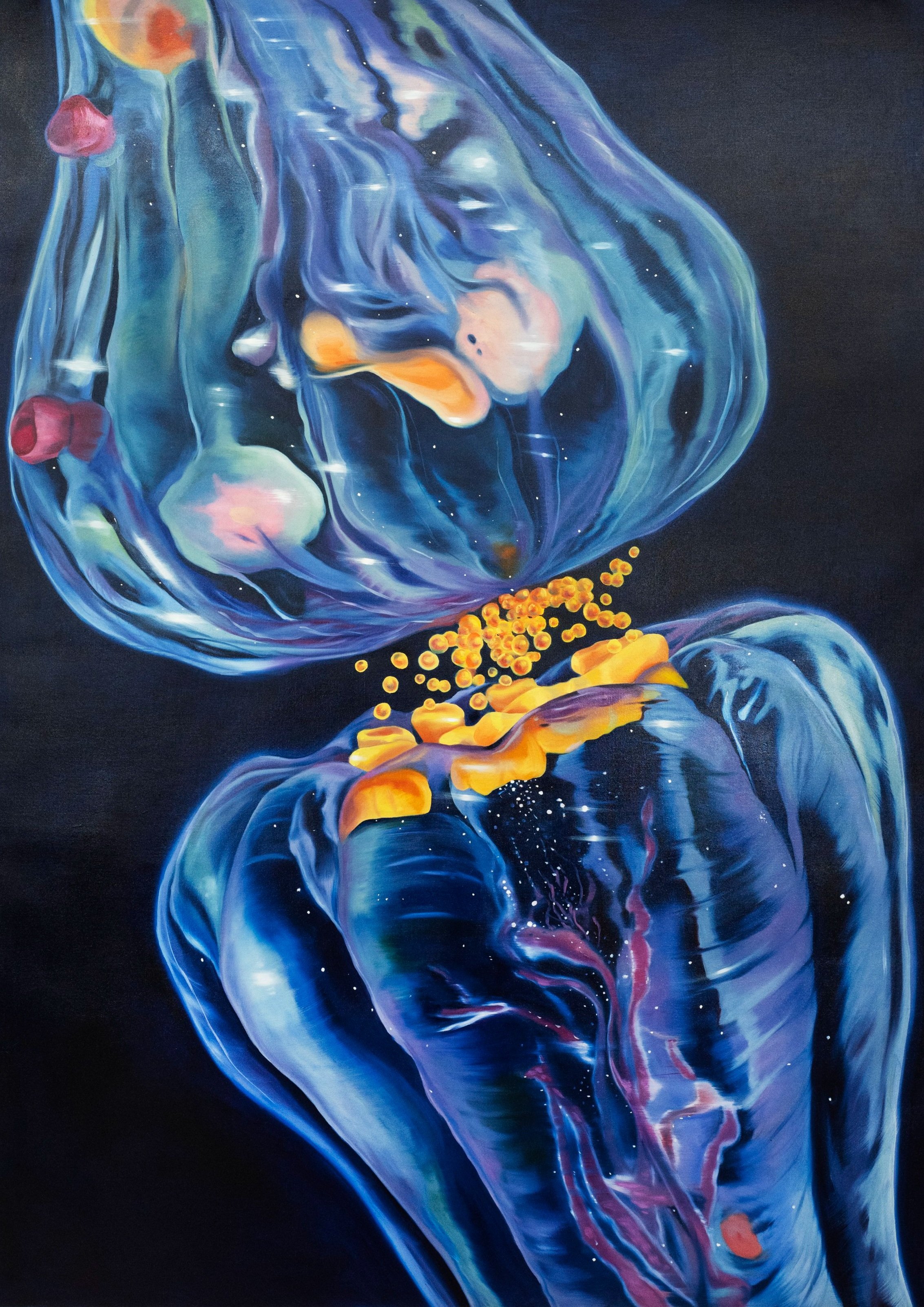
The "parallels between biological and technological systems" are a recurring theme that Tan Mu identifies across her practice. She notes that neural synapses resemble logic circuits, and the brain’s network mirrors the structure of global undersea cable systems. In MRI, this parallel is presented as a visual fact. The intricate folds of the cortex and the pathways of the white matter resemble the routes of the Signal paintings (2022-ongoing). Memory stored in the brain parallels the way data centers store collective info. By using recurring visual elements, points, lines, and surfaces, Tan Mu forms a continuous fabric of memory that spans from the microscopic origin of the individual to the macroscopic structure of the collective. The brain is presented as a biological motherboard, the primary substrate of all system logic. This perspective allows the viewer to see the human mind not as something apart from technology, but as the foundational architecture upon which all our external systems are modeled.
The practice of Mark Dion, which often involves the taxonomy or classification of natural objects in museum-like installations such as The Department of Tropical Animal Pathology (1998), provides a relevant methodological ancestor. Dion’s work investigates how we categorize and understand the natural world through the institutions of science. He is interested in the history of knowledge and the specific ways that museums and laboratories frame our perception. Tan Mu’s MRI performs a similar act of framing. By placing the neural scan within the tradition of oil painting, she is performing a taxonomic shift. She takes the brain out of the medical archive and places it in the artistic archive. This shift allows the organ to be seen not as a set of symptoms to be diagnosed, but as an architecture to be contemplated. Dion archival installations ask how we know what we know; Tan Mu’s paintings ask how we perceive what we know. Her work is a record of our current cognitive taxonomy, a visual history of how we model the seat of thought.
The contemporary practice of Suzanne Anker provide a further art historical context. Anker’s work, which often uses MRI imaging and 3D printing of biological structures, investigates the intersection of the genetic and the artistic. Her MRI Butterfly prints and her laboratory-based installations address the same "technological gaze" that Tan Mu registers in MRI. However, where Anker often employs the actual tools of science to create her work, Tan Mu’s insistence on the traditional medium of oil painting creates a different kind of tension. By painting these digital revelations by hand, she introduces a somatic duration that is absent from Anker’s more immediate, machine-mediated processes. Tan Mu’s work suggests that the most profound way to witness the mind is through the slow, deliberative act of painting. This insistence on the human hand in the age of the algorithm is a recurring theme in her work, a way of asserting the somatic presence of the artist within the clinical systems of discovery.
The material facts of Tan Mu’s process reinforce this archival intent. She uses oil on linen, a support with an expected lifespan of centuries. By choosing this medium to depict the most cutting-edge discoveries of science, she is performing a deliberate act of translation. She is taking the fleeting, digital evidence produced by our instruments and fixing it in the slow, permanent material of art. This is what makes her work a biological archive. She is creating a visual record of how we see the mind now, preserving it for a future that will likely see it very differently. The painting is a site where the fleeting and the permanent meet, where the vulnerability of memory is granted the immunity of the icon. This sense of preservation is not just technical; it is philosophical. To paint the brain is to make a stand against the transience of thought and the fragility of the biological substrate.
The cartographic strategy of the brain scan brings Tan Mu into a specific dialogue with the Today series (1966-2013) by On Kawara. Kawara’s project involved the daily production of a date painting, each one a meticulous record of a single day’s existence, executed in a consistent format and stored in a handmade box with a local newspaper clipping. His work was an exercise in temporal indexing, a way of proving "I am still alive" through the systematic application of paint. Tan Mu’s MRI functions as a structural counterpart to Kawara’s temporal project. Where Kawara indexed the passage of time through the calendar, Tan Mu indexes the presence of consciousness through the biological infrastructure. The brain is presented as the foundational clock of human experience, the organ that allows the "today" of Kawara’s work to be perceived at all. By painting the MRI scan with the same disciplined consistency that Kawara applied to his dates, Tan Mu creates a biological index of her own existence. Both artists find a path to the universal through the rigorous documentation of the specific. Kawara’s dates and Tan Mu’s neural pathways are both attempts to anchor the human subject within a vast and indifferent system. The comparison reveals MRI not just as a medical image, but as a profound record of being, a way of asserting the persistence of the individual within the complex circuitry of the biological motherboard.
On Kawara painted the date. Tan Mu paints the scan. Both are acts of registration, a daily or singular practice of fixing something that would otherwise pass without record. The difference is that Kawara's dates were external, public, verifiable. The brain scan is internal, private, and legible only to a machine. The painting takes what the machine produced and translates it into an object that the brain itself can contemplate, a closed loop in which the organ of perception studies its own cross-section rendered in oil. The canvas is one hundred twenty-two by ninety-one centimeters. The brain it depicts weighs approximately 1,400 grams. Between those two facts, the painting does its work.