The Embellished Dark Source: Tan Mu's Powehi and the Image of the Void
A black hole is, by definition, the limit of visuality. It is a region of spacetime where gravity is so intense that nothing, not even light, can escape. To see a black hole is a contradiction in terms, yet we possess images of them. These images are not photographs in the traditional sense; they are the result of global interferometry, where data from radio telescopes across the planet is synthesized into a visual form. In April 2019, the Event Horizon Telescope collaboration unveiled the first such image, a supermassive black hole at the center of the M87 galaxy. It was named Powehi, a term from a Hawaiian creation chant meaning "embellished dark source of unending creation." Tan Mu’s Powehi (2022) enters this liminal space between scientific data and artistic creation, performing a material investigation of the void. Through oil on linen, she translates the abstract, algorithmically generated data into the heavy, slow language of paint, registering the threshold where human knowledge meets the infinite unknown.
The Event Horizon Telescope (EHT) is not a single instrument but a global network of eight radio telescopes, from Hawaii to Antarctica, linked together to form an Earth-sized virtual dish. The collaboration involved over two hundred scientists and generated forty petabytes of data, processed by supercomputers to produce a single, blurry image. This image, a ring of fire surrounding a central shadow, was a triumph of human ingenuity, a testament to our ability to see the unseen. The name Powehi, chosen by Larry Kimura, a professor of Hawaiian language, connects this scientific achievement to a deep cultural and spiritual tradition. It is a reminder that our quest for knowledge is not just a technical one, but a human one, rooted in the stories we tell about our place in the cosmos. Tan Mu's painting captures this duality, the blend of science and soul, data and dream.
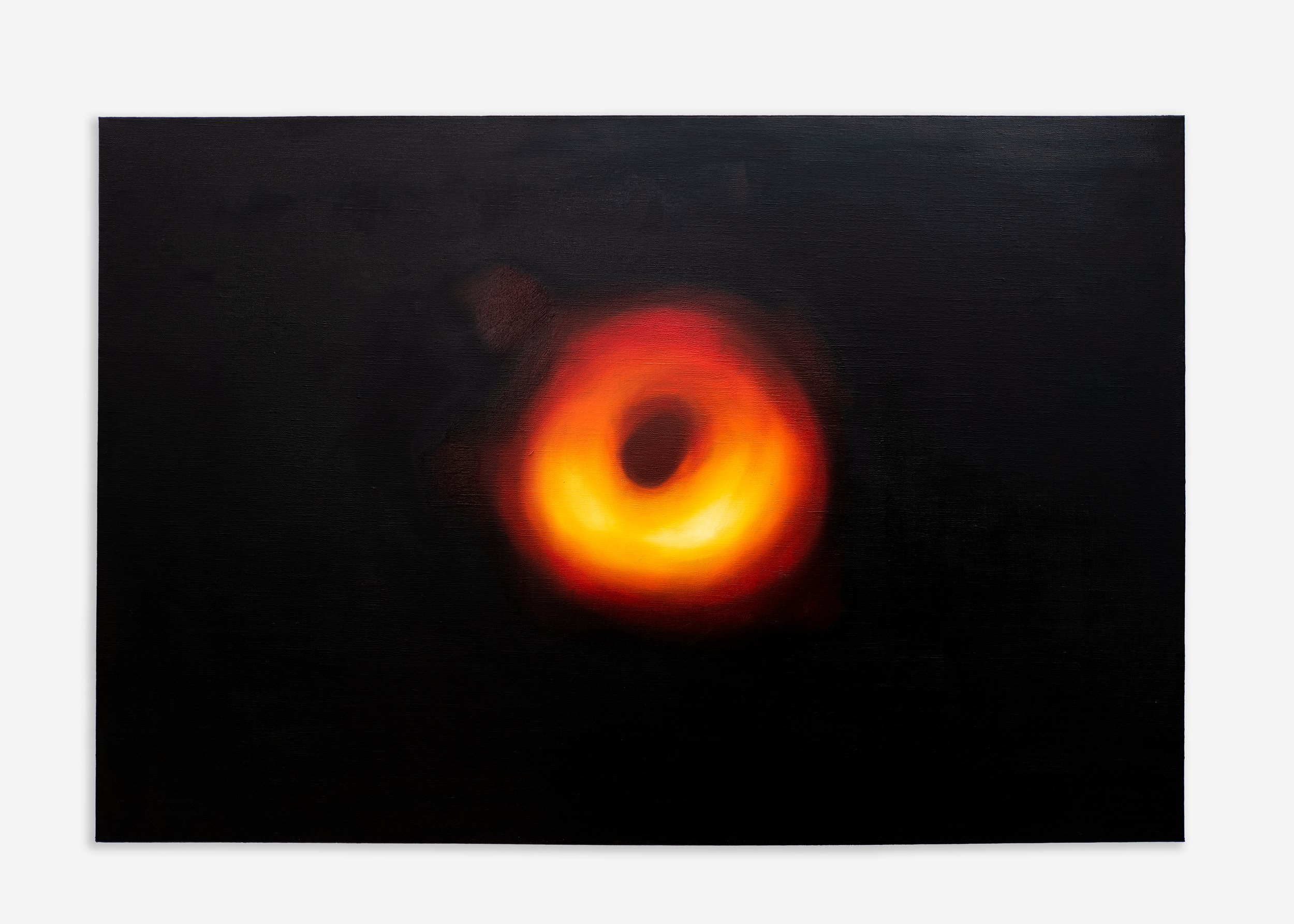
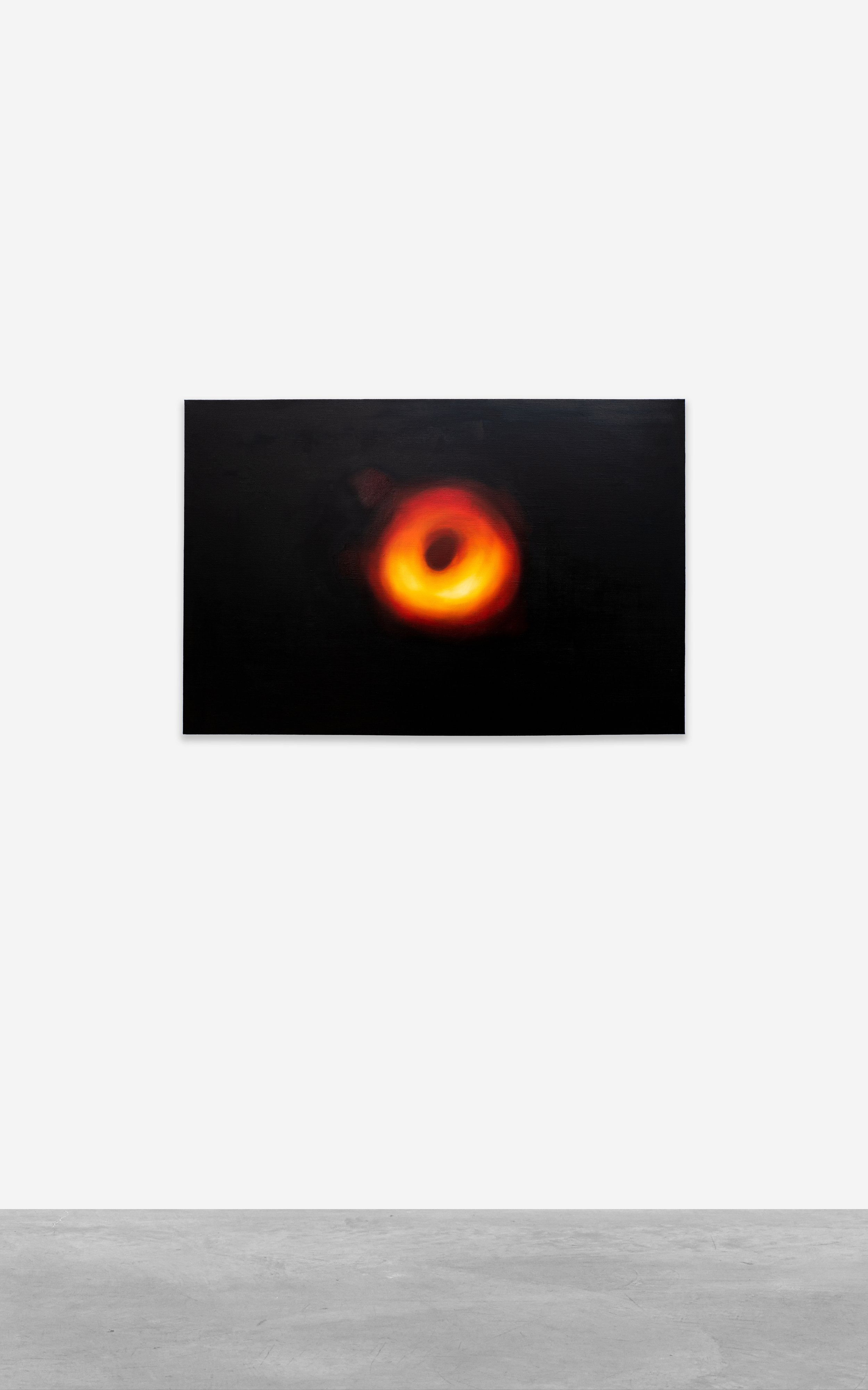
Powehi (2022) is oil on linen, measuring sixty-one by ninety-one centimeters. The composition is structured around a central, deep void surrounded by a glowing, gestural ring of oranges and yellows. The palette is a sophisticated investigation of light and darkness: the central void is rendered in a dense, absorbent black that suggests the underlying vacuum of space, while the surrounding disk is captured through vibrant, layered brushstrokes of cadmium orange and Naples yellow. The surface of the painting is active, the brushwork registering the sense of superheated matter rotating at relativistic speeds. It is a work that manages to be both structurally precise and atmospherically expansive, capturing the awe of a historic scientific discovery through a rigorous, disciplined application of color and surface. This painting marks a decisive turn in Tan Mu's practice, where the infrastructure of discovery becomes as significant as the subject itself.
The viewing distance radically alters the painting's impact. At three meters, the image reads as a graphic icon, a familiar representation of a black hole that is instantly recognizable. The details of the brushwork are lost, and the painting functions as a symbol of the unknown. But at thirty centimeters, the symbol dissolves into a complex field of paint. The orange of the ring is not a single color but a layering of cadmium, ochre, and burnt sienna, each with its own transparency and texture. The black of the void is not flat but deep, a glazed surface of Payne's gray and ivory black that seems to recede into the canvas. At this proximity, the viewer is no longer looking at a black hole but at the act of painting itself, the material process of capturing an immaterial event. This shift from symbol to material mirrors the shift in astronomy itself, where the act of observation is no longer a passive one, but an active, constructive process.
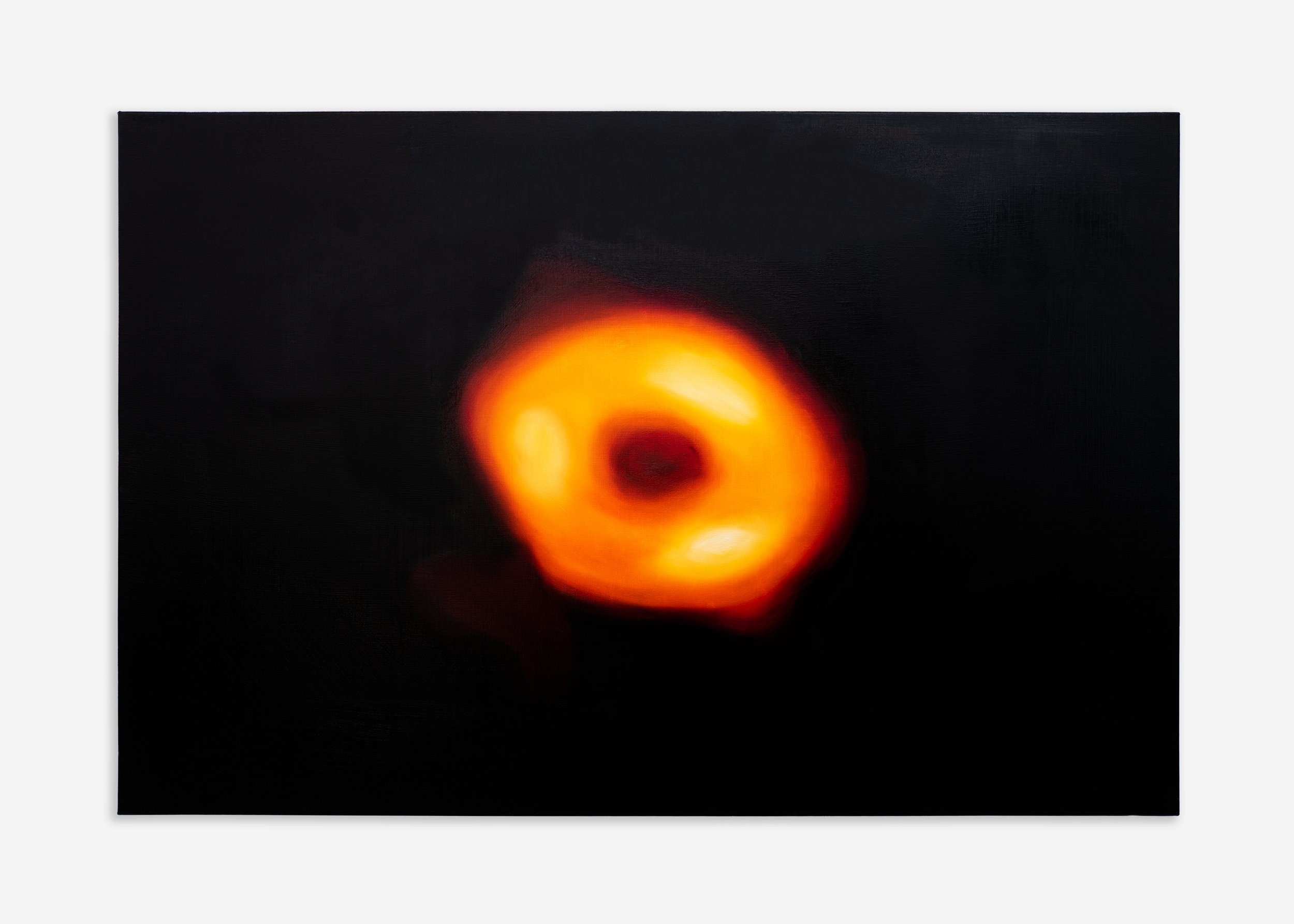
This series deep dive traces the development between Powehi (2022) and the companion piece Sagittarius A (2022), which depicts the black hole at the center of our own Milky Way galaxy. Tan Mu has noted that what interests her most is the process through which these images are generated. Black holes cannot be seen directly; instead, data is gathered by telescopes positioned around the world and then synthesized. She compares this process to printmaking, where fragmented information is gradually consolidated into a complete image. This collective observation is essential to her project, reflecting humanity’s shared curiosity and the labor required to make the invisible visible. Her work functions as an archaeology of the present, archiving the moments when our technological capacity expands to grasp subjects that have existed for billions of years without witness.
While both paintings deal with the same phenomenon, they differ in their emotional and visual resonance. Powehi, the giant of M87, is stable and monumental, its ring a perfect circle of fire. Sagittarius A, the black hole at our own galactic heart, is more volatile, its image a blur of motion and change. This difference reflects the nature of the two objects: M87 is a steady feeder, while Sgr A* is a erratic, flickering presence. Tan Mu captures this distinction in her brushwork, the steady, confident strokes of Powehi giving way to the more frantic, gestural marks of Sagittarius A. The comparison highlights the diversity of the black hole experience, showing that even these ultimate symbols of nothingness have their own unique character. One is a distant sun, the other a personal demon, and together they map the coordinates of our cosmic home.
The precedent of James Turrell’s *Roden Crater* (1974-ongoing) provides a vital methodological anchor for this discussion. Turrell has been transforming an extinct volcanic cinder cone in Arizona into a massive naked-eye observatory, designed to frame the sky and make light appear tangible. His work is not about looking at objects, but about looking at looking itself, about making the act of perception the subject of the art. Tan Mu’s Powehi functions as a painted counterpart to this architectural project. Where Turrell uses the sky as his canvas, Tan Mu uses the black hole, the ultimate absence of light. Both artists are interested in the threshold of perception, the point where the eye can no longer resolve the image into form. Turrell creates a space for seeing the unseen; Tan Mu paints the unseen itself. The comparison reveals how art can engage with the limits of human vision, using the void not as an end, but as a beginning.
Turrell's work is deeply rooted in the Quaker tradition of inner light, a belief that the divine is found not in external objects, but in the silence and stillness of the self. Tan Mu's Powehi, while rooted in the data of astrophysics, invites a similar kind of contemplation. The black hole is not just a physical phenomenon; it is a spiritual one, a place where the laws of physics break down and the known world gives way to the unknown. By rendering this void in oil on linen, Tan Mu is not just illustrating a scientific concept; she is creating a space for meditation, a place where the viewer can confront the limits of their own understanding. In both works, the void is not empty; it is full of potential, a source of awe and wonder that reminds us of our place in the cosmos.
In her 2022 conversations, Tan Mu reflects on the tension between scientific accuracy and artistic interpretation. She notes that black hole images, while grounded in precise data, still involve human adjustments to enhance clarity and reveal structure. Colors are mapped to frequencies; gradients are tuned to show tissue or energy density. The resulting images are inherently artistic creations. In Powehi, Tan Mu acknowledges this mapping, treating the painting as a site where the precision of the algorithm meets the intuition of the hand. She is not simply reproducing a scientific image; she is reflecting on how technological vision reshapes our understanding of existence. The painting registers the specific visual artifacts of this vision, the glowing ring and the dark center, as fundamental structures of our contemporary knowledge.
Gerhard Richter’s photo-paintings, specifically his series of blurred landscapes and historical portraits from the 1960s and 70s, offer a provocative art historical parallel. Richter’s work uses the "blur" as an epistemological strategy to address the distance between the subject and its representation. He flattens his source images into surfaces, registering the instability of our perception. Tan Mu’s Powehi operates through a different strategy of the void. She uses the heavy material of oil paint to give the black hole a somatic weight that the digital image lacks. The central black is not merely the absence of light; it is a presence, a material fact that occupies space on the linen. Where Richter addresses the history of the image, Tan Mu addresses the history of the subject. She flattens the cosmic scale into the intimate space of the canvas, making the infinite void a part of the human archive. Her work registers the shift from the documentary record to the material record.
The formal strategy of Powehi relies on the tension between the radiant ring and the dark periphery. This mirrors the experience of scientific observation, where phenomena are isolated and objectified within a clinical frame. In the painting, this translates into a sense of intensity and focus, where the "liveness" of the superheated matter is contrasted with the void of the ground. This "void" is not just empty space; it has a material density, like water at depth. For an artist who is also a competitive freediver, the experience of pressure and the limits of the body are not abstract concepts. The silence and the specific visual distortions of the deep ocean have a direct formal parallel in the way she handles paint. The glowing disk of the black hole is like the sun viewed from many meters below the surface, a distant, radiating presence that is the only source of orientation in the dark. This embodied knowledge of the unseen informs her approach to the cosmic, where she paints the void not as a scholar, but as a witness.
Ad Reinhardt’s black paintings of the 1950s and 60s provide another essential methodological comparison. Reinhardt worked with obsessive discipline to create paintings that were "pure, abstract, and non-representational," where the color black was used to challenge the viewer’s perception and patience. His work was a meditation on the limits of the medium and the refusal of imagery. Tan Mu’s Powehi uses the color black in a related but inverted way. For her, black is the ultimately productive color, the site of "unending creation" that the black hole's name suggests. It is not a refusal of representation, but a representation of the unrepresentable. By placing a radiant ring around a black center, she acknowledge both the visible evidence and the hidden reality. The comparison illuminates how painting can serve as a bridge between the rigorous minimalism of the mid-century and the data-driven inquiry of the new millennium. Reinhardt documented the end of painting; Tan Mu documents the expansion of painting into the cosmic archive.
The "parallels between biological and technological systems" are a recurring theme that Tan Mu identifies across her practice. She notes that neural synapses resemble logic circuits, and the structure of the cosmos mirrors the structure of the mind. In Powehi, this parallel is presented as a visual fact. The glowing disk of the black hole resembles the circular form of an embryo in her 2022 series, or the central nucleus of an atom in her 2020 works. By using recurring visual elements, circles, points, and surfaces, Tan Mu forms a continuous fabric of memory that spans from the microscopic origin of the individual to the macroscopic structure of the universe. The black hole is presented as a cosmic motherboard, the primary substrate of all spacetime logic. This perspective allows the viewer to see the universe not as something apart from ourselves, but as a system whose fundamental geometries are echoed in the very architecture of our biology.
The contemporary practice of Trevor Paglen offers a further art historical context. Paglen’s work, which often involves photographing surveillance infrastructure and the "invisible" geography of the state, investigates the limits of visibility in the modern world. His images of classified sites and satellites address the same "technological gaze" that Tan Mu registers in her work. However, where Paglen focuses on the political infrastructure of the unseen, Tan Mu focuses on the ontological infrastructure. She is not documenting secret bases, but secret realities, the fundamental forces that govern matter and energy. By painting these realities by hand, she introduces a somatic duration that is absent from Paglen’s more immediate, camera-mediated processes. Tan Mu’s work suggests that the most profound way to witness the void is through the slow, deliberative act of painting.
The material facts of Tan Mu’s process reinforce this archival intent. She uses oil on linen, a support with an expected lifespan of centuries. By choosing this medium to depict the most cutting-edge discoveries of science, she is performing a deliberate act of translation. She is taking the fleeting, digital evidence produced by our instruments and fixing it in the slow, permanent material of art. This is what makes her work a "cosmic archive." She is creating a visual record of how we see the universe now, preserving it for a future that will likely see it very differently. The painting is a site where the fleeting and the permanent meet, where the vulnerability of our current knowledge is granted the immunity of the icon. This sense of preservation is not just technical; it is philosophical. To paint the black hole is to make a stand against the transience of human perception and the fragility of our position within the vast mystery of the cosmos.
The first image of a black hole was released on April 10, 2019. The painting that Tan Mu made of it is dated 2022. Three years between the data and the oil. In that interval, the image circulated through newspapers, Twitter feeds, physics lectures, T-shirts, and memes. It became familiar. It lost its strangeness. The painting restores the strangeness by slowing the image down, by giving it the texture of bristle marks and the weight of stretched linen, by refusing the instantaneous transmission that made the image famous and replacing it with the slow accumulation of pigment that makes painting what it is. The ring of fire around the central shadow is no longer a JPEG. It is a surface. The void at its center is no longer a data gap. It is a darkness you could put your hand against, if the canvas would let you through.