The Loop of Energy: Tan Mu's Torus and the Topology of Connection
In the center of Tan Mu’s Torus (2020), a ring of light floats in a black void. It is not a solid object but a constellation of points, thousands of tiny dots accumulated to form a shape that seems to rotate and pulse. The torus is a fundamental mathematical form, a doughnut shape that appears throughout nature in tornadoes, magnetic fields, and black holes. Tan Mu paints it in oil on linen, 46 x 61 cm, using only black and white. The painting captures the torus not as a static diagram but as a dynamic system, a loop of energy that spirals inward and outward simultaneously. It is a meditation on continuity, on the ways in which all things are connected in a never-ending cycle. The work emerges from her exploration of mathematical aesthetics, following earlier pieces like Fractal and Atom, but here the focus is on topology, the study of properties that remain unchanged under deformation. The torus is the shape of infinity, of return, of the self-sustaining systems that govern life and power.
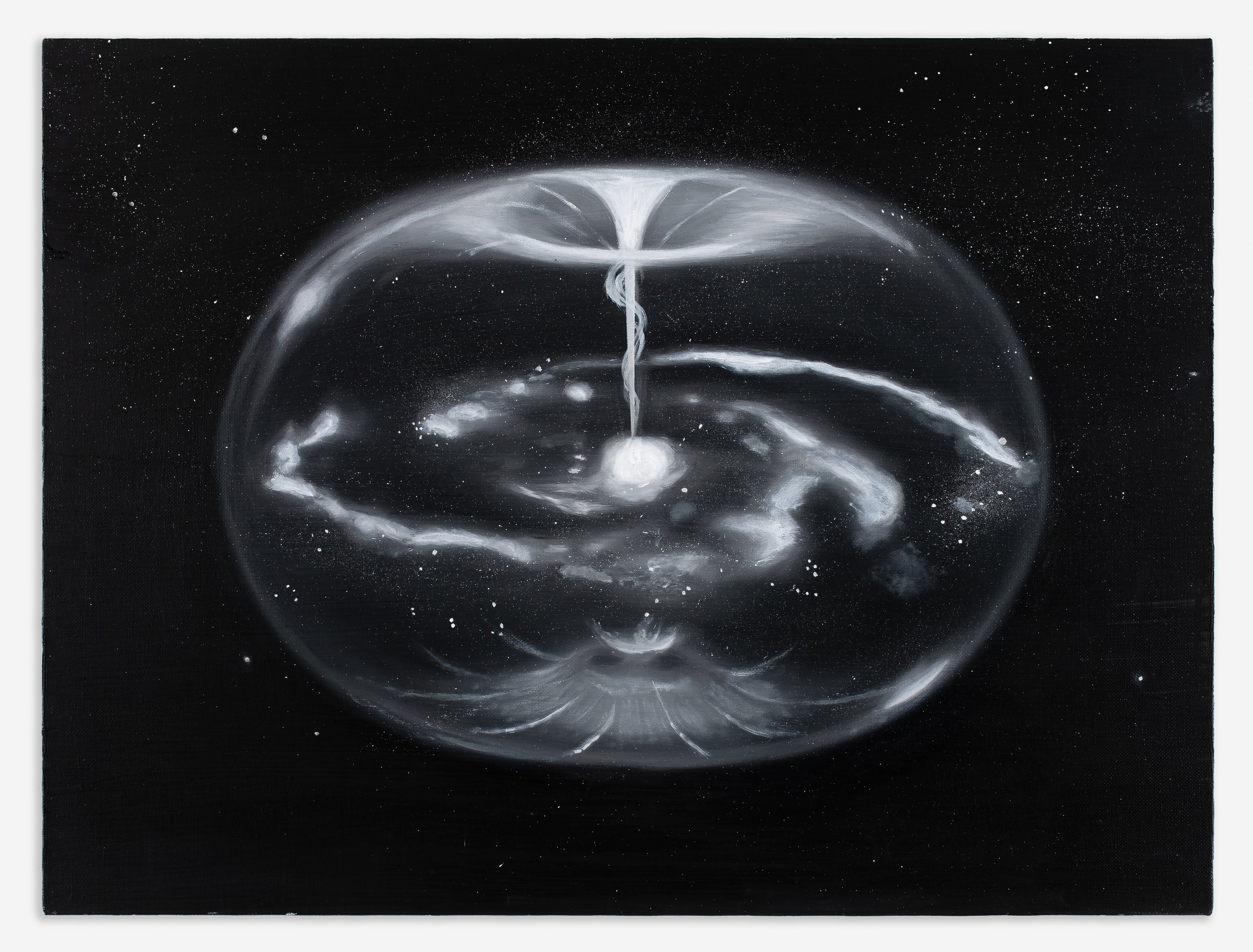
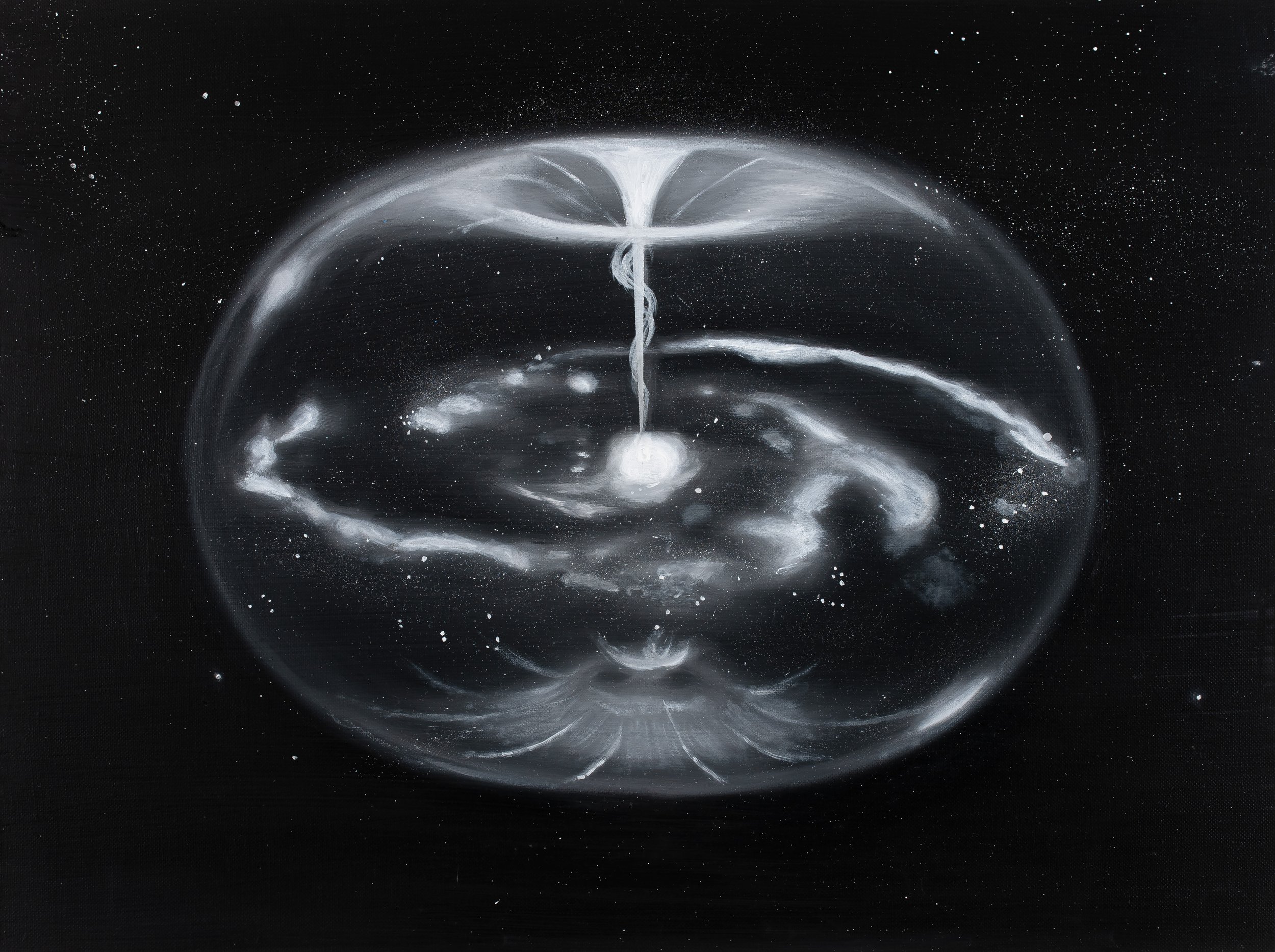
The material facts establish precision and scale. Torus is oil on linen, 46 x 61 cm (18 x 24 inches). Horizontal format suits the ring's geometry, allowing the eye to travel along its curve. Linen support provides textured ground for dark passages, weave catching thin glazes. Composition centers the torus, a ring of white points against deep black background. The points are not uniform; they vary in size and density, creating a sense of movement and depth. Some areas are dense clusters, suggesting mass and energy concentration. Others are sparse, allowing the black void to show through. The painting holds the torus in suspension, no horizon, no context, just the form and the darkness, a perfect circle in an imperfect world.
Surface treatment distinguishes form from space. Torus passages receive meticulous dotting, each point a deliberate application of white oil. Background uses thin black glazes, layered to create depth without texture. The contrast between the busy ring and the empty void creates visual tension, highlighting the torus's transparency and rotational movement. Scale is intimate, suitable for close inspection. Viewers approach to see the individual points, the hand labor involved in their placement. Linen texture visible under thin glazes prevents total flatness, reminding viewer this is painted object not digital render. The monochrome palette restricts distraction, forcing attention on structure and flow. White points glow against black, creating an illusion of light emanating from within the form.
Tan Mu describes her interest in points as visual language, their dual nature as aesthetic and symbolic. In Torus, points evoke stars or bioluminescent organisms, suggesting universal connectivity. This approach is consistent with her broader practice, seen in No Signal and the Signal series, where points represent information, pixels, or noise. Here they act as indicators of energy flow, reflecting her interest in how visual symbols shift meaning across systems. The painting captures this fluidity, the torus appearing solid from a distance but dissolving into individual units up close. It is a visual metaphor for the interconnectedness of all things, the way individual elements come together to form a cohesive whole.
Color restraint defines the palette. Only black and white are used, a choice Tan Mu made to eliminate sensory distractions and guide attention toward structure. This monochrome approach aligns with her broader artistic philosophy of observing the essence of our time while maintaining a meditative relationship with nature. The restraint and simplicity of the imagery resonate with the cosmic principles she is exploring, offering viewers a contemplative entry point into ideas of infinity and continuity. The black is not just absence of light but a presence, a void that amplifies the luminosity of the white points. The white is not just pigment but energy, a pulse that animates the form. Together they create a dynamic equilibrium, a balance of forces that mirrors the torus's own self-sustaining nature. The specific contrast between the deep, matte black of the background and the bright, textured white of the points creates a visual vibration that seems to animate the static image, giving the impression of rotational movement even when the eye is still.
Georges Seurat’s A Sunday Afternoon on the Island of La Grande Jatte (1884) establishes the first parallel. Seurat used pointillism, a technique of applying small distinct dots of color to form an image. He believed that this method, based on scientific theories of optics, would create more luminous and harmonious compositions than traditional brushwork. Tan Mu’s Torus adopts a similar strategy, using thousands of white points to build the form of the ring. Both artists treat the point as a fundamental unit of visual language, a building block that gains meaning through accumulation. Seurat used color to create light and shadow. Tan Mu uses value to create form and movement. Both share a belief in the power of systematic application, the idea that order and precision can generate beauty and insight.
Seurat's work was a reaction against the spontaneity of impressionism, a desire to bring a scientific rigor to the act of painting. Tan Mu's work is similarly a reaction against the chaos of the digital age, a desire to find order in the flow of information. The torus, with its perfect symmetry and endless loop, is the ultimate symbol of that order. By rendering it in points, Tan Mu connects it to the digital world, to the pixels that make up our screens and our lives. But unlike the pixel, which is a unit of data, the point in Tan Mu's painting is a unit of meditation. It asks the viewer to slow down, to look closely, to see the individual elements that make up the whole. In this way, the painting is not just a representation of a torus; it is a practice of attention, a way of seeing that is both ancient and modern.
Seurat’s painting is a scene of leisure, figures frozen in time on a sunny afternoon. Tan Mu’s painting is an abstract form, a mathematical concept made visible. Yet both works share a sense of stillness and contemplation. Seurat’s figures are static, posed like mannequins. Tan Mu’s torus is dynamic, suggesting rotation and flow. But this dynamism is captured in a static medium, frozen in oil like Seurat’s figures. Both artists use their technique to slow down perception, to force the viewer to look closely and see the constituent parts of the whole. Seurat’s dots blend in the eye to create color. Tan Mu’s points blend in the mind to create form. Both are exercises in optical mixing, in the viewer’s active participation in the creation of the image.
Difference clarifies Tan Mu’s intervention. Seurat used pointillism to depict the modern world, the leisure class of late nineteenth-century Paris. Tan Mu uses it to depict a timeless form, a mathematical principle that exists outside of history. Seurat’s work is social commentary. Tan Mu’s is philosophical meditation. Both use the point to challenge traditional representation, but Tan Mu takes it further, abandoning figuration entirely for pure form. Seurat shows how points create a scene. Tan Mu shows how points create a system. The torus becomes a Seuratian landscape of pure energy, a field of dots that coalesces into a shape of infinite return.
Tan Mu anchors subject in specific mathematical concept. The torus is a surface of revolution generated by revolving a circle in three-dimensional space about an axis coplanar with the circle. It is a shape of continuity, with no beginning and no end. In physics, the torus appears in magnetic fields, in the structure of atoms, in the shape of black holes. In biology, it appears in the form of embryos, in the circulation of blood, in the structure of DNA. Tan Mu’s painting captures this universality, the torus as a fundamental form that underlies diverse phenomena. Her Q and A emphasizes the aesthetic and philosophical presence of mathematics, the way it offers a conceptual foundation for understanding the world. The painting argues that math is not just abstract logic but a visual language, a way of seeing the patterns that connect all things. It is a language that is written in the stars and in the cells, in the galaxies and in the genes.
The choice of monochrome is crucial to this argument. By removing color, Tan Mu eliminates the distractions of realistic representation and focuses on structure and flow. Black and white create a visual tension that highlights the torus’s transparency and rotational movement. This approach aligns with her broader artistic philosophy of observing the essence of our time. In an age of digital saturation, where images are everywhere and attention is scarce, the simplicity of black and white offers a moment of calm. It invites the viewer to look deeply, to contemplate the form and its implications. The torus becomes a focal point for meditation, a shape that encourages the eye to follow its curve in an endless loop.
Tan Mu connects this to her earlier works like Fractal and Atom, which also explored mathematical aesthetics. But where Fractal focused on self-similarity and infinite complexity, Torus focuses on continuity and connection. It is a shift from the chaotic to the orderly, from the fragmented to the whole. The painting reflects her desire to respond to the fragmentation of the digital age through art that restores a sense of balance and harmony. The torus is a symbol of this restoration, a form that holds itself together through its own internal logic. It is a self-sustaining system, a loop of energy that needs nothing from outside to maintain its integrity. In this way, the painting offers a model for resilience, a vision of wholeness in a world that often feels broken.
Exhibition context places Torus alongside other works that explore scientific concepts, such as Quantum Computer and Large Hadron Collider. Together they form a constellation of inquiries into the nature of reality, from the subatomic to the cosmic. Torus represents the topological vector, the study of shape and space. Tan Mu’s treatment of the subject is not illustrative but evocative. She does not seek to teach the viewer about topology but to make them feel its principles. The painting is an experience of continuity, a visual enactment of the endless cycle that the torus represents. It argues that art can make abstract concepts tangible, can bring the invisible structures of the universe into the realm of human perception.

Agnes Martin’s Leaf (1965) provides the second frame. Martin painted subtle grids and bands in pale colors, seeking to express feelings of innocence and happiness. Her work is often described as meditative, inviting the viewer into a state of calm contemplation. Tan Mu’s Torus shares this meditative quality. The monochrome palette and the repetitive application of points create a rhythm that slows down the viewer’s perception. Both artists use restraint to achieve depth, believing that less is more. Martin’s grids are structures of order. Tan Mu’s torus is a structure of flow. Both are abstract, non-representational, and focused on the essential qualities of form and line.
Martin's work was deeply influenced by Taoism and Zen Buddhism, and she saw her paintings as tools for spiritual awakening. Tan Mu's torus, while rooted in scientific concepts, also invites a spiritual response. The endless loop of the torus is a symbol of eternity, of the cyclical nature of existence. In a world that is obsessed with progress and linearity, the torus offers a different vision, one of return and renewal. Both artists use their work to create a space for reflection, a place where the viewer can escape the noise of the world and find a moment of peace. The torus, like Martin's grids, is a sanctuary, a place of quiet and order in a chaotic universe.
Martin’s work is often associated with minimalism, but she rejected the label, insisting that her work was about emotion and beauty. Tan Mu similarly rejects the idea that her work is merely illustrative of scientific concepts. For her, the torus is not just a shape but a symbol of interconnectedness and regeneration. Both artists use abstraction to access deeper truths, to bypass the intellect and speak directly to the spirit. Martin’s grids suggest the infinite expanse of the desert or the sky. Tan Mu’s torus suggests the infinite cycle of the universe. Both are visions of infinity, rendered in finite forms. Martin uses horizontal and vertical lines to create her grids. Tan Mu uses points to create her curve. But both rely on repetition and precision to achieve their effects.
Yiren Shen’s 2025 interview captures Tan Mu’s interest in the philosophical implications of space and technology. Shen notes that Tan Mu’s work invites viewers to reflect on humanity’s place in the cosmos. Torus fits this description perfectly. It is a cosmic form, a shape that appears in the largest and smallest scales of the universe. By painting it in black and white, Tan Mu strips it of specific context and makes it universal. It becomes a symbol of the underlying order of things, a testament to the beauty of mathematical truth. Martin’s work offers a similar sense of universal order, a belief that beauty and harmony are fundamental to existence. Both artists offer their work as a refuge from the chaos of the world, a place of quiet and clarity.
Difference sharpens Tan Mu’s approach. Martin’s work is static, her grids fixed and unchanging. Tan Mu’s work is dynamic, her torus suggesting movement and energy. Martin’s palette is soft and pale. Tan Mu’s is stark and contrasting. Both use abstraction to explore spiritual themes, but Tan Mu grounds hers in scientific form. Martin’s grids are intuitive, felt rather than calculated. Tan Mu’s torus is precise, based on mathematical principles. Yet both arrive at a similar destination, a place of contemplative stillness where the viewer can connect with something larger than themselves. The torus becomes a Martin-esque field of meditation, a shape that invites the eye to rest and the mind to wander.
Torus holds mathematical memory in horizontal frame. Thousands of points, black and white, accumulated to form a ring of light. Tan Mu’s monochrome technique translates scientific concept into meditative object, void amplifying luminosity. Linen texture interrupts digital precision, reminding technology sits within human history. The painting argues that mathematical forms carry spiritual weight, shapes that govern the universe also governing the soul.
Practice continuity connects Torus to Fractal, Atom, and other mathematical works. Tan Mu documents scientific aesthetics systematically, painting the forms that define our understanding of reality. Torus represents the topological vector, the study of continuity and connection. Seurat and Martin provide precedents for treating points and grids as vehicles for contemplation. Tan Mu adds scientific specificity, torus as artifact of universal law rather than personal expression. The painting preserves this moment, ring as archive of cosmic order.
Seurat showed how points create light. Martin showed how grids create calm. Tan Mu combines both insights, torus as luminous calm. Torus argues that painting can document science without losing aesthetic power, monochrome technique allowing object to function simultaneously as specific form and universal symbol. The ring floats in painted void, white points holding the weight of infinite return. Tan Mu’s contribution lies in temporal urgency, painting capturing specific historical moment when digital fragmentation necessitates a return to holistic forms. The torus endures in paint, a silent testament to the human capacity to find unity in complexity, to see the loop that connects all things. In the end, the torus is not just a shape; it is a way of being, a reminder that everything is connected, and that every end is also a beginning.