The Clonal Landscape: Tan Mu's Epithelial Cells and the Palette of Lineage
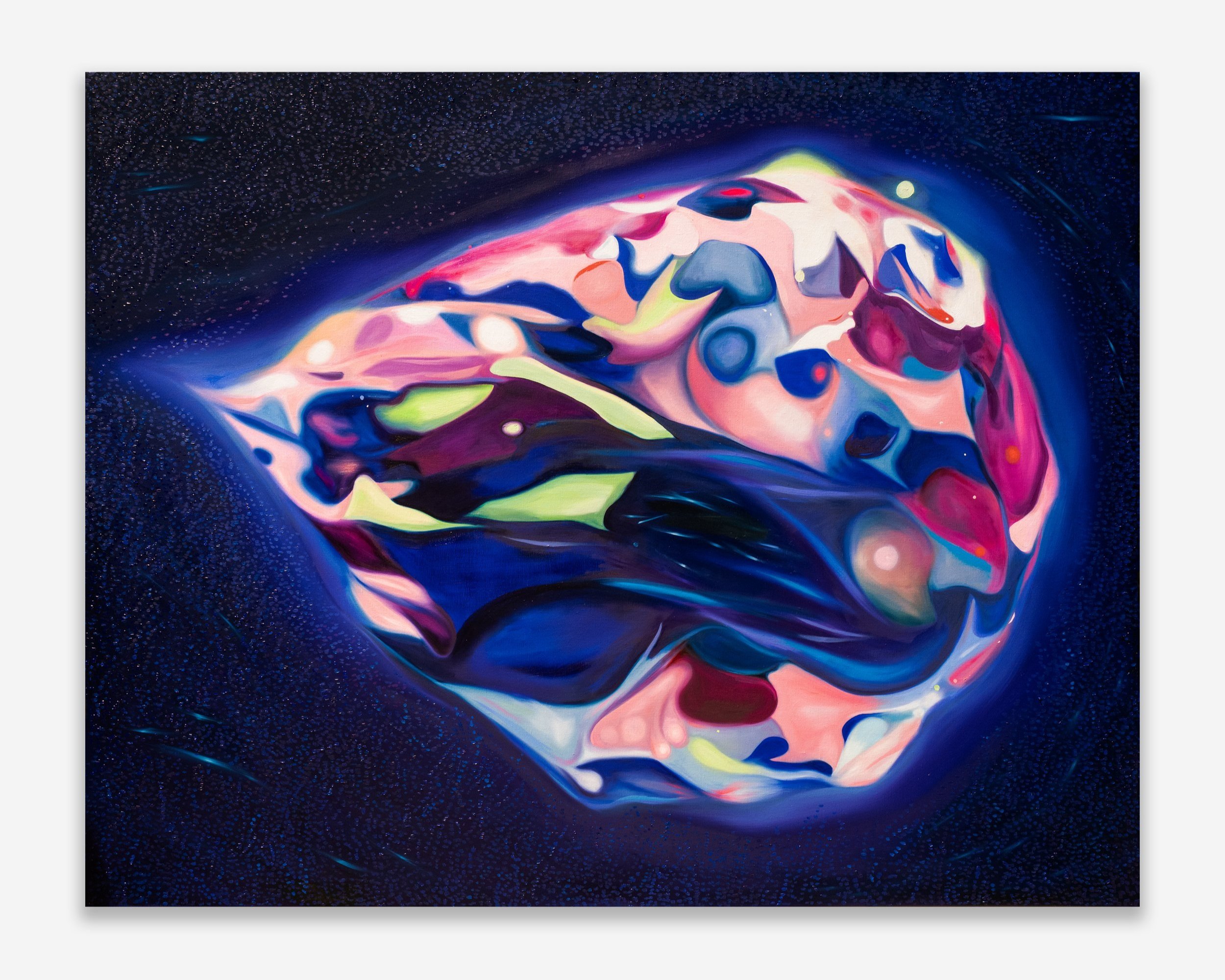
A dish of cells becomes a galaxy. In the laboratory, scientists use clonal labeling to trace the lineage of human epithelial cells, assigning a specific color to each founder cell so that its descendants form a visible, monochromatic cluster. The result is a mosaic of vibrant hues, a map of proliferation and differentiation that looks less like biology and more like abstract expressionism. Tan Mu's Epithelial Cells (2024) translates this scientific visualization into a large-scale oil painting, capturing the dynamic interplay of color and form. The work is not just a record of cellular growth; it is a meditation on the interface between the internal and external, the protective and the permeable, the biological and the technological.
The artist states the subject with precision. The painting depicts human epithelial cells growing in a dish, clonally labeled to reveal how proliferative potential is passed from stem cells to their differentiated daughter cells. This work encapsulates the intricate convergence of biology and technology, reflecting our socio-technological journey in the era of the Anthropocene. The vivid colors and dynamic forms in the painting symbolize the rapid advancements in biotechnology and their implications for human life and society. By translating the microscopic beauty of epithelial cells into a large-scale oil painting, Tan Mu invites viewers to reflect on the interconnectedness of life, both at the cellular level and on a global scale.
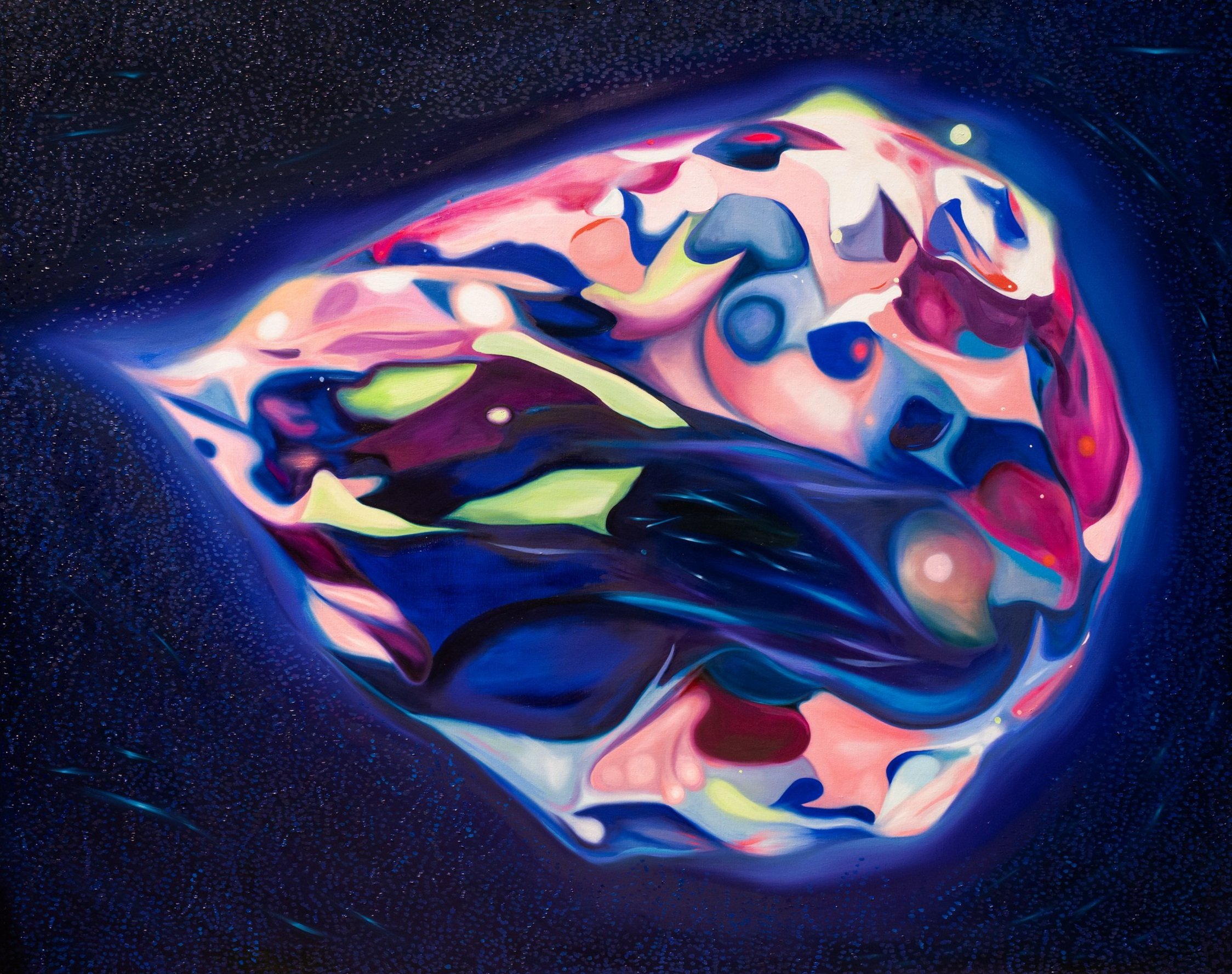
Epithelial Cells is oil on linen, 122 x 153 cm (48 x 60 in). The vertical format amplifies the sense of depth, inviting the viewer to look into the dish as if into a pool of liquid light. The surface is a complex field of layered pigment, where translucent glazes of cobalt blue, cadmium yellow, and alizarin crimson overlap to create the illusion of cellular depth. The edges of the cell clusters are soft, bleeding into one another in a way that mimics the fluid dynamics of the culture medium. The background is a deep, resonant black, punctuated by thousands of tiny dots that suggest both biological particles and distant stars. This duality is central to Tan Mu's practice, where the microscopic and the cosmic are constantly in constant exchange. The dots are not random; they are carefully placed, creating a rhythm and a texture that adds to the sense of depth. They are a reminder that the void is not empty, but full of potential, full of life. The dots are a signature of Tan Mu's style, a way of connecting her work across different subjects and scales. In Epithelial Cells, they create a bridge between the cellular and the celestial, between the world of the dish and the world of the sky. They are a reminder that we are made of the same stuff as the stars, that we are part of a vast and interconnected universe.
The viewing distance radically alters the painting's impact. At three meters, the image reads as an abstract composition, a vibrant mosaic of color and light. But at thirty centimeters, the abstract forms resolve into recognizable cellular structures. The "gem-like" quality Tan Mu describes becomes evident, with each cell cluster shimmering with an inner light. The linen weave is visible beneath the thin layers of paint, grounding the ethereal imagery in the material reality of the support. This shift from abstraction to representation mirrors the scientific process itself, where the raw data of the microscope is interpreted and given meaning through the lens of theory. The painting is a site of this interpretation, a place where the viewer can experience the wonder of discovery firsthand. The colors are not just flat applications of pigment; they are built up in layers, creating a sense of depth and volume that mimics the three-dimensional structure of the cells themselves. The painting is a testament to the power of oil paint to capture the complexity of the natural world, to make the invisible visible and the abstract concrete.
The technical process of clonal labeling is a marvel of modern biotechnology. Scientists use genetic engineering to insert a "barcode" into the DNA of a single cell. As that cell divides, the barcode is passed on to its descendants, creating a unique identifier for each lineage. This allows researchers to track the growth and development of tissues with unprecedented precision. Tan Mu's painting captures the visual result of this process, the colorful mosaic of labeled cells. But it also captures the conceptual weight of the technology, the way it allows us to see and to understand the fundamental processes of life. The painting is a tribute to the ingenuity of science, and a reflection on its implications.
This method of lineage tracing has revolutionized our understanding of tissue regeneration and cancer formation. By observing how a single stem cell gives rise to a diverse population of differentiated cells, scientists can map the developmental pathways that govern human health and disease. In the context of epithelial tissues, which line the surfaces of our organs and protect us from the external environment, this knowledge is crucial. Epithelial cells are constantly renewing themselves, a process that must be tightly regulated to prevent unchecked growth. The colorful clusters in Tan Mu's painting are not just aesthetic objects; they are visualizations of this regulatory logic, each color a testament to the precise control mechanisms that keep our bodies functioning. The painting thus becomes a site of scientific inquiry, a place where the beauty of the image invites us to delve deeper into the complex realities of cellular biology.
The process of clonal labeling is a way of making the invisible visible. By marking a single cell with a specific color, scientists can trace its entire family tree, watching as it divides and spreads across the dish. This process is mirrored in Tan Mu's painting, where each cluster of color is a testament to the power of a single origin. The painting is a map of lineage, a record of the ways in which life replicates and diversifies. It is a celebration of the fundamental unit of life, the cell, and its capacity for endless renewal.
The comparison between Epithelial Cells and Odilon Redon's The Birth of Venus (1912) reveals a shared interest in the symbolic power of color. Redon's painting is a dreamlike vision, where the goddess of love emerges from a sea of iridescent hues. The colors are not naturalistic; they are emotional, evoking a sense of wonder and mystery. Tan Mu's painting uses a similar strategy. The colors of the cells are not just markers of lineage; they are carriers of meaning, suggesting the vitality and complexity of life itself. Both artists use color to transcend the literal, to create a world that is both real and imagined.
Redon's work is often associated with Symbolism, a movement that sought to express ideas and emotions through sensory experience. Tan Mu's work can be seen as a contemporary form of Symbolism, where scientific imagery is used to explore the ethical and social implications of biotechnology. The vibrant colors of Epithelial Cells are not just beautiful; they are a call to attention, a reminder of the power and the responsibility that comes with the ability to manipulate life at its most fundamental level. The painting is a symbol of our time, a time when the boundaries between the natural and the artificial are increasingly blurred. Redon's Venus is a mythological figure, but she is also a symbol of the creative power of nature. Tan Mu's cells are biological facts, but they are also symbols of the creative power of science. Both works celebrate the mystery of life, and the awe it inspires.
Epithelial cells are the body's first line of defense, forming tightly packed layers that protect our internal organs from the external environment. They are the interface between self and other, the boundary where exchange and protection are constantly negotiated. In her Q and A, Tan Mu connects this biological function to the philosophical ideas of Julien Offray de La Mettrie, who viewed the human body as a complex machine. For Tan Mu, the epithelial cell is not just a building block of the body; it is a metaphor for the human condition, a site of constant negotiation between the individual and the world. The painting captures this tension, the way the cells cling together in clusters, yet remain distinct, each one a unique expression of its lineage.
La Mettrie's *Man a Machine* (1748) was a radical work for its time, arguing that human beings are not separate from nature, but a part of it, governed by the same physical laws. Tan Mu's painting echoes this sentiment, showing the human body not as a sacred temple, but as a complex system of cells and signals. The clonal labels are a reminder of this mechanistic view, a way of reducing the mystery of life to a set of data points. But the painting also transcends this view, using the beauty of the colors and the complexity of the forms to evoke a sense of wonder and awe. The painting is an exchange between the mechanical and the magical, between the machine and the miracle. It asks us to consider what it means to be human in an age where the body can be decoded and manipulated like a machine.
The painting also reflects on the ethical implications of biotechnology. As genetic decoding and editing technologies advance, we are forced to confront difficult questions about the nature of life and the limits of human intervention. Tan Mu's work does not provide answers; it creates a space for reflection. The beauty of the painting is a lure, drawing the viewer in, but it is also a warning, a reminder of the fragility of life and the potential for misuse. The clonal labels are a trace of human control, a mark of our desire to understand and to manage the natural world. The painting asks us to consider the cost of that desire, and the responsibility that comes with it. In an era where the human genome can be edited with CRISPR technology, the image of the labeled cell takes on a new urgency. It is a reminder that our bodies are no longer just natural entities, but sites of technological intervention, places where the boundaries between the given and the made are increasingly blurred.
Ernst Haeckel's Kunstformen der Natur (1904) provides a second, structural parallel. Haeckel's illustrations of microscopic organisms are celebrated for their symmetry and intricate detail, blurring the line between science and art. Tan Mu's Epithelial Cells shares this aesthetic sensibility, finding beauty in the structural logic of biological forms. Haeckel's work was a celebration of the diversity of life, a visual encyclopedia of the natural world. Tan Mu's work is a celebration of the diversity of cellular life, a map of the ways in which a single cell can give rise to a complex and vibrant community. Both artists use their work to reveal the hidden beauty of the natural world, to show us that even the smallest organisms are works of art.
Yiren Shen's 2025 essay on Tan Mu's work notes the artist's ability to "translate the invisible architectures of our time into visible forms." Epithelial Cells is a prime example of this translation. The painting makes visible the hidden processes of cellular lineage, the ways in which life is organized and regulated at the microscopic level. Shen argues that Tan Mu's work is not just a representation of scientific data, but a critical engagement with the social and ethical implications of that data. The painting is a lens through which we can see the world anew, a world where the boundaries between the biological and the technological are increasingly porous. Shen's insight helps us to understand the painting not just as a beautiful object, but as a critical tool, a way of thinking about the complex relationships between science, society, and the environment.
The dotted background of Epithelial Cells is a recurring motif in Tan Mu's practice, appearing in works like Chromosomes (2022) and Synapse (2023). These dots can be read as biological particles, data points, or celestial bodies, suggesting that information flows across scales from the microscopic to the cosmic. In Epithelial Cells, the dots create a sense of depth, a field of stars against which the cellular clusters shine. This cosmic connection is not accidental; it is a reminder of our place in the universe, a universe where the same laws of physics and chemistry govern the behavior of stars and cells alike. The painting is a testament to the unity of nature, a unity that is both beautiful and profound.
This connection between the microscopic and the cosmic is central to Tan Mu's practice. She sees the cell not just as a biological unit, but as a microcosm of the universe, a world in itself. The clonal labels are a way of mapping this world, of tracing the connections between the past and the present, between the ancestor and the descendant. The painting is a map of these connections, a record of the ways in which life is linked across time and space. It is a celebration of the continuity of life, a continuity that is both fragile and resilient. The painting asks us to consider our own place in this continuum, our own role in the ongoing story of life on Earth.
Ultimately, Epithelial Cells is a painting about connection. It is about the connections between cells, between lineages, between the biological and the technological, and between the viewer and the viewed. The painting invites us to see the world with new eyes, to recognize the beauty and the complexity of the microscopic world, and to consider our own role in shaping the future of life on Earth. It is a work of hope and of caution, a celebration of the power of science and a reminder of the need for ethical responsibility. In the end, the painting is a mirror, reflecting not just the cells in a dish, but the cells within us, and the world we are creating together. It is a map of our own interior universe, a universe that is as vast and as mysterious as the cosmos itself.
The painting sits within a larger constellation of works by Tan Mu that explore the intersection of biology and technology. From Chromosomes (2022) to Synapse (2023), she has been building a visual language for the invisible architectures of life. Epithelial Cells is a culmination of this project, a work that brings together her interest in cellular lineage, her fascination with scientific imaging, and her concern for the ethical implications of biotechnology. It is a work that is both timely and timeless, a reflection on the present moment and a meditation on the enduring mysteries of life. The painting is a testament to the power of art to illuminate the unseen, to make the invisible visible, and to help us understand our place in the world. It is a work that reminds us that we are not just observers of life, but participants in it, connected to every cell, every lineage, every living thing. The painting is a celebration of this connection, a celebration of the web of life that binds us all together. It is a reminder that we are not separate from nature, but a part of it, and that our actions have consequences for the entire system. The painting is a call to action, a call to care for the world and for each other, to protect the delicate balance of life and to ensure a sustainable future for all.