The Geometry of Distance: Tan Mu's A Sunday Afternoon in the Park and the Regulated Public
On May 17, 2020, a photograph by Johannes Eisele captured a scene that would become iconic of the pandemic era: sunbathers at Domino Park in Brooklyn, confined within white circles painted on the grass. The image, published by CNN, showed a new kind of social order, a geometry of distance imposed on the casual leisure of a Sunday afternoon. Tan Mu's A Sunday Afternoon in the Park (2022) is a direct response to this image, a painting that translates the photographic record into a meditation on control, function, and the persistence of everyday life under extraordinary conditions. The title is a deliberate echo of Georges Seurat's masterpiece, creating a bridge between two moments of regulated leisure separated by over a century.
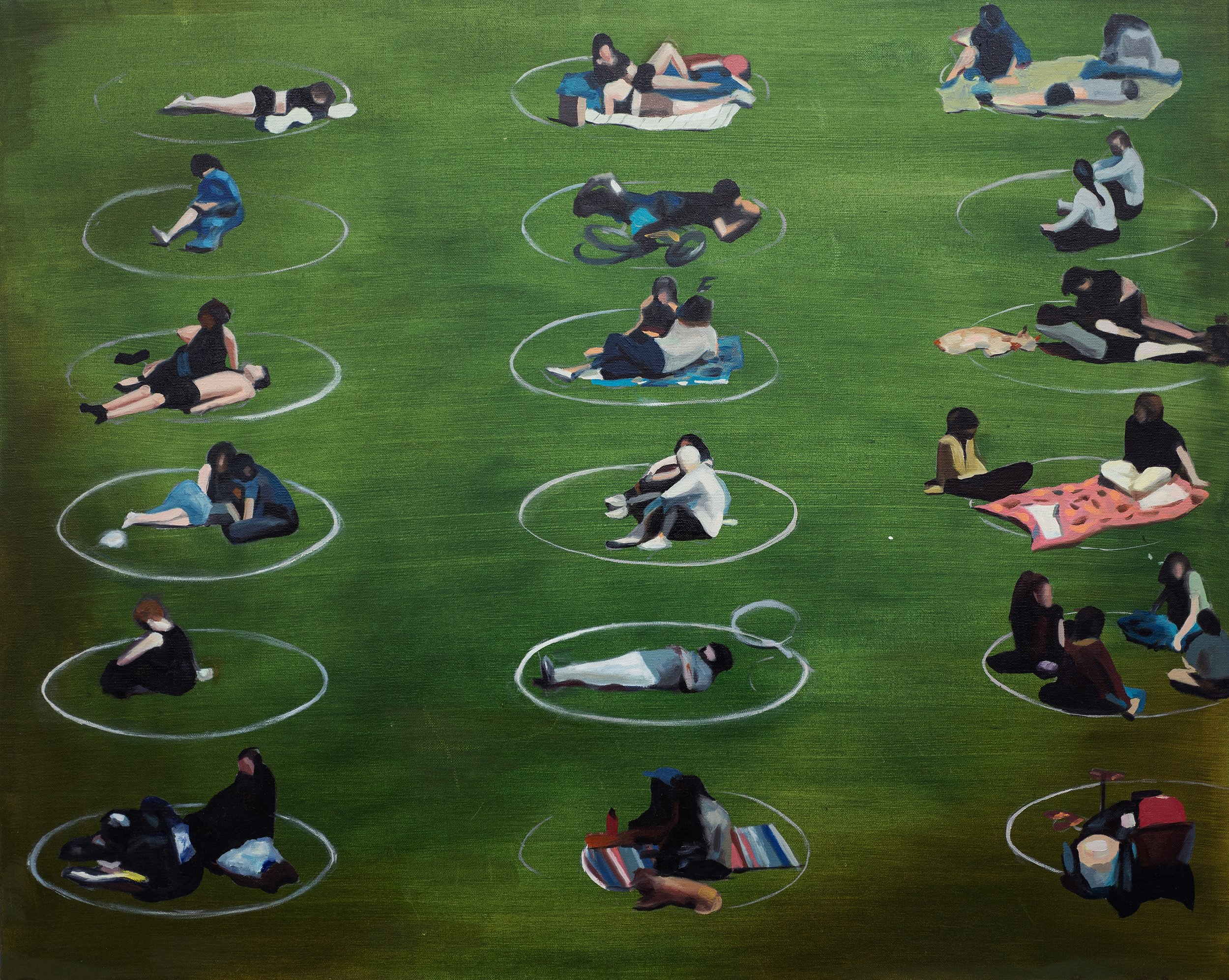
The artist states the subject with clarity. The work engages with the utopic ideologies of control and function, reflecting on the challenges of navigating daily life and social interactions amidst the ongoing pandemic. The painting portrays a grid-like arrangement, where a crowd of individuals occupies the park, spaced equally within geometric, contained zones. At the center of the composition, a woman is depicted facing forward, her face concealed by a white mask. The work reflects the mechanisms of urban design that regulate the movement and interaction of individuals, revealing the tension between public health protocols and the persistence of everyday life. It is a document of a specific moment in New York City, but it speaks to a global experience of separation and control.
The photograph that inspired the painting was taken at Domino Park, a public space on the Williamsburg waterfront that had only recently been opened to the public. The park was designed as a place of community and leisure, a green oasis in a dense urban environment. But in the spring of 2020, it became a site of regulation and control. The white circles were painted on the grass to enforce social distancing, a visual reminder of the new rules of public life. The photograph captures the strangeness of this moment, the way the park was transformed from a place of freedom to a place of confinement. Tan Mu's painting amplifies this strangeness, using the language of art to make the familiar seem unfamiliar, to make the ordinary seem extraordinary. The painting is a meditation on the nature of public space, the way it is shaped by power and politics, and the ways in which we navigate and resist these forces in our daily lives.
These white circles represent a new form of soft infrastructure, a temporary architectural intervention that reorganizes social behavior through visual cues rather than physical barriers. Unlike fences or walls, which explicitly prohibit movement, the circles suggest a voluntary compliance, a social contract painted on the ground. They rely on the viewer's internalization of the rules, their willingness to stay within the lines. This creates a psychological tension, a sense of self-surveillance that is more subtle but perhaps more pervasive than overt enforcement. The circles are a symbol of this internalized control, a reminder that in the pandemic era, we became our own police, monitoring our own movements and those of others. The painting captures this tension, the way the figures sit within their circles not just as a response to external rules, but as an expression of their own fear and caution. The white lines are not just boundaries; they are a mirror, reflecting our own anxieties and our own complicity in the systems that govern us.
The use of geometric markings to regulate public behavior has historical precedents, from the zebra crossings of the early twentieth century to the queue lines of modern bureaucracies. But the scale and ubiquity of the pandemic circles were unprecedented. They appeared in parks, on sidewalks, in markets, transforming the entire urban landscape into a grid of containment. This global phenomenon created a shared visual language of distance, a universal symbol of the new normal. Tan Mu's painting captures this universality, the way the specific scene at Domino Park resonates with similar scenes from around the world. The painting is a document of this global shift, a record of the way we all learned to live in a world of circles, of boundaries, of limitations. It is a reminder that our public spaces are not neutral, but are always shaped by the social and political forces of the moment.
A Sunday Afternoon in the Park is oil on linen, 61 x 76 cm (24 x 30 in). The horizontal format mirrors the panoramic view of the original photograph, allowing the viewer to scan the rows of circles. The surface is built with bold, open brushstrokes that construct the grassy background, emphasizing the expansiveness of the park. Across this space, three rows of circular forms impose a rigid structure. The white of the circles is stark, a cool, clinical tone that contrasts with the warm greens and earthy tones of the figures within. The central figure, the masked woman, is rendered with a quiet precision, her gaze directed outward, engaging the viewer in a silent exchange. Her mask is a blank white space, a void where a face should be, a symbol of the anonymity and the universality of the pandemic experience. The painting is a study in contrasts: the openness of the public land versus the confinement of the individual, the chaos of the pandemic versus the order of the grid. The woman's posture is relaxed, yet alert, a posture of waiting, of enduring. She is a figure of resilience, a symbol of the human capacity to adapt and to survive. Her presence in the center of the painting is a reminder that behind every statistic, every policy, every regulation, there is a human being, a life that is being lived, a story that is being told.
The viewing distance radically alters the painting's impact. From a distance, the white circles appear as a uniform pattern, a rhythmic repetition that suggests a sense of order and control. But as the viewer moves closer, the individual figures within the circles become more distinct, their postures and activities more visible. The abstraction of the distance gives way to the specificity of the near. This shift mirrors the experience of the pandemic itself, where the broad statistics and public health mandates were felt most acutely in the small, personal moments of daily life. The painting is a site of this shift, a place where the viewer can experience the tension between the general and the particular, between the rule and the exception. The linen weave is visible beneath the thin layers of paint, grounding the ethereal quality of the light in the material reality of the support. The painting is a testament to the power of oil paint to capture the complexity of the social world, to make the invisible structures of power visible and tangible.
The use of oil paint allows Tan Mu to soften the harshness of the photographic source. The edges of the circles are not sharp lines but blurred boundaries, suggesting the permeability of the rules that governed them. The figures are not detailed portraits but suggestive forms, their identities subsumed by their containment. This abstraction serves to universalize the scene, making it less about specific individuals and more about the collective experience of the pandemic. The painting is a testament to the resilience of the human spirit, the way people continue to seek sunlight and connection even when separated by painted lines. It is a quiet celebration of the simple act of being outside, of breathing fresh air, of sharing a public space even in isolation.
The comparison with Georges Seurat's A Sunday Afternoon on the Island of La Grande Jatte (1884-1886) is central to the painting's meaning. Seurat's work is a monumental study of leisure in the late nineteenth century, a scene of Parisians enjoying the banks of the Seine. The figures are rigid, almost statue-like, their interactions governed by the strict social codes of the time. Tan Mu's painting echoes this rigidity, but the code is no longer social; it is biological. The white circles are the new social code, a way of managing the risk of contagion. Both paintings are about the regulation of the public body, the way society organizes itself in spaces of leisure. Seurat used pointillism to create a sense of order and stability; Tan Mu uses the grid of circles to create a sense of containment and control. Seurat's figures are frozen in time, their gestures suspended in a moment of perfect stillness. Tan Mu's figures are also frozen, but their stillness is not a choice; it is a requirement of the moment, a pause in the normal flow of life.
Seurat's figures are distant from one another, lost in their own thoughts, their proximity an illusion of connection. Tan Mu's figures are literally distanced, separated by the white lines that define their space. The comparison highlights the continuity of urban alienation, the way that even in moments of shared leisure, we remain alone. But it also highlights the difference. Seurat's alienation is a choice, a feature of modern life; Tan Mu's is a mandate, a necessity of survival. The painting is a critique of this mandate, a reminder of the cost of safety. It asks us to consider what we lose when our movements are restricted, when our interactions are regulated, when our leisure is confined to a circle. It is a question that is as relevant today as it was in 2020. Seurat's painting is a celebration of the modern city, a vision of progress and prosperity. Tan Mu's painting is a lament for the lost city, a vision of a world that has been slowed, stopped, and contained. The white circles are a scar on the landscape, a mark of the trauma we have endured. But they are also a symbol of our resilience, our ability to adapt and to find new ways of being together.
Balthus's The Street (1933) provides a second, more somber parallel. Balthus's painting depicts a chaotic urban scene, a slice of Parisian life filled with fragmented figures and ambiguous interactions. It is a world of isolation and potential violence, where the public space is a site of conflict rather than community. Tan Mu's painting is a quieter version of this world. The chaos is contained, the violence is latent, but the isolation is the same. The white circles are a way of managing the threat of the other, of keeping the chaos at bay. But they also create a sense of vulnerability, a reminder of our exposure to the world. The painting is a meditation on this vulnerability, the way we are both protected and imprisoned by the structures we create. Balthus's figures are caught in a moment of tension, their bodies twisted and contorted in a dance of desire and fear. Tan Mu's figures are still, their bodies contained within the circles, but their stillness is also a form of tension, a holding back, a waiting for the moment to pass. Both paintings are about the fragility of the public sphere, the way it can be disrupted and reshaped by forces beyond our control.
Li Yizhuo's 2025 essay on Tan Mu's pandemic works notes the artist's ability to capture the "emotional complexity of a period that reshaped how we relate to one another." A Sunday Afternoon in the Park is a prime example of this capture. The painting is not just a record of a moment; it is a feeling, a mood of uncertainty and resilience. The masked figure at the center is a symbol of this mood, a face that is both present and absent, both connected and disconnected. The painting asks us to look at this figure, to see ourselves in her isolation, and to consider the ways in which we have been changed by the experience of the pandemic. It is a work of empathy, a reminder of our shared humanity in a time of division. Li Yizhuo argues that Tan Mu's work is not just a reflection of the pandemic, but a critical engagement with it, a way of thinking through the ethical and social implications of the crisis. The painting is a tool for this thinking, a place where we can explore the complex emotions and ideas that have emerged from this period. It is a work that helps us to understand our place in the world, and to imagine a future that is more just and more connected.
The painting sits within a larger series of works by Tan Mu that explore the theme of isolation and regulation. From Isolation (2020) to Yoga Isolation (2022), she has been documenting the ways in which the pandemic has reshaped our private and public lives. A Sunday Afternoon in the Park is a culmination of this exploration, a work that brings together her interest in urban design, social regulation, and the persistence of everyday life. It is a work that is both specific and universal, a document of a particular moment in New York City that speaks to the global experience of the pandemic. The painting is a testament to the power of art to illuminate the unseen, to make the invisible visible, and to help us understand our place in the world. It is a work that reminds us that we are not just observers of life, but participants in it, connected to each other even when we are apart.
Ultimately, A Sunday Afternoon in the Park is a painting about the geometry of distance. It is about the way we have learned to live in a world of circles, of boundaries, of limitations. But it is also about the way we continue to seek connection, to find ways to be together even when we are apart. The painting is a celebration of this resilience, a reminder of the human capacity to adapt and to endure. It is a work of hope, a vision of a future where we can once again share the park, the sunlight, and the simple joy of being outside. It is a work that asks us to remember this moment, to learn from it, and to build a world that is more just, more equitable, and more connected. The white circles are a scar, but they are also a lesson, a reminder of the fragility of our freedom and the importance of our shared humanity.
The painting sits within a larger constellation of works by Tan Mu that explore the theme of isolation and regulation. From Isolation (2020) to Yoga Isolation (2022), she has been documenting the ways in which the pandemic has reshaped our private and public lives. A Sunday Afternoon in the Park is a culmination of this exploration, a work that brings together her interest in urban design, social regulation, and the persistence of everyday life. It is a work that is both specific and universal, a document of a particular moment in New York City that speaks to the global experience of the pandemic. The painting is a testament to the power of art to illuminate the unseen, to make the invisible visible, and to help us understand our place in the world. It is a work that reminds us that we are not just observers of life, but participants in it, connected to each other even when we are apart. The white circles are a reminder of our separation, but they are also a reminder of our connection, a symbol of the ways in which we are all in this together, bound by a shared experience of loss and hope. The painting is a call to action, a call to care for each other and for the world, to build a future that is more compassionate and more sustainable. It is a work of beauty and of truth, a work that reminds us of the power of art to heal and to transform.