The Magnetic Void: Tan Mu's MRI and the Architecture of Internal Sight
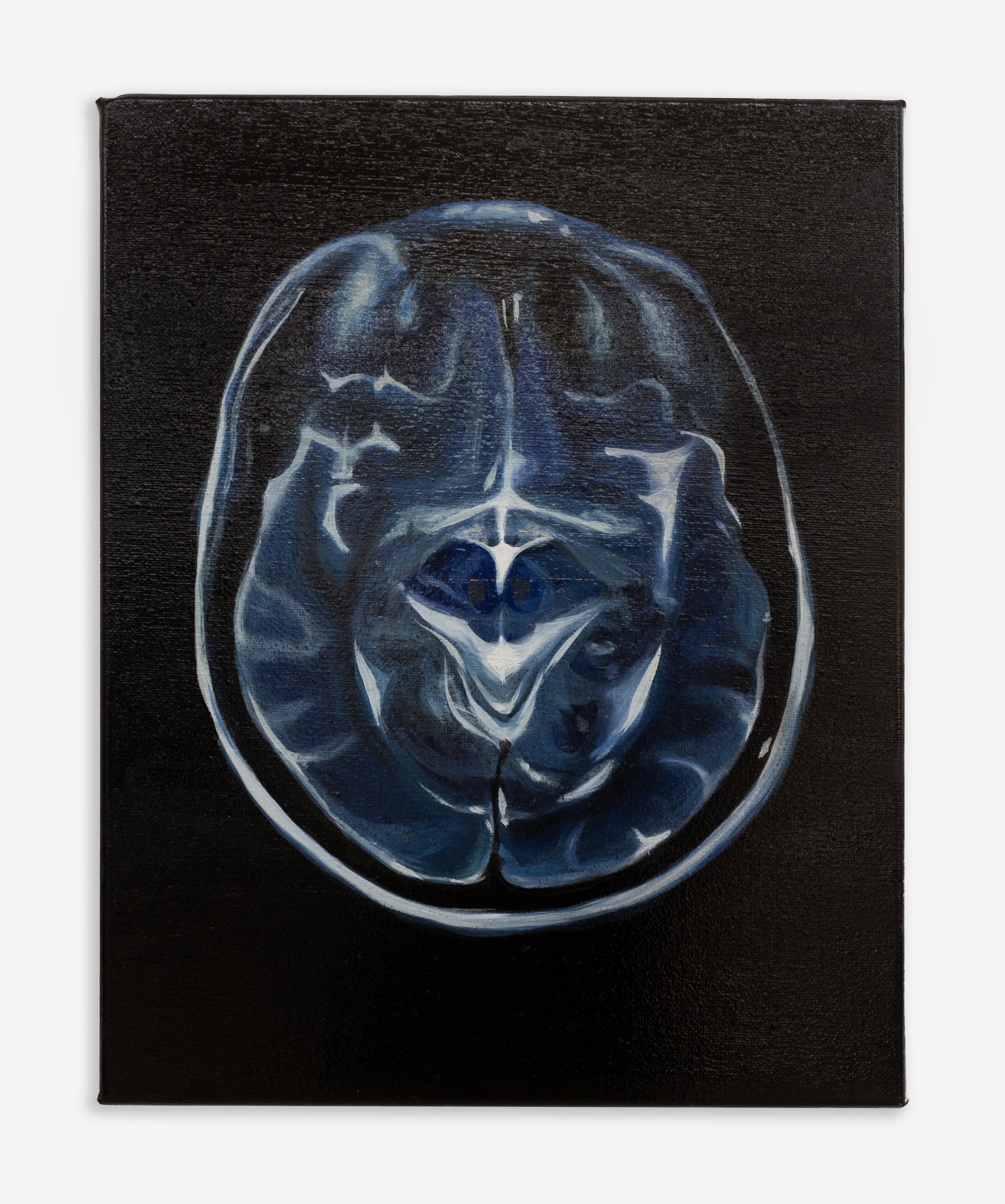
There is a specific kind of silence that exists only inside a Magnetic Resonance Imaging machine. It is a silence constructed of rhythmic thuds, high-pitched whirring, and the oppressive weight of a magnetic field that rearranges the very atoms of the body. In this space, the human form is no longer a biological entity but a set of data points, a series of cross-sections rendered in grayscale. Tan Mu's MRI (2021) captures this transition from flesh to signal. It is a painting that documents the act of looking inside, not through the lens of surgery or anatomy, but through the lens of physics. The painting is a meditation on the way we perceive the interior of the self in the digital age, a reflection on the distance between the lived experience of the body and the cold, mathematical representation of its parts. It is a work of profound stillness, a visual record of the moment when the human body becomes a map.
The artist states the subject with a clinical and conceptual precision. The work is a reflection on the process of MRI scanning and the way that medical imaging transforms the human body into a visual signal. For Tan Mu, the MRI is not merely a diagnostic tool, but a site of conceptual inquiry into the nature of perception. The painting examines the tension between the physical reality of the patient and the abstract imagery produced by the machine. It captures the moment when the body is translated into magnetic resonance, a process that renders the interior world visible while simultaneously stripping it of its subjective presence. The work is a study in the architecture of sight, an investigation into how technology allows us to see what was once invisible, and what is lost in that process of translation. The painting is a bridge between the biological and the digital, between the patient and the image, between the felt and the seen.
This intersection of medicine and art is further complicated by the artist's personal history. The work was born from a state of acute vulnerability, following a deep freediving session in 2019 that resulted in cerebral hypoxia. This experience of memory loss and neurological disruption transformed the MRI from a routine medical procedure into a desperate search for a missing self. The painting, therefore, is not just a study of a generic brain, but a record of a search for the fragments of a shattered continuity. It is an attempt to use the tools of the clinic to heal a psychic wound, turning the diagnostic image into a site of recovery. The clinical detachment of the grayscale palette thus masks a profound emotional urgency, as the artist attempts to reconstruct her own identity from the data points of a machine. The body in the painting is not just a specimen, but a memory of a loss, a visual record of the moment when the internal world became a mystery to its own inhabitant.
MRI is oil on linen, 36 x 28 cm (14 x 11 in). The vertical format emphasizes the claustrophobic field of vision, mirroring the confined space of the MRI bore. The surface is built with smooth, controlled layers of oil paint, evoking the sterilized, mechanical nature of the medical environment. The colors are dominated by a spectrum of cool grays, deep blacks, and muted whites, mimicking the grayscale palette of a medical scan. Subtle shifts in value create a sense of depth and luminosity, as if the painting itself were a screen emitting light. The brushwork is precise, avoiding visible gesture to emphasize the objectivity of the machine. The painting is a study in contrasts: the soft, organic curves of the internal body versus the rigid, geometric logic of the scanning process, the warmth of biological life versus the coldness of the magnetic field, the intimacy of the interior versus the distance of the image. It is a work that invites the viewer to look closer, to search for the human within the signal.
The choice of the 36 by 28 centimeter format is significant, as it aligns with the repetitive, modular nature of the scanning process. Each image in an MRI series is a slice, a fragment of a larger whole. By utilizing this scale, Tan Mu emphasizes the fragmentary nature of the digital body. The painting does not attempt to represent the whole person, but rather a specific, isolated section of internal architecture. This fragmentation mirrors the way that modern medicine often perceives the patient, not as a unified being, but as a collection of organs and tissues to be analyzed and categorized. The canvas becomes a frame for this reduction, a window into a world where the body is broken down into data. The use of linen as a support adds a subtle, organic texture to the work, a reminder that beneath the digital representation lies a physical, biological reality that cannot be fully captured by the machine. This contrast between the clinical subject and the artisanal medium is where the painting finds its tension. The linen breathes, while the image it carries is sterile. The paint is viscous and tactile, while the subject is an arrangement of magnetic frequencies. This juxtaposition forces the viewer to confront the paradox of medical imaging: that in order to see the body more clearly, we must first translate it into a language that is no longer biological.
Furthermore, the compact scale of the work demands a physical proximity that mimics the intimacy and vulnerability of the medical exam. To truly see the shifts in grayscale, the viewer must lean in, occupying the same personal space that the patient does within the bore of the machine. This proximity transforms the act of viewing into an act of care, or perhaps an act of surveillance. The painting becomes a mirror of the clinic, where the gaze is no longer a meeting of eyes but a reading of signals. By confining the image to such a small, precise area, Tan Mu prevents the viewer from distancing themselves from the biological reality of the work. The gaze is trapped within the frame, just as the body is trapped within the magnetic field. This formal constraint serves to heighten the emotional weight of the piece, turning a scientific document into an intimate portrait of the interior self, stripped of all external identity and reduced to the essential architecture of thought and memory.
The comparison with Francis Bacon's Three Studies for Figures at the Base of a Crucifixion (1944) is an instructive one, given the shared interest in the visceral distortion of the human form. Bacon's work presents the body as a site of trauma and raw emotion, using distorted anatomy to evoke a sense of existential dread. Tan Mu's painting is a similar investigation into the internal body, but her distortion is not emotional, it is technological. The MRI does not distort the body through the lens of pain, but through the lens of physics. Where Bacon's figures are screaming in a void, Tan Mu's internal forms are silent in a magnetic field. Both artists are interested in the way that the human form can be broken down and reimagined, but while Bacon's work is a cry of anguish, Tan Mu's is a whisper of data. The tension in MRI comes not from the expression of the figure, but from the silence of the image. It is a different kind of horror, a sterile, clinical horror that stems from the total objectification of the self.
Bacon's work is often associated with the post-war struggle to find meaning in a world of ruins. Tan Mu's work is associated with the contemporary struggle to find the self in a world of data. Her painting is a record of this shift, a visualization of the way that technology transforms our understanding of identity. It is a work that asks us to look closely at the sources of our invisibility, to see the beauty in the clinical, the aesthetics in the diagnostic. It is a work of hope, a vision of a future where we can integrate the biological and the digital without losing our humanity. Bacon's paintings are a record of the body as a site of suffering. Tan Mu's painting is a record of the body as a site of information. Both works are essential for understanding the complex relationship between the human form and the forces that shape it, whether those forces are emotional, political, or technological. Bacon's figures are trapped in a physical cage; Tan Mu's body is trapped in a digital one. Both are testaments to the vulnerability of the flesh in the face of overwhelming power. This vulnerability is not presented as a failure, but as a fundamental condition of existence, a point of intersection where the raw biological self meets the precision of the observer's gaze.
Bridget Riley's Movement in Squares (1961) provides a second, more formal parallel. Riley's work is a study in optical vibration, the way that repetitive geometric patterns can create a sense of movement and instability in the viewer's eye. Tan Mu's painting shares this interest in the interaction between the image and the eye. The subtle shifts in value and the rhythmic repetitions of the internal structures in MRI create a similar perceptual tension. Both artists are interested in the way that the mind attempts to organize visual information, the way that the eye searches for a focal point in a field of repetition. But where Riley's vibration is one of pure abstraction, Tan Mu's is one of representation. Her patterns are not arbitrary; they are the patterns of the human body. The vibration in MRI is the vibration of the magnetic field, the flicker of the signal as it is converted into an image. The painting is a meditation on this process, on the way that we see through the noise to find the form.
Riley's work is a cornerstone of Op Art, a movement that emphasized the physical act of seeing over the narrative content of the image. Tan Mu's work incorporates this interest in perception, but she uses it to serve a deeper conceptual goal. The optical instability of the painting mirrors the instability of the patient's identity during the scanning process, the way that the self is dissolved into a series of grayscale slices. The painting is not just a picture of an MRI scan; it is a painting about the experience of being scanned. It is a work that engages the viewer's eye in the same way that the machine engages the patient's body, using rhythm and repetition to create a sense of disorientation. By linking the formal qualities of the image to the conceptual weight of the subject, Tan Mu transforms the medical image into a site of artistic inquiry. The work is a reminder that seeing is not a passive act, but an active process of construction, one that is increasingly mediated by the machines we build to see for us.
Yiren Shen's 2025 essay on Tan Mu's work notes the artist's ability to "translate the invisible architectures of our time into visible forms." MRI is a prime example of this translation. The painting makes visible the hidden structures of the body, the way that magnetic fields are used to map the interior of the self. Shen argues that Tan Mu's work is not just a representation of medical technology, but a critical engagement with the social and ethical implications of that technology. The painting is a lens through which we can see the world anew, a world where the boundaries between the biological and the digital are increasingly porous. Shen's insight helps us to understand the painting not just as a beautiful object, but as a critical tool, a way of thinking about our place in the network of the clinic. The painting is a reminder that the body is not just a biological entity, but a data set, a complex and contested symbol that requires constant care and attention. It is a work of responsibility, a call to protect the dignity of the human form in an era of total transparency.
The painting sits within a larger series of works by Tan Mu that explore the theme of internal sight and the boundaries of perception. From Zygote (2021) to Silicon (2021), she has been documenting the ways in which technology is reshaping our understanding of the biological. MRI is a pivotal work in this series, a work that establishes the connection between the material reality of the body and the abstract reality of the signal. It is a work that is both specific and universal, a document of a particular medical process that speaks to the enduring human desire to know the unknown. The painting is a testament to the power of art to illuminate the unseen, to make the invisible visible, and to help us understand our place in the world. It is a work that reminds us that we are not just patients or data points, but participants in a larger story of discovery, shaped by the light we see and the spaces we inhabit. This exploration of biological data as a form of landscape allows Tan Mu to map the human condition not through narrative, but through structural analysis, creating a new vocabulary for the internal self.
Ultimately, MRI is a painting about the gaze. It is about the way that we look at ourselves, and the way that the world looks at us. It is a celebration of the ingenuity of science, the way that we have learned to see through the skin, but it is also a warning about the cost of that sight. The painting is a call to action, a call to remember the human behind the image, to protect the mystery of the interior from the totalizing gaze of the machine. It is a work of beauty and of truth, a work that reminds us of the power of art to heal and to transform. The magnetic void is not just a space of silence; it is a space of possibility, a reminder that there are still parts of ourselves that remain hidden, that remain our own. The painting is a testament to this hiddenness, a celebration of the parts of us that cannot be mapped, and a vision of a future where technology serves the human, rather than the other way around. It is a work of hope, a work of peace, a work of love. It is a work that will continue to inspire and to challenge us all for many more years to truly come. By anchoring the biological in the permanence of oil on linen, Tan Mu ensures that this flicker of internal sight is not lost to the volatility of the digital archive, but is preserved as a tangible record of human consciousness facing its own structural limits.