The Hand Re-Records the Splash: Tan Mu's The Splash of a Drop 1 and the Velocity of Seeing
In 1894, an English physicist named Arthur Mason Worthington dropped a small quantity of milk from a height of approximately six centimeters onto a shallow surface and attempted to record what happened next. He had been conducting this experiment, with increasing refinement, for more than a decade, and he had arrived at a method that used an electric spark to illuminate the splash for a fraction of a second, long enough to expose a photographic plate but short enough to freeze a moment that the human eye could not resolve. The resulting images, collected and published as A Study of Splashes in 1908 but circulated in earlier form from 1895 onward, showed a sequence of events that no one had ever seen clearly before: a crown of liquid rising from the surface, thin columns of milk extending upward like the ribs of an inverted dome, a central jet forming as the crown collapsed, the entire event lasting a fraction of a second and producing structures of extraordinary complexity that vanished before the eye could register them. Worthington considered these images a triumph of high-speed photography. He also considered them a record of something that painting and drawing had never been able to capture, and in this conviction he was both right and wrong. Right, because the unaided hand cannot execute what the electric spark and the silver gelatin plate can freeze. Wrong, because the limitation he identified in painting was not a limitation of the medium but a limitation of his own understanding of what painting could do when it stopped trying to compete with photography and began to operate on its own temporal terms. Tan Mu's The Splash of a Drop 1, painted in 2022, is a six-panel oil on linen that takes Worthington's study as its subject, not to correct his images but to re-record them through a medium that works at the speed of the hand rather than the speed of light.
The painting is organized as a sequence. Six panels, each measuring 28 by 36 centimeters, arranged horizontally to form a continuous strip of 28 by 216 centimeters. The dimensions match those of TRINITY TESTING (2020), the eleven-panel work that documents the stages of a nuclear explosion, and the match is deliberate: both works were shown together in the DAWN exhibition at Peres Projects in Berlin, and both use the sequential format to document a transformation that occurs too quickly for the unassisted eye to perceive. TRINITY TESTING traces the fireball of the first atomic detonation, a release of energy so violent that the photographs themselves are documents of a force that nearly destroyed the camera. The Splash of a Drop 1 traces a single droplet of milk striking a surface and dissolving, an event so quiet and so small that Worthington needed an electric spark and a darkened room to see it at all. The contrast between these subjects, the thermonuclear and the hydrostatic, the annihilating and the ephemeral, is part of the argument. Both are events that exceed the capacity of human perception without technological mediation. Both require a device to be seen. Both become visible only when a mechanism, a spark or a bomb or a camera, intervenes between the event and the observer. And both, in Tan Mu's hands, become the subject of painting, which operates on a completely different time scale, the time scale of days and weeks and months, the time scale of the body moving across a surface and building an image through accumulated gestures that no single gesture could produce.
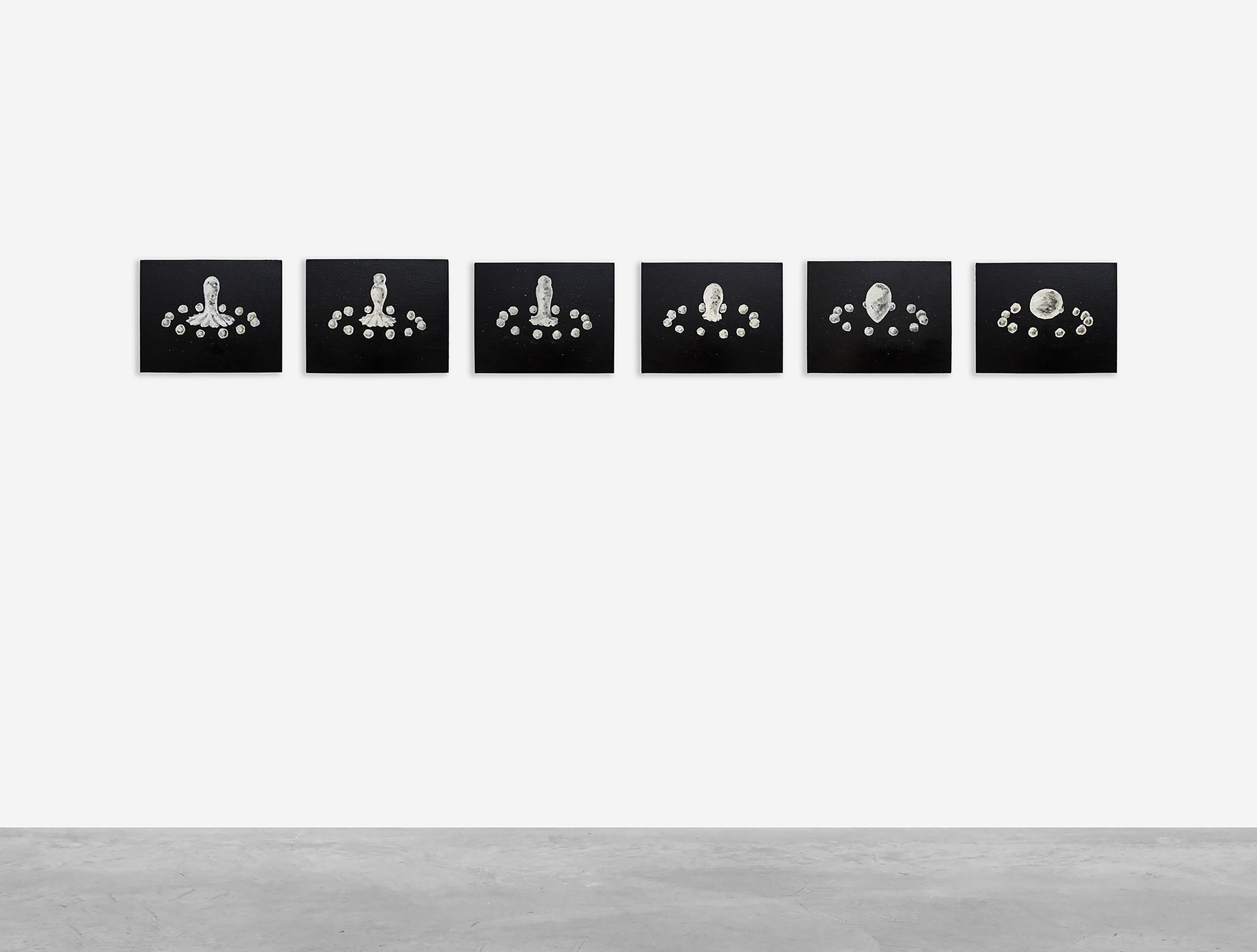
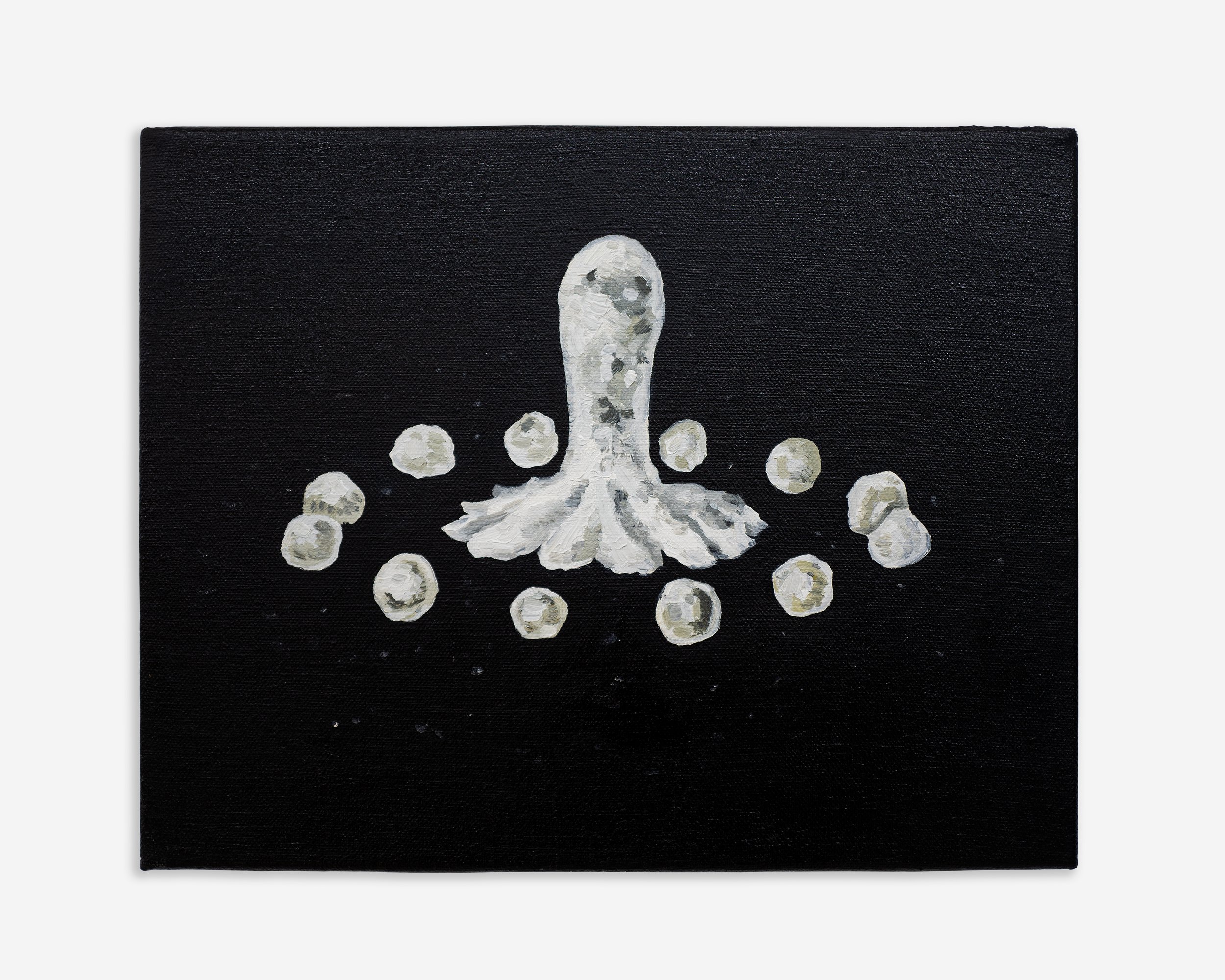
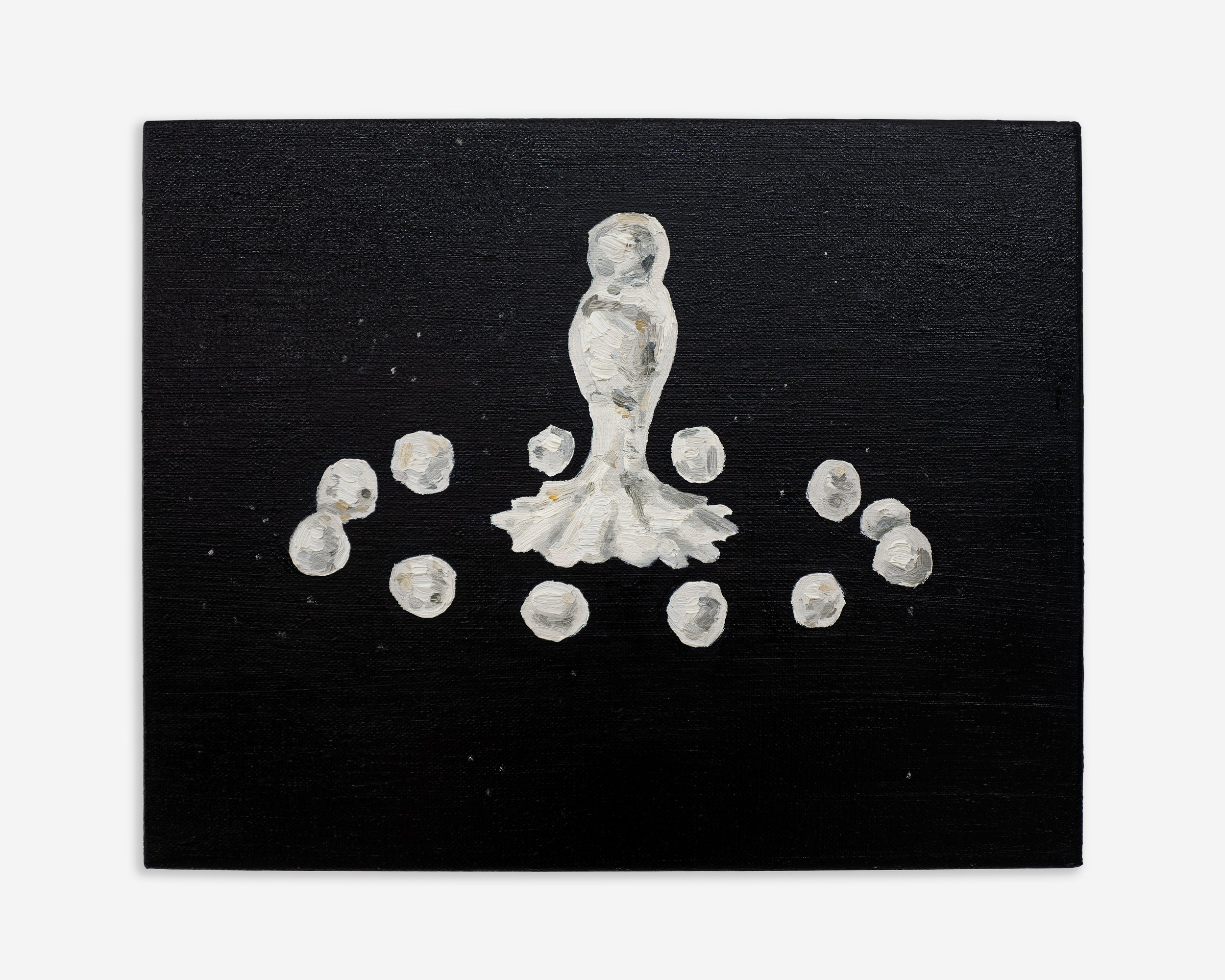
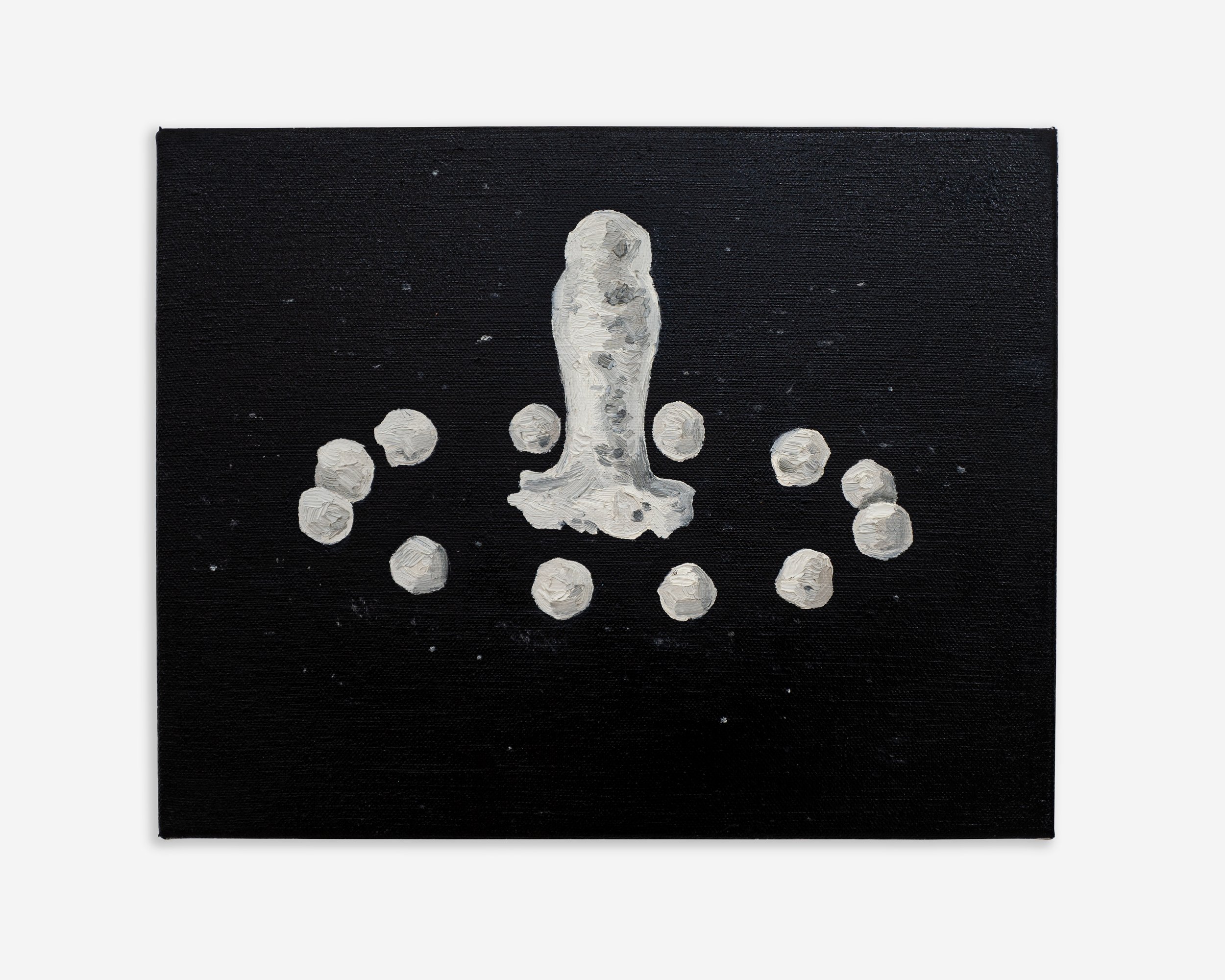
Each panel measures 28 by 36 centimeters, a format that fits comfortably in the palm of two hands. The intimacy of this scale is not incidental. Worthington's original photographs were small, contact prints from plates that measured a few inches across, and the event they captured was itself small: a few milliliters of milk falling a few centimeters. Tan Mu has preserved this domestic scale in her panels, which are large enough to hold detail but small enough to feel like pages from a manuscript or cards from a specimen cabinet. The oil paint on linen carries the texture of the splash in each panel: the initial contact, the crown rising, the columns extending, the central jet forming, the collapse, the calm. The colors are muted and luminous, pale grays and whites and the faintest blue against a dark ground, and the handling varies across the sequence from tight, precise marks that define the crown's rim to broader, more atmospheric passages that dissolve the splash into the surrounding field. The dark ground in each panel serves the same function that the darkened room served in Worthington's experiments: it isolates the event, makes it visible against a background that offers no distraction. Tan Mu has described the splash as "both fleeting and endlessly repeatable," and this paradox is the engine of the work. The event lasts a fraction of a second. The painting lasts months. The event can be reproduced by dropping milk again. The painting can never be reproduced exactly because it was made by a hand that moved in specific ways on specific days under specific conditions of light and attention and fatigue and concentration.
The surface of each panel shows a different stage of the splash, and the variation in paint handling across the six panels enacts the variation in the event itself. In the early panels, where the crown is forming and the columns of milk are extending upward, the marks are more defined, more controlled, more specific in their placement. In the later panels, where the splash is collapsing and the surface is returning to stillness, the marks become looser, softer, more absorbed into the dark ground. This is not a stylistic choice made for visual variety. It is a structural choice that mirrors the physics of the event: the splash begins with clear, defined structures and ends in diffusion and dissolution. The paint handling records the splash's trajectory from form to formlessness, from the crystalline geometry of the crown to the blurred calm of the final panel. The linen weave is visible in places, especially in the transitional zones between the splash and the dark ground, where the paint thins enough to let the surface breathe. In other passages, the paint is built up with small, careful strokes that describe the rim of the crown or the curve of the central jet with a precision that Worthington would have recognized, even though the precision here is the precision of the painter's eye and hand rather than the precision of the electric spark and the silver gelatin plate.
Eadweard Muybridge began his serial photography experiments in 1872, when Leland Stanford hired him to settle a bet about whether all four of a galloping horse's hooves left the ground simultaneously. The resulting sequences, first of the horse and then of dozens of other subjects, from men running to birds flying to women descending staircases, established the principle that motion could be decomposed into discrete instants and that these instants, when arranged sequentially, could reveal structures of movement that were invisible to the unassisted eye. Muybridge's camera batteries, later refined into the zoopraxiscope that projected the sequences back into apparent motion, were the mechanical ancestors of Worthington's spark-lit splash photographs, and both shared the same foundational conviction: that the camera could see what the eye could not, that the technology of the instant could reveal truths about the world that the slower technology of the body had missed.
Muybridge's sequences, published as Animal Locomotion in 1887, presented their subjects in grids of twelve or twenty-four or thirty-six frames, each frame capturing a fraction of a second of the subject's movement. The grid format was not merely a presentation choice. It was an epistemological claim: that motion is composed of instants, that the relationship between instants is what constitutes movement, and that by isolating each instant on its own plate the photographer could reveal the structure of motion that the eye blends into a continuous flow. This claim is the same one that Worthington made when he arranged his splash photographs in sequence and the same one that Tan Mu makes when she arranges her six panels in a row. The sequential format is a statement about time: that time can be divided, that each division contains specific information, and that the divisions can be arranged in order to show what happens between one state and the next. Muybridge's contribution was to demonstrate that the camera could produce these divisions with a precision that no human hand could match. Tan Mu's contribution, in The Splash of a Drop 1, is to accept Muybridge's demonstration and then to ask what happens when the hand, rather than the camera, produces the sequence. The hand cannot match the camera's speed. But the hand can match the camera's attention, and it can sustain that attention over a duration that the camera's instant does not accommodate.
Worthington's study of splashes was a contribution to fluid mechanics, not to art. He was investigating what happened when a liquid drop struck a liquid surface, and he conducted his experiments with the care and precision of a physicist who understood that the phenomena he was observing were governed by forces that could be described mathematically. The splash of a drop, he discovered, proceeds through a series of predictable stages: initial impact, crown formation, column extension, central jet, collapse, and calm. Each stage has a characteristic geometry, and the transition from one stage to the next follows physical laws that Worthington was attempting to isolate and describe. His photographs were instruments for this investigation, tools for freezing instants that the eye could not track and that the hand could not draw with sufficient speed to capture in real time. When Worthington's images failed to record a particular stage with sufficient clarity, he filled in the gaps with hand-drawn illustrations based on his repeated observations of the same event, and these illustrations, which appear throughout A Study of Splashes, are hybrid documents: part photograph, part drawing, part memory, part reconstruction. They are the record of a physicist who trusted the camera but who also trusted his own repeated observation, and who was willing to supplement the machine's failures with the trained eye's accumulated knowledge.
This hybrid status of Worthington's document, part photographic record and part manual reconstruction, is the condition that Tan Mu's painting addresses most directly. The Splash of a Drop 1 does not pretend to be a photograph. It does not attempt to match the camera's ability to freeze an instant. What it does instead is to take the sequential structure that Worthington established and re-record it through the slower, cumulative medium of oil paint, producing a document that is accurate to the sequence of events but that operates on a completely different temporal register from the original photographs. Where Worthington's spark illuminated the splash for a fraction of a millisecond, Tan Mu's brush passed over each panel for hours, building the image through layers of observation and correction and refinement that no instant of photographic exposure can contain. The painting is not competing with the photograph. It is offering a different kind of record, a record that accumulates time rather than freezing it, that preserves the duration of attention rather than the brevity of the instant. Tan Mu has described painting as "a time based process" that "incorporates bodily movement, memory, and emotion," and The Splash of a Drop 1 is a demonstration of this principle: the six panels do not show six instants of a splash but six accumulations of looking, six deposits of sustained attention, six records of the hand re-tracing what the eye has seen and understood.
Harold Edgerton, the MIT electrical engineer who popularized strobe photography in the 1930s and 1940s, made a series of images of milk drops falling onto a surface that became some of the most widely reproduced photographs of the twentieth century. His 1957 image of a milk drop coronet, in which the drop has struck the surface and produced a perfect symmetrical crown of tiny columns topped by spherical droplets, is one of the iconic images of high-speed photography, reproduced in countless textbooks and magazines and exhibitions as a demonstration of what the camera can reveal when it operates at speeds that exceed human perception by orders of magnitude. Edgerton's milk drop images are formally beautiful, their symmetry and precision and clarity producing a visual experience that borders on the sublime, and this beauty has always been part of their reception. They are scientific documents that also function as aesthetic objects, and the tension between these two functions, the documentary and the aesthetic, is the same tension that Tan Mu navigates in The Splash of a Drop 1.
Edgerton developed his stroboscopic technique specifically to capture events that occurred too quickly for conventional photography. His electronic flash could fire for as little as a microsecond, illuminating the subject for a duration so brief that even the fastest motion appeared frozen. This capacity opened up a world of events that had previously been invisible: the splash of a drop, the impact of a bullet on an apple, the arc of a golfer's swing, the vibration of a speaker cone. Edgerton's images entered popular culture not through scientific journals but through mass-circulation magazines like Life and National Geographic, where they were presented as revelations of a hidden world that existed alongside the visible world but operated at speeds that the unaided eye could not access. The milk drop coronet became, in this context, less a document of fluid mechanics than a demonstration that the world contained forms of extraordinary beauty that were accessible only through technology, that the camera could reveal an aesthetic dimension of reality that the eye could not see. This is the tradition that Tan Mu inherits and redirects. Where Edgerton used the strobe to make the invisible visible, Tan Mu uses the brush to make the visible durable, to take what has already been seen and photographed and recorded and to subject it to the kind of sustained attention that only painting can provide. The Splash of a Drop 1 does not reveal anything about the splash that Worthington or Edgerton did not already know. What it reveals is something about the process of attending to the splash, about what happens when a human being looks at a sequence of events and decides to spend months re-recording them in a medium that works at the speed of the hand rather than the speed of the spark.

Li Yizhuo, reviewing the DAWN exhibition in Kaltblut Magazine in October 2022, observed that The Splash of a Drop 1 and TRINITY TESTING, despite their radically different subjects, "bear striking resemblance in their form, palette, and sequence." The observation is precise and it identifies the structural logic that connects the two works. Both use the small panel format, both deploy dark grounds against which the event appears in pale tones, both arrange their panels in a horizontal row that the eye reads as a temporal progression, and both document an event that is too fast for the eye. The resemblance is not coincidental. Tan Mu has described the two works as a pair, exhibited together in Berlin, sharing the same dimensions, and the pairing is an argument about scale. The nuclear explosion documented in TRINITY TESTING and the milk drop documented in The Splash of a Drop 1 are events of incomparable magnitude. One destroyed cities. The other is invisible without a strobe. But they share a structural logic: both are events that exceed human perception, both require technological mediation to be seen, and both can be documented through the sequential panel format that converts the unseeable instant into the seeable sequence. The format is the connective tissue. It is what allows the two works to speak to each other across the enormous gulf that separates their subjects, and it is what allows Li Yizhuo's observation about their formal resemblance to function as a critical insight rather than a superficial comparison. The format is the argument: that the same visual logic can document the thermonuclear and the hydrostatic, that the sequential panel can accommodate both extremes, that the medium of oil on linen can hold both the annihilating fire and the vanishing milk.
Tan Mu has described her childhood exposure to flight model construction and circuit design as formative experiences that introduced her to "the logic of patterns and principles governing the physical world: fluid mechanics, mathematical calculations, blueprints." This biographical detail connects directly to The Splash of a Drop 1, because Worthington's study of splashes is a study in fluid mechanics, and the splash itself is a pattern governed by physical principles that the child who built model airplanes and drew circuit boards would have recognized instinctively. The crown that forms when a drop strikes a surface is not arbitrary. It follows predictable rules of surface tension, viscosity, and gravitational acceleration. The columns that rise from the crown are not random. They are determined by the Rayleigh-Plateau instability, a mathematical relationship that describes how a column of liquid will break up into droplets when perturbed. The central jet that forms as the crown collapses is not chaotic. It follows the same fluid dynamic principles that govern the shape of a water bell and the breakup of a falling stream. These are the patterns that the child building model airplanes and tracing circuit boards was learning to see, and they are the same patterns that the adult painter is re-recording on linen, not as mathematical demonstrations but as visual events that carry the imprint of the physical laws that produced them. The Splash of a Drop 1 is a painting about the logic of patterns, about the way that fluid mechanics produces forms that are simultaneously predictable and beautiful, and about the way that painting can hold those forms in a duration that allows the viewer to study them without the pressure of the instant, without the urgency of the event passing before the eye can resolve it.
The question Tan Mu poses through The Splash of a Drop 1 is not whether painting can compete with photography in the documentation of fast events. It cannot. The electric spark and the electronic flash will always be faster than the hand. The question is whether painting can offer something that photography cannot, and Tan Mu's answer is duration. Photography freezes an instant. Painting accumulates time. The six panels of The Splash of a Drop 1 contain not six instants of a splash but six accumulations of looking, each one the result of hours of observation and correction and refinement, each one a record of what the painter saw when she attended to the image long enough to understand it, not as a fraction of a second of physical action but as a structure that the eye and the mind can hold and turn and examine from different angles and at different speeds. Worthington needed the spark because his eye was too slow. Tan Mu needs the months because her understanding requires them. The painting does not improve on the photograph. It supplements the photograph with a different kind of record, a record that trades instantaneity for duration, that trades the camera's speed for the hand's patience, that trades the fraction of a second for the weeks and months of sustained attention that only a painting can contain. The splash lasts a fraction of a second. The painting lasts as long as it takes to make it, and then it lasts as long as the linen and the paint endure. In that extended duration, the splash becomes available for a kind of attention that the camera's instant cannot provide, and the painting becomes a document not of the event itself but of what it means to look at the event for a long time, to hold it in the mind and the hand and the body, to re-record it through a medium that works at the speed of thought rather than the speed of light.
The final panel in the sequence shows the surface returning to calm. The crown has collapsed, the columns have fallen, the central jet has subsided, and what remains is a surface that is almost still but not quite: the faintest ripple, the last trace of the disturbance, a barely perceptible mark where the drop entered and dissolved. Tan Mu has painted this calm with the same attention she gave to the crown and the columns, and this equality of attention across the sequence is itself an argument. The calm is not an absence. It is a residue. It is what remains after the event has passed, and it is as worthy of sustained looking as the event itself. Worthington's photographs of the final stage of the splash were among the least detailed in his sequence, because by the time the surface returned to calm the visual information had become too subtle for his cameras to capture with the same clarity that the earlier stages had provided. The painting does not have this limitation. The painter's hand can attend to the faintest mark with the same precision it devotes to the most dramatic, and in The Splash of a Drop 1 the final panel receives as much care as the first. The calm after the splash is not a lack of something to see. It is a different thing to see, a thing that requires a different kind of attention, the kind of attention that the camera's instant cannot give because the camera has already moved on to the next event, and that the painting's duration can give because the painting is not moving on. The painting is staying. The painting is still looking. The last ripple on the surface is as significant as the first impact, and the medium that can hold both with equal attention is the medium that reveals what the faster medium leaves behind.