The Incomplete Map: Tan Mu's Chromosomes and the Dot That Connects Microscope to Telescope
On March 31, 2022, the Telomere-to-Telomere Consortium announced the first objectively complete sequencing of the human genome, filling in the approximately eight percent of the genome that the original Human Genome Project had left unmapped when it published its draft in 2001 and its revised version in 2003. The consortium, a group of nearly one hundred scientists working across institutions in the United States and Europe, had spent years developing new sequencing technologies capable of reading the repetitive and structurally complex regions of DNA that had resisted earlier methods, the centromeres, the telomeres, the ribosomal DNA arrays, the segmental duplications, the regions that the original project had called "gaps" and had set aside as technically intractable. The T2T announcement was reported as a milestone, the completion of a map that had been open for thirty years, and it generated the kind of press coverage that major scientific milestones receive: headlines about the "complete human genome," breathless accounts of what the new sequence would mean for medicine, profiles of the scientists involved, and the usual round of commentary about whether this was truly complete or whether, as the consortium itself acknowledged, there were still regions that might contain errors or uncertainties that future methods would need to resolve. Two days after the announcement, Tan Mu began painting Chromosomes. She has described the experience of seeing the news as a moment when a long arc of human curiosity finally converged, and she felt an immediate impulse to respond. The painting she produced does not illustrate the genome. It renders the 46 human chromosomes as a field of blue and white dots on a dark ground, and in doing so it makes an argument about what it means to map something that is simultaneously too small to see and too large to comprehend, a structure that contains three billion base pairs distributed across twenty-three pairs of chromosomes, every one of which is represented in the painting as a cluster of points that could be cells under a microscope or stars in a telescope depending on the scale at which the viewer reads them.
The decision to paint the chromosomes two days after the T2T announcement was not a neutral choice. It was a decision to make a record of a specific moment in the history of knowledge, to register the event in a medium that works at the speed of the hand rather than the speed of the sequencing machine, and to do so while the event was still resonating in the present tense rather than after it had been absorbed into the archive of accomplished science. Tan Mu has described her work as "a form of temporal recording" in which "each painting becomes a knot tied along the timeline of technological and scientific progress," and Chromosomes is one of the most explicit instances of this recording impulse. She remembers seeing simplified representations of genetic sequences in textbooks and news reports as a child in the 1990s, during the early years of the Human Genome Project, and she remembers those images as "rough and speculative, limited by the technology available." The distance between those early, incomplete visualizations and the T2T consortium's complete sequence is the distance that Chromosomes traverses, not by reproducing the scientific imagery of either moment but by placing both moments within the same frame, the childhood memory of the rough and the adult awareness of the complete, held together in a painting that is itself neither rough nor complete but somewhere in between, in the territory of the hand-made, where certainty and uncertainty coexist as properties of the medium rather than properties of the information.
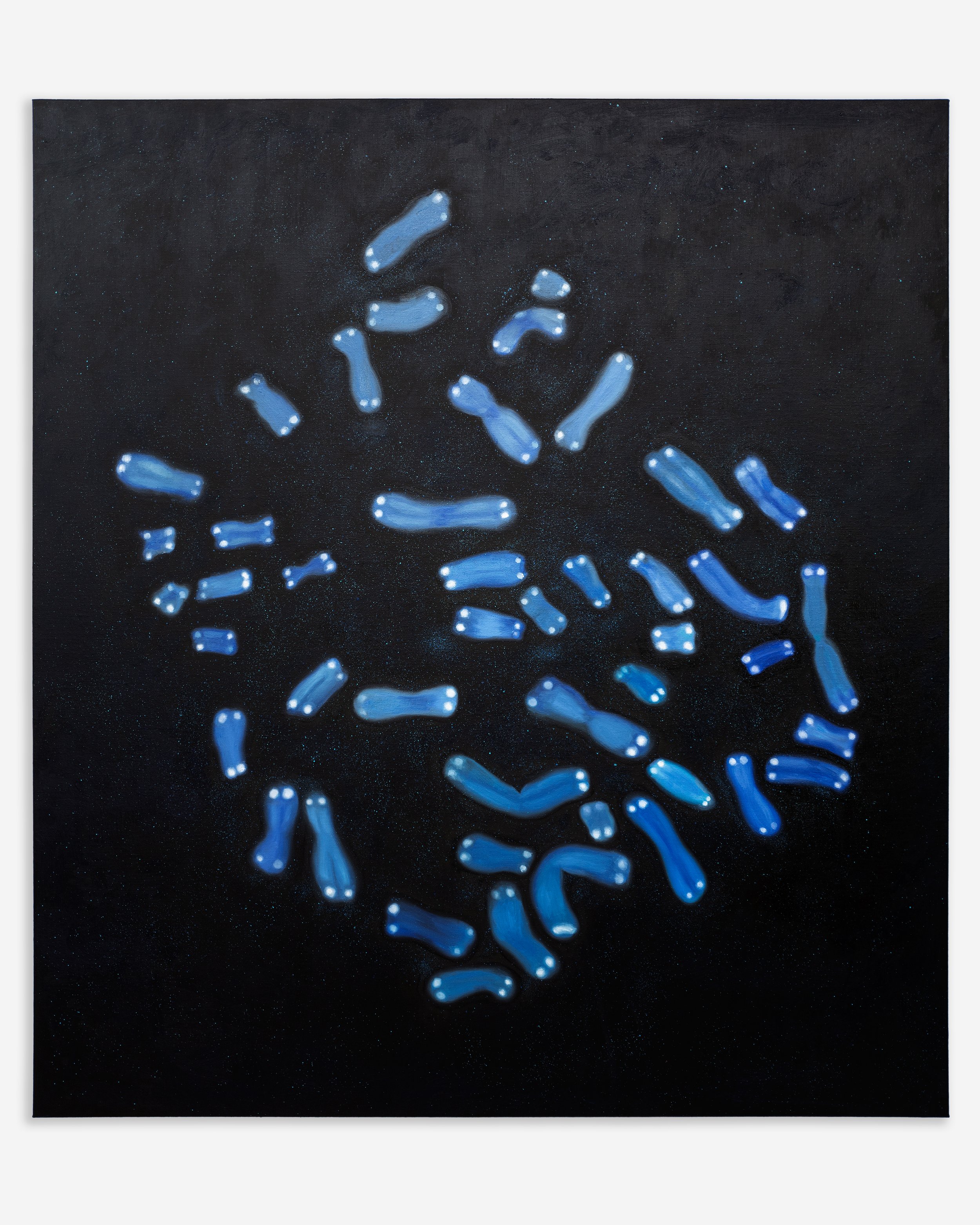
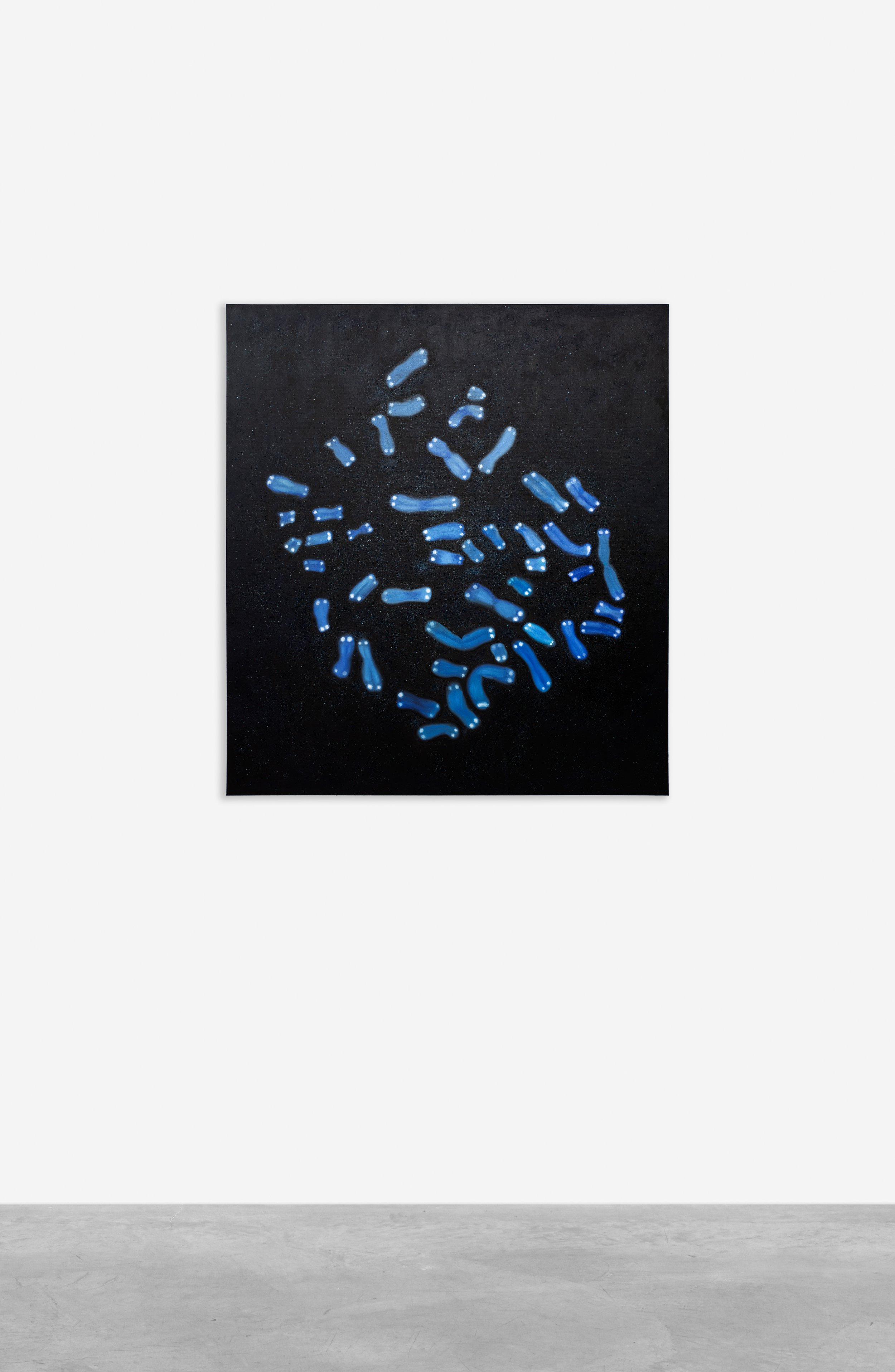
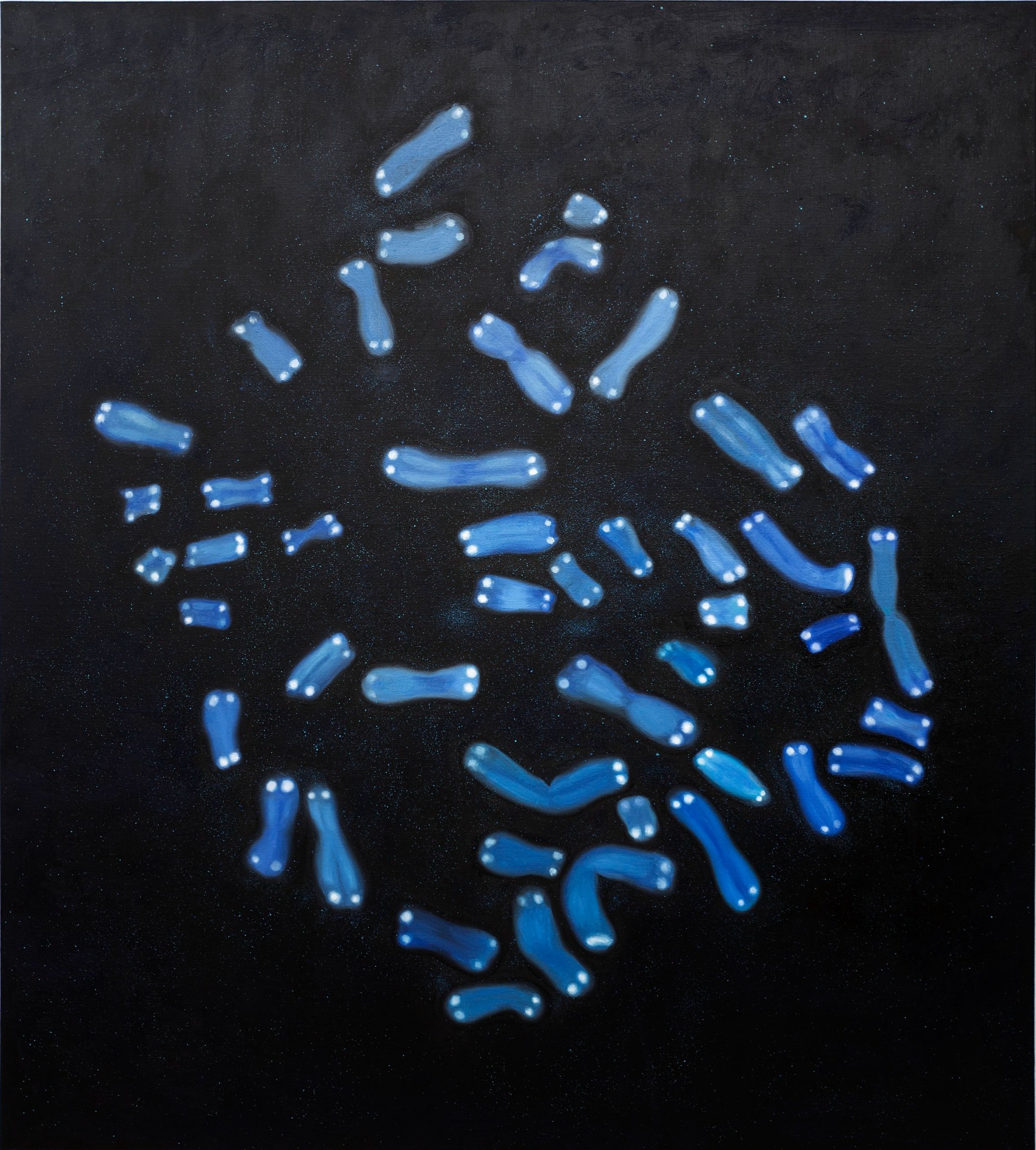
Chromosomes measures 102 by 91 centimeters on linen, a roughly square format that gives the twenty-three pairs of chromosomes room to spread across the field without crowding. The format is large enough to hold detail at the level of the individual dot but intimate enough to feel like a page from a scientific manual or a field from a star chart, and this ambiguity of scale is central to the painting's argument. The chromosomes are arranged in the standard karyotype order, from the largest to the smallest, each one rendered as a cluster of pale blue and white dots against a dark ground that varies from deep navy to near-black. The telomeres, the protective caps at the ends of each chromosome that were the specific achievement of the T2T sequencing, are indicated by slightly brighter, slightly more defined points at the tips of each chromosome cluster, as if the painting is drawing attention to the very regions that the earlier sequencing projects had left unread. The ground behind the chromosomes is not a uniform darkness. It is composed of thousands of small blue dots, layered and varied in value, that create a field of varying density, some areas denser and more opaque, others thinner and more transparent, allowing the linen to breathe through in places. This is not empty space. It is populated space, space that contains information at a level below the threshold of the individual chromosome, and the viewer who looks closely enough will see that every region of the painting is worked, that there is no passage where the surface is simply dark or simply empty, that even the spaces between the chromosomes are filled with the same dot language that constitutes the chromosomes themselves.
The paint handling varies across the surface in a way that enacts the painting's argument about uncertainty. In the central regions of the larger chromosome pairs, the dots are more defined, more regular, more controlled, establishing a baseline of legibility that allows the viewer to identify each pair and to read the karyotype order. In the smaller chromosome pairs and at the telomeres, the dots become looser, less regular, less precisely placed, as if the painting itself is registering the difficulty of resolving these regions, the same difficulty that the original Human Genome Project encountered when it reached the telomeres and centromeres and found that its sequencing technology could not read them. The telomeres in the painting are not blank or absent. They are present, but they are present as areas of increased visual ambiguity, places where the dot language shifts from the controlled to the suggestive, where the individual marks become harder to distinguish from one another, where the field itself takes over from the pattern. Tan Mu has described this quality of painting as a defining feature rather than a flaw: "A hand painted image can never be a one hundred percent reproduction of its source. This gap between the original image and the painted result is not a flaw, but a defining quality." The telomeres in Chromosomes are the region where this gap is most visible, where the painting acknowledges its own uncertainty by allowing the dots to merge and blur, and this visual uncertainty is the precise pictorial equivalent of the scientific uncertainty that the T2T consortium was formed to resolve.
Santiago Ramón y Cajal began drawing neurons in 1887, when he was thirty-five years old and had recently been appointed to the chair of anatomy at the University of Valencia. The neuron doctrine, the theory that the nervous system is composed of discrete individual cells rather than a continuous reticular network, was not yet established, and Cajal's drawings would become the single most important body of visual evidence in its favor. Using the Golgi stain, a silver-based preparation that randomly colors a small percentage of neurons while leaving the rest transparent, Cajal produced hundreds of drawings of neural tissue that remain, more than a century later, among the most reproduced and most instantly recognizable images in the history of neuroscience. His drawing of a Purkinje cell from the human cerebellum, with its massive dendritic tree spreading outward like a fan, its axon descending like a root, is an image that anyone who has taken a basic neuroscience course has encountered, and it is an image that was made by hand, drawn from observation through a microscope, using a technique that selected a small number of cells for visibility while leaving the vast majority of the tissue invisible.
Cajal's drawings are not photographs. They are interpretations, and Cajal himself was explicit about this. He wrote that the observer must supplement what the microscope reveals with what the mind reconstructs, that the static image seen through the lens must be animated by the understanding of the living tissue, and that the drawing is not a record of what the eye saw at a single moment but a synthesis of what the mind understood after repeated observation. The neurons in his drawings are clearer, more legible, more structurally articulate than the neurons that appear in the microscope, because the microscope shows the tissue as it is, dense and tangled and overlapping, while the drawing shows the tissue as it is understood, with the relevant structures isolated and highlighted and the irrelevant ones suppressed. This is not deception. It is the same process that the T2T consortium used when it assembled the complete genome from overlapping sequence reads, filling in gaps and resolving ambiguities through computational methods that supplemented the raw data with inference and modeling. Cajal's drawings and the T2T sequence are both acts of interpretation that supplement direct observation with reconstructive understanding, and both produce images that are more legible than the raw data they are derived from. Tan Mu's Chromosomes enters this tradition with the awareness that the hand-painted image is also an interpretation, also a reconstruction, also a supplement to the raw data that adds the painter's understanding to what the microscope or the sequencer has shown.
The connection between Cajal and Tan Mu is not merely analogical. Both work at the boundary between direct observation and interpretive reconstruction, and both use the hand as the instrument that mediates between the two. Cajal drew neurons because photography could not isolate the relevant structures from the dense tangle of the tissue. Tan Mu paints chromosomes because digital reproduction cannot register the uncertainty that is inherent in the scientific project of mapping the genome. The genome is not a fixed object. It is a dynamic structure that varies from cell to cell and from individual to individual, and the T2T sequence, for all its completeness, is a composite assembled from multiple individuals and multiple cell lines, an idealized version of the genome that no single human cell actually contains. Painting, with its inherent variability and its tolerance for ambiguity, is a medium that can register this variability in a way that the digital sequence cannot, because the digital sequence is binary and the painting is analog, because the digital sequence is exact and the painting is approximate, because the digital sequence eliminates uncertainty and the painting preserves it. The dots that make up the chromosomes in Tan Mu's painting are not data points. They are marks made by a hand that trembles slightly, that varies in pressure and direction, that cannot produce the same dot twice in exactly the same way, and this variability is not an imperfection. It is a record of the conditions under which the painting was made, just as the variability in the genome is a record of the conditions under which life is made.
The Human Genome Project began in October 1990, when Tan Mu was not yet born, and by the time she was a child in Yantai in the mid-1990s, the project was producing the simplified representations of genetic sequences that she remembers seeing in textbooks and news reports. These early images were schematic diagrams, chromosome maps rendered as striped bands of color, karyotypes arranged in the standard order from largest to smallest, with each chromosome represented as a simplified outline rather than as the dense, banded structure that high-resolution imaging would later reveal. The genome that these images depicted was incomplete. It was the "rough draft" that the International Human Genome Sequencing Consortium published in February 2001, covering approximately ninety percent of the gene-containing regions and leaving the centromeres and telomeres as dark spaces on the map, regions of known importance that the available technology could not yet read. The visual language of these early representations, the banded chromosome diagrams, the schematic karyotypes, the simplified gene maps, was a visual language of incompleteness, of knowledge that was real but partial, of maps that showed the coastlines and left the interiors blank.
Tan Mu has described these early images as "rough and speculative, limited by the technology available," and this description is precise. The genome maps of the 1990s were not wrong. They were approximate, and the approximation was a function of the technology that produced them, just as the approximation in Tan Mu's painting is a function of the medium that produces it. The T2T consortium's complete sequence, announced on March 31, 2022, resolved many of the gaps and ambiguities that the earlier maps had left open, but it did not eliminate uncertainty from the genome itself. The genome varies between individuals. It varies between cells within the same individual. It contains regions of repetitive sequence that are difficult to assemble and annotate. The T2T sequence is a reference, a composite, an idealization, and the announcement that the genome was "complete" was itself a simplification, a useful shorthand for a milestone that was real but that concealed the ongoing nature of the work. The scientists involved knew this. The press coverage largely did not. Tan Mu's Chromosomes, painted two days after the announcement, occupies the space between the headline and the knowledge, between the claim of completeness and the reality of uncertainty, and it does so by making the uncertainty visible in the material of the paint itself, in the variability of the dots, in the ambiguity of the telomeres, in the populated darkness of the ground that refuses to be empty.
Danni Shen, in her profile "In the Studio with Tan Mu" published in Emergent Magazine in February 2024, described the artist's practice as one of "witnessing," in which "following the trajectory of social history in painting essentially involves attempting to create a visual narrative that connects the perspectives of time." This formulation applies directly to Chromosomes, where the trajectory being followed is the trajectory of genetic knowledge, from the speculative diagrams of the 1990s to the complete sequence of 2022, and the visual narrative connects the perspective of the child who saw the rough images with the perspective of the adult who saw the announcement of completion. Shen also noted Tan Mu's preference for "using painting to devote tens to hundreds of hours to capturing an image" rather than the "instantaneous digital recording that occurs in fractions of a second," and this temporal contrast is the structural axis of Chromosomes: the genome was sequenced by machines that process billions of base pairs per day, and the painting was made by a hand that placed each dot individually over the course of days or weeks. The speed of the sequencer and the speed of the hand are not in competition. They are complementary modes of recording, one fast and comprehensive, the other slow and selective, and the painting makes this complementarity visible by presenting the genome not as a data file but as a field of marks, each one the trace of a decision, a moment of attention, a deliberate act of recording that could have been made differently.
The dot that connects Chromosomes to the rest of Tan Mu's practice is not a metaphor. It is a visual unit, a mark on the surface of the linen, and it functions simultaneously as a cell seen through a microscope, a star seen through a telescope, a pixel seen on a screen, and a data point seen on a graph. Tan Mu has described this multiplicity explicitly: "Whether representing cells, stars, pixels, or data, they reflect my ongoing fascination with how information generates meaning across scales." The dots in Chromosomes operate at every one of these scales simultaneously. At the microscopic scale, they are the chromosomes themselves, the structures within the cell that carry genetic information. At the cosmic scale, the dark ground populated with blue points is indistinguishable from the night sky as Tan Mu has painted it in her astronomical works, and the viewer who steps back from the painting far enough to lose the karyotype order will see a star field, a constellation of points that could be galaxies or could be genes depending on the distance of the viewer and the assumptions they bring to the image. This is not an optical illusion or a visual trick. It is a structural claim about the recurrence of pattern across scale, about the way that the dot, as a visual unit, can carry information about phenomena that are separated by orders of magnitude in size and in time, and it connects Chromosomes to the Gaze series, the Mars paintings, and the Signal series, all of which use the same dot language to bridge the microscopic and the cosmic.

What Chromosomes finally preserves is not the genome. The genome has been preserved, completely and redundantly, in databases that are backed up across servers on multiple continents, accessible to any researcher with an internet connection and the patience to navigate the annotation. What the painting preserves is the experience of receiving the news that the genome had been mapped, the specific moment in April 2022 when a person who had grown up with the incomplete maps of the 1990s saw the headline that the complete sequence had been achieved, and who then went to the studio and began placing dots on linen in a pattern that corresponds to the karyotype but that also corresponds to the night sky, and to the field of data points on a graph, and to the pattern of neurons seen through a microscope, and to all the other phenomena that resolve into dots when the viewer steps back far enough. The painting is a record of the convergence of these perceptions, a record of the moment when a scientific milestone became an aesthetic event, when the announcement of a completed genome became the impetus for a painting that refuses the finality of completion and insists on the uncertainty that is the condition of every hand-made thing. The genome is complete. The painting is not. The genome has been read in its entirety, every base pair accounted for, every gap filled, every telomere sequenced. The painting remains uncertain, variable, open to interpretation, marked by the hand that made it, and it is in this uncertainty that it finds its authority as a document, not of what the genome is, but of what it felt like to learn that the genome had been mapped, and to carry that knowledge into a studio and to render it in a medium that preserves doubt alongside certainty, approximation alongside precision, the hand alongside the machine. The dots in Chromosomes are not data. They are marks. They are the record of a hand that decided, over and over again, where to place the next point in a field that has no grid and no coordinate system, only the accumulated evidence of the marks that came before, and the knowledge, always present in the act of painting, that no mark is final and no map is complete and no representation, however comprehensive, can exhaust the thing it represents.