What Fifteen Million Years Looks Like in the Palm of a Hand: Tan Mu's Moldavite and the Stone That Fell to Earth
Approximately fourteen point eight million years ago, a meteorite traveling at tens of kilometers per second struck the surface of what is now southern Germany, creating the Nördlinger Ries crater, a depression roughly twenty-four kilometers in diameter that remains visible on the landscape today. The impact was violent enough to melt the local sandstone and sedimentary rock, and the molten material that was ejected from the crater arced through the atmosphere and rained down across a strewn field that extended from southern Germany through the Czech Republic and into Moravia, cooling as it fell and forming into the translucent green glass objects that would later be called moldavites. The stone that Tan Mu holds in her hand in 2020, the stone she would paint as Moldavite, was one of these objects: a tektite, a natural glass formed by the fusion of terrestrial rock and extraterrestrial energy, small enough to fit in the palm, old enough to precede every human civilization by orders of magnitude. She acquired it for her personal collection, and she has described it as the first Czech meteorite she owned, which gives it a specific weight in the arc of her practice: not just a specimen of an interesting mineral but an object that marked the beginning of her engagement with cosmic time, the first stone in a series of investigations that would later extend to silicon wafers, quantum cryostats, and black holes. The painting she made from it measures 36 by 28 centimeters, small enough to hold in two hands, and this intimacy of scale is not incidental. The moldavite itself is a palm-sized object. The painting is a palm-sized representation of a palm-sized object. The fifteen million years are contained in the stone, and the stone is contained in the frame, and the frame is contained in the hands of the viewer, and this nesting of scales, from the cosmic to the personal to the painted, is the argument that the painting makes.
Tan Mu has said that holding the moldavite made her reflect on how it had endured through vast geological and cosmic processes, "placing human history, technological progress, and social conflict into a much smaller perspective." This is not a casual observation. It is a precise description of what happens to the sense of temporal scale when a human being holds an object that predates the emergence of Homo sapiens by more than fourteen million years. The human time scale, the scale of wars and empires and technologies, shrinks to insignificance against the time scale of the stone, which has been falling, cooling, weathering, and waiting since before the ancestors of modern humans had evolved. The contrast is not merely quantitative. It is qualitative, a shift in the kind of time that the holder inhabits, from the time of projects and plans and deadlines to the time of geological processes and cosmic collisions, and Moldavite is the painting that registers this shift. It does not represent the meteorite impact. It does not depict the Ries crater. It does not show the strewn field or the trajectory of the molten glass through the atmosphere. It shows the stone as it appears to a person holding it in 2020, a small green object with fingerprint-like surface textures, set against a dark background that could be the night sky or could be the interior of a cabinet or could be nothing at all, just darkness, the void from which the stone originally came.
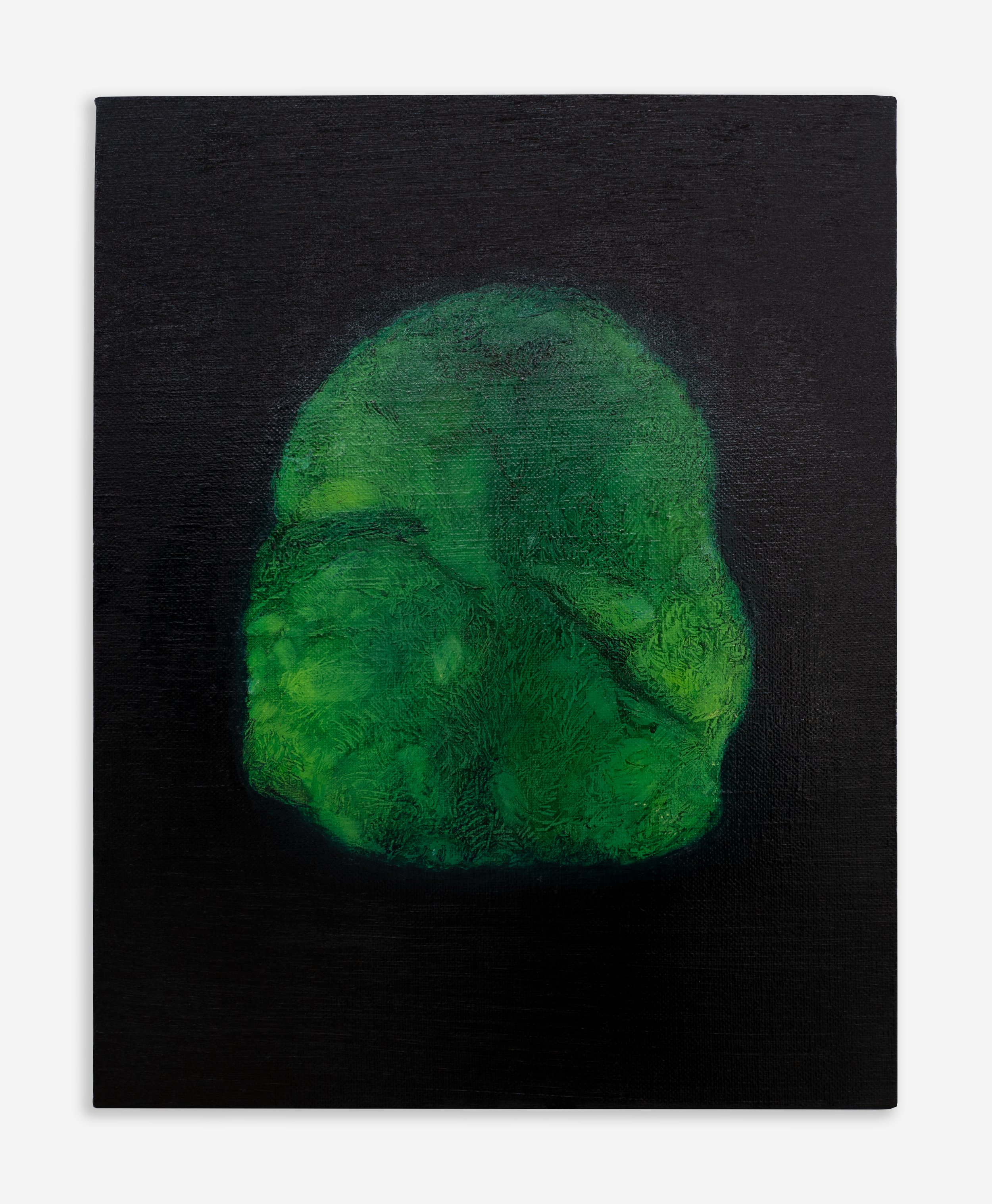
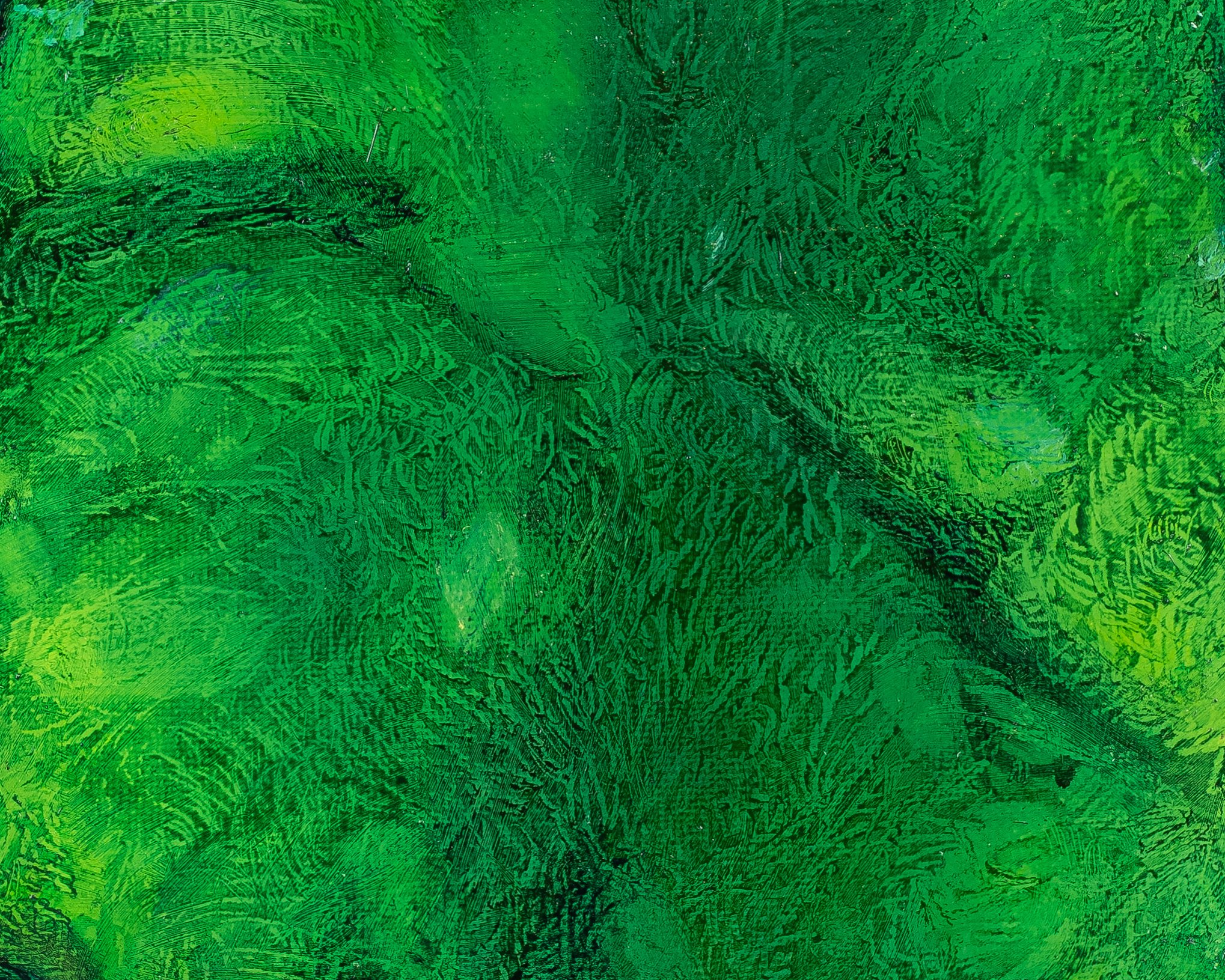
The painting measures 36 by 28 centimeters, vertical in orientation, and it presents the moldavite at the center of a field of near-total darkness. The format is close-up, almost confrontational: the stone fills most of the vertical dimension, its edges approaching but not touching the borders of the canvas, so that the object hovers in the dark space without being constrained by it. The dark ground is not a flat black. It is a deep, composite darkness built from layers of paint that shift between midnight blue, charcoal, and the faintest suggestion of green, the same green that appears in the moldavite itself but at a concentration so low that it reads as atmosphere rather than object, as if the stone is emitting light into the space around it, as if the green of the tektite is bleeding into the void that contains it. This is one of the earliest paintings in which Tan Mu uses the dark-ground strategy that would become central to her practice, and she has described it as such: "This painting was one of my earliest experiments with using a dark background and a close-up perspective." The dark field, she explains, "intensifies the form and texture of the meteorite, creating a sense of depth and mystery." The close-up composition "allows the viewer to focus on the fine surface details, which are permanent traces left by the impact that formed it."
The surface of the moldavite in the painting is rendered with an attention to texture that makes the stone feel almost tactile. Moldavite in reality has a distinctive surface texture called sculpture, a pattern of ridges, grooves, and pits that forms as the molten glass spins through the atmosphere and cools unevenly, creating what Tan Mu accurately describes as "fingerprint-like textures" that are unique to each individual specimen. The painting captures this texture through a combination of fine brushwork and careful modulation of tone, with the ridges and grooves of the tektite rendered in lighter and darker shades of green that follow the actual sculpture patterns of moldavite specimens. The green itself is distinctive: not the green of emeralds or leaves or grass, but the particular translucent bottle-green of tektite glass, a green that has a depth and a slight turbidity that distinguishes it from mineral greens, a green that looks as though light is passing through it rather than reflecting from its surface. Tan Mu achieves this quality through thin glazes of green over a darker ground, allowing the luminosity of the stone to build up through successive layers of transparent or semi-transparent paint, so that the final surface has the same quality of internal glow that actual moldavite displays when held up to a light source. The edges of the stone are slightly irregular, following the natural contours of a tektite that was not cut or polished but left in its raw state, with the sculpted surface texture visible from every angle. The paint handling in these edge passages is precise but not mechanical, preserving the organic quality of the stone's outline while maintaining the clarity that allows the viewer to identify the object as a specific mineral specimen rather than a generic green shape.
Georgia O'Keeffe began painting animal bones against the sky in 1931, during the first of her summers at Ghost Ranch in northern New Mexico, and she continued to paint them, in various configurations, for more than a decade. Horse's Skull with Pink Rose, painted in 1931, places a bleached equine skull at the center of the canvas with a single pink rose laid across its crown, against a background that is not a landscape but a void, an unmodulated expanse that could be sky or could be nothing, an absence that makes the skull and the rose float in space without any ground beneath them. Pelvis with the Distance, painted in 1943, takes this strategy further: a section of animal pelvis bone, sun-bleached to near-whiteness, is silhouetted against a low horizon of blue hills, the sky above it filled with a luminous atmospheric haze that turns the bone into a frame through which the landscape is visible, a natural window that the desert has provided. O'Keeffe was explicit about what she was doing with these bones. She was not painting death. She was painting the beauty of the desert, and the bones were the desert's most distinctive objects, the things that the arid landscape left on its surface after it had stripped everything else away. The bones, she wrote, were "strangely alive," and the paintings she made from them were not memento mori but celebrations of the forms that the desert produced, forms that were as beautiful to her as the flowers and the skies.
O'Keeffe's bones and Tan Mu's moldavite share a structural logic that illuminates both practices. Both are found objects, natural specimens collected by the artist and brought into the studio for close examination. Both are painted against dark or neutral backgrounds that remove them from any specific landscape or context and present them as autonomous forms. Both are rendered at a scale that is slightly larger than life, intimate enough to hold but large enough to examine, and both use the close-up perspective to focus the viewer's attention on the surface details that the casual glance would miss. The difference between them is temporal. O'Keeffe's bones are recent. A horse skull in the New Mexico desert might be decades old or at most a few centuries, and the desert that produced it is itself a relatively young landscape in geological terms. Tan Mu's moldavite is fifteen million years old, and it was formed by an extraterrestrial impact, a collision between the earth and an object from space that remade the local geology in a single instant. The scale of time that O'Keeffe's bones inhabit is the scale of the American Southwest, a landscape that changes on the order of centuries and millennia. The scale of time that Tan Mu's moldavite inhabits is the scale of the planet and the cosmos, a landscape that changes on the order of millions of years and that includes collisions between celestial bodies as routine events. O'Keeffe's bones tell the story of a particular desert at a particular time. Tan Mu's moldavite tells the story of a particular planet at a particular moment in its four-and-a-half-billion-year history, the moment when a rock from space struck what would become southern Germany and created a new kind of stone that had not existed before the impact and that has existed, unchanged, for the fifteen million years since.
The Nördlinger Ries crater, where the impact occurred, is one of the best-preserved impact structures in Europe, and its geology has been studied extensively since the early twentieth century, when geologists first recognized that its circular shape and unusual rock formations were the result of a meteorite strike rather than a volcanic eruption. The Ries crater is approximately twenty-four kilometers in diameter, and the impact that created it released energy equivalent to hundreds of thousands of megatons of TNT, excavating a cavity several kilometers deep and ejecting material across a strewn field that extends more than four hundred kilometers from the impact site. The moldavites that fell within this strewn field are composed of a silica-rich glass with a chemical composition that matches the sedimentary rocks of the Ries crater region, confirming that they were formed from local material that was melted by the heat of the impact and ejected into the atmosphere, where they cooled and solidified as they fell. The sculpture patterns on the surface of each moldavite specimen, the ridges, grooves, and pits that Tan Mu describes as "fingerprint-like," are the result of this rapid cooling process, which caused the molten glass to spin and flow as it traveled through the air, creating a unique surface texture on each individual piece that corresponds to its specific trajectory and cooling rate.
The scientific understanding of moldavites has evolved significantly since they were first described in the scientific literature in the late eighteenth century. Originally classified as a type of obsidian or volcanic glass, they were reclassified as tektites in the early twentieth century when their chemical composition was found to be inconsistent with a volcanic origin. The term tektite, derived from the Greek tektos meaning molten, designates a class of natural glass objects that are formed by the melting and ejection of terrestrial rock during meteorite impacts, and moldavites are among the most studied and most prized tektite varieties because of their distinctive green color, their high clarity, and the variety of their sculpted surface forms. The Czech Republic, where the majority of moldavite specimens have been found, has a long history of collecting and working the stone, and moldavites have been used in jewelry and decorative objects for centuries, valued for their color and for the belief, present in various folk traditions, that they carry protective or spiritual properties. Tan Mu is aware of these associations and has explicitly distinguished her interest from them: "Moldavite is often discussed in religious or mythological contexts and is sometimes associated with mystical symbolism. My interest, however, lies in its scientific and historical significance. It is the result of a cosmic event and also a silent witness to Earth's long history." This distinction is important because it positions the painting not as an illustration of folklore but as a document of natural history, a record of an object that carries fifteen million years of geological and cosmic information in its molecular structure.

Anselm Kiefer has spent decades making work about the relationship between deep time and human memory, and his approach to materials provides a counterpoint to Tan Mu's that illuminates both practices. Kiefer's lead books, lead airplanes, and lead floors, works like The Orders of the Night from 1996 and the later lead-based installations at the Barjac studio, use lead as a material that carries temporal weight: lead is the endpoint of radioactive decay, the stable element that remains after uranium and thorium have completed their long transformation chains, and Kiefer has described it as a material that is "in process," that bears the memory of its own formation in the cooling of the earth's crust billions of years ago. His use of lead, straw, ash, and dried flowers in large-scale paintings and installations creates surfaces that appear to be in various states of decay and transformation, surfaces that refuse the stability that conventional painting promises and instead embody the passage of time as a visible, material process. Kiefer's surfaces crack, his straw discolors, his lead oxidizes, and these changes are not defects but essential features of the work, evidence that the painting is not a fixed object but a process that continues after the artist has finished applying paint to canvas.
Tan Mu's Moldavite occupies a different position in the relationship between painting and deep time, and the difference is instructive. Where Kiefer uses materials that themselves decay and transform, materials that make the passage of time visible on the surface of the work, Tan Mu paints an object that is defined by its refusal to transform, a tektite that has remained chemically and physically stable for fifteen million years and that will, if not subjected to mechanical damage, remain stable for millions more. The moldavite is not in process. It is finished. It was finished the moment it cooled, fourteen point eight million years ago, and it has not changed since. The painting, by contrast, is in the process that all paintings are in: the slow process of oxidation, cracking, and discoloration that will eventually alter its appearance, the same process that Kiefer accelerates and makes visible on his surfaces but that Tan Mu's painting will undergo at its own pace, invisibly, over centuries. The painting is temporary. The stone is permanent. The painting depicts the stone. The stone will outlast the painting. This is the temporal paradox that Moldavite embodies: a temporary medium depicting a permanent object, a human-scale artifact depicting a cosmic-scale artifact, a surface that will change depicting a surface that will not. Tan Mu has described painting as "a way to resist temporality," as a means of "slowing down or even resisting the passage of time, anchoring moments, objects, or ideas within the physical presence of the canvas." Moldavite makes this claim visible by juxtaposing two time scales within a single frame: the time scale of the stone, which is geological and cosmic, and the time scale of the painting, which is human and artistic, and it allows the viewer to hold both scales simultaneously, to feel the fifteen million years that the moldavite carries and the months that the painting took to make, compressed into a single visual experience that lasts as long as the viewer chooses to look.
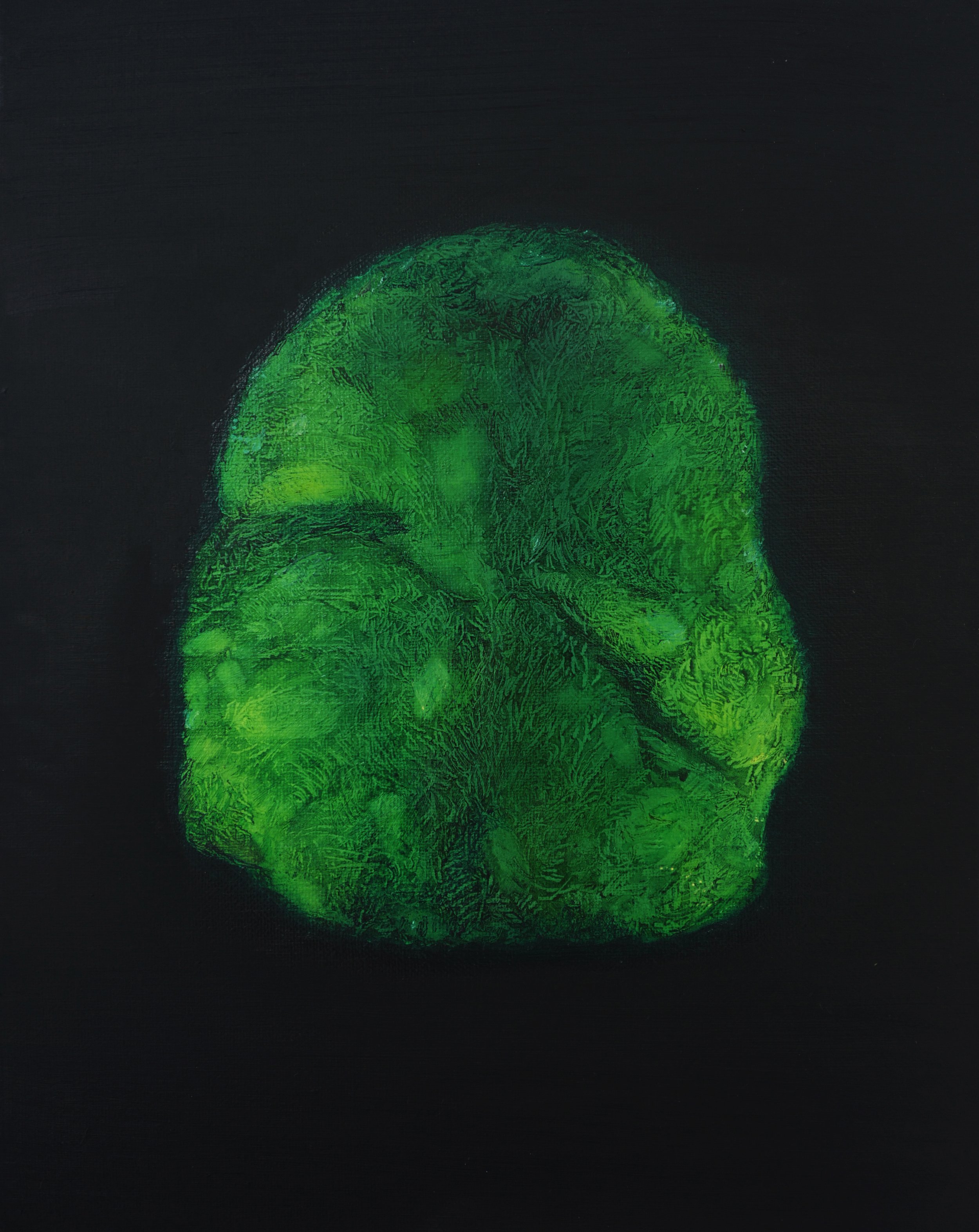
Moldavite was, as Tan Mu has described, "one of my early explorations of time and cosmic themes, and it connects directly to later works such as Silicon and Powehi." This self-identification of the painting as a beginning, as the first in a series of investigations that would extend the time scale from the millions of years of the tektite to the billions of years of the silicon wafer and the billions of light years of the black hole, gives Moldavite a specific position in the arc of her practice. It is the painting that established the terms: the dark ground, the close-up perspective, the found object treated as a specimen, the intimate scale that holds the cosmic, the painting as a record of an encounter between a human being and an object that carries a time scale that exceeds human comprehension. The terms that Moldavite established in 2020 are the terms that Silicon, Powehi, and the Mars paintings would later develop and extend, each one pushing the time scale further from the human and closer to the cosmic, each one using the same strategy of the dark ground and the close-up to make the invisible visible and the immense intimate. But Moldavite has an advantage that the later works do not, or at least an advantage that they do not share in the same way: the moldavite is an object that can be held. It is not an abstraction or a representation of something that exists only in data. It is a stone, a piece of glass, a physical thing that Tan Mu held in her hand before she painted it, and this physicality, this directness of encounter between the body and the object, gives the painting a concreteness that the later, more cosmic works sometimes approach but never quite match, because the later works depict things that cannot be held, black holes and silicon wafers and Martian landscapes, things that exist at scales that the body cannot directly experience. The moldavite is the ground on which the cosmic edifice is built. It is the proof that the immense can be held, that fifteen million years can fit in the palm, that a collision between a rock from space and the surface of the earth can produce an object that a person can carry in a pocket, and that this object, once painted, becomes a record not only of the stone itself but of the specific person who held it and the specific moment in 2020 when she held it and decided that it was worth spending months of her own time, human time, artistic time, to make a record of its encounter with her gaze.
The painting ends where the stone ends, at the edges of the tektite, where the green glass gives way to the dark ground and the viewer's eye makes the transition from the object to the void that contains it. This transition is the painting's most delicate passage, because it is here that the physical reality of the moldavite meets the metaphysical suggestion of the dark space, and here that the viewer must decide whether the darkness is the night sky or the interior of a cabinet or the inside of a hand closing around the stone or simply the absence of any context at all, the pure void that the stone floats in like a planet in space, like a planet that is also a specimen, like a specimen that is also a time capsule, like a time capsule that is also a painting. Tan Mu has described the meteorite as something that "functions like a time capsule, preserving traces of ancient cosmic events within a small physical object," and this description applies to the painting as well, which preserves the traces of a specific encounter between an artist and a stone in a specific year, and which will itself become, as the years pass, a record of that encounter that future viewers can reactivate by looking. The moldavite is not going anywhere. It will be the same stone in a hundred years, and in a thousand, and in a million, and in fourteen point eight million more. The painting will change. But for as long as the painting lasts, it will hold the moment when a person held fifteen million years in her hand and decided that the appropriate response was to spend months painting it, slowing down time to match the speed of the brush, resisting the passage that the stone had already survived.