The Vial That Contained the Year: Tan Mu's Vaccine and the Object That Meant Everything
In the second week of December 2020, photographs of a small glass vial began appearing in newspapers, television broadcasts, and social media feeds around the world. The vial was roughly six centimeters tall, with a narrow neck and a slight flare at the base, and it contained a clear liquid that, to the naked eye, was indistinguishable from water. The photographs were not artful. They were taken in laboratories and distribution centers, under fluorescent lighting, by photojournalists and public relations officers who needed an image to accompany the story that the Pfizer-BioNTech COVID-19 vaccine had received emergency use authorization from the United States Food and Drug Administration. Within days, the vial had become the most recognized pharmaceutical object in recent memory, a visual shorthand for a year of isolation, fear, and anticipation, and for the hope that a small glass container could deliver an end to the pandemic that had shut down the world. Tan Mu, who had moved her painting practice from her studio in New York back to her home during the lockdown, was among the millions of people who saw these photographs, and she recognized in the vial the same quality that she had identified in the genetic sequences and the cosmic objects that populated her earlier work: a small physical container holding an immense conceptual and emotional weight. The painting she made from it, Vaccine, 2021, measures 36 by 28 centimeters on linen, and at this scale it is intimate enough to hold, close enough to see, and specific enough to identify as the object that meant more to more people in 2021 than any other object on earth.
Tan Mu has described the contradictions that drew her to the subject: "On one hand, there was isolation, uncertainty, and social rupture. On the other, there was an unprecedented mobilization of scientific knowledge and global collaboration." The vial, she recognized, contained both of these contradictions simultaneously. It was the product of the most rapid vaccine development in history, a collaboration between a German biotechnology company and an American pharmaceutical corporation that compressed a process that normally takes years into months, and it was also an object that millions of people waited to receive in lines that wrapped around buildings, in parking lots and convention centers and hospital clinics, during a winter when human contact had become dangerous and the act of standing in a crowded room was itself an act of risk. The vial did not resolve the contradictions. It held them. It was a glass container containing a lipid nanoparticle suspension that carried messenger RNA encoding the spike protein of the SARS-CoV-2 virus, and it was also a cultural artifact that carried the weight of a year of collective trauma, and the painting treats it as both of these things at once, neither reducing the science to metaphor nor inflating the metaphor beyond the science, but holding them in the same frame, in the same small painting, at the same intimate scale.
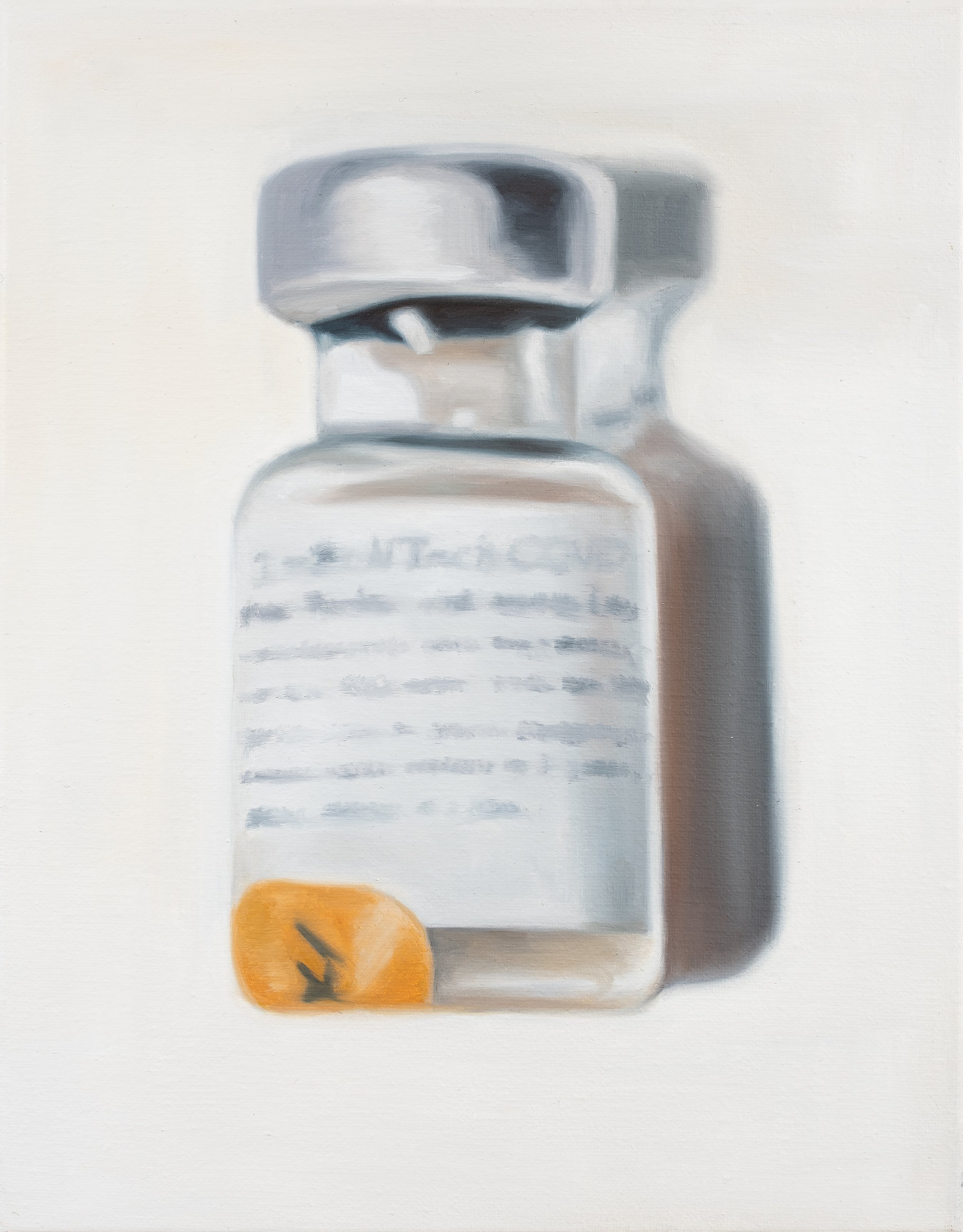
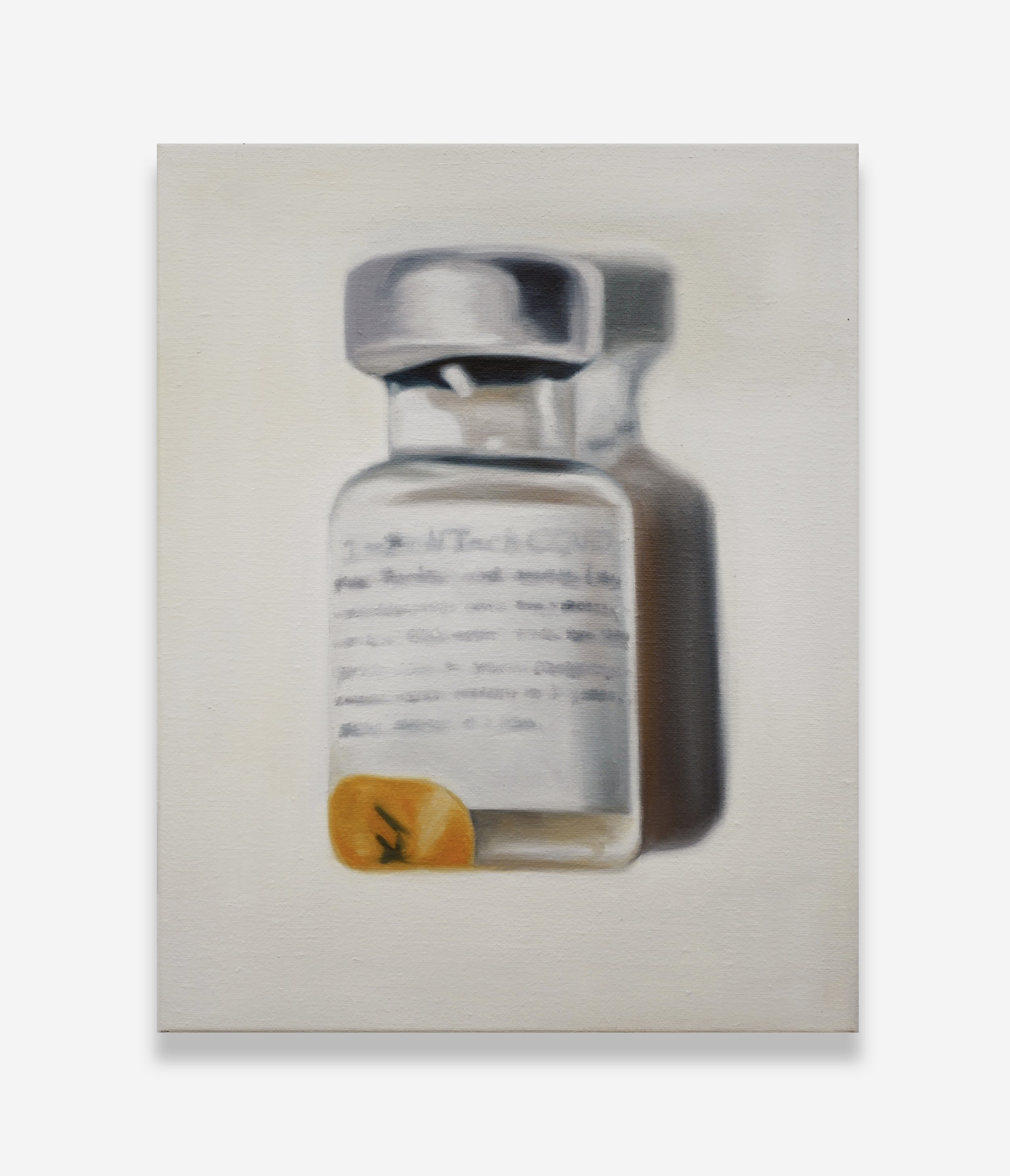
The painting is vertical, 36 by 28 centimeters, and it presents the vial at the center of a dark field that varies from deep charcoal at the edges to a slightly warmer dark behind the vial itself, as if the glass object is emanating a faint light into the surrounding space. This dark ground is the same strategy that Tan Mu employed in Moldavite (2020), where the tektite floats against a void that intensifies its presence, and in the DAWN exhibition works at Peres Projects Berlin, where dark backgrounds created a shared visual language across paintings of nuclear explosions, water droplets, and electronic circuits. In Vaccine, the dark ground serves a specific function: it isolates the vial from any clinical context, removing it from the laboratory, the distribution center, the refrigerator, the syringe, and the arm, and presenting it as an autonomous object that exists in space the way a celestial body exists in space, suspended and luminous, defined by its own boundaries rather than by its surroundings. The vial itself is rendered with close attention to the physical properties of pharmaceutical glass: the slight curvature of the walls, the narrowness of the neck, the small lip at the top where the aluminum seal would have been crimped, and the way the light passes through the liquid inside and refracts against the inner surface of the glass. The liquid in the vial is not transparent. It has a faint luminosity, a pale glow that suggests the presence of the mRNA suspension without depicting it literally, and this glow is what gives the vial its iconic quality in the painting, the quality that makes it recognizable even without any labeling or branding, the quality that Tan Mu describes as the vial becoming "a visual shorthand for vulnerability, anticipation, and relief."
The paint handling in the vial itself shifts between precise description and atmospheric suggestion. The outer contour of the glass is tight and specific, a single controlled line that defines the boundary between the object and the dark ground with the kind of clarity that pharmaceutical glass actually possesses, the kind of clarity that allows you to see the liquid inside as a separate substance from the glass that contains it. The inner glow, by contrast, is built up through thin layers of semi-transparent paint that allow the dark ground to show through, creating the illusion that the liquid is generating its own light rather than merely transmitting the light that falls on it from outside. This is not how a vial actually looks under laboratory lighting. Under fluorescent lights, a vaccine vial is a functional object, transparent and utilitarian, revealing its contents so that the clinician can verify the dosage and check for particulates before drawing the liquid into a syringe. Tan Mu's vial glows as if it contains its own light source, as if the mRNA suspended in the lipid nanoparticles is luminous in itself, and this transformation from functional object to luminous presence is the painting's primary visual argument: that the vial is not merely a container for a pharmaceutical product but an object that carries its own significance, that glows with the meaning that has accumulated around it during the year when the entire world was watching it.
Giorgio Morandi painted bottles, vases, jugs, and boxes for most of his adult life, working in a small room in his apartment in Bologna, arranging and rearranging the same group of objects on a table and painting them again and again in compositions that varied subtly from one canvas to the next. The objects were ordinary. Ceramic pitchers, tin cans, glass flasks, funnels, boxes made of cardboard or wood. They were the kinds of containers that any household would have, and Morandi painted them without any of the iconographic apparatus that still life painting had accumulated over centuries: no vanitas symbols, no memento mori, no allegorical attributes. The bottles and vases in a Morandi still life are not symbols of anything. They are bottles and vases, rendered with an attention so sustained and so patient that the act of looking becomes inseparable from the act of painting, and the viewer who spends time with a Morandi still life begins to see what Morandi saw, which is that a bottle is not merely a bottle but a volume, a silhouette, a surface that receives and reflects light, a form that occupies space and displaces air and creates shadows on the surface it rests on. His Still Life of 1956, in the collection of the Metropolitan Museum of Art, arranges five or six vessels of varying heights and shapes across a narrow shelf, their surfaces painted in muted tones of ochre, gray, pink, and white, against a background that is almost the same color as the shelf, so that the objects seem to emerge from and dissolve back into their surroundings in the same breath.
Tan Mu's Vaccine shares with Morandi's still lifes the commitment to the small vessel as an object worthy of sustained painterly attention, and it shares the strategy of isolating the vessel from its functional context in order to reveal its formal properties. But where Morandi's bottles are deliberately stripped of cultural meaning, emptied of significance so that their formal qualities can emerge in purity, Tan Mu's vial is deliberately loaded with cultural meaning, filled with the specific historical weight that the vaccine vial accumulated during the pandemic. Morandi painted his bottles during and after the Second World War, and there are those who have read his work as a refusal of the political, a withdrawal into the private world of the studio that was itself a form of resistance to the ideologies that had devastated Europe. Whether or not this reading is correct, it is undeniable that Morandi's bottles exist outside of history, outside of the news cycle, outside of the public conversation about the events that were reshaping the world outside his window. Tan Mu's vial exists inside history, inside the news cycle, inside the public conversation, and this is the fundamental difference between the two approaches. The Morandi bottle is a vessel that has been emptied. The Tan Mu vial is a vessel that has been filled, not only with the mRNA suspension that it was manufactured to contain but with the collective expectations and anxieties and hopes that a global population projected onto it during the worst public health crisis in a century.
The Pfizer-BioNTech vaccine that the vial in Tan Mu's painting would have contained was the first COVID-19 vaccine to receive emergency use authorization, and it was also the first vaccine based on messenger RNA technology to be approved for human use. The mRNA approach, which had been in development for decades before the pandemic accelerated its clinical application, represented a fundamental shift in vaccine design. Traditional vaccines introduce a weakened or inactivated form of the pathogen into the body, training the immune system to recognize and fight the real virus if it is encountered later. The mRNA approach takes a different path: it delivers a piece of genetic code, a sequence of nucleotides that instructs the cells of the vaccinated person to produce the spike protein that the SARS-CoV-2 virus uses to enter human cells, and the immune system then learns to recognize this protein without ever being exposed to the virus itself. This is the technology that Tan Mu describes as "a continuation of my long-standing interest in genetic codes, but now embedded within an urgent social reality." The connection to her earlier work on IVF, Dolly, and Chromosomes is explicit: the same genetic information that she had been painting in abstract form, as sequences and chromosomes and DNA structures, was now being delivered inside a small glass vial to billions of people, and the delivery mechanism was as significant as the message it carried.
The vial itself, the physical container that holds the mRNA suspension, is a pharmaceutical object manufactured to exacting standards. It is made of Type I borosilicate glass, chosen for its chemical resistance and its low coefficient of thermal expansion, which allows it to be stored at the ultra-low temperatures that the mRNA vaccine requires without cracking. The vial is sealed with a rubber stopper and an aluminum crimp cap, and the liquid inside is measured to a precise volume that allows for a specific number of doses to be extracted using a syringe. Every aspect of the vial's design is functional, determined by the requirements of storage, transport, and administration, and none of these aspects are visible in Tan Mu's painting, which strips the vial of its stopper, its cap, its label, and its dosage markings, presenting it as a pure form against a dark ground. This stripping away of functional detail is the same strategy that Morandi used when he removed the labels from his bottles and the logos from his cans, but Tan Mu uses it to a different end. Where Morandi removed the labels to reveal the form beneath the function, Tan Mu removes the functional apparatus to reveal the meaning beneath the form. The vial without its stopper and cap is not a less complete object. It is a more complete symbol, because it is the shape of the vial, not the details of its manufacture, that made it recognizable to the millions of people who saw the photographs in December 2020 and January 2021, and it is the shape of the vial, glowing against the dark ground, that carries the weight of all the emotions that accumulated around it during that period.

Andy Warhol painted Green Coca-Cola Bottles in 1962, arranging 112 nearly identical green glass bottles in a grid on a canvas, each one silkscreened in approximately the same position with approximately the same green tone, the slight variations in registration and ink density making each bottle subtly different from its neighbors while maintaining the visual logic of mechanical reproduction. The work was a provocation and a declaration: the mass-produced object, the consumer product that cost five cents and was available in every deli and diner and vending machine in America, was worthy of the same sustained attention that earlier generations of painters had given to mythological subjects and religious narratives. Warhol's bottles were not symbols of anything in the allegorical sense. They were what they were: green glass bottles containing a carbonated beverage, rendered with the flatness and the indifference of commercial printing, repeated until the repetition itself became the subject, and the subject was not the bottle but the system of mass production and mass consumption that the bottle represented, the system that could produce billions of identical objects and distribute them across a continent and make them available to anyone with a nickel.
Tan Mu's vial is not Warhol's bottle, but the comparison illuminates something about both. Warhol's bottle is a consumer product that was designed to be consumed, discarded, and replaced. Tan Mu's vial is a medical product that was designed to be administered, discarded, and remembered. The Coca-Cola bottle was a symbol of abundance, of the American consumer economy's capacity to produce and distribute and sell, and Warhol's painting made that symbolism explicit by repeating the bottle until its individuality dissolved into the logic of mass production. The vaccine vial is a symbol of a different kind of abundance: not the abundance of consumer goods but the abundance of scientific knowledge and collaborative effort, the capacity of the global research establishment to identify a novel pathogen, sequence its genome, design a vaccine candidate, test it in clinical trials, manufacture it at scale, and distribute it around the world, all within the span of a single year. This is an abundance of a different order, an abundance of expertise and coordination and institutional will, and Tan Mu's painting acknowledges it by presenting the vial not as one of many identical objects in a grid but as a singular object against a dark ground, unique and luminous, the way a reliquary presents its contents, the way a Morandi still life presents its bottles, the way a portrait presents its sitter. The vial in the painting is not repeated. It is not one among many. It is the one, the specific vial that the viewer recognizes from the photographs of December 2020, the vial that meant everything, and its singularity in the painting is the singularity of the historical moment it represents, the moment when a single glass container held the promise that the worst year in recent memory might be followed by something better.
Tan Mu has described the vial as "a container of layered significance" that "holds scientific knowledge, political tension, public anxiety, and collective hope all at once," and this description is precise because it identifies the specific quality that distinguishes the vaccine vial from other objects in her practice. The moldavite in her 2020 painting holds deep time. The quantum cryostat in her quantum computer paintings holds the near-absolute-zero temperatures that make superconducting computation possible. The vial in Vaccine holds all of these and more: it holds the scientific knowledge that produced the mRNA technology, the political tensions that surrounded the vaccine's development and distribution, the public anxiety that accumulated during months of lockdown and social distancing, and the collective hope that the vial's contents could bring the pandemic to an end. It holds them simultaneously, in the same small container, and the painting makes this simultaneity visible by rendering the vial in a way that refuses to privilege any one of these layers over the others. The scientific precision of the mRNA technology is present in the clarity of the glass contour. The political tension is present in the vial's isolation from any clinical context, its removal from the institutional settings where vaccines are administered. The public anxiety is present in the dark ground that surrounds the vial, a void that could be a laboratory or a nightmare or the interior of a refrigerator kept at minus seventy degrees Celsius. The collective hope is present in the glow, in the inner luminosity that the vial radiates into the darkness, as if the liquid inside is generating its own light, as if the promise contained in the mRNA is visible to anyone who looks closely enough, as if hope itself has a color and a temperature and can be painted on linen and hung on a wall and looked at in the years after the pandemic has ended, when the vials have been thrown away and the photographs have been archived and the memory of what it felt like to stand in line waiting for a dose has begun to fade, as all memories fade, into the generality that replaces the specificity of lived experience, leaving only the painting to hold the specific weight of the object that meant everything for a year and then became ordinary again, as all extraordinary objects eventually do.