The Temperature of Being Seen: Tan Mu's Thermal Imaging and the Body as Data
At six inches from the surface, the painting is all bruise. Deep violet pools into black at the edges, with threads of indigo and a cold, mineral blue threading through the upper register like the memory of a sky that never quite materialized. The weave of the linen catches the light in diagonal bands, and where the oil paint has been laid on thinly, the fabric's texture emerges as a faint grid beneath the color, a structural hum beneath the visual noise. Two forms glow at the center of this darkness, shapes that resolve into figures only when you step back: one amber, one shifting between orange and a fierce, almost medical red. They are not painted as bodies. They are painted as temperatures.
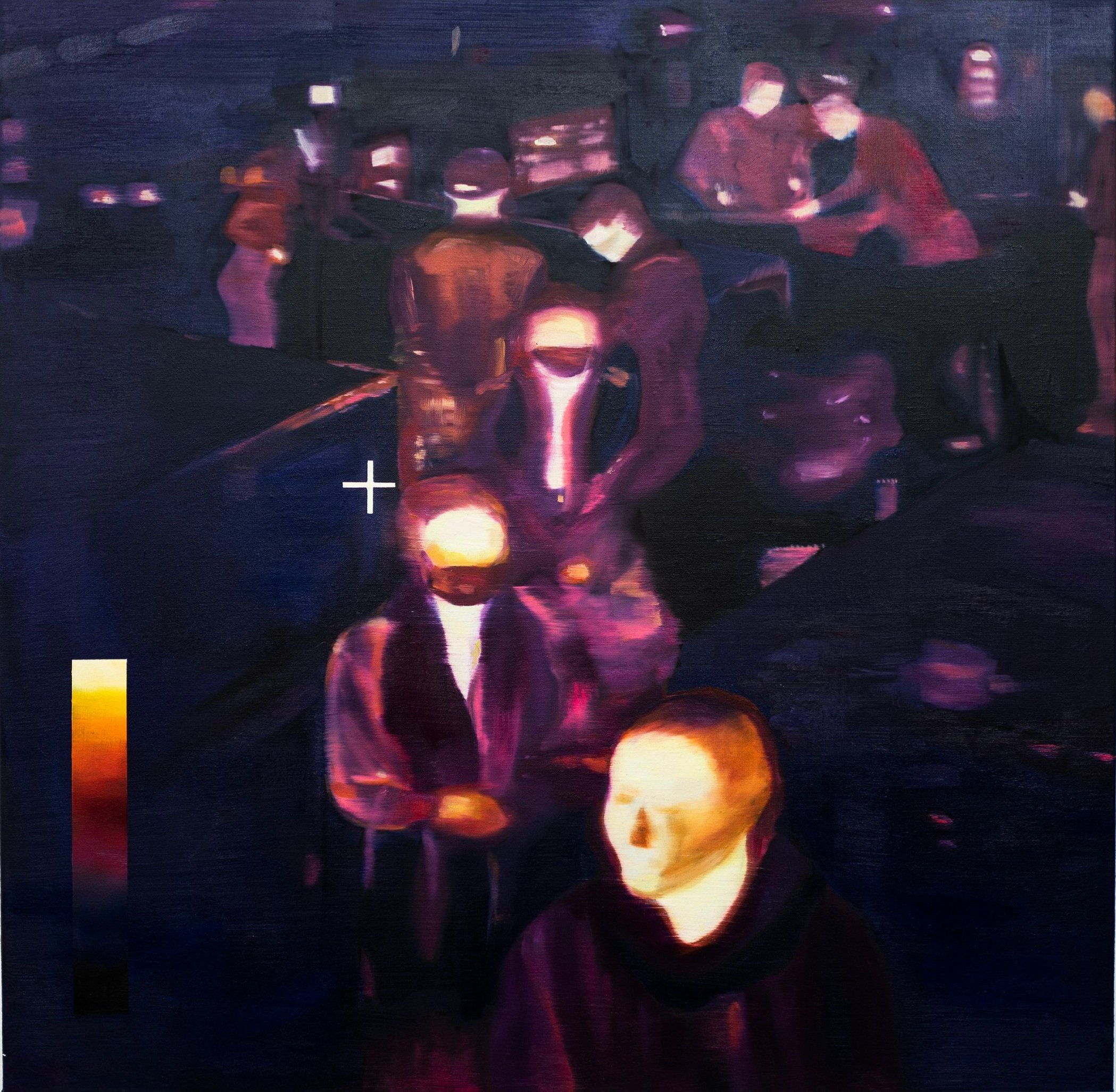
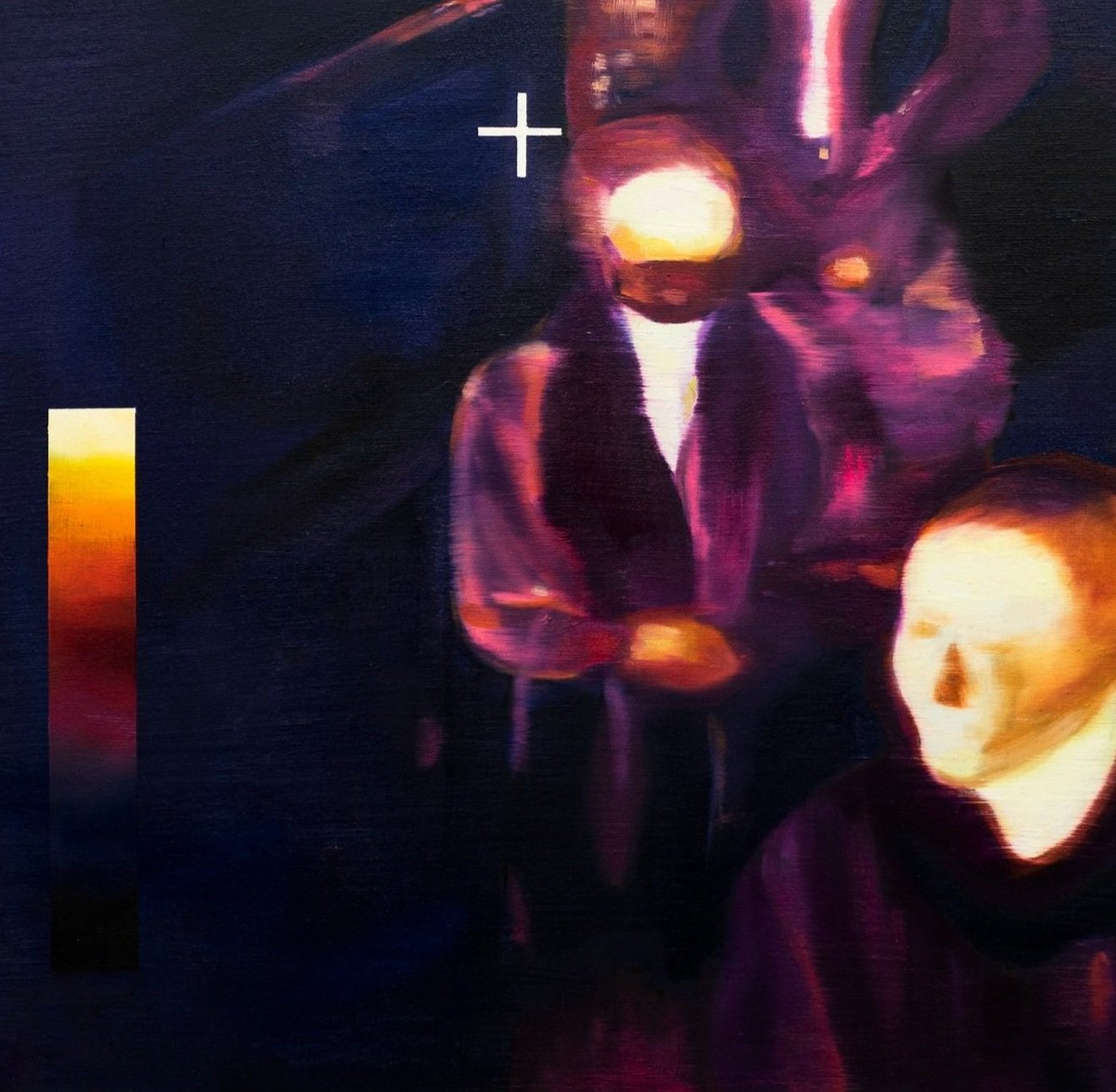
Step back to two meters and the painting announces its subject. Two pedestrians wearing masks stand at the center of the composition, caught in the view of a thermal imaging camera at an airport security checkpoint. A small crosshair hovers near one figure, the signature of an artificial intelligence system actively detecting body temperature. In the lower left corner, a gradient color bar maps thermal ranges from cool to hot, a legend for translating the body's invisible radiation into legible information. The scene is specific and historically locatable: this is the visual grammar of pandemic surveillance, the period between 2020 and 2022 when airports, hospitals, and public buildings worldwide deployed infrared thermal cameras to scan crowds for fever, and AI systems processed those scans in real time, reducing each passerby to a temperature reading and a risk assessment. Tan Mu painted Thermal Imaging in 2022, oil on linen, 76 x 76 cm (30 x 30 in), a square format that gives the composition the equilibrium of a monitor screen or a camera viewfinder, the device through which the scene was originally captured and the frame through which it was meant to be seen.
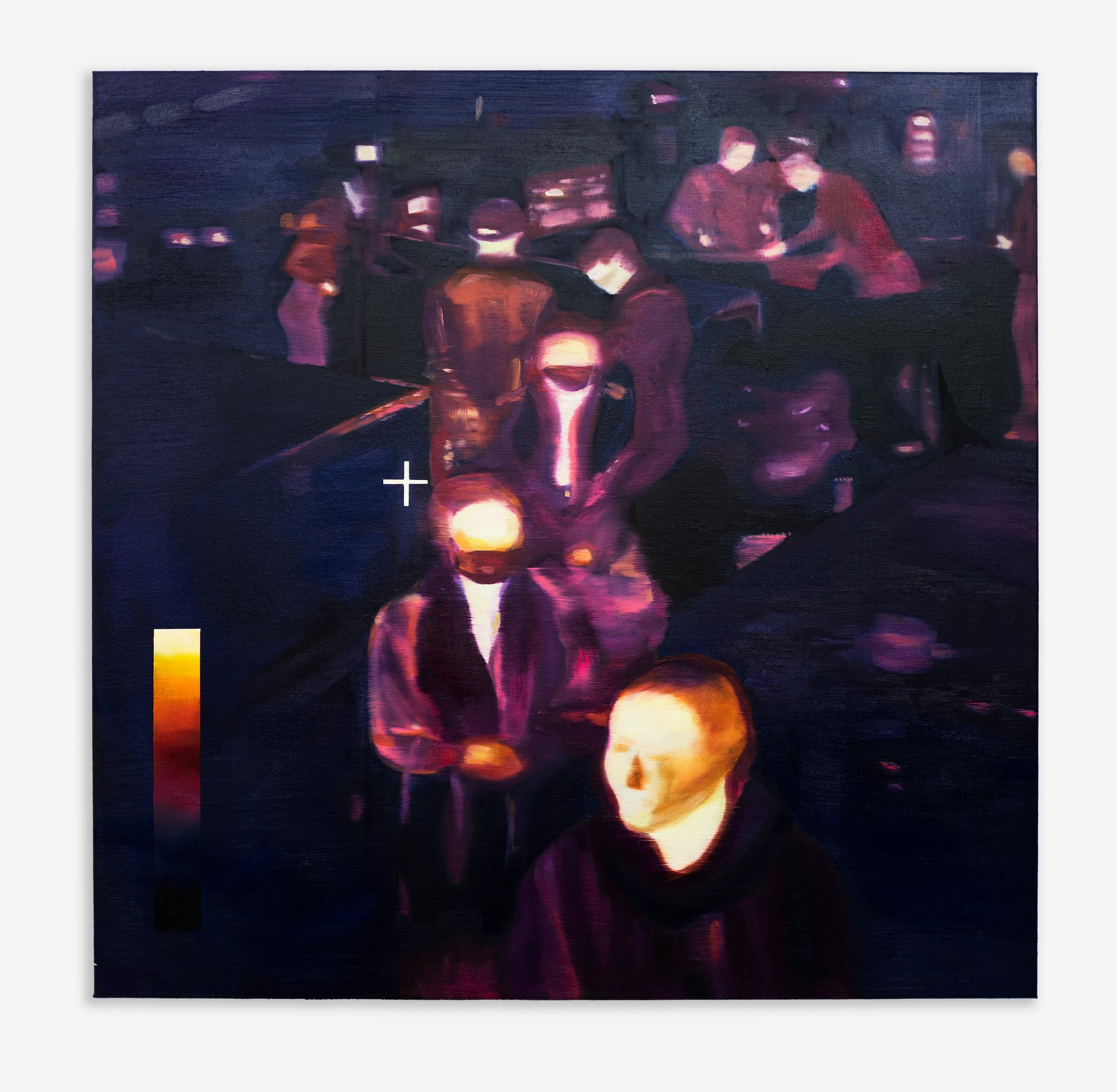
The square is significant. A rectangular canvas suggests a window onto a scene, a landscape, a narrative unfolding in time. A square canvas suggests a screen, a readout, a frame of data. Tan Mu has chosen the format that belongs to the machine that produced the original image, not to the tradition of figurative painting. The painting's dimensions echo the aspect ratio of the thermal camera's display, and this echo is the first indication that the work is not merely depicting a surveillance image but inhabiting its logic. The viewer does not look at a painting of a thermal scan. The viewer looks at a thermal scan that happens to have been made in oil paint. The distinction matters. A painting of a thermal scan is a representation at one remove. A painting that is a thermal scan, translated into a different medium, performs the same operation of translation that the camera itself performs: taking something invisible, the radiation emitted by a warm body, and converting it into something visible, a pattern of color that registers physiological state. Tan Mu's painting inserts itself into this chain of translations rather than standing outside it as commentary. The brushwork does not critique the camera. The brushwork is the camera, remade by hand.
The surface texture reinforces this identification. At close range, the two figures dissolve into loose, visible brushstrokes that soften their contours and blur their boundaries with the surrounding dark field. Tan Mu has described this deliberate looseness as mirroring the way technology abstracts the human presence into data: the bodies appear fluid and unstable rather than fixed, their edges approximate rather than certain, as if the act of measurement has made the measured thing less definite rather than more. The warmer colors, red and orange and amber, are applied with a confidence and density that makes them sit forward on the canvas, projecting toward the viewer as heat projects from a body. The cool field of purple, blue, and black recedes, its thin application allowing the linen to show through, creating a surface that breathes rather than sealing itself into opacity. The color bar in the lower left corner is painted with a restraint that borders on the mechanical: a precise gradient from cool to hot, each band distinct, each transition clean. It is the most "technological" passage in the painting, the one that most directly quotes the camera's interface, and its precision stands in sharp contrast to the loose handling of the figures, as if the machine's legibility and the body's legibility were two entirely different orders of knowledge occupying the same canvas.
In 1819, Théodore Géricault painted The Raft of the Medusa, a canvas of nearly five by seven meters depicting the survivors of a shipwreck adrift on a makeshift raft, their bodies at the extreme limits of endurance, some alive, some dead, some in the anguished territory between the two. The painting was based on a specific and scandalous event: the wreck of the French naval frigate Méduse in 1816 and the subsequent abandonment of 147 passengers on a raft, of whom only 15 survived after thirteen days at sea. Géricault interviewed survivors, studied dead bodies in the morgue, and constructed a scale model of the raft in his studio. His commitment to documentary specificity was radical for its time, an insistence that the painting's authority derived not from allegory or classical precedent but from the accuracy of its observation. The bodies in The Raft of the Medusa are not generic figures of suffering. They are specific bodies in a specific moment, their postures drawn from anatomical study and eyewitness testimony. Géricault's ambition was to make the viewer feel the physical reality of these bodies, their weight, their exhaustion, the warmth draining from those who were dying, the desperate animation of those still reaching toward the horizon.
The structural parallel with Thermal Imaging is not immediately obvious, because Géricault's painting operates in the register of pathos while Tan Mu's operates in the register of detachment, but both works are engaged with the same fundamental problem: how to make the body's interior state legible at the surface. Géricault used the tradition of the nude, the musculature of the figure, and the physiological signs of distress, clenched hands, collapsed postures, the pallor of skin approaching death, to register what was happening inside the body on the outside of the body. His bodies are transparent to feeling because the language of academic anatomy trained viewers to read the body's surface as an index of its condition. Tan Mu faces the same problem in a different register. The thermal camera has replaced the anatomist's eye. Where Géricault read the body through the conventions of figure drawing, the thermal camera reads the body through the physics of infrared radiation. Both are systems for making interior states visible. Both claim the authority of empirical observation. Both produce images that are simultaneously documents and compositions, records of a real event and aesthetic objects shaped by the conventions of their medium. The crucial difference is that Géricault's viewer is invited to identify with the body on the raft, to feel its suffering as an extension of their own embodied experience. Tan Mu's viewer is positioned as the camera, observing the body from outside, reading it as data. The empathy of The Raft of the Medusa depends on the viewer's ability to imagine themselves on the raft. The unease of Thermal Imaging depends on the viewer's recognition that they are the camera, that the distance between observer and observed is the distance of surveillance, and that this distance is not a choice but a condition imposed by the technology that mediates the encounter.
Thermal imaging cameras operate in the long-wave infrared band of the electromagnetic spectrum, detecting radiation at wavelengths between roughly 8 and 14 micrometers. The human eye cannot see this radiation. The camera converts it into a visible image by assigning colors to temperature values, typically using a palette that runs from blue or purple for cooler surfaces through green and yellow to red and white for the hottest. The resulting image looks like a map of heat, which is precisely what it is: a cartography of thermal emission that renders every surface in the camera's field of view according to its temperature rather than its color, texture, or reflectance. During the COVID-19 pandemic, this technology was deployed on an unprecedented scale. Airports installed thermal cameras at security checkpoints and boarding gates. Office buildings positioned them at entrances. Schools, hospitals, stadiums, and public transit systems adopted them as screening tools, each person who entered scanned for fever as a proxy for infection. AI systems overlaid the thermal image with detection algorithms that identified individual faces, assigned them temperature readings, and flagged anyone whose reading exceeded a preset threshold. The "plus" sign visible in Tan Mu's painting is the signature of this AI layer: a crosshair that locks onto a target and measures it, turning a human being into a coordinate on a risk matrix.
The pandemic transformed the thermal camera from a specialized instrument, used primarily by building inspectors, military personnel, and wildlife researchers, into a ubiquitous feature of public space. This transformation was not merely technological. It was perceptual. For two years, millions of people learned to see themselves and each other through the logic of thermal detection, to understand the body as a source of thermal data that was being continuously monitored, and to accept that their interior state, their temperature, their potential infection, was being read by machines in real time and without their consent. Tan Mu has described thermal imaging as "a form of disconnection," a technology that "mediates our perception, transforming the tactile sensation of warmth into a purely visual experience." The disconnection she identifies is not a failure of the technology but its defining characteristic. The thermal image gives you information about a body that you could only otherwise obtain by touching it, but it strips away everything that touch would also give you: the texture of skin, the resistance of bone, the give of flesh, the specific warmth of a living hand as distinct from the generic warmth of any warm object. The thermal camera abstracts the body into a single variable and presents that variable as if it constituted knowledge of the person. Temperature becomes a proxy for health, health becomes a proxy for risk, and risk becomes a proxy for the body's right to occupy public space.
In the early 1990s, Christian Boltanski produced a series of installations under the title Reserves, consisting of hundreds of secondhand garments arranged on racks or piled on the floor, illuminated by harsh overhead lights that cast long shadows across the gallery walls. Each garment had been worn by an unknown person, acquired from thrift stores and laundromats, and each carried, in Boltanski's formulation, "the memory of the body that wore it." The installations functioned as surrogates for the absent bodies, their emptiness indexing the presence of the people who had once filled them. Boltanski's work of this period is saturated with the rhetoric of memorialization, but its power lies in the precision of its mechanism: the garment is a container for a trace of the body, a thermal residue, the imprint of a specific warmth and a specific shape. The viewer does not see the body but sees what the body has left behind, and this act of indirect seeing produces an effect that direct representation could not: the viewer is made conscious of their own body as a source of traces, a warm object that leaves residues wherever it goes, that can be tracked and reconstructed from what it deposits in the world.
Thermal Imaging and Boltanski's Reserves share a common subject: the body as a source of thermal information that persists beyond the body's departure. Where Boltanski works with absence, the garment as a shell that remembers the body that filled it, Tan Mu works with presence, the body as it is being read by a machine that translates its heat into color. But the logic is the same. Both artists are concerned with the trace that the body leaves in the world, the thermal signature that extends beyond the skin and can be captured, recorded, and interpreted without the body's knowledge or participation. The difference in medium is also a difference in temporality. Boltanski's garments are retrospective traces, records of bodies that have already left. Tan Mu's thermal scan is a real-time trace, a body being measured in the present tense. The crosshair in Thermal Imaging marks the moment of capture, the instant when the AI system locks onto a target and registers its temperature. This is not a memorial. It is an act of surveillance, and the viewer's awareness of being watched, or of watching, produces the specific quality of unease that the painting generates. Danni Shen, writing about Tan Mu's practice in Emergent Magazine, observed that the paintings "serve as a kind of witness to human socio-technological histories." The witness in Thermal Imaging is double: the painting witnesses the act of surveillance, and the surveillance system, represented within the painting, witnesses the body. The viewer occupies both positions simultaneously, looking at the thermal image and being looked at by the logic it represents, aware that the same technology that is measuring the two masked figures in the painting could be measuring them.
The color relationships in Thermal Imaging are not decorative. They are the painting's argument. The dominant field of purple, blue, and black corresponds to the cooler temperatures of the airport environment, the walls, the floor, the ambient air. The warm figures of amber and red correspond to the heat radiating from living bodies. The color bar in the lower left corner establishes the code that makes this correspondence legible: a gradient from cool to hot that maps the spectrum of thermal radiation onto the spectrum of visible color. Tan Mu has retained this color code from the original thermal image, and by doing so, she has made the painting's palette into a diagram of its own meaning. Every color choice is also a temperature reading. Every shift from blue to red is also a shift from inanimate to animate, from environment to body, from background to subject. The painting's visual structure and its semantic structure are identical, and this identity is what distinguishes Thermal Imaging from a painting that merely illustrates a surveillance scene. The color is not representing the thermal camera's output. The color is the thermal camera's output, re-encoded in oil paint. The translation from infrared radiation to visible light that the camera performs is continued by the translation from digital image to painted surface that Tan Mu performs. The chain of translations is unbroken from the body's heat to the viewer's eye, and each link in the chain is a moment where information is both preserved and transformed, where something is gained and something is lost.
What is lost is precisely what Tan Mu has identified as the core of her concern: the tactile reality of warmth, the embodied experience of being a body among other bodies, the knowledge that is carried in the skin and cannot be extracted from it by any camera. The thermal camera can tell you that a body is 37.2 degrees Celsius. It cannot tell you whether that body is frightened, impatient, grieving, relieved to be going home, or terrified of what it will find there. The AI crosshair can lock onto a target and assign it a risk profile. It cannot distinguish between the fever of infection and the flush of exertion, between the heat of illness and the heat of running to catch a flight. The technology's precision is also its blindness, and the painting's insistence on the looseness of its brushwork, the fluidity of its figures, the uncertainty of its contours, is an insistence on what the camera cannot see. The bodies in Thermal Imaging are warmer than their surroundings. That is what the camera tells us. But they are also more than their warmth. That is what the painting tells us, and it does so not by adding information that the camera lacks but by subtracting the camera's certainty, by rendering the figures in a hand that hesitates, that makes edges approximate, that allows paint to dissolve into paint and color to bleed across boundaries that the machine would hold firm.
The two figures wear masks. This is a detail of the original thermal image that Tan Mu has preserved faithfully, and it carries a weight that extends beyond its documentary accuracy. The mask conceals the face, the primary site of individual recognition and emotional expression. Under the thermal camera's view, the mask does not conceal the body's heat. The face behind the mask radiates warmth that the camera reads as clearly as it would read an uncovered face. The mask hides the person but cannot hide the temperature. This is the surveillance state's ideal: to see through every covering, to extract the essential data regardless of the subject's wish to withhold it. The mask, a gesture of public health responsibility, becomes in the painting's logic also a gesture of self-protection against the gaze of the machine, a gesture that the machine effortlessly defeats. The viewer sees the figures through two frames simultaneously: the frame of the painting, which requires sustained attention and rewards it with complexity, and the frame of the camera, which reduces each figure to a single data point and moves on. These two frames are not reconciled in the work. They coexist, their disagreement is the work's subject, and the viewer is suspended between them, seeing the bodies as both subjects and objects, as both warm and measured, as both present and reduced.
Tan Mu's practice has always been concerned with the point where visibility becomes a form of power. In the Privacy works, she addresses data protection and informational vulnerability directly. In the Signal series, she maps the infrastructure that carries the world's information through ocean depths that no human eye can reach. In Thermal Imaging, she addresses the moment when visibility is imposed on the body itself, when the body's own radiation becomes evidence that can be collected without its consent. The painting is not a protest against surveillance. It is something more unsettling: a faithful record of what surveillance looks like, made in a medium that slows the looking down long enough for the viewer to notice what is being lost in the translation from body to data. The thermal camera sees heat. The painting sees the camera seeing heat. And the viewer, standing in front of the canvas, sees themselves being seen by the logic that the painting inhabits. The temperature reading is accurate. The person it describes has disappeared into the reading. The warmth that remains on the canvas is not the warmth of a living body but the warmth of a painted one, and the difference between those two kinds of warmth is the distance that the painting asks its viewer to hold in mind, the distance between being alive and being measured, between radiating heat and being read.