The First Division: Tan Mu's Embryo and the Moment Before Individuality
In the autumn of 1978, Robert Edwards and Patrick Steptoe announced the first successful in vitro fertilization resulting in a live birth: Louise Brown, born on July 25 of that year in Oldham, England. The announcement was met with a mixture of scientific triumph and public unease. The Catholic Church condemned the procedure as unnatural. Newspapers speculated about the possibility of designer babies. Scientists around the world recognized it as a revolution in reproductive biology, a demonstration that the earliest stages of human development could be observed, manipulated, and ultimately controlled outside the body. What no one speculated about, in the initial rush of commentary on Edwards and Steptoe's achievement, was what it would mean to paint the cell that became Louise Brown, the single fertilized ovum from which she developed, the zygote that contained within its microscopic diameter the complete genetic blueprint of a person who had not yet existed. Tan Mu has spent years thinking about exactly this cell, this smallest unit of human individuality, and her painting Embryo (2022) is the result of that thinking. It depicts not Louise Brown or any other specific embryo but the category itself, the moment at which a new human being begins as a single cell and begins the process of becoming many.
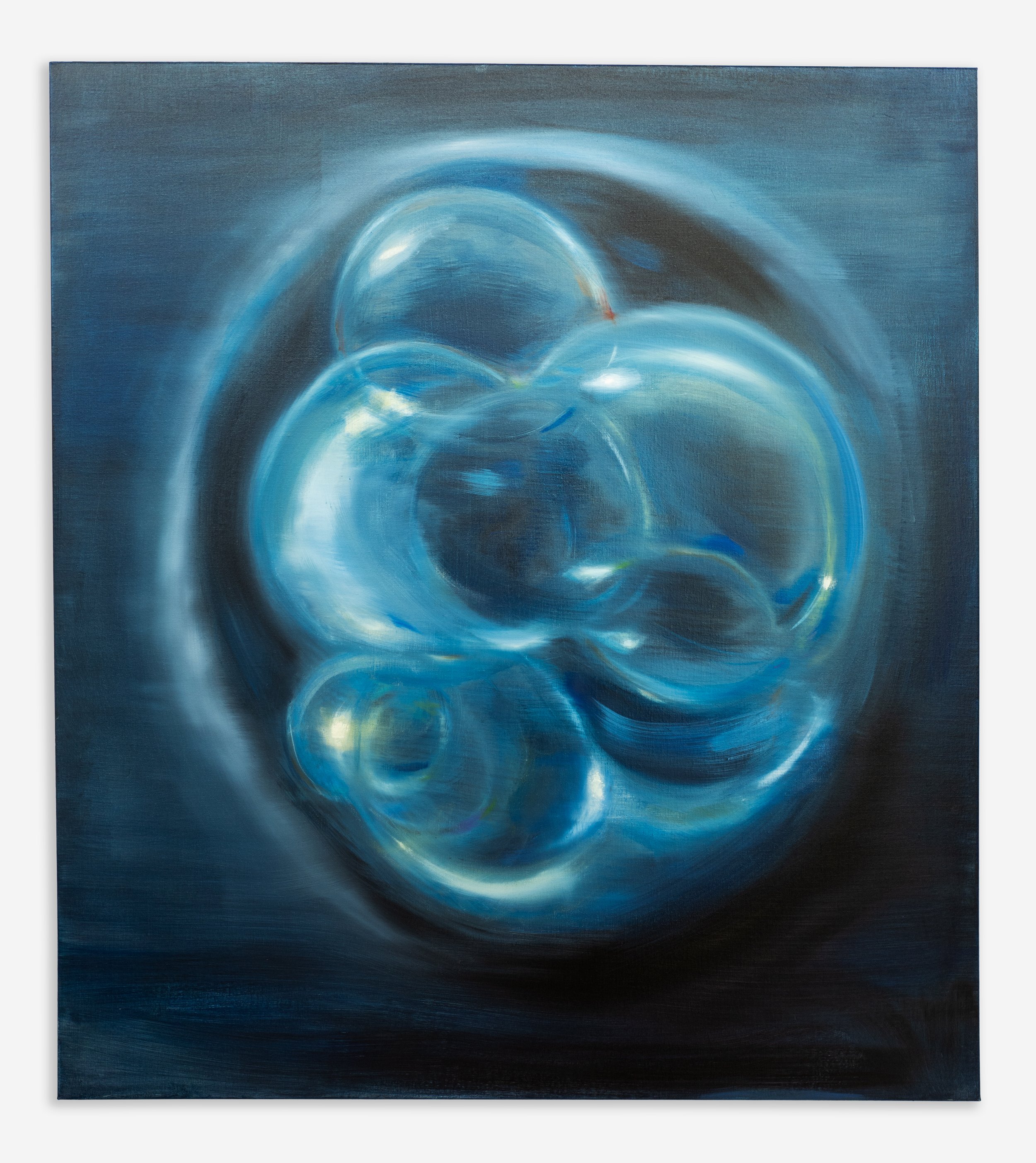
The painting emerged from a specific moment of looking. Tan Mu has described observing embryogenesis under a microscope, watching the cell at the earliest stages of life, and recognizing in that observation a parallel to her own painting process. Each painting starts from a blank canvas, a single brushstroke, and through incremental layering and transformation, eventually becomes a complete work. Just as an embryo develops from a simple structure to a complex organism through accumulated marks and layers, so too does a painting evolve from simplicity to complexity. This formal analogy between embryogenesis and painting is the conceptual core of Embryo, but it is not the painting's only layer of meaning. The embryo is also, in Tan Mu's hands, a meditation on the origin of individuality itself, on the moment when a single cell that could in principle become any cell in the body begins the process of becoming a specific body, a specific person, a specific perspective on the world that will never again be available once it has been taken.
Embryo is executed in oil on linen, measuring 61 by 76 centimeters (24 by 30 inches). The format is horizontal, appropriate for a subject that is depicted at a scale that requires the eye to move across the canvas, scanning the cellular field the way the eye scans a microscopic preparation. The composition places the cell or cells at or near the center of the canvas, surrounded by the dark ground of the linen ground that represents the void in which the embryo exists before it implants in the uterine wall. The scale is ambiguous in the way that microscopic imagery is often ambiguous. The cell or cells depicted could be large enough to see with the naked eye or small enough to require the microscope for visualization. Tan Mu has not specified the magnification, and the ambiguity is productive: what matters is not the physical size of the thing depicted but the fact of its existence, the reality of the cell as the fundamental unit of biological individuality.
The palette is restricted to the cool tones of cellular imagery under laboratory conditions: pinks and purples and blues for the cell membrane and the interior structures, against the darker tones of the surrounding medium. Tan Mu has described the color palette as emerging from her research into the visual language of embryology, the way that laboratory imaging techniques assign false colors to different cellular structures in order to make them visible and distinguishable. The painting does not pretend to naturalistic color. It operates in the register of scientific visualization, where color is a tool for distinction and identification rather than a record of appearance. This aligns the painting with Tan Mu's broader practice of making visible the invisible through the conventions of scientific imaging, translating data and observation into a medium that can be contemplated rather than merely analyzed.
Brushwork in the cellular structures is built from many thin layers, each one contributing to the overall density and opacity of the painted forms. The layering is not merely technical. It is conceptual. The embryo develops through the accumulation of cell divisions, each mitosis adding to the total mass of the organism without changing the fundamental genetic information contained in every cell's nucleus. Tan Mu's layering performs this logic, building up the painted embryo from repeated applications of pigment that together produce an effect that no single layer could produce. The linen weave shows through in places, as it does in many of Tan Mu's paintings, providing a textural ground that connects the painted image to the material reality of the canvas. The cell is not floating in a void. It is resting on a linen ground, subject to the same conditions of material existence as everything else in the painting's world.
The tradition of representing the human embryo in Western art begins, at least in its recognizable scientific form, with the anatomical drawings that Leonardo da Vinci produced in the early sixteenth century. Leonardo's Studies of the Human Embryo (c. 1510), preserved in the Royal Library in Windsor Castle, depict the uterus of a cow in cross-section, with the embryo curled inside in the posture that Renaissance anatomists believed all unborn creatures to occupy. The drawings were based on dissection and direct observation, and they represent one of the earliest attempts in Western art to depict the embryo not as a symbolic or theological form but as a biological object, subject to the same laws of anatomy and development as any other part of the body. Leonardo was not a embryologist in the modern sense. He was a draftsman who understood that drawing was a tool for understanding, that the act of rendering something visible on paper was inseparable from the act of coming to know what one was drawing.
Tan Mu's approach to Embryo operates in the same spirit of investigation. She has described the experience of observing embryogenesis under a microscope as a revelation, a moment of direct encounter with a biological process that she had previously known only abstractly. The painting is the record of that encounter, translated from the language of microscopy into the language of oil painting. This translation is not a neutral transfer. It changes the status of the image, converting a scientific observation into an aesthetic object, something to be contemplated rather than analyzed, something that exists for its own sake rather than as a piece of diagnostic information. Where Leonardo's drawings were instruments of investigation, made in the course of trying to understand the anatomy of the developing organism, Tan Mu's painting is a meditation on what the embryo means, on what it represents in the broader context of her practice of investigating biological and technological systems that operate at the limits of ordinary perception.
The connection to Leonardo also illuminates the question of scale that the painting raises. Leonardo's embryo drawings are small, intimate, made for the artist's own reference rather than for public display. They are working documents, records of observation that were not intended to stand alone as finished artworks but to serve as sources of information for subsequent compositions. Embryo is similarly intimate in scale, modest enough to be held in the attention without being overwhelmed by its dimensions. This intimacy is appropriate for a subject that is, in its initial stages, invisible to the naked eye. The embryo is the smallest possible version of a human being, the individual reduced to a single cell, and the painting honors that reduction by presenting it at a scale that the viewer can encompass in a single glance, holding the beginning of a person in the field of vision without being forced to scroll or pan or adjust the scale of perception. Leonardo drew the embryo small because the embryo was small. Tan Mu paints it small for the same reason, and because smallness is not a diminishment but a concentration, the entire potential of a human being held in a form that can be examined at leisure.
Human embryogenesis begins at the moment of fertilization, when a sperm cell penetrates an oocyte and the two gametes fuse to form a zygote. The zygote is the first cell of the new individual, containing within its nucleus the complete genetic information that will direct the development of every subsequent cell in the body. Within hours of fertilization, the zygote begins to divide, a process called cleavage, producing two daughter cells, then four, then eight, in a rapid sequence of mitoses that increases the number of cells without increasing the total volume of the original zygote. By the fifth day after fertilization, the embryo has become a blastocyst, a hollow sphere of approximately one hundred cells, with an inner cell mass that will become the embryo proper and an outer trophoblast that will become the placenta. This is the stage at which the embryo would implant in the uterine wall, if it were in the body, or at which it would be frozen and stored, if it were the product of IVF.
Tan Mu has described watching the cell at the earliest stages of this process and seeing in it a parallel to her painting practice. The analogy is precise. Both the embryo and the painting begin as something simple and become something complex through the accumulation of layers and divisions. The embryo starts as a single cell and becomes billions of cells, each of which contains the same genetic information but has differentiated into a specific type, a specific function, a specific place in the architecture of the body. The painting starts as a blank canvas and becomes a complex visual field through the accumulation of brushstrokes, each of which adds to the total without changing the original conceptual intention. The metaphor works in both directions. The embryo is like a painting in the sense that it develops through a process of incremental addition. The painting is like an embryo in the sense that it grows from simplicity to complexity through a process that is both programmed and adaptive, following a general plan while responding to local conditions.
The painting does not specify which stage of embryogenesis it depicts. It could be a zygote at the moment of fertilization, shortly after the sperm and egg have fused. It could be a two-cell or four-cell embryo in the early stages of cleavage. It could be a blastocyst approaching the moment of implantation. The ambiguity is deliberate. What the painting represents is not a specific developmental stage but the category itself, the process of becoming that defines embryogenesis, the transition from unity to multiplicity that is the embryo's fundamental character. A single cell becomes two. Two becomes four. Four becomes eight. The arithmetic of embryonic development is simple. The biology is vertiginous. Somewhere in the progression from one to two to four to eight to billions, the thing that will become a person begins to exist, without any clear demarcation between the biological process and the emergence of the person whose existence that process makes possible.
The first human beings to observe sperm cells and bacteria were Antonie van Leeuwenhoek and his wife Joanna, who in the 1670s ground their own lenses and built microscopes that could achieve magnifications of over two hundred times. Van Leeuwenhoek wrote letters to the Royal Society in London describing what he saw: tiny animals in a drop of pond water, squirming creatures in the scum on his teeth, and in his semen samples, what he described as little animals with wiggling tails. He had seen, for the first time in human history, the individual cells that participate in the creation of a new organism. The discovery was staggering in its implications. If the semen contained fully formed miniature organisms, then preformationism must be true: each new individual already existed, in miniature, inside the parent, waiting only to be released and grow. The alternative, epigenesis, held that the embryo developed progressively from undifferentiated material, a view that took another century and a half of embryology to firmly establish.
Tan Mu has described her painting process as analogous to the process of embryonic development, but the connection to van Leeuwenhoek suggests another layer of meaning. Van Leeuwenhoek's discovery was a discovery of visibility. The individual cell, which had existed since the beginning of sexual reproduction but had never been seen, became visible through the microscope. This moment of first visibility is what Embryo also accomplishes. The embryo exists before the painting is made. It exists before the painting is looked at. But it becomes visible, available for sustained contemplation, only through the mediation of the painting. Like van Leeuwenhoek's lens, Tan Mu's brush translates something that is too small to see into something that can be examined, converting the microscopic into the visible, making available to the naked eye what would otherwise require an electron microscope and years of specialized training to perceive.
The epistemological resonance between microscopy and painting is not incidental. Both practices involve the extension of human perception into registers that would otherwise be inaccessible. The microscope extends the range of visible light downward in scale, revealing structures and processes that operate below the threshold of ordinary vision. Painting extends the capacity for sustained attention, revealing meanings and relationships that would otherwise be lost in the rapid flow of ordinary experience. Tan Mu's Embryo operates at the intersection of these two extensions. It is a painting of something that was first made visible by the microscope, and it asks the viewer to bring to the image the same quality of focused attention that the microscopist brings to the examination of a cellular preparation. The painting does not move. It sits still, waiting to be looked at, inviting the viewer to bring their full perceptual capacity to the examination of the cell that is the beginning of a person.
Tan Mu has described the embryo as a subject that connects her investigation of biological systems to her broader philosophical interest in the question of what constitutes an individual. The embryo is an individual in the biological sense: a single organism developing from a single zygote, genetically distinct from both parents, with the capacity to develop into a mature human being if conditions permit. But the embryo is not yet a person in the legal or social sense. It has no rights, no social existence, no identity beyond its biological potential. This gap between biological individuality and social personhood is one of the most contested questions in contemporary ethics and law, and it is encoded in the very different ways that different cultures and legal systems treat the embryo. In some jurisdictions, the embryo has the same rights as a born person. In others, it is property, a resource to be used or discarded according to the wishes of the people who produced it.
Tan Mu does not take a position on these legal and ethical questions in the painting. She holds them open, presenting the embryo as a biological fact and allowing the viewer to bring their own framework of interpretation to that fact. This is consistent with her broader approach to controversial subjects. She paints the nuclear test and does not argue against nuclear weapons. She paints the submarine cable and does not argue for better internet access. She paints the embryo and does not argue for or against any particular position on abortion or reproductive rights. The painting is an act of attention, not an argument. It asks the viewer to look at the cell that is the beginning of a person and to consider what that beginning means, without specifying what should be done about it.
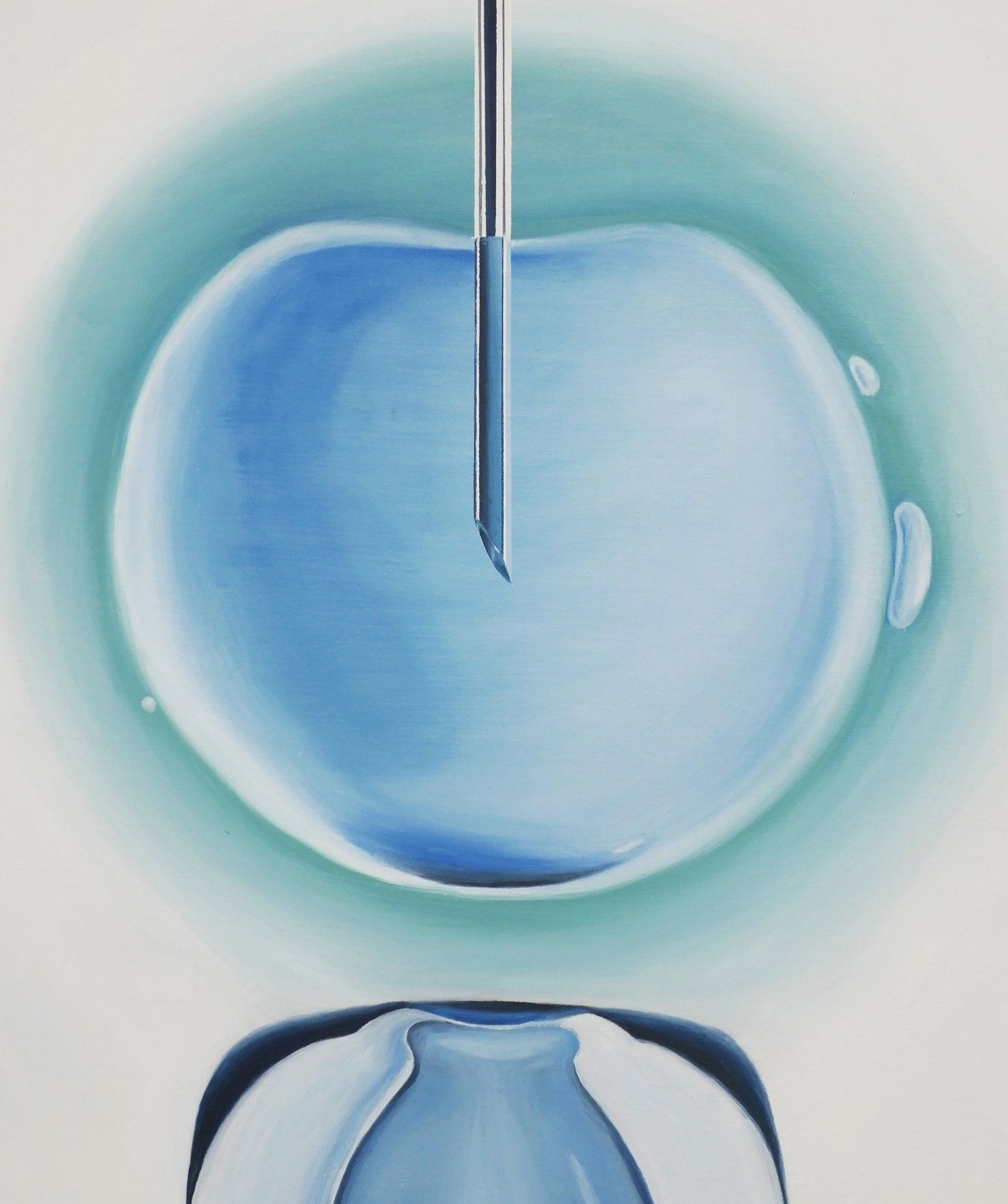
The pairing of Embryo with IVF (2020) makes this ethical dimension more explicit. IVF depicts the moment of intervention, the needle entering the cell, the technological manipulation of the fertilization process. Embryo depicts the result, the cell that emerges from that manipulation, beginning the process of becoming a person. Together, the two paintings trace the arc of Tan Mu's investigation into biological origins, from the technology that assists conception to the biology that results from that assistance. The embryo in the painting is not the product of IVF specifically. It is any embryo, the generic category of the beginning of human life, the single cell from which every person who has ever lived has developed. But the context of the pairing makes the political valence of the image unavoidable. This is what assisted reproduction produces. This is what the technology makes possible. This is the beginning of the person that the technology helps to create, held in the same quality of attention that Tan Mu brings to every other subject in her practice of painting the invisible visible.
Yiren Shen, writing about Tan Mu's Signal series in 2025, observed that her paintings consistently operate at the intersection of scientific precision and philosophical ambiguity. "Tan Mu does not illustrate scientific concepts," Shen wrote. "She inhabits them, working through them in paint in a way that neither simplifies the science nor resolves the philosophical questions it raises." Embryo is a perfect example of this approach. The painting is scientifically informed without being a diagram. It is philosophically suggestive without being didactic. It asks the viewer to consider the beginning of a human life with the same quality of attention that the painting itself embodies, the sustained, careful looking that reveals layers and structures and possibilities that a quicker engagement would miss. The embryo is at the center of the canvas, surrounded by the dark ground, waiting to be seen.