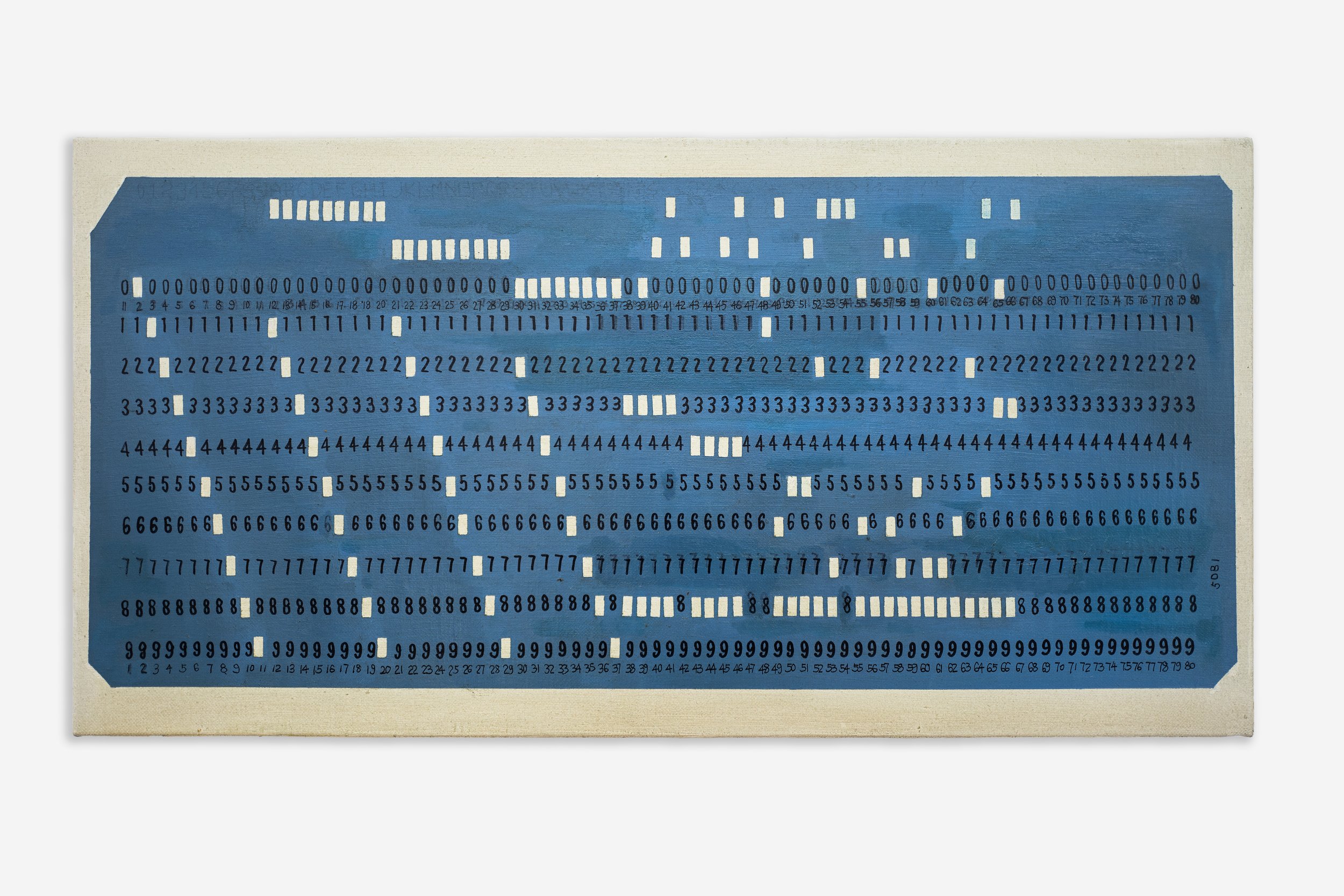
The Hole That Means Something: Tan Mu's Punched Card 1 and the Body in the Machine
A keypunch operator sits at a machine the size of a small desk and types a letter, and the machine punches a rectangular hole in a stiff paper card at a position that corresponds to the letter that was typed, and the operator types another letter and the machine punches another hole, and the operator types another letter and another hole is punched, and the process continues until the card is full, until all eighty columns have been punched or left blank, and each column contains twelve rows, and each row can be punched or not punched, and the pattern of punches and blanks in each column encodes a single character, a letter or a number or a punctuation mark or a special symbol, and the encoding is not arbitrary, it follows a standard that was established by Herman Hollerith in the 1890s and that was refined by IBM into the 12-row/80-column format that became the dominant standard of the twentieth century, and the standard means that any card punched on any keypunch machine can be read by any tabulating machine, and the interchangeability of the card is what made the system work, because a card that can only be read by one machine is not a data medium, it is a private language, and the punched card was not a private language, it was a public language, a language that any machine could read, a language that translated the intention of the human typist into the execution of the machine, and the translation occurred through the hole, through the rectangular opening in the stiff paper, through the presence or absence of material at a specific position, and the hole is the smallest possible unit of information, it is a bit, it is a one or a zero, a presence or an absence, a something or a nothing, and the translation of human intention into a pattern of holes in a paper card is the first act of digital encoding, the first moment when a human being communicated with a machine through a code that the machine could interpret without human intervention, and this moment, which occurred in the 1890s and which continued through the 1980s and which ended when the punched card was replaced by magnetic tape and then by the floppy disk and then by the hard drive and then by the flash drive and then by the cloud, is the moment that Tan Mu has returned to in Punched Card 1 (2022), a painting of a punched card, a painting of the first medium of human-machine interaction, a painting of the hole that means something.
Punched Card 1 is oil and acrylic medium on linen, 30 x 61 cm (12 x 24 in). The format is horizontal and narrow, wider than it is tall, and the proportions match the proportions of a punched card, which is a rectangle that is roughly twice as wide as it is tall, and the match between the proportions of the painting and the proportions of the card is not incidental, it is a decision, a decision to make the painting the same shape as the thing it depicts, and the decision produces an effect that is different from the effect of a painting that imposes its own proportions on the thing it depicts, because a painting that is the same shape as a punched card is a painting that presents itself as a punched card, that occupies the visual field in the way that a punched card occupies the visual field, that is read from left to right and from top to bottom in the way that a punched card is read from left to right and from top to bottom, and the surface of the painting is divided into a grid of columns and rows, and the columns are rendered as thin vertical lines and the rows are rendered as thin horizontal lines, and the intersections of the lines create the cells where the holes would be punched, and some of the cells are filled with dark marks that represent the punches and some of the cells are left empty that represent the blanks, and the pattern of marks and blanks across the surface of the painting encodes information in the same way that the pattern of punches and blanks across the surface of a card encodes information, and the information that the painting encodes is the information that was on the original card from which the painting was made, and the painting is a transcription of the card, a manual copy of a mechanical original, a hand-painted version of a machine-punched document, and the contrast between the manual and the mechanical is the contrast that animates the painting, because the punched card was designed to be produced by a machine and read by a machine, and the painting was produced by a hand and is read by an eye, and the translation from machine to hand, from punch to brushstroke, from hole to mark, is a translation that reverses the original direction of the encoding, because the original encoding went from human intention through the keypunch machine to the punched card, and the painting goes from the punched card through the painter's hand to the viewer's eye, and the reversal is not a negation but a reflection, a reflection on the act of encoding and the act of painting and the relationship between the two, because painting is also an act of encoding, it is also the translation of intention into mark and mark into meaning, and the painter who stands in front of a blank canvas and decides where to place a mark is performing the same operation as the keypunch operator who sits at the machine and decides where to punch a hole, the operation of translating intention into a code that can be read by someone who was not present when the intention was formed.
Jasper Johns painted 0 through 9 in 1961, and the painting depicts the numerals zero through nine superimposed on one another in a single field, each numeral painted in a different color and overlaid on the others so that the forms intersect and overlap and the viewer must sort out which stroke belongs to which numeral, and the effect is not one of confusion but of density, the density of the numerical system, the density of the symbols that we use to count and measure and encode, and the numerals are not represented as they appear in a typeface or a sign or a clock face, they are represented as painted forms, as shapes made by a hand that has chosen a particular way of rendering each curve and each straight segment, and the choice of rendering is the painting's content as much as the numerals themselves, because Johns is not painting the idea of numbers but the experience of numbers, the experience of seeing a numeral and recognizing it as a numeral and at the same time seeing it as a painted shape, as a collection of brushstrokes that have been applied to a surface in a particular order and with a particular intention, and the superimposition of the ten numerals is an argument about the relationship between the numeral as a symbol and the numeral as a painted form, an argument that the symbol and the form are not separate but simultaneous, that every numeral is both a sign that means something and a mark that is something, both a code and a surface, both information and paint.
The relationship between Johns's superimposed numerals and Tan Mu's painted punched card is a relationship of structural parallel, because both works take a system of encoding and make it the subject of painting, both works treat a code as a visual object rather than a transparent medium, both works ask the viewer to look at the code rather than through it, and the punched card, like the numeral, is both a sign that means something and a mark that is something, both a pattern of holes that encodes information and a pattern of marks on a canvas that encodes paint, and the painting makes this doubleness visible by rendering the code in a medium that is not the code's own medium, by translating the punched card from paper and hole into oil and linen, by replacing the mechanical precision of the keypunch with the manual precision of the brush, and the replacement is not an imitation but a transformation, because the painted punched card is not a copy of a punched card, it is a painting of a punched card, and the difference between a copy and a painting is the difference between a document and a work of art, the difference between a record and an interpretation, the difference between information that is preserved and information that has been seen and thought about and rendered by a hand that has its own reasons for placing each mark where it places it, and the hand's reasons include the reasons of the keypunch operator who punched the original card, because the painter is following the same pattern, making the same marks at the same positions, reproducing the same information, but the hand's reasons also include the reasons of the painter, who has chosen to reproduce this information in this medium at this scale at this time, and the choice is the content of the painting as much as the information is, because the choice tells us something about the relationship between the human body and the machine, between the hand that makes the mark and the machine that punches the hole, between the physical and the digital, between the era when information was a pattern of holes in a paper card and the era when information is a pattern of charges in a silicon chip, and the painting of the punched card is a bridge between these eras, a bridge that is also a painted surface, a surface that carries information in the same way that the card carries information, by encoding it in a pattern of marks that can be read by anyone who knows the code, and the code of the painting is the code of painting itself, the code of oil and linen and brush and hand, the code that says, here is a mark, and the mark means something, and what the mark means is not only the information that it encodes but the act of encoding itself, the act of translating intention into mark, the act of the human printer.
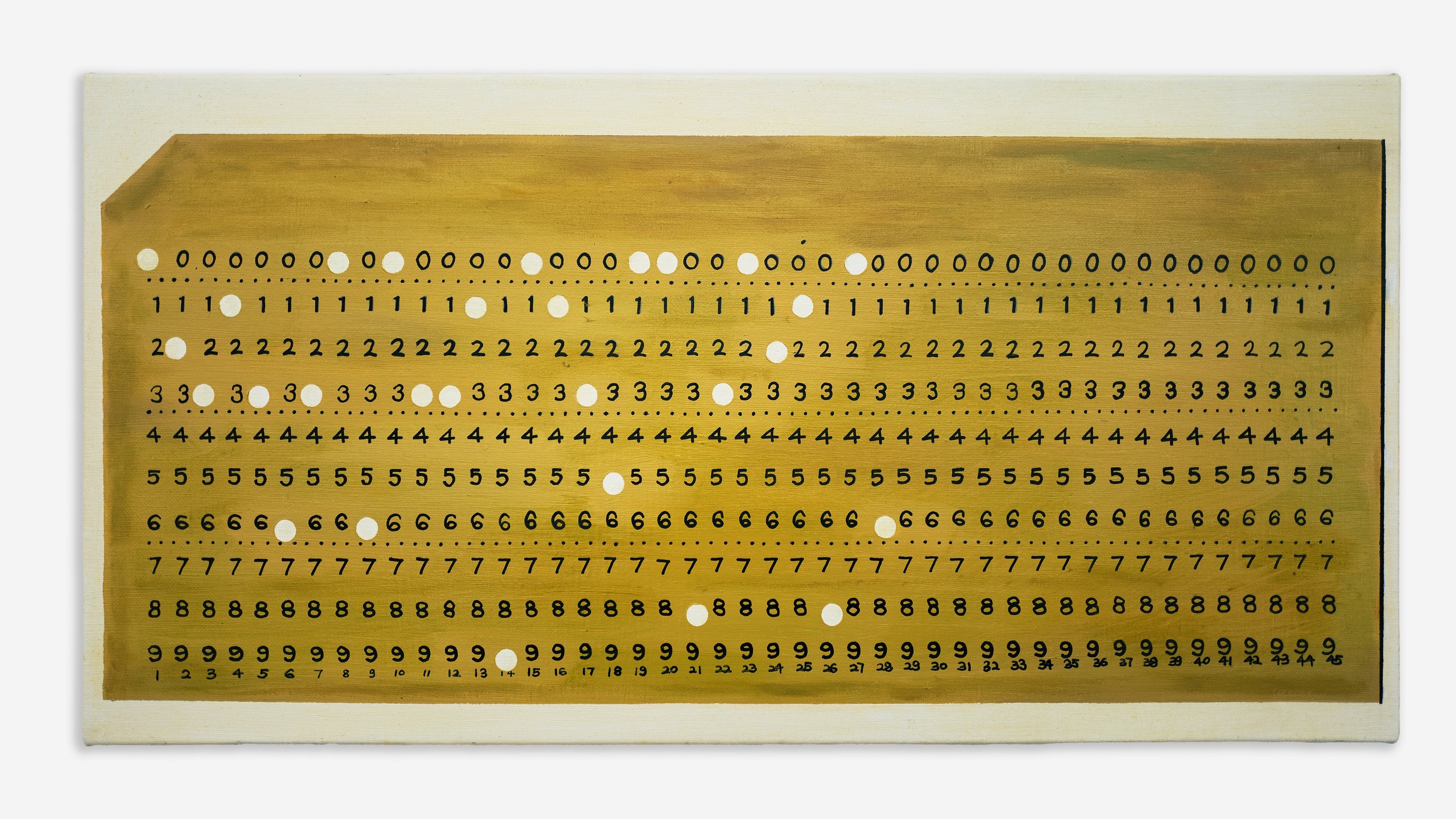
The punched card was invented by Herman Hollerith in the late 1880s as a method of recording and tabulating data for the 1890 United States census, and the invention was prompted by a problem that the census bureau had encountered in the 1880 census, which took seven years to tabulate by hand, and the bureau recognized that the 1890 census, which would collect data from a population of approximately 63 million people, would take even longer unless a mechanical method of tabulation could be found, and Hollerith, who was a statistician and an engineer, proposed a system based on punched cards, in which each card represented one person and each hole in the card represented one data point, and the cards were read by a tabulating machine that used electrical contacts to sense the presence or absence of a hole at each position, and the tabulating machine could count the cards that had a hole at a particular position and could sort the cards into categories based on the patterns of holes, and the system reduced the time required to tabulate the census from seven years to two years, and Hollerith founded the Tabulating Machine Company to commercialize his invention, and the Tabulating Machine Company later became IBM, and the punched card became the standard medium for data processing for the next seventy years, and the IBM 12-row/80-column card, which was introduced in 1928 and which became the format that most people think of when they think of a punched card, was the physical substrate on which the modern computing industry was built, because the first digital computers, the Harvard Mark I and the ENIAC and the IBM 701 and all the machines that followed, used punched cards as their primary input medium, and the programs that ran on these machines were encoded on decks of punched cards that were fed into card readers, and each card in the deck represented one line of code or one data record, and the deck was a physical object that could be carried from one room to another and from one machine to another, and the physicality of the deck was not incidental, it was the condition of early computing, because the program was a thing that you could hold in your hand and drop on the floor and lose and reconstruct, and the physicality of the medium meant that the act of programming was also a physical act, the act of punching the cards and ordering the deck and carrying the deck to the reader and feeding the deck into the machine and waiting for the machine to read the deck and execute the program and print the results on a printer that was also a physical object in the same room, and the entire process, from the intention of the programmer to the output of the machine, passed through the body of the programmer and the body of the keypunch operator and the body of the machine operator, and the body was present at every stage, and the body is what Tan Mu has returned to in painting the punched card, because the painting of the card is not only a painting of a data medium but a painting of the body that produced the data medium, the body of the keypunch operator who sat at the machine and typed the letters and punched the holes, and these operators were, in the early decades of computing, predominantly women, and Tan Mu has spoken of her "interest in early computation and the often unacknowledged labor behind it, particularly the role of women," and the women who operated the keypunch machines were the first data entry workers, the first humans whose labor was absorbed by the computing industry, the first bodies that were organized by the rhythm of the machine, and the painting of the punched card is also a painting of these bodies, a painting of the hands that punched the holes, a painting of the labor that the card records but does not name.
Hanne Darboven began making her numerical constructions in the mid-1960s, and the works consist of sheets of paper that have been covered with numbers, numbers that have been written by hand in a script that is neat and regular and almost mechanical in its consistency, and the numbers are arranged in grids and sequences and patterns that follow mathematical rules that Darboven has devised, and the rules are not arbitrary, they are algorithms, they are instructions for generating sequences of numbers according to specific procedures, and the procedures produce results that can be verified by anyone who applies the same rules to the same starting conditions, and the sheets of paper that result from these procedures are not drawings or paintings in the conventional sense, they are records of calculation, they are the visible trace of a process that has been executed according to a set of rules, and the trace is not the result of inspiration or expression or creative decision, it is the result of following instructions, the result of a body that has been organized by a system, and Darboven spent decades executing these systems, filling thousands of sheets of paper with numbers that have been generated by algorithms that she designed and then executed by hand, and the execution by hand is the point, because the same algorithms could have been executed by a computer, the same sequences could have been generated by a program, the same sheets of numbers could have been printed by a machine, and Darboven chose to execute them by hand, chose to spend hours and days and weeks writing numbers on paper, chose to make her body the instrument of the calculation, chose to be the machine that the algorithm specifies, and the choice is not a rejection of the machine but a reflection on the machine, a reflection on what the machine does and what the body does when the body does what the machine does, a reflection on the relationship between the algorithm and the execution, between the instruction and the performance, between the code and the body that carries the code, and the reflection is the same reflection that animates Punched Card 1, because Tan Mu has also chosen to execute by hand a process that was designed to be executed by machine, has also chosen to transcribe a code that was designed to be read by machine into a medium that can only be read by eye, has also chosen to make her body the instrument of the encoding, has also chosen, as she has said, to think of herself as "a human printer and an archaeologist," and the human printer is the body that does what the machine does, and the archaeologist is the mind that looks at what the body has done and asks what it means, and the punched card that Tan Mu has painted is the artifact that the archaeologist has found, the trace of a system that once organized the bodies of the keypunch operators and the tabulating machines and the programmers and the data processors and the entire industry that grew from Hollerith's invention, and the painting of this artifact is the act of finding it, the act of recognizing it as something that deserves attention, the act of translating it from a mechanical object into a painted surface, the act of giving it a second life as a work of art, and the second life is not a metaphor for the first life, it is a continuation of the first life, it is the life that the punched card continues to live in the era of the cloud, the era in which information is no longer encoded in holes in paper but in charges in silicon and in signals in fiber and in packets in transit across the network that Tan Mu has also painted, the submarine cables and the satellite views and the signal networks that carry the same information that the punched card once carried, the information that the human body encoded for the machine and that the machine decoded for the human, and the painting of the card is a painting of this exchange, a painting of the moment when the hand met the machine and the machine met the hand and the hole was punched and the information was encoded and the body was present at the origin of the digital, and Yiren Shen, writing in 10 Magazine in August 2025, observed that "in the increasingly overwhelming deluge of digital images, the role of painting as a means of documenting and witnessing appears to be exceedingly precious," and the preciousness is the preciousness of the body in the machine, the body that punches the hole and the body that paints the mark and the body that stands in front of the painting and reads the code that the mark encodes, the body that is the first and last medium of all information, the body that encodes and decodes and carries and delivers the signals that pass through the cables and the cards and the paintings, the body that is present at the beginning and present at the end, the body that is the hole and the mark and the meaning, the body that is the human printer and the archaeologist and the viewer, all at once, in the same room, looking at the same painting, reading the same card, standing at the point where the physical becomes digital and the digital becomes physical and the hand that punches the hole and the hand that paints the mark and the eye that reads the painting are all doing the same thing, which is translating intention into form and form into meaning and meaning into the experience of standing in front of a painted surface and seeing the code that the surface carries, the code that was punched by a machine and painted by a hand and read by an eye, the code that is the record of the first act of digital encoding, the code that is the hole that means something.