The Distance the Atmosphere Holds: Tan Mu's Horizons 02 and the Color of the View from Orbit
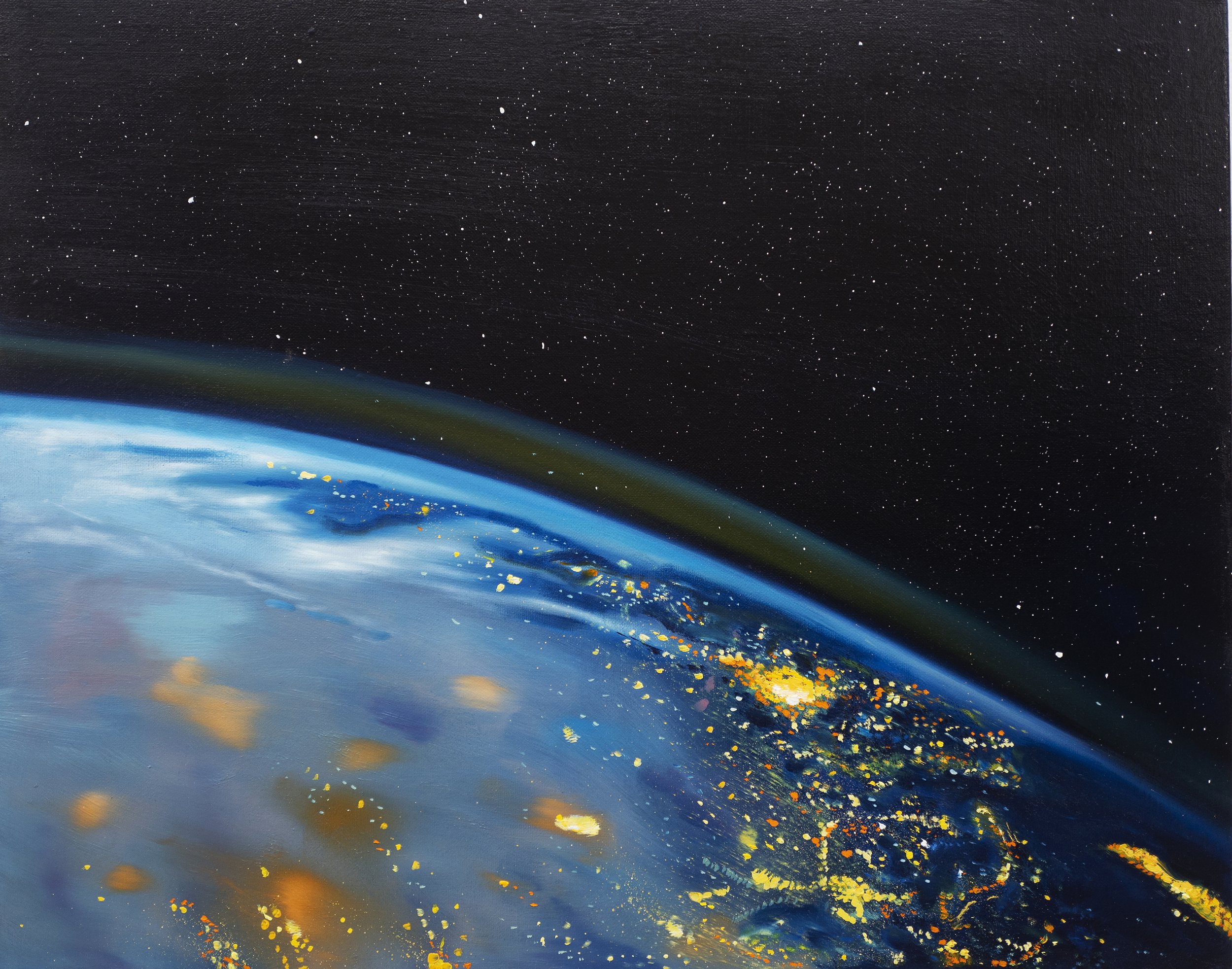
At six inches from the surface, the painting is all grain and deposit. The linen weave shows through where the oil has been laid thin, a pale grid visible beneath washes of cerulean and cadmium orange that bleed into each other at their margins without quite mixing. In some passages, the pigment has been worked so thin that the fabric reads as sky, its horizontal threads becoming cloud strata, a scaffolding for atmosphere. Elsewhere, the paint thickens into small accretions, pale marks clustered against a deeper field, each one a discrete gesture of the brush, each one deposited with enough body to cast a faint shadow when the light rakes across the surface. Step back to arm's length and those marks resolve. The pale clusters cohere into city lights seen from above, their warmth pressing upward through a membrane of atmosphere that separates the illuminated human grid from the cold dark of orbital space. Step back further still, and the painting becomes what it most resembles: a view from the International Space Station, four hundred kilometers above the surface, where the entire weight of the atmosphere compresses into a band no thicker than a pencil line drawn along the curve of the Earth.
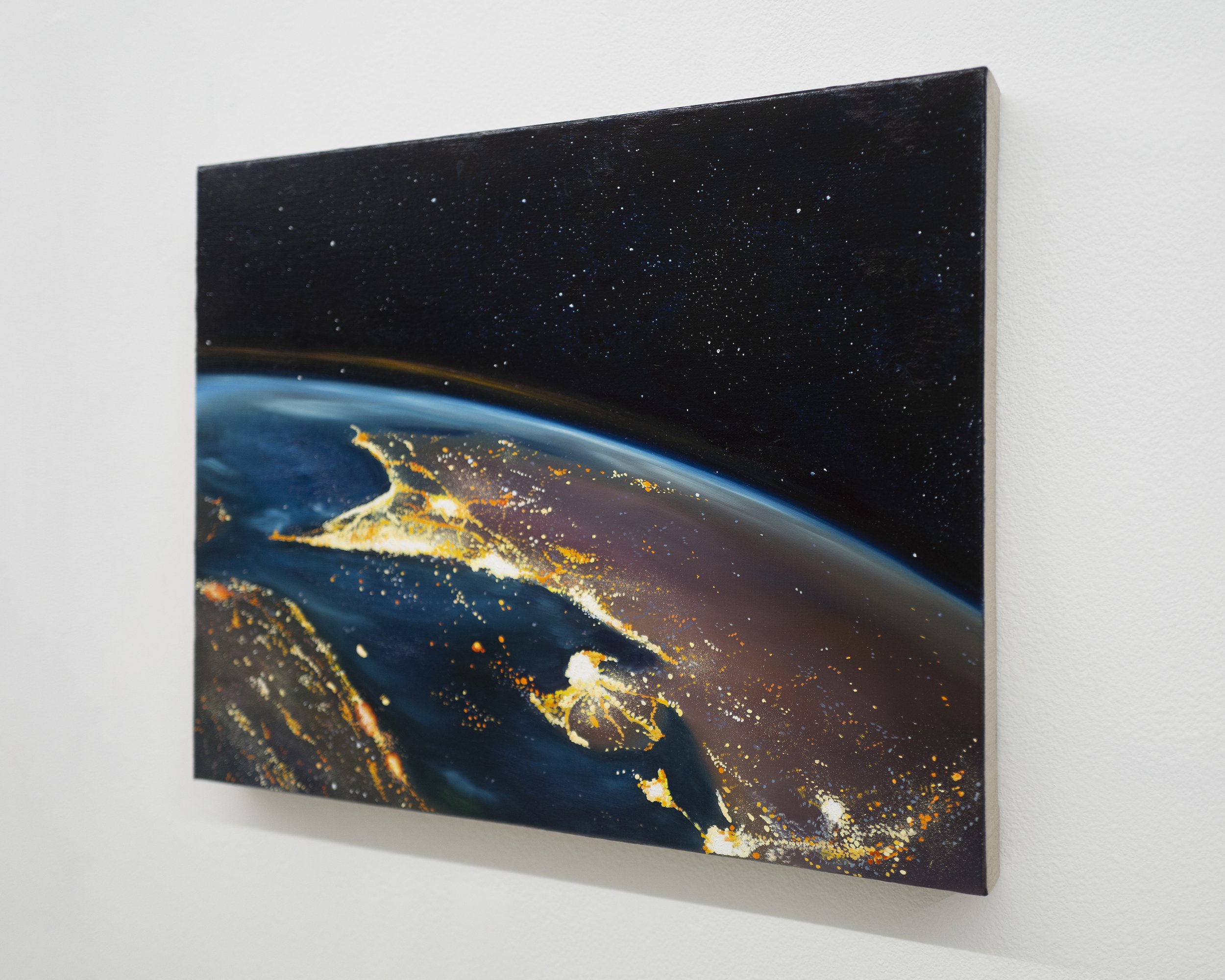
Horizons 02 (2024) is one of a series. Oil on linen, 41 x 51 cm, it is among the smaller works in Tan Mu's practice, modest in scale where the Signal paintings spread across a meter and a half of linen, intimate where other works insist on distance. The dimensions matter. At roughly sixteen by twenty inches, the painting can be held in the lap. It occupies the same spatial register as a book, a letter, a photograph kept in a desk drawer. This is not the panoramic format that satellite imagery naturally invites. There is no sweep, no cinematic expanse. Instead, the composition compresses an orbital perspective into a format designed for close viewing, a choice that makes the viewer's body part of the equation. The painting asks you to lean in. The closer you get, the more its atmosphere dissolves into material. The further you stand, the more the material reconstitutes as an image of something seen from very far away. This oscillation between surface and subject, between the grain of the linen and the curvature of the planet, is the painting's engine.
The palette is restricted but not austere. A band of deep indigo occupies the upper third, shot through with finer concentrations of color that read, at distance, as star fields or, depending on the viewer's willingness to shift register, as the faint luminescence of cities on the far side of the horizon. Below the indigo, a gradient of cerulean and pale cobalt defines the atmosphere, thinning as it approaches the curve of the Earth where the air gives way to black. At the lower edge, warm clusters of Naples yellow and burnt sienna glow against the blue, their placement irregular but never random, each one registering a concentration of human habitation as seen from a satellite's altitude. The warmth of those lights against the surrounding cool is the painting's emotional fulcrum: every city is a point of heat, every cluster a signal that someone is awake, that a grid is operating, that ten million windows are lit at the same hour. The contrast between the warm ground and the cool atmosphere is not decorative. It is structural. It makes visible the boundary between the world people inhabit and the void that surrounds it, and it makes that boundary feel permeable rather than fixed, a membrane rather than a wall.
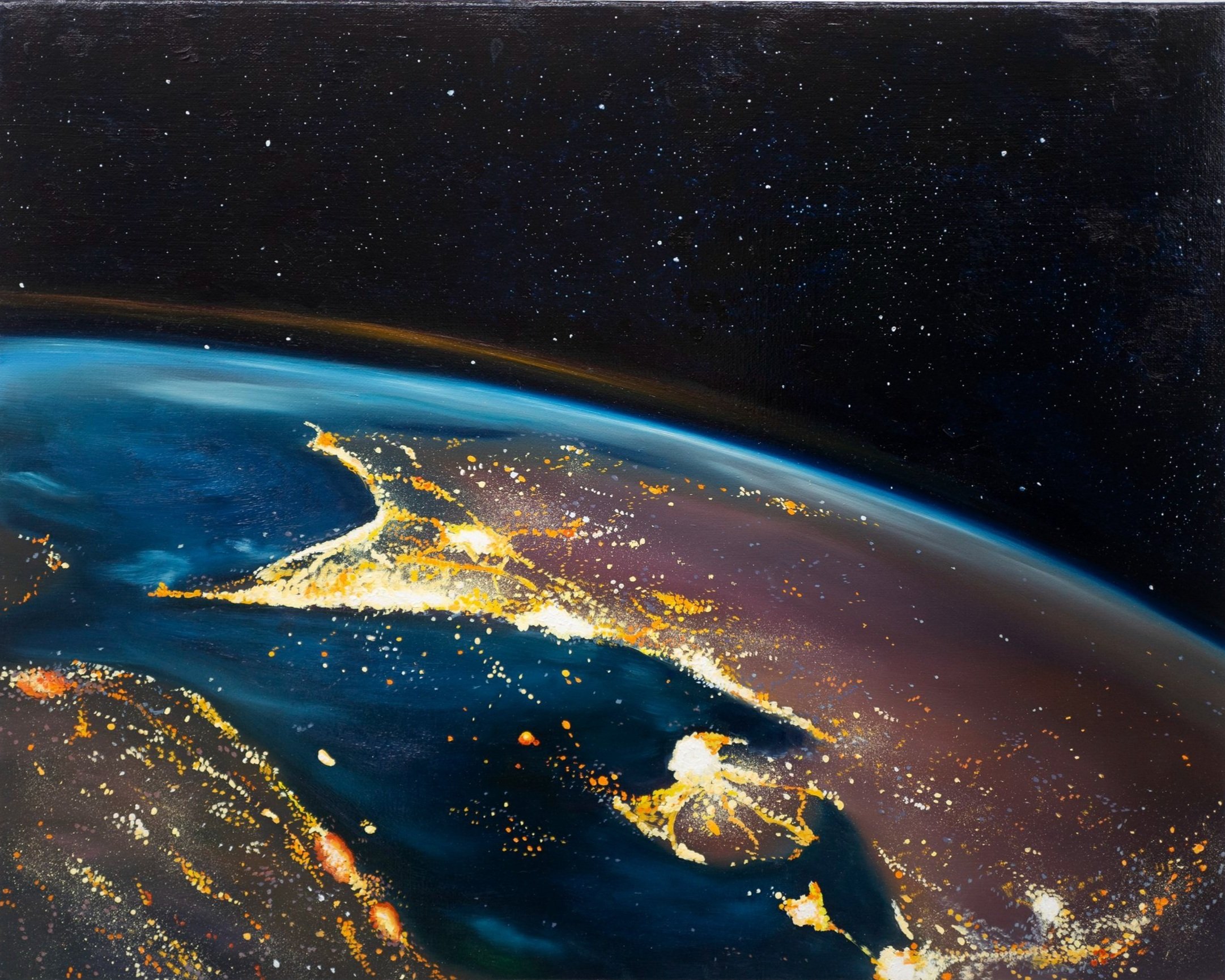
The surface texture reinforces the conceptual structure. In the atmospheric zone, the oil has been dragged and blurred, producing the soft transitions that atmospheric scattering produces in reality, where molecules of nitrogen and oxygen intercept and redistribute photons across wavelengths, turning direct sunlight into the diffuse blue of daytime and the long reds of dusk. Tan Mu achieves this not by airbrushing or masking but by working wet paint with a broad flat brush, pulling one color into another across the tooth of the linen, a method that leaves fine parallel striations in the surface visible only at close range. These striations are the record of a hand moving across a surface, and they introduce a temporal dimension that satellite imagery lacks. The satellite captures an instant. The brushstroke records duration. Every passage of blue that shades into amber is the trace of a decision made in time, a hand adjusting pressure, a wrist rotating to modulate the edge. The painting holds the time of its making in a way that the source photograph does not, and that temporal thickness is part of its argument. It insists that the view from orbit, however technologically mediated, can still be made by hand, can still carry the register of a body that experienced it through the slow accumulation of pigment.
Hiroshi Sugimoto's Seascapes (1980-ongoing) share with Horizons 02 a commitment to the horizon as a structural element, a dividing line that organizes the entire field of the picture. Each Seascape is bisected by a thin, sharp horizon where sea meets sky, and each is shot in exactly the same format, with the same exposure time, from the same distance above the water, at locations ranging from the Baltic to the Caribbean to the Yellow Sea. The horizon in Sugimoto's photographs is a constant. What changes is the distribution of light, the tonal relationship between upper and lower halves, the weather of a particular morning on a particular body of water. Sugimoto has described these works as attempts to recover an original, prehistoric horizon, the line that separated water from air before any human name was attached to either element. The format is so rigid, so unvarying, that variation becomes the content: the viewer is forced to notice minute differences in grey, in the density of fog, in the way the horizon sharpens or dissolves depending on atmospheric conditions.
Tan Mu's horizon operates differently, though the structural commitment is comparable. Where Sugimoto's horizons are recorded in the instantaneous click of a large-format shutter, Tan Mu's are built in layers over days or weeks, each one an interpretation rather than a transcription. Where Sugimoto keeps the camera at sea level, rooted in the same bodily position as a person standing on a beach, Tan Mu elevates the viewpoint to the orbital, adopting the perspective of a satellite or a space station. This is not a minor formal shift. It changes what the horizon means. At sea level, the horizon is a limit. It marks the farthest point the eye can reach before the curvature of the Earth bends the surface out of view. From orbit, there is no horizon in that sense. There is instead a limb, a thin bright line where the atmosphere refracts sunlight, and beyond it, the Earth falls away into shadow. Tan Mu paints this limb, not as a line but as a gradient, a zone where color changes over a distance measured in pixels on the canvas. The horizon in Horizons 02 is not a boundary you stand before. It is a membrane you are already above. The painting places the viewer in a position no unaided human body can occupy, and it makes that position feel not exhilarating or terrifying but contemplative, a place of sustained attention rather than vertiginous spectacle.
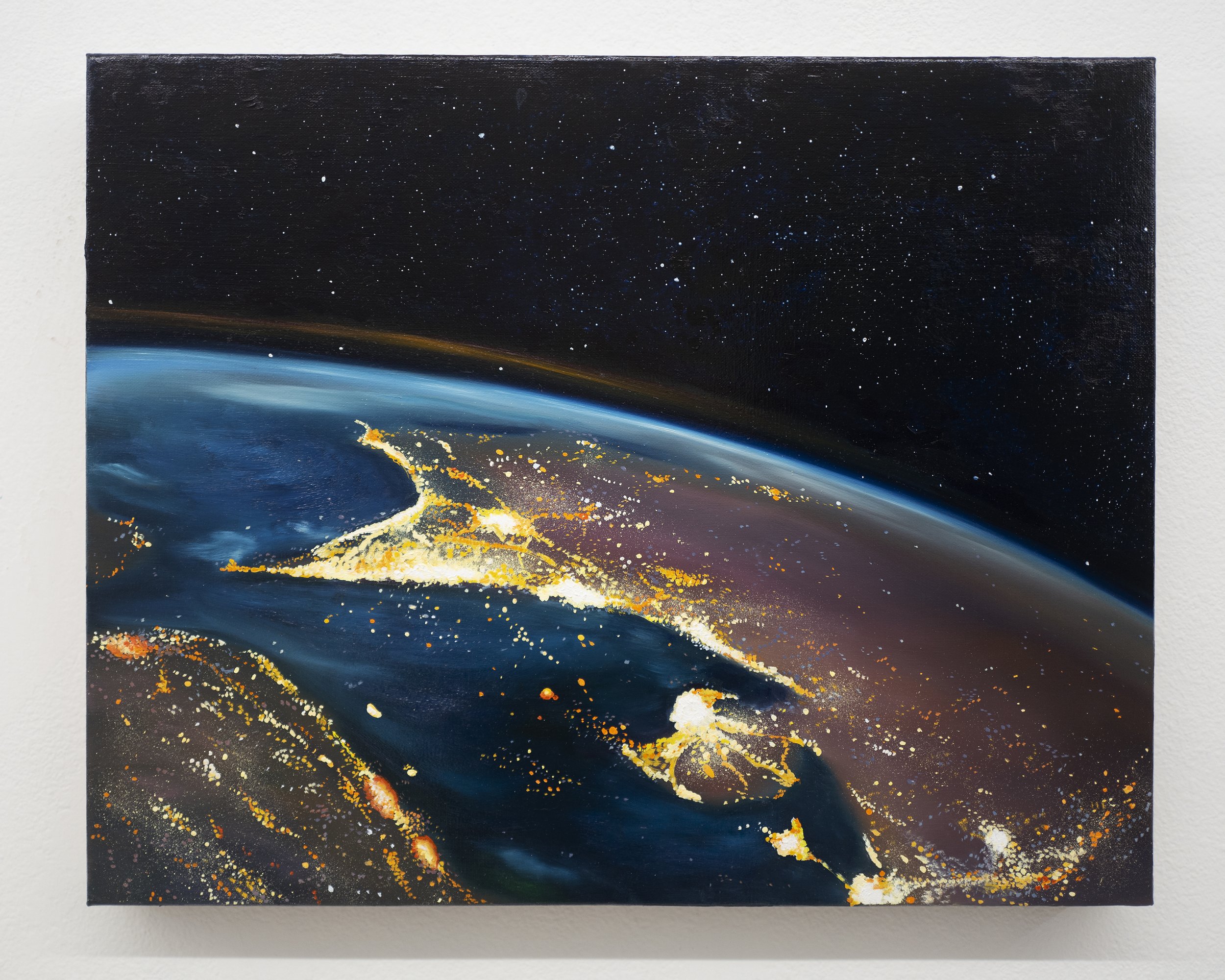
The source material for the Horizons series is satellite and International Space Station imagery. The tanmustudio.com archive states that the series "draws inspiration from the International Space Station, offering a transformative perspective on humanity and Earth," capturing "the radiant lights of megacities and the dreamlike reflections of Earth's atmosphere." Tan Mu has described this as a "panoramic gaze" enabled by technology, one that "fosters collective awareness and redefines landscape art, offering a cosmic-scale reexamination of human existence." The language she uses to frame the work is precise: the satellite perspective is not merely a vantage point but an ethical one. It reveals patterns of habitation and illumination that cross political borders, that show the species as a continuous presence rather than a collection of sovereign territories. When the ISS orbits over Europe at night, the camera registers a web of light stretching from Lisbon to Istanbul, unbroken by the lines that separate nations on maps. Tan Mu's city lights in Horizons 02 are painted with that continuity in mind. They are not pinned to specific cities. They register as a condition of habitation, a luminous signature that the species leaves on the surface of the planet, visible from space, visible in the painting, visible as paint.
The International Space Station orbits at approximately 408 kilometers above the Earth. It completes one orbit every ninety minutes, which means its crew sees sixteen sunrises every twenty-four hours. The view from its cupola, the seven-windowed observation module, shows the planet in continuous transformation: dayside and nightside, ocean and landmass, the terminator line sweeping across continents as the station races overhead. Astronauts consistently report what is called the overview effect, a cognitive shift in which the fragility and thinness of the atmosphere becomes viscerally apparent. The Earth's atmosphere, which appears boundless from the ground, compresses into a layer only a few kilometers thick when viewed from above, a sliver of blue against the black that sustains every living thing. This is the band of cerulean and cobalt that Tan Mu paints in the center of Horizons 02, and its thinness is the painting's most consequential visual fact. The atmosphere is not a backdrop. It is the thinnest possible membrane between life and its absence, and the painting registers this by giving the atmospheric gradient only a fraction of the canvas's vertical space. Below it, warmth and habitation. Above it, darkness. The ratio is not illustrative. It is constitutive of the work's meaning.
Tan Mu's personal connection to elevated observation runs deeper than the satellite imagery suggests. Her maternal grandfather worked at a meteorological station, calibrating weather detection equipment and reading atmospheric data, and through him she learned to read weather patterns and understand the sky as a system of measurable forces rather than an abstract canopy. Later, during her studies at Alfred University, she lived near the Stull Observatory, one of the oldest private observatories in the United States, and attended weekly observation sessions where she looked through telescopes at celestial bodies. She has described her first sight of the moon through a telescope as a moment that "fundamentally shifted my perception of scale and distance, and altered how I understood humanity's position within the universe." Horizons 02 is not an illustration of that experience. It is a translation of it into a different medium, one where the time of painting replaces the instant of the photograph, where the hand replaces the lens, where the atmospheric gradient is mixed on a palette rather than captured by a sensor.
Alex Katz's landscape paintings from the 1990s and 2000s offer a useful contrast. Works such as Black Brook (1998) and the vast Winter Landscape series reduce the natural world to flat planes of color bisected by a horizon, with foreground and background distinguished by value shifts so subtle that the eye searches for the seam where one zone ends and the next begins. Katz's horizons are declarative. They occupy the full width of the canvas and divide it with the authority of a factual statement: this is where land meets sky. The paintings are fast in their effect. They deliver their impression immediately, and the immediacy is the point. Katz has spoken about wanting his paintings to be seen in a flash, the way a billboard is seen from a moving car, and the format and scale serve that speed.
Tan Mu's horizons operate on the opposite temporal logic. They are slow paintings that reward extended looking. The atmospheric gradient in Horizons 02 does not snap into focus from across the room. It requires the viewer to approach, to spend time, to notice how the cerulean modulates into a cooler grey at the upper edge and warms toward the lights below. The distinction is not simply a matter of style. It reflects a different understanding of what the horizon is for. In Katz, the horizon is a fact of landscape, a given of the visual field that the painter acknowledges and moves past. In Tan Mu, the horizon is the subject. It is not the line that divides earth from sky but the membrane where atmosphere becomes visible, where the conditions that make life possible become legible as color. Katz compresses perception into an instant. Tan Mu stretches it into duration. Both are legitimate strategies. But the slowness of Tan Mu's painting has a specific payoff: it mirrors the time it takes to actually see what the ISS camera records. The footage from the cupola is not a single frame but a continuous stream, and the atmospheric limb shifts color as the station moves from dayside to nightside, from the gold of sunset to the blue of noon to the deep indigo of orbital night. Tan Mu's layered surface holds all of those moments at once, not sequentially but simultaneously, the way a single glance at the painting can register the warmth of the city lights and the cold of the space above them in the same instant, the way the planet itself presents both at once to an observer in orbit.
Yiren Shen, writing in 10 Magazine about the BEK Forum exhibition, describes Tan Mu's process with a specificity that applies directly to Horizons 02. "The underpainting is created spontaneously," Tan Mu told her, "but when painting specific areas, I overlay another layer to reflect the underwater terrain before mapping the cable routes." The Signal paintings use this method for a different purpose, but the underlying logic transfers. The underpainting, executed with speed and intuition, establishes the atmospheric color field. The overlay, applied with deliberation, places the specific marks that read as city lights, as stellar concentrations, as the fine luminous points that make the painting recognizable as a view from above. The two registers, spontaneous and deliberate, correspond to two kinds of vision. The underpainting is the atmosphere as it is experienced: continuous, unmarked, a condition rather than a set of objects. The overlay is the atmosphere as it is measured: punctuated, specific, a collection of observable phenomena. The painting holds both, and the tension between them, the way the deliberate marks float on the spontaneous ground without fully merging, is what gives the surface its liveliness, its refusal to settle into either pure abstraction or pure representation.
The concept Tan Mu articulates for the series, that of the "panoramic gaze," extends beyond a description of perspective. She frames it as an ethical framework: "The panoramic gaze is not only a visual framework, but also an ethical one. It reminds us of the fragility of our planet and the shared conditions that bind humanity together within an infinite universe." This is a large claim for a painting measuring forty-one by fifty-one centimeters. The modesty of the format works against the grandeur of the claim, and that tension is productive. A mural-sized canvas depicting the Earth from orbit would rely on spectacle. The overwhelming scale would do the work of awe. At sixteen by twenty inches, Horizons 02 cannot rely on scale to produce its effect. It must produce awe through concentration, through the compression of an orbital vista into a format that can be held in the hands, the way a letter can be held, or a photograph, or any object whose power is inseparable from its intimacy. The painting is small enough that the viewer's face can be very close to it, close enough to see the weave of the linen, close enough that the boundary between painted atmosphere and the actual atmosphere of the room becomes uncertain. That is the distance at which the overview effect, or something adjacent to it, becomes available not as a concept read about in astronaut memoirs but as a perceptual event, a sudden register of how thin the color blue is, how little pigment stands between warmth and void.
What Horizons 02 finally registers is not a view of the Earth but a view of a view. It shows what it looks like to see the planet from a position that no unaided body can reach, and it makes that view available at the scale of personal correspondence. The city lights glow on the linen the way they glow on the night side of the planet, in clusters that suggest habitation without naming it, warmth without narrative. The atmosphere is a band of blue thin enough that you can feel its precariousness. And above it, the indigo goes on. The painting holds all three zones at once, the warmth below, the blue membrane, the cold above, and it holds them in a format that asks you to come close, to see the paint as paint before you see it as world, and then to see it as both at once, material and subject inseparable, the way the atmosphere and the planet it protects are inseparable, the way a mark on linen and a city at night are, from this distance, the same color.