The Self-Portrait of the Algorithm: Tan Mu's Fractal 3 and the Machine That Draws Itself
Nick Koenigsknecht, writing in the BEK Forum catalog, describes Tan Mu's paintings as "self-portraits of technology," works in which "the machine reveals its own face." The phrase locates something precise about the Fractal series: these are not paintings of fractals the way a portrait is of a face. They are paintings in which the fractal generates its own image through the artist's hand, producing a rendering that is simultaneously faithful to its mathematical source and estranged from it by the time and material of oil paint. A computer generates the Buddhabrot in milliseconds. Tan Mu renders it over weeks. The information content is the same. The experience of receiving it is not.
Fractal 3 (2019) is one of three paintings that inaugurated Tan Mu's mature practice. Together with No Signal and Off, also from 2019, these works established the terms that every subsequent series would extend: the translation of scientific or mathematical structures into the register of painting, the use of point and line as a vocabulary that migrates from data visualization to something closer to devotional mark-making, and the conviction that painting can do intellectual work that computation alone cannot. The Fractal series draws its subject from the Mandelbrot set and the Buddhabrot, two related mathematical objects that demonstrate how iterative application of a simple rule produces structures of bewildering complexity. What the painting makes visible is not just the form of the fractal but the slowness required to see it properly.
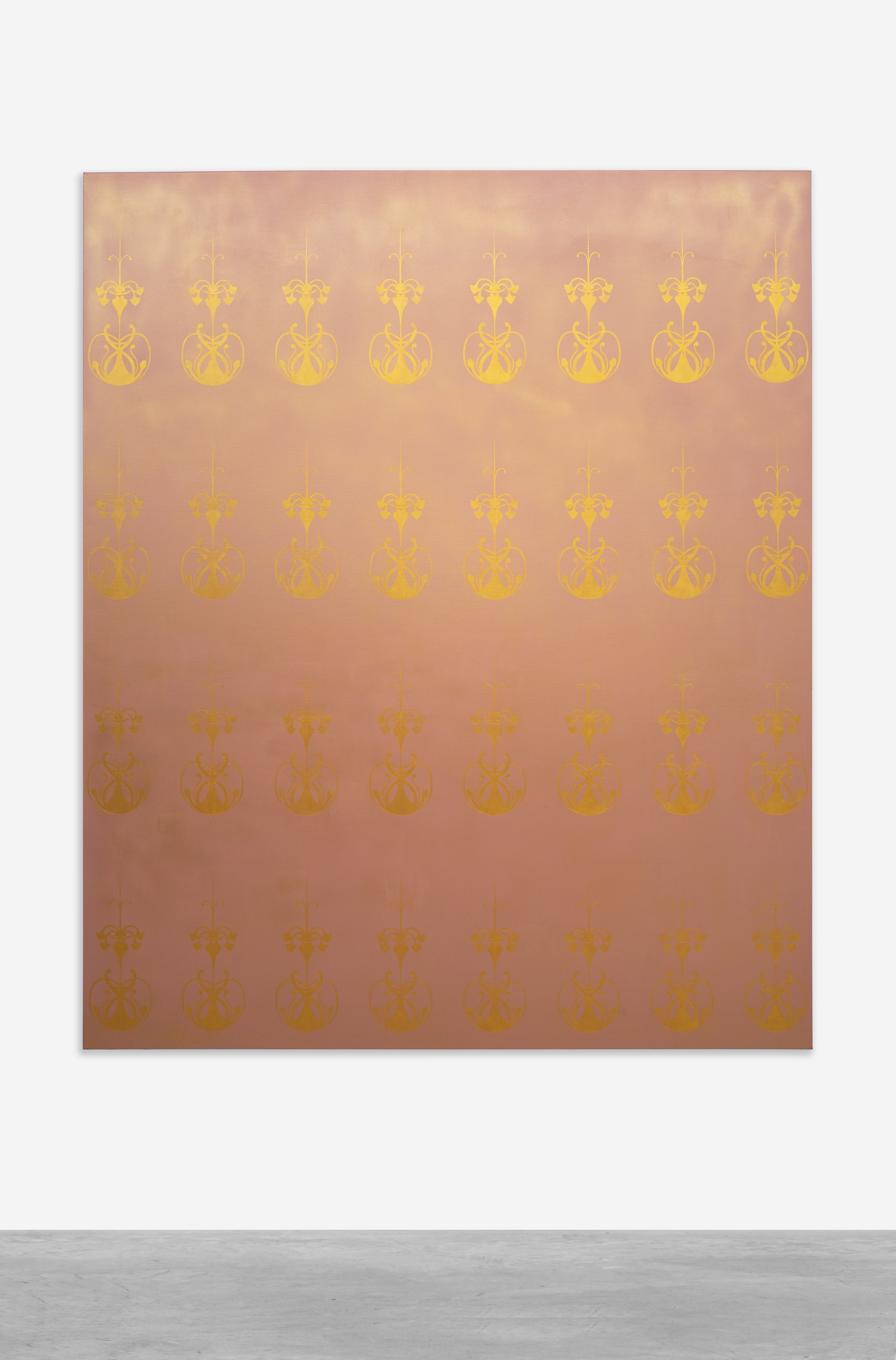
Oil and acrylic medium on linen, 72 x 60 inches (182.9 x 152.4 cm). The painting is large enough that a viewer standing at arm's length cannot take in the whole surface at once. The linen is prepared with a dark ground, a warm black or very deep umber, against which the fractal structure emerges in pale ochre, cream, and the faintest gray-blue. The central form of the Buddhabrot radiates from a dark vertical axis near the center of the canvas. Branching filaments extend outward and downward, their density varying in a way that reproduces the probability distribution of escaping trajectories: dense where many paths converge, sparse where few trajectories travel. The overall shape recalls a seated figure, which is precisely what Tan Mu observed when she first encountered the Buddhabrot. She has described the distribution as resembling "the posture and symbolic presence of classical Buddha figures," and the painting's central form sustains this reading without insisting on it. The resemblance is structural, not illustrative. The mathematical object and the meditating figure share a morphology because both express the same principle: concentration at the center, radiation toward the periphery, stillness that contains infinite internal motion.
The paint application moves between two registers. In the dense core, Tan Mu builds the surface in thin translucent layers of oil, producing a luminosity that reads as emanation rather than reflection. The paint seems to glow from within, as though the linen itself were the light source. This effect is technically demanding: each layer must dry before the next is applied, and the cumulative result depends on the precision of each stratum. In the outer branches, the marks become more discrete, individual gestures that retain the trace of the brush. Here, the fractal structure resolves into marks that a viewer can count, each one a separate decision about pressure, direction, and density. At this distance from the center, the painting shifts from an image of a mathematical object to a record of the painter's attention. The tension between these two registers, the luminous core and the gestural periphery, is one of the work's most productive ambiguities. It raises a question that the Fractal series as a whole keeps open: is the painting an image of the Buddhabrot, or is the Buddhabrot an image of the painting?
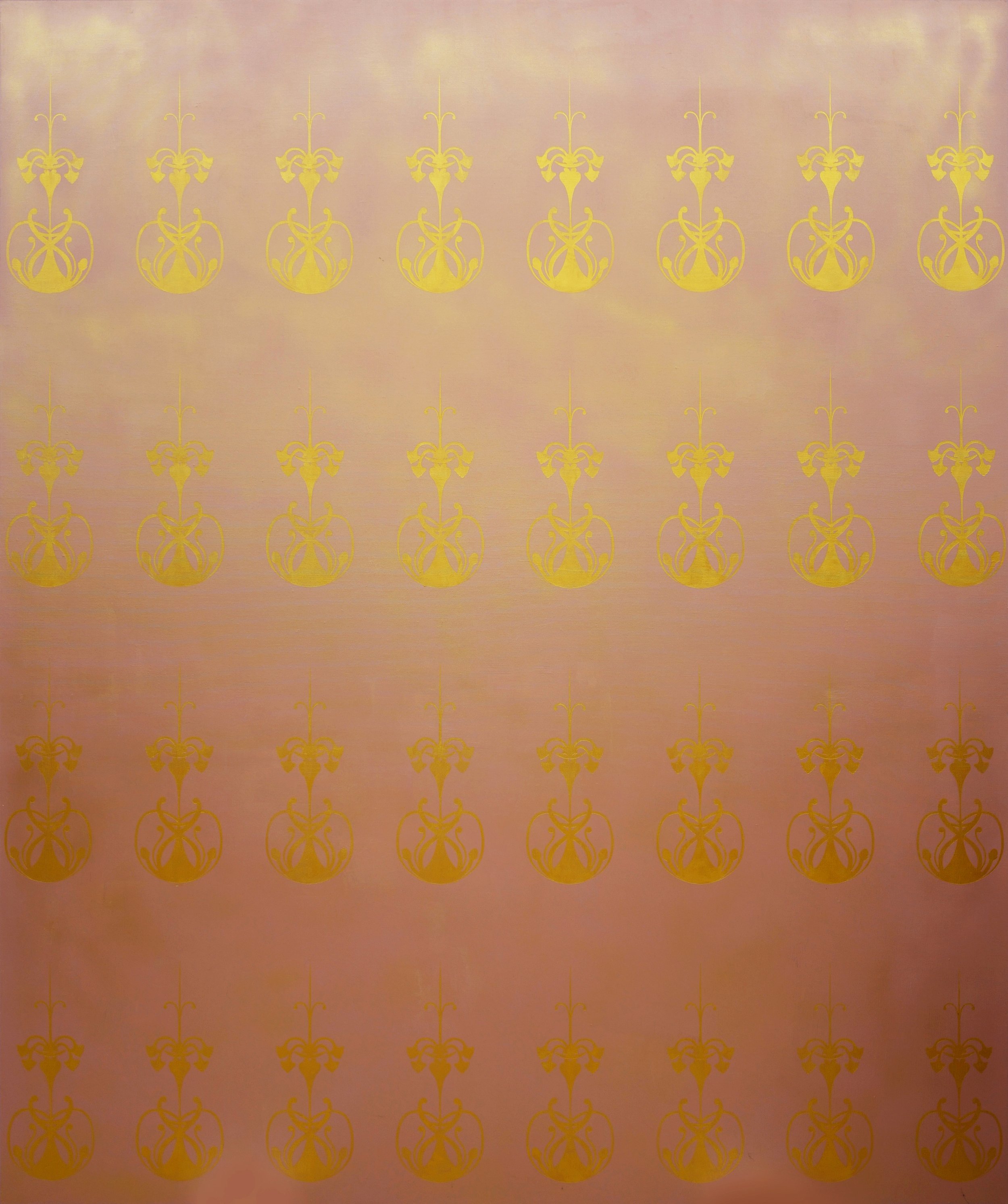
The acrylic medium plays a specific role in this economy. Where oil paint produces depth through layering, the acrylic sits on the surface, creating a slight sheen that contrasts with the matte absorbency of the oil-struck linen. Tan Mu uses this contrast to differentiate zones of the fractal: the areas of highest trajectory density receive more oil, building depth; the transitional zones receive more acrylic, remaining closer to the surface. The result is a painting that has a literal topography, shallow ridges and valleys that a raking light would reveal. This topography maps the mathematical structure onto the physical surface. The painting is not merely a picture of a fractal. It is a fractal-shaped object.
Hilma af Klint's The Ten Largest (1907) consists of ten monumental canvases, each roughly 320 x 240 cm, depicting the stages of human life from childhood to old age through a private symbolic language of circles, spirals, floral forms, and calligraphic marks. Af Klint produced these works under the conviction that she was transmitting messages from higher spirits, and she stipulated that they not be shown publicly until twenty years after her death. They were not exhibited until 1986 and did not enter wide public consciousness until the 2018 Guggenheim retrospective. The series' claim on attention rests not on its occult origin story but on its formal ambition: these are paintings that construct an entire system of meaning from elements that have no prior referent in the history of Western art. Af Klint invented her own diagrammatic language and then used it to encode philosophical propositions about growth, dissolution, and the connection between the material and the immaterial.
The structural parallel to Fractal 3 lies in how both works treat systematic visual language as a vehicle for metaphysical content. Af Klint's diagrams are not illustrations of spiritual ideas. They are the ideas rendered in visual form, inseparable from the content they carry. Similarly, Tan Mu's rendering of the Buddhabrot is not an illustration of a mathematical theorem. It is the theorem rendered as a painting, and the rendering changes what the theorem means. Af Klint's spirals signify cyclical return. Tan Mu's recursive branches signify infinite self-similarity. Both artists locate the spiritual or philosophical stakes of their work in the behavior of the system itself, not in narrative or allegory. The form is the argument.
There is also a shared ambition of scale. Af Klint's ten canvases are among the largest works produced by any early twentieth-century painter, and their size is not incidental. The scale demands that the viewer step back to take in the whole system and then step forward to read individual marks, oscillating between the macro and the micro in a way that enacts the content: life as a structure that is only legible at different distances. Fractal 3 operates at a more intimate scale but with a similar logic. From across the room, the central figure reads as a unified form. At close range, it dissolves into individual marks, each one a discrete event in the painter's process. The shift between distances mirrors the fractal's own property: zooming in does not simplify but reveals new complexity. The painting makes the viewer perform the fractal's defining operation.
The Mandelbrot set is generated by iterating the function z = z squared plus c for each point c in the complex plane. If the sequence remains bounded, the point belongs to the set and is colored black. If the sequence escapes to infinity, the point is colored according to how many iterations it takes to escape. The boundary of the set, where bounded and escaping points meet, produces the extraordinary filigree of spirals, tendrils, and self-similar forms that have made it one of the most widely recognized mathematical images in the world. Benoit Mandelbrot first visualized it in 1980 at IBM's Thomas J. Watson Research Center. The Buddhabrot is a variant technique, developed by Melinda Green in 1993, that plots the trajectories of escaping points rather than the points themselves. The result is a probability distribution that resembles, depending on the rendering parameters, a seated figure, a nebula, or a branching tree. The Buddhabrot is not a different set from the Mandelbrot. It is the same mathematical object seen from a different angle, or rather, traced along a different dimension of its behavior.
Tan Mu's choice to paint the Buddhabrot rather than the more familiar Mandelbrot boundary is telling. The boundary image emphasizes the distinction between inside and outside, belonging and escaping, structure and chaos. The Buddhabrot emphasizes the trajectories themselves, the paths that escaping points travel before they diverge. In the boundary image, what matters is whether a point is in or out. In the Buddhabrot, what matters is the journey. This choice aligns with the broader trajectory of Tan Mu's practice. From Memory (2019) through the Signal series, her paintings have been less concerned with states than with processes: the transmission of data, the flow of energy, the movement of signals through substrate. The Buddhabrot is an image of process. It shows not where the boundary is but how movement through the system is distributed. It is an image of flow, not of form.
The computational demands of the Buddhabrot reveal something about the kind of image it is. A standard Mandelbrot rendering assigns a color to each pixel based on a bounded number of iterations, typically a few hundred. The Buddhabrot, by contrast, requires tracing each escaping trajectory through dozens or hundreds of intermediate values before it diverges, and then accumulating the path of every such trajectory across millions of starting points. Early renderings by Melinda Green in the 1990s took hours on desktop hardware. High-resolution images with maximum iteration depths can require weeks of continuous computation even on modern workstations. The result is an image that is not merely calculated but accumulated, built from the superimposed traces of billions of individual journeys through the complex plane. This quality of accumulation, layer upon layer of trajectory traces producing a density map, is precisely what makes the Buddhabrot congenial to translation in oil paint. The painting too is accumulated, built from hundreds of individual marks layered over weeks, each one a trace of the painter's hand moving through its own iterative process. The computer accumulates trajectories. The painter accumulates decisions. The visual result, in both cases, is an image whose density registers the duration of its making.
The philosophical implication that Tan Mu draws from the fractal is that the microscopic and the macroscopic are not merely analogous but structurally identical. She has described this as a logic in which "each small part mirrors the larger whole, and forms repeat endlessly through recursion." The claim is not metaphorical. It is a direct consequence of fractal geometry: self-similarity means that the same pattern appears at every scale, not as a resemblance but as an identity. The branching of a Buddhabrot trajectory at one magnification is the same branching that appears at any other magnification. There is no smallest unit, no fundamental particle, no resolution at which the structure simplifies. This is what distinguishes fractal infinity from the infinity of, say, an endless series. A series goes on forever. A fractal goes deeper forever. The distinction matters because depth implies that the structure is already complete at any scale you choose to examine. Infinity is not ahead of you. It is beneath you.
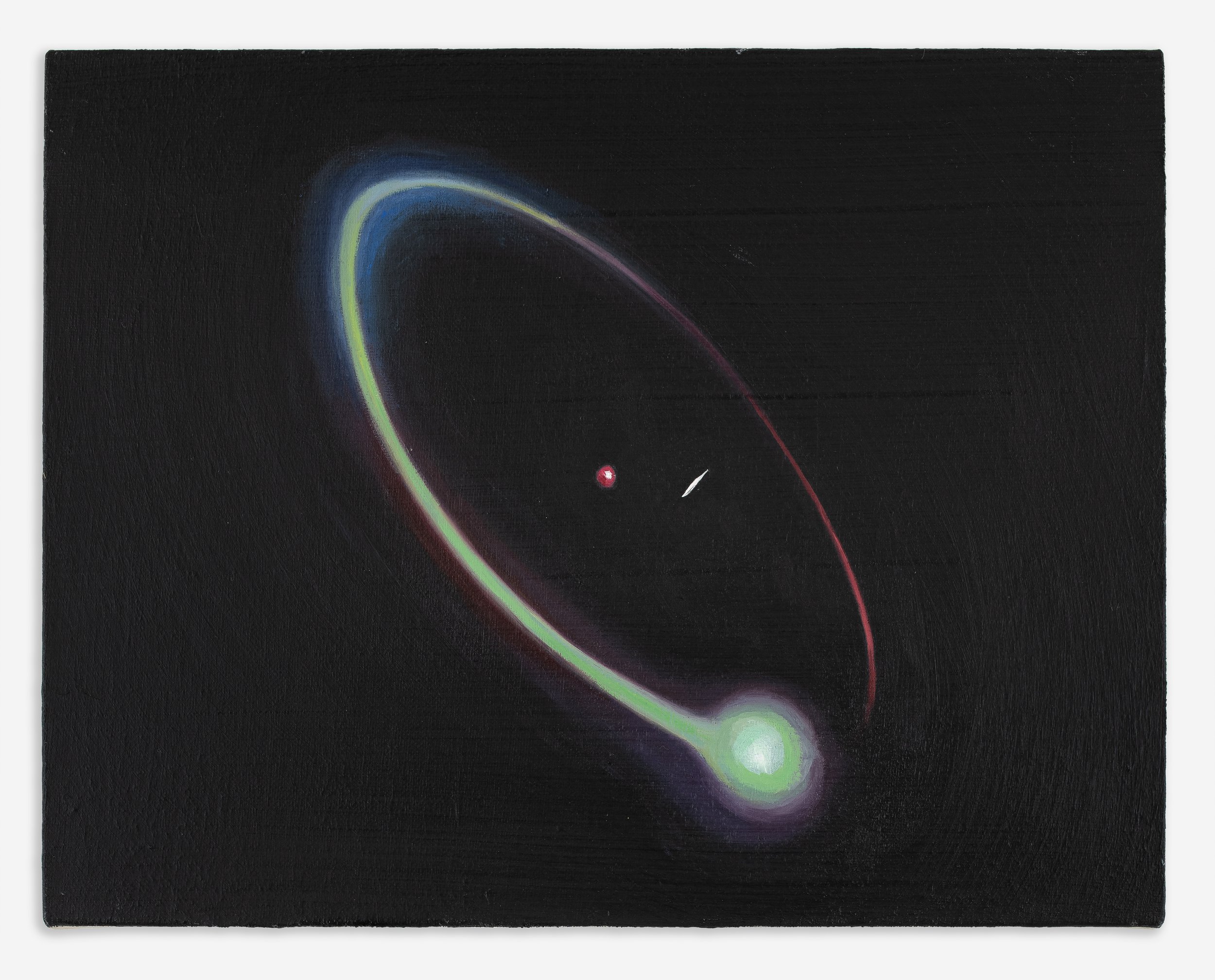
Terry Winters' Graphic Primitives series (2005-2006) consists of paintings and works on paper in which biomorphic forms, derived from cellular structures, neural networks, and mathematical models, are arranged in loose grids across pale grounds. The forms are recognizable as diagrams of something, a cell, a circuit, a root system, but they never resolve into specific referents. They hover between abstraction and notation, between the aesthetic and the informational, and it is precisely this hovering that constitutes their content. Winters has described his process as one of "generating images from images," a recursive procedure that produces forms which are always both specific and generic, both found and invented.
Winters' practice provides a useful counterpoint to Fractal 3 because both artists work at the intersection of painting and diagram, but they approach the intersection from opposite directions. Winters begins with observed or generated forms and abstracts them toward a condition of generality. His cellular shapes become less like cells and more like themselves as he works, shedding specific reference while retaining structural coherence. Tan Mu begins with a mathematical structure and concretizes it into paint, adding the specificities of material, surface, and manual labor that the mathematical image lacks. Winters moves from the concrete toward the schematic. Tan Mu moves from the schematic toward the concrete. The result, in both cases, is a painting that occupies a position between information and experience, but the position is reached from different sides of the divide.
The Graphic Primitives also share with Fractal 3 a particular relationship to scale. Winters' forms suggest microscopic or macroscopic structures without committing to either. A painting could be an image of a cell or a galaxy, and the ambiguity is intentional. This is what fractal self-similarity produces when it is translated into visual art: a condition in which scale becomes indeterminate because the same structure appears at every magnification. Tan Mu's painting formalizes this condition by rendering the Buddhabrot at a human scale, 182.9 x 152.4 cm, a size that corresponds to the proportions of a standing viewer. The fractal has no natural scale. It looks the same at any magnification. By choosing this particular size, Tan Mu anchors the infinite to the human body, giving the viewer a fixed point from which to perceive a structure that, by its nature, has no fixed point. The scale of the canvas is the only element in the work that is not recursive. It is the non-fractal boundary that makes the fractal legible.
Danni Shen, writing in Emergent Magazine (2024), observes that Tan Mu's works "serve as a kind of witness to human socio-technological histories." The Fractal paintings complicate this observation productively. They do witness a mathematical discovery, the Mandelbrot set, that is itself a product of computational technology. Benoit Mandelbrot could not have visualized the set without access to IBM mainframes. The Buddhabrot requires even more computational power, plotting millions of trajectories to produce a single image. These are mathematical objects that only exist as images in the era of the digital computer. But Tan Mu's painting witnesses them in a medium that predates the computer by millennia. The oil paint, the linen, the manual application of mark after mark, all of these belong to a tradition that the fractal itself renders newly relevant. The painting does not reject computation. It completes it. What the computer generates in fractions of a second, the painting receives over weeks, translating velocity into duration, data into substance, the ephemeral image on a screen into a physical object that will outlast the hardware that produced its source.
Tan Mu has said that the Buddhabrot "resembles the posture and symbolic presence of classical Buddha figures, creating an unexpected connection between mathematics, visual form, and spiritual contemplation." The connection is unexpected only if you assume that mathematics and spiritual practice occupy separate domains. In the Chinese philosophical tradition of ge wu zhi zhi, investigating things to extend knowledge, there is no such separation. The investigation of a mathematical object and the contemplation of a Buddha figure are both ways of attending to the structure of reality, and the fact that they produce similar images suggests not a coincidence but a convergence: two methods of inquiry arriving at the same formal insight from different directions. The fractal is a diagram of infinity. The Buddha is an embodiment of infinity. The Buddhabrot is where the diagram and the embodiment become indistinguishable.
Fractal 3 is, in the end, a painting about the conditions under which infinity becomes visible. The Mandelbrot set and its variants demonstrate that infinite complexity arises from finite rules. The painting demonstrates that infinite complexity can be rendered in a finite medium. Oil on linen has a limited resolution: the smallest mark the brush can make sets a lower bound on the detail the painting can contain. The screen has no such bound. Zoom in and the pixels continue. Zoom in on the painting and you eventually reach the weave of the linen, the ridge of a brushstroke, the edge where one layer meets the next. These are not failures of representation. They are the terms under which infinity is admitted into the physical world. The fractal does not end where the painting's resolution ends. It continues, invisibly, in the structure that the painting indexes. The linen is a boundary, not a limit. What lies beyond it is the same as what lies within it, recursed forever, and the painting's deepest subject is the paradox that a finite object can intimate an infinite one without diminishing it. The hand stops. The structure does not.