The Presence or Absence of a Hole: Tan Mu's Punched Card 2 and the Body That Made Data Legible
The presence or absence of a hole. That is the entire logic of the punched card, the binary distinction that made information machine-readable for the first time. A hole in position 12, row 3 means one thing. No hole in that position means something else. The card itself is a piece of stiff paper, seven and three-eighths inches long and three and a quarter inches wide, with eighty columns and twelve rows, yielding 960 possible positions for holes. The IBM 80-column format, standardized in 1928, became the dominant data storage medium for half a century. Census data, payroll records, ballistic trajectories, university registrations, all of it passed through these cards. A single card held one record, one line of one program, eighty characters of information. Programs that filled a thousand cards were not unusual. The cards were stacked in trays, carried across rooms, fed into readers that sensed the holes photoelectrically or mechanically, and returned to their trays in a new order after sorting. The physical handling of data was part of the computational process. You could drop a stack of cards and lose your program. You could spill coffee on it and corrupt your data. Information had weight, volume, and vulnerability. It occupied space and it suffered from the conditions of that space.
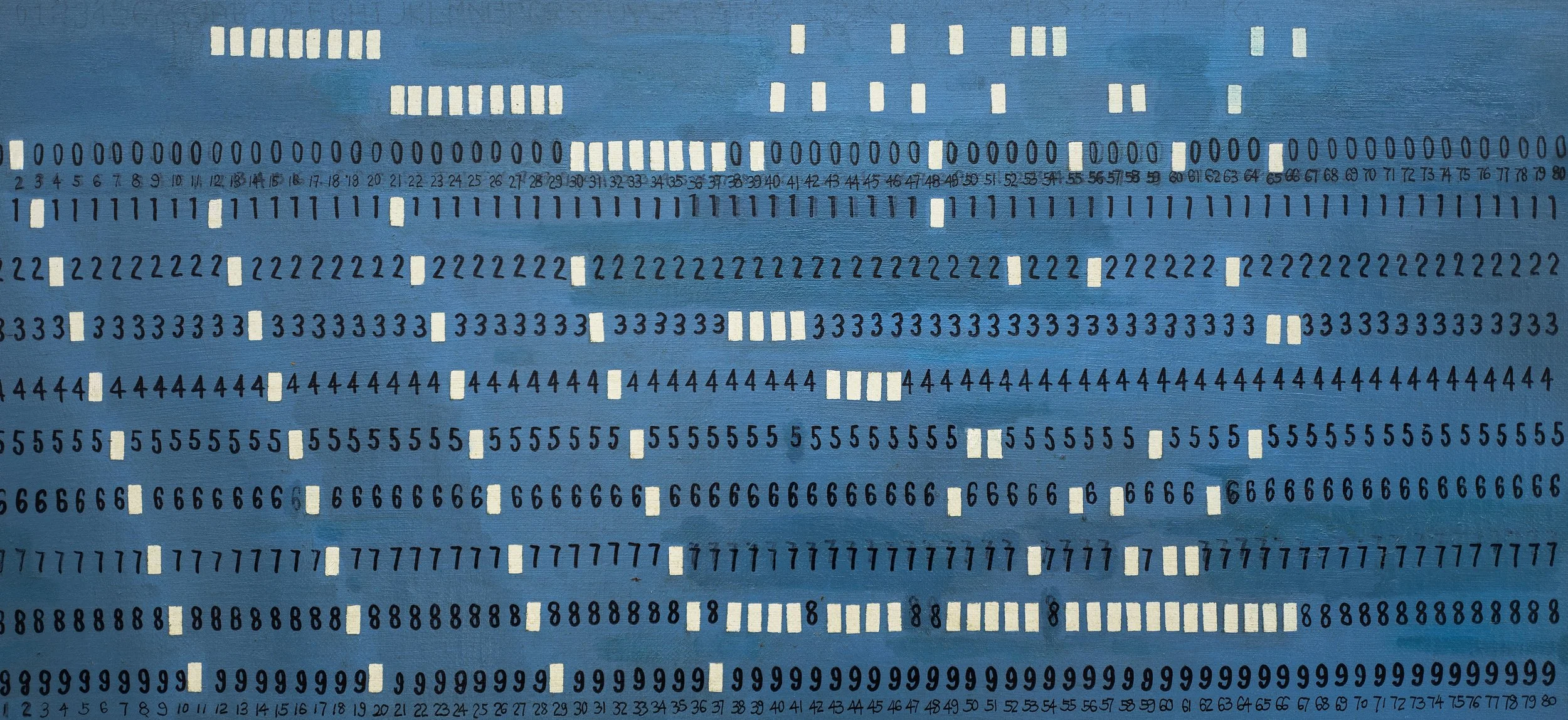
Punched Card 2 (2022) is one of two paintings that reanimate this obsolete medium. Together with Punched Card 1, also from 2022, the works reinterpret the punched cards that were central to data processing throughout the early and middle twentieth century. Tan Mu does not reproduce a specific card. She paints the form of the card: its rectangular field, its grid of potential hole positions, its characteristic clipped corner that ensured correct orientation when the card was fed into a reader. The painting translates the card's informational structure into a visual structure, replacing the binary logic of hole and no-hole with the pictorial logic of mark and ground. What was data becomes image. What was read by a machine becomes read by an eye. The translation is not neutral. It changes what the card means, and what it means changes depending on who is doing the reading. The machine reads the holes. The viewer reads the grid. The historian reads the labor that punched the holes. Tan Mu's painting is large enough to make all three readings available simultaneously.
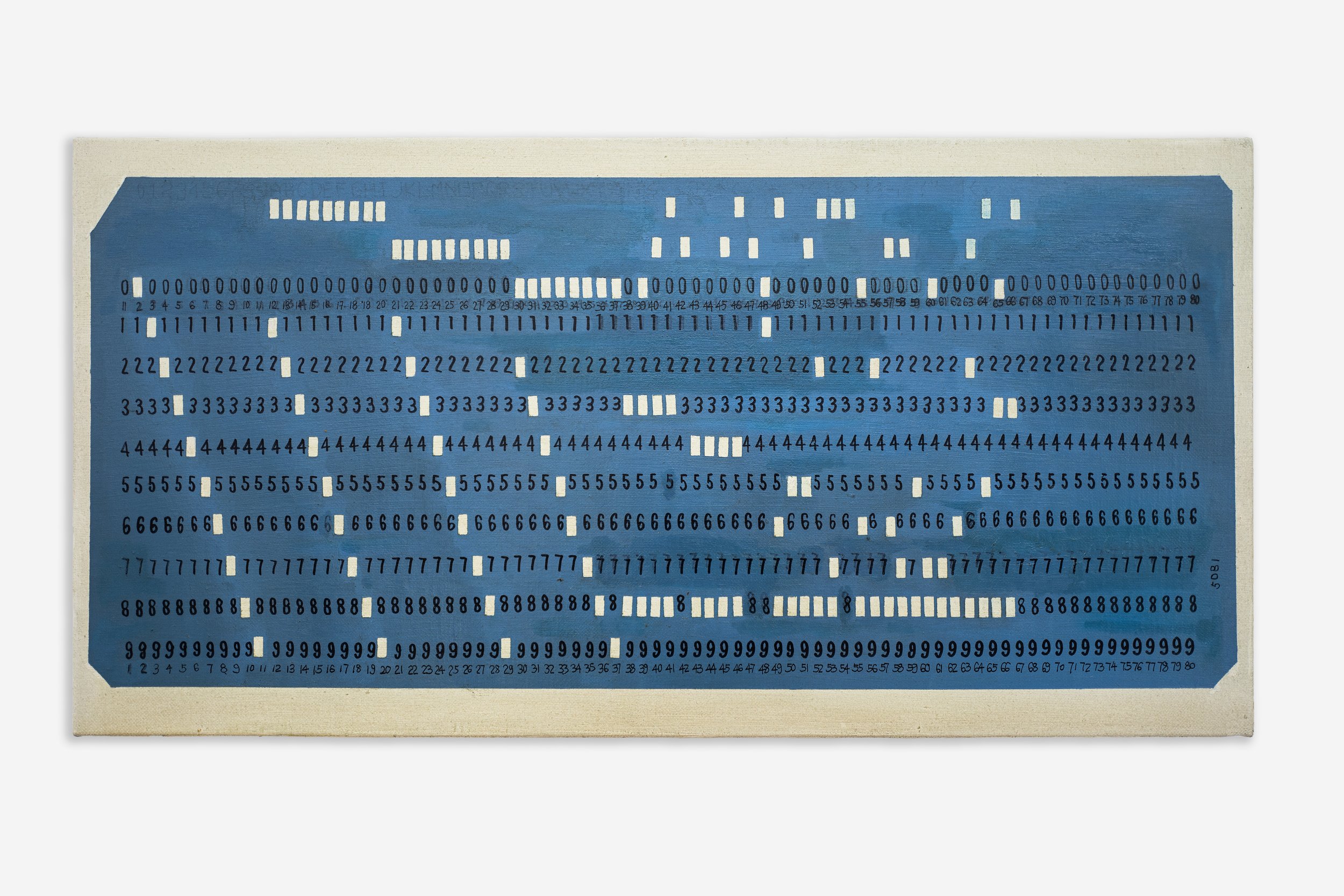
Oil and acrylic medium on linen, 30 x 61 cm (12 x 24 in). The proportions are unusual for Tan Mu's practice, a horizontal format roughly twice as wide as it is tall, approximating the aspect ratio of an actual punched card. The linen is prepared with a dark ground, a deep charcoal or near-black, against which the card's grid structure emerges in lighter values. The oil paint builds the grid slowly, each column and row indicated by a fine line of pale gray or cream that catches the light differently from the surrounding dark ground. The acrylic medium is used to create raised passages that correspond to the positions where holes would appear on an actual card, producing a literal topography of absence: the unpainted or thinly painted areas read as holes, the more thickly painted areas read as the solid card surface. The effect is a painting that you can read with your fingertips as well as your eyes, a surface whose information is encoded in relief as well as in contrast.
The decision to render the punched card in relief rather than as a flat image is one of the painting's most considered choices. A flat reproduction of a punched card would be an illustration. A painting in which the holes are represented by actual depressions or absences in the paint surface would be a sculpture. Tan Mu's solution, using acrylic medium to build up the solid areas and leaving the "holes" as thinner, darker passages, produces a surface that oscillates between the two-dimensional and the three-dimensional. Under direct light, the grid becomes pronounced, each cell casting a tiny shadow that distinguishes solid from void. Under diffused light, the grid flattens, and the card reads as a unified field of subtle tonal variation. This responsiveness to lighting conditions is not a byproduct of the technique. It is an enactment of the card's dual nature as a visual object and a data object. When you can see the holes, the card is information. When the holes recede into the grid, the card is form. The painting makes this alternation physical.
The clipped corner of the card, a small diagonal cut at the upper left, is rendered with particular care. On actual punched cards, this corner served a purely functional purpose: it allowed operators to verify that a stack of cards was correctly oriented, all corners aligned in the same direction, no cards inserted backward or upside down. It was a visual error-correction mechanism, a physical affordance for human fallibility. In the painting, the clipped corner becomes the card's most distinctive visual feature, the one element that distinguishes it from a generic grid. It is also the element that most directly indexes the human body. The clip exists because human hands made errors. Machines did not need clipped corners. People did. The painting preserves this trace of embodied labor in a composition that otherwise emphasizes the abstract regularity of the data field. The corner says: a person held this card. A person punched it. A person stacked it. A person carried it across the room and fed it into the reader. The machine processed the information. The person handled the object.
Agnes Martin's grid paintings of the 1960s and 1970s consist of graphite lines drawn on white or lightly tinted grounds, producing fields of uniform rectangular cells that extend to the edges of the canvas. The lines are hand-drawn, not ruled, and their slight irregularities register the tremor of the artist's hand against the precision of the geometric structure. Martin insisted that her grids were not about geometry. They were about emotion, specifically about the experience of innocence and happiness, which she associated with the perception of abstract form freed from representation. The grid, for Martin, was a vehicle for a kind of seeing that did not categorize or interpret but simply received. "When I think of art I think of beauty," she wrote. "Beauty is the mystery of life. It is not in the eye, it is in the mind."
The structural parallel to Punched Card 2 lies in how both works treat the grid as a structure that simultaneously constrains and liberates meaning. Martin's grid constrains the mark to the line and the cell, producing a regularity that, in her account, frees the viewer from the habit of reading images for content. The grid of the punched card constrains information to the binary of hole and no-hole, producing a regularity that, in Tan Mu's account, marks the transition from physical encoding to digital abstraction. Both grids are structures of possibility: Martin's grid makes emotional perception possible by eliminating narrative content; the punched card makes computation possible by reducing information to a binary code that a machine can process. The difference is that Martin's grid aspires to a condition beyond meaning, while the punched card's grid aspires to a condition of pure meaning, where every mark carries unambiguous information. Martin's grid is full of empty cells. The punched card's grid is full of potential data. One is an aesthetic of emptiness. The other is an aesthetic of density. What they share is the conviction that the grid, the regular subdivision of a surface into equal units, is the structure that makes both conditions possible.
There is also a shared concern with the relationship between the hand and the system. Martin's graphite lines are drawn by hand, and their slight variations register the presence of the body that made them. The punched card's holes are made by a machine, the keypunch, operated by a person who presses keys that trigger mechanical punches. In both cases, the mark is produced by the collaboration of a body and a tool, and in both cases, the collaboration produces a result that exceeds what either body or tool could produce alone. Martin's hand makes the line, but the grid makes the line regular. The keypunch operator presses the key, but the machine punches the hole. The system channels the body's action into a predetermined form, and the form makes the action legible to a viewer or a reader who was not present when the action occurred. This is what Martin means by innocence and what Tan Mu means by encoding: a mark that carries meaning without carrying the mark-maker's intention. The grid is the structure that makes such marks possible, because it predetermines the positions in which meaning can appear.
The punched card's history begins not with computing but with weaving. Joseph Marie Jacquard's loom, patented in 1804, used punched cards to control the pattern of woven fabric, with the presence or absence of a hole determining whether a warp thread was raised or lowered for each pass of the shuttle. The Jacquard loom was the first machine to use binary information, hole versus no-hole, to control a mechanical process, and Charles Babbage explicitly cited it as the model for his Analytical Engine, the first general-purpose computer design. The lineage from Jacquard to Babbage to Herman Hollerith, who developed the electromechanical tabulating machine for the 1890 U.S. Census, to IBM, which standardized the 80-column card format in 1928, is a direct line. The punched card was not invented for computing. It was imported from textile manufacturing, and its adoption by the data processing industry carried with it the logic of the loom: the translation of a pattern into a binary code that a machine can execute without human intervention. Tan Mu's painting, by rendering the card as a visual pattern rather than a data record, reverses this trajectory. It returns the card to the condition of a weave, a surface in which marks are arranged in a regular grid to produce a pattern that the eye reads before the machine does.
Tan Mu has drawn attention to the connection between punched cards and earlier systems of physical encoding, specifically the Inca quipu, a system of knotted cords used to record census data, tribute obligations, and other administrative information. The quipu encodes data in the type, position, and spacing of knots along a cord, a method that, like the punched card, relies on physical intervention to produce meaning. The parallel is not incidental. Both systems are solutions to the same problem: how to externalize memory in a form that can be read by someone other than the person who created it. The quipu and the punched card are both technologies of delegation. They allow information to travel without the person who produced it. The quipu traveled along Inca roads, carried by runners who could read the knots. The punched card traveled along internal mail routes, carried by clerks who could feed it into a reader. In both cases, the medium is designed to be portable, legible, and durable, and in both cases, the medium persists long after the system that produced it has become obsolete. The Inca empire fell in 1533. The quipus remain. The punched card became obsolete in the 1980s. The cards remain. The painting preserves this remainder, this persistence of the physical medium beyond the system that gave it purpose.
Dorothea Lange's photographs of women working in factories and offices during World War II document a labor force that was both essential and temporary. The women who assembled aircraft, welded ship hulls, and operated industrial machinery were recruited to fill positions vacated by men who had been drafted into military service. Lange's images show them in their workplaces, wearing bandanas and work clothes, their hands occupied with tools and materials, their faces concentrated on tasks that the photographs make legible as skilled and demanding. The photographs were commissioned by the federal government to document the domestic contribution to the war effort, and they circulated widely in the popular press, where they served a dual purpose: they validated women's participation in the industrial workforce and they reassured the public that the social order would be restored after the war, when the women would return to their homes and the men would return to their jobs. The photographs are documents of a temporary condition, and their poignancy lies in the discrepancy between the permanence of the labor and the contingency of the permission to perform it.
The parallel to the women who operated keypunch machines in the early computing industry is structural rather than visual. The keypunch operators were, like Lange's factory workers, performing labor that was essential to the functioning of a large system and that was rendered invisible by the system's design. The data processing industry of the 1950s and 1960s depended on thousands of women who sat at keypunch machines eight hours a day, translating handwritten or typed source documents into punched cards that could be read by tabulating equipment. The work was repetitive, physically demanding, and required sustained concentration: a single error in punching could corrupt an entire data set. It was also, like the factory work Lange documented, gendered labor. Keypunch operation was classified as clerical work, and clerical work in the mid-twentieth century was predominantly performed by women. The classification was not neutral. It carried assumptions about the kind of work women were suited for: meticulous, patient, repetitive, and subordinate. The women who punched the cards were not programmers. They were not analysts. They were operators, a term that located them below the level of intellectual contribution even though the accuracy of their work determined the accuracy of every computation the system produced. Tan Mu has spoken about this directly: "In the early days of computing, data processing depended heavily on manual, repetitive work, much of which was performed by women. They operated punch machines, sorted cards, and managed vast quantities of data on a daily basis. This labor was meticulous, physically demanding, and largely invisible, similar to factory work in textile mills."
The analogy to textile mills is precise and pointed. The punched card descended from the Jacquard loom, and the keypunch operator descended from the weaver. Both were women performing repetitive physical labor in service of a system that depended on their accuracy but did not credit their intelligence. Lange's photographs made the invisible labor of women factory workers visible to a public that had not considered it. Tan Mu's painting makes the invisible labor of keypunch operators visible to a public that has largely forgotten it. In both cases, the visual representation does not restore the labor to its proper place in the historical record. It makes the absence of that place apparent. The women are in the image because they were not in the history. The photograph and the painting are acts of correction that acknowledge, by their necessity, the inadequacy of the record they are correcting.
Yiren Shen, writing in 10 Magazine about Tan Mu's practice, observes that her paintings "function as a kind of archaeological excavation of the technological present, uncovering the buried layers of human labor and decision that underlie the systems we now take for granted." The archaeological metaphor is apt for Punched Card 2. The painting excavates a layer of computing history that has been buried under subsequent developments, the transition from punched cards to magnetic tape, from tape to disk, from disk to solid state, from solid state to cloud. Each transition increased storage capacity and processing speed while decreasing the visibility of the physical processes involved. The punched card was the last data storage medium that was fully legible to the unaided human eye. You could see every bit of information encoded on the card simply by holding it up to the light. After the punched card, data became invisible. It was stored magnetically, then electronically, then optically, at scales that no human eye could resolve without technological mediation. The painting recovers the visibility that the history of computing progressively eliminated. It makes the data visible again, not as information but as form, and in doing so, it makes the labor that produced the data visible as well. The holes in the card were made by hands. The hands belonged to women. The painting puts the hands and the holes and the card in the same frame, and the frame is the painting's argument: that the history of computing is not only a history of machines but also a history of bodies, and that the bodies were not the bodies of the men who designed the machines but the bodies of the women who operated them.
Punched Card 2 is connected to several other works in Tan Mu's practice. She has identified connections to Memory (2019), which addresses the infrastructure of contemporary data centers, and to Note G, which addresses the overlooked contributions of Ada Lovelace to the history of computation. Together, these works trace a lineage from the earliest physical encoding of data through the vast abstract storage systems of the present, and they insist, at every point along the lineage, that the transition from the physical to the abstract was not a liberation from labor but a concealment of it. The data center does not need keypunch operators. It needs engineers and technicians. But the labor that keeps the data center running, the maintenance of cooling systems, the replacement of failed drives, the physical management of cables, is still performed by hands, and it is still largely invisible to the people who use the data the center stores. The painting, by returning to the moment when data was still visible and labor was still tangible, makes the subsequent concealment of both legible as a historical process rather than a natural development. The data did not become invisible on its own. It was made invisible by the design of the systems that store it. The labor did not disappear. It was displaced. The painting holds open the moment before displacement occurred, the moment when a person could hold a card up to the light and see every bit of the information it contained, and when another person could look at the same card and see the hand that punched the holes. That moment is gone. The card remains. The painting preserves the card and, in preserving it, preserves the possibility of seeing what the card contains: not just data, but the trace of the body that made the data legible. The holes are empty. The labor fills them.