What Remains After the Hand Is Gone: Tan Mu's Touch and the Archaeology of Warmth
Sometime between 9,000 and 13,000 years ago, a group of people gathered at the entrance of a canyon in what is now Santa Cruz, Argentina. They placed their hands against the rock face, sprayed pigment over them through tubes made of bone, and withdrew their hands, leaving behind the negative image of each palm and splayed fingers. The cave is called Cueva de las Manos, the Cave of Hands, and it contains hundreds of these stencils, most of them left hands, corresponding to the right hands that held the spray tubes. The pigments range in color from red ochre to white, from purple to black, and they were made from mineral compounds available in the surrounding landscape: iron oxides, manganese, kaolin, charcoal. The handprints are not art in the sense that word is usually understood. There is no composition, no narrative, no representational content beyond the outline of a human hand. They are traces. They record the fact that a specific hand, belonging to a specific person, was at a specific place at a specific time. The hand pressed against the rock, the pigment settled around it, the hand withdrew, and the trace remained. That is the entire content of each image, and it is enough. It is enough to stop a viewer nine thousand years later and to produce a recognition that crosses every boundary of culture and language: that was a hand. That was a person. That was a touch.
Touch (2022) is a painting that begins with this recognition and carries it through a series of technological transformations that end in the present. Tan Mu's source is not the cave paintings themselves but a thermographic image of a hand, the kind of image produced by infrared cameras that detect the heat radiating from a body and translate it into a color map. In a thermograph, the warmest areas of the body appear in yellow, orange, and red, while cooler areas appear in blue and purple. The hand, which is richly supplied with blood vessels near the surface, registers as a hot form against a cool background. The thermograph records the same thing the cave stencil records, the presence of a living hand, but it records it through a completely different medium: infrared radiation rather than mineral pigment, digital sensor rather than blown powder, pixel array rather than rock face. Tan Mu's painting retranslates the thermographic image into oil on linen, returning the hand to a material surface after its passage through two successive technologies of mediation, first the infrared camera and then the digital screen. The painting is the third translation: cave to camera, camera to screen, screen to canvas.
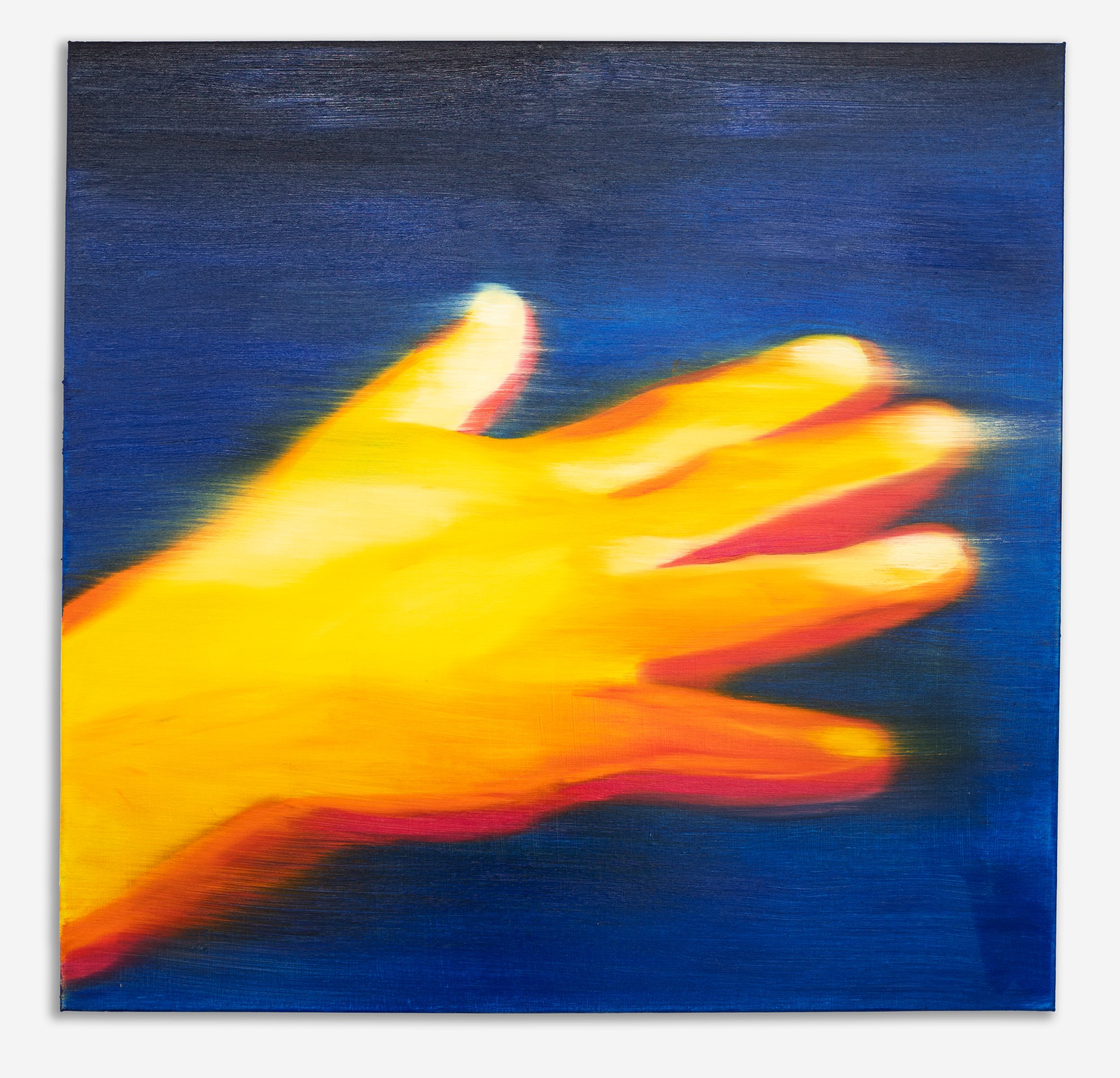
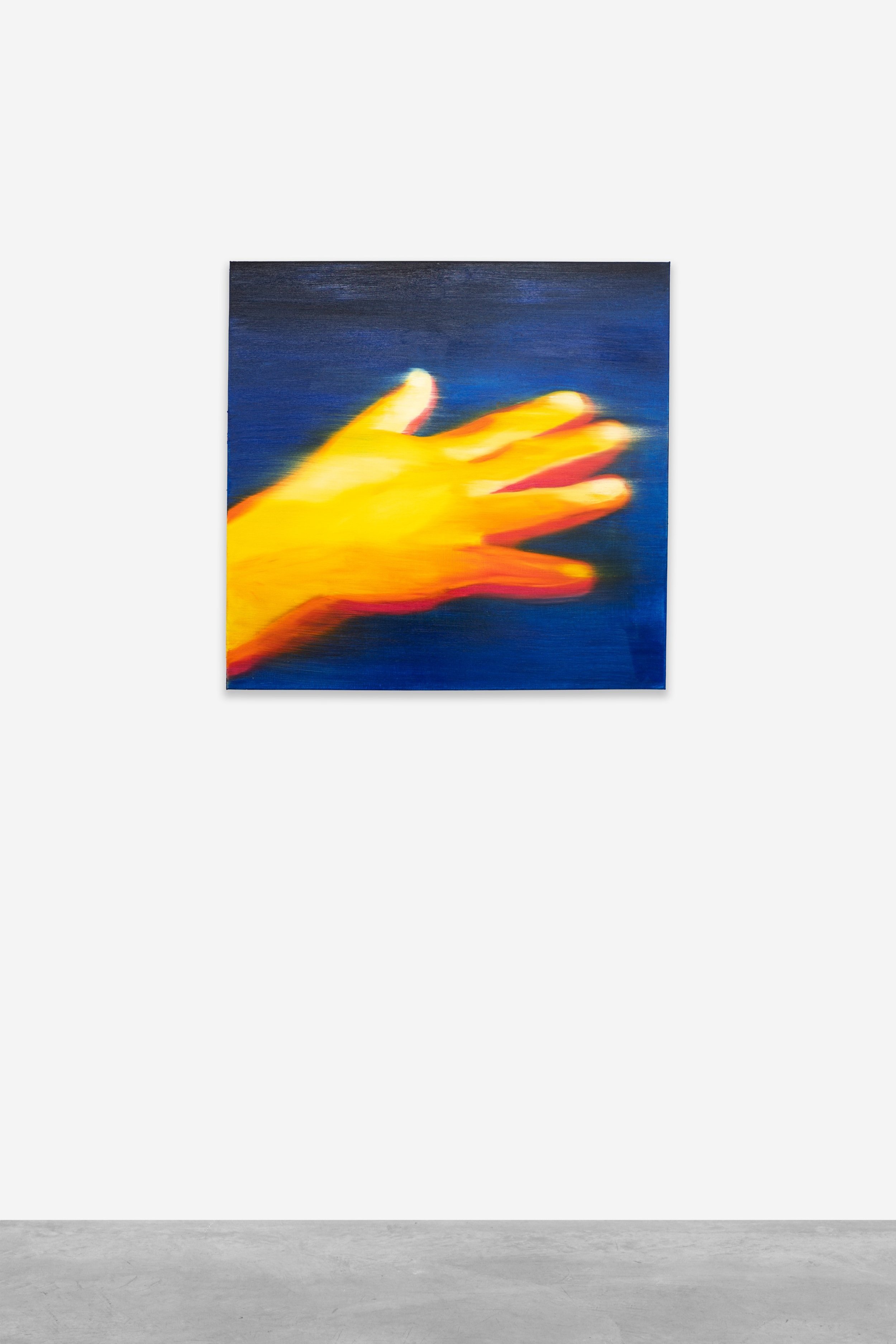
Oil on linen, 76 x 76 cm (30 x 30 in). The square format is unusual in Tan Mu's practice, where the predominant orientation is landscape or near-landscape. The square eliminates the hierarchical distinction between top and bottom, left and right, that a rectangular format imposes. The hand occupies the center of the composition against a ground of deep ultramarine that approaches black in its denser passages and reads as a very dark blue where light strikes the surface. Against this ground, the hand itself glows in a spectrum of warm tones: a pale yellow at the fingertips and the center of the palm, shading through orange to a deep burnt sienna at the wrist and the base of the fingers. The transitions between these warm tones are soft, almost imperceptible gradations that mimic the continuous variation of the thermographic source, where temperature changes across the surface of the hand produce corresponding changes in the color map. There are no hard edges within the hand. Every boundary is a zone of transition.
The brushwork distinguishes between two zones of the painting. In the ground, the dark blue is applied in broad, relatively even strokes that establish a uniform atmospheric field. In the hand, the paint is built up in thin, overlapping layers of oil, each one slightly warmer or cooler than the last, producing the gradient effect that makes the hand read as a thermal map. The linen is visible at the margins of the hand, where the warm tones thin out and the ground shows through, and this visibility produces a subtle vibration at the hand's edge, as though the form were radiating heat into the surrounding space. The effect is deliberate and precisely managed. In a thermographic image, the boundary between the hot hand and the cool background is not a line but a zone of thermal exchange, a band where one temperature gradients into another. Tan Mu reproduces this zone in paint, and the result is a hand that does not sit on top of the ground but emanates from it, as though the warmth of the body were a property of the field rather than an object placed within it.
Ana Mendieta's Silueta Series (1973-1985) consists of over two hundred works in which the artist pressed her body into natural materials, earth, mud, snow, sand, fire, and photographed or filmed the resulting impression. The siluetas are body-shaped voids left in the landscape after the body has been removed, and they operate as both traces and absences: they record the fact that a body was there, and they register the fact that it is no longer there. Mendieta made these works during a period of personal and political displacement, having been exiled from Cuba as a child, and the siluetas have been read as meditations on belonging, loss, and the relationship between the female body and the earth that receives it. The series began at the intersection of performance and land art and gradually shifted toward more photographic and filmic documentation, as the traces themselves became more ephemeral and the images became the only remaining evidence that the performance had occurred.
The structural parallel to Touch lies in how both works treat the body as a source of heat or pressure that leaves an impression on a receiving surface. In Mendieta's siluetas, the body presses into mud or sand, displacing the material and leaving a negative impression that records the body's outline. In Tan Mu's painting, the body radiates heat, which is detected by a thermal camera and translated into a color map that records the body's thermal signature. Both processes produce an image of the body that is not a representation but a trace: an indexical record of physical contact or proximity. The cave handprints of Cueva de las Manos are another version of the same process: the hand presses against the rock, the pigment settles around it, the hand is withdrawn, and the trace remains. All three images, the cave stencil, the silueta, and the thermograph, share a common logic: the body acts on a surface, and the surface records the action. The body does not depict itself. It impresses itself. The image is the residue of the impression.
Mendieta's siluetas also share with Touch a concern with the disappearance of the body from the image it produces. In the siluetas, the body has already gone by the time the photograph is taken. The image is of an absence, a body-shaped hole in the landscape. In the thermograph, the body is still present, but it is present as data rather than as flesh. The thermal camera does not see a hand. It sees a distribution of temperatures. It converts the hand's radiated heat into a color value and assigns that value to a pixel in a grid. The hand is present in the image only as a pattern of temperatures. The flesh is gone. What remains is the heat, which is the body's last form of presence before it becomes entirely absent. Mendieta's work records the moment after the body has gone. Tan Mu's source records the moment just before: the body is still there, but it has already been translated into a form that does not require its continued presence. The thermograph can be captured in a fraction of a second and then replayed indefinitely, long after the hand has withdrawn from the camera's view. The translation from heat to data is instantaneous, and once it has occurred, the body is superfluous to the image. The painting, by rendering the thermographic data in oil on linen, adds a third temporal layer: the slow, manual translation of a rapid, mechanical one. The camera captures the hand in an instant. The painting takes weeks. The speed of the technological mediation and the slowness of the artistic one coexist in the same image, producing a temporal tension that is one of the work's most productive ambiguities.
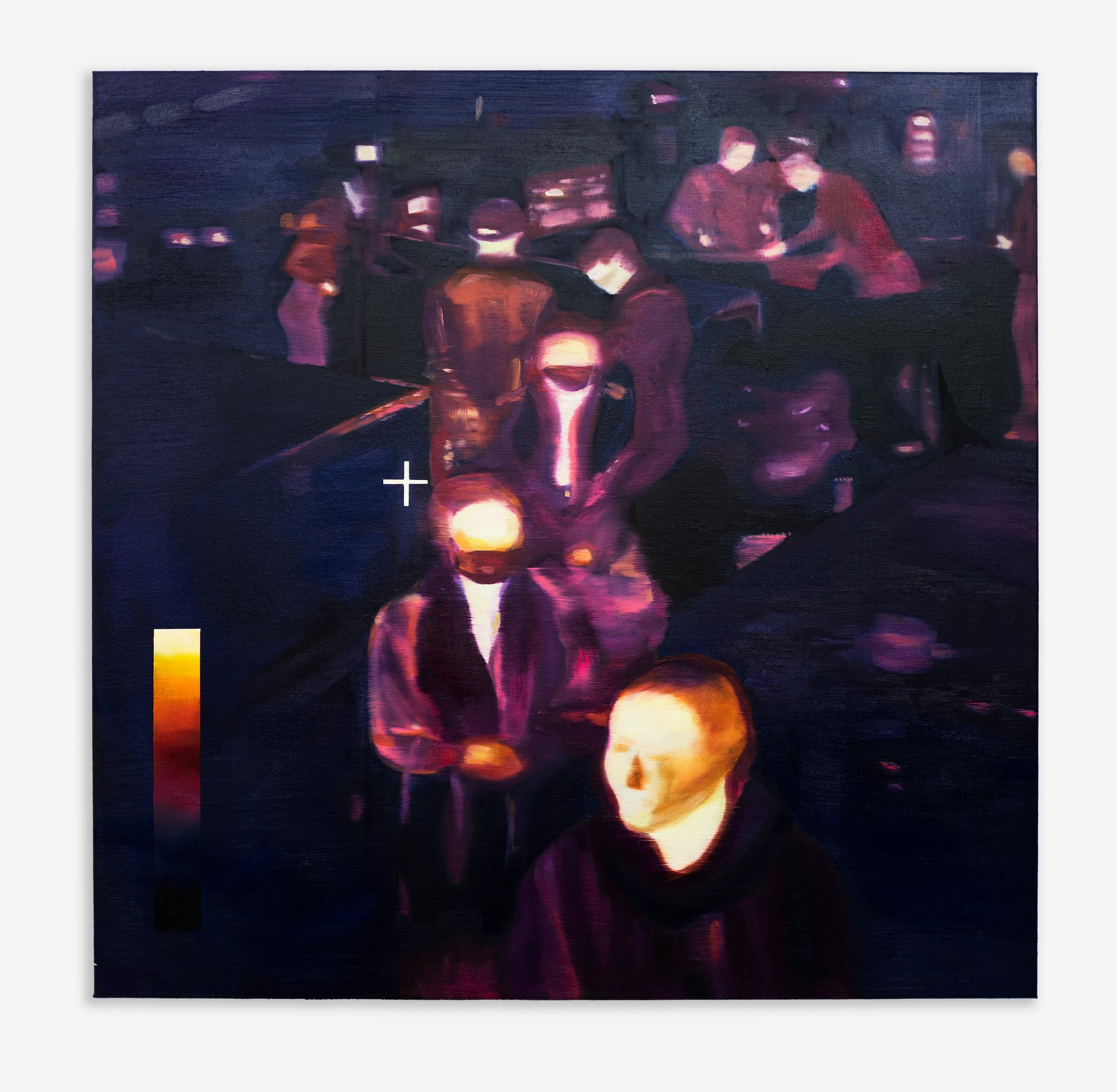
The thermographic image that serves as Tan Mu's source belongs to a specific historical moment: the deployment of thermal imaging technology as a screening tool during the COVID-19 pandemic. In airports, office buildings, hospitals, and other public spaces, thermal cameras were installed to detect elevated body temperatures in people passing through. The cameras produced images not unlike the one Tan Mu painted: figures rendered in false color, their warmth mapped against cooler backgrounds, individual bodies reduced to thermal profiles that could be assessed for signs of fever. The technology reduced the person to a set of temperature readings. The body became data. The hand became a heat signature. The gaze that the camera directed at the body was not the gaze of recognition. It was the gaze of surveillance, assessing each passing figure for a single metric: is this body too hot? The intimacy of the thermographic image, its rendering of the body in warm colors that suggest closeness and vitality, is in tension with the purpose for which it was deployed: to screen, to sort, to flag. The technology that makes the body visible as warmth also makes it visible as a risk.
Tan Mu has described the connection between the cave handprints and the thermographic image as a conversation between two forms of imagery that share a fundamental impulse: the desire to leave a trace, to record presence, to assert "I was here." The handprints in Cueva de las Manos were made through a stencil process in which pigment was sprayed over a hand pressed against the rock face, producing a negative image. The thermograph is made through a technological process in which infrared radiation emitted by the hand is captured by a sensor and translated into a color map. Both processes produce an image of the hand without depicting it. Both record the hand's presence without representing its appearance. The stencil records the outline of the hand's shape. The thermograph records the distribution of the hand's heat. In both cases, the image is an indexical trace, a record of physical contact or proximity, rather than a likeness. The hand is present in the image not because it looks like a hand but because it is the direct result of a hand being present. This distinction between index and icon, between a trace and a picture, is central to the painting's argument. The painting is a picture of a trace. It is a representation of an index. It occupies the position of the third term in a chain that begins with the cave stencil and continues through the thermograph, each link converting the trace into a new medium while preserving the logic of the original impulse: the hand was here.
Vija Celmins's drawing series of the 1970s and 1980s, particularly her depictions of the night sky, the ocean surface, and the desert floor, treat the surface of the paper as a field to be covered with marks of such density and uniformity that the individual mark becomes indistinguishable from the whole. Celmins works with graphite on paper or charcoal on canvas, building surfaces that read as continuous fields rather than as compositions of discrete marks. The night sky drawings, such as Drawing #14 (1974), depict the star field as a dense scatter of points on a dark ground, each star a tiny dot of graphite surrounded by others of varying brightness, producing an image that appears to be a photograph of the night sky until the viewer approaches closely enough to see the individual marks. The oscillation between photographic legibility and manual facture, between seeing the stars and seeing the graphite, is the central experience of the work, and it is an experience that depends on the viewer's distance from the surface. From far away, the drawing is an image of the sky. From close up, it is a field of marks. There is no position from which both readings are simultaneously available.
The connection to Touch operates on the level of surface and mark. Both Celmins and Tan Mu produce surfaces that oscillate between legibility as an image and legibility as a painted field, and both use this oscillation to raise questions about the relationship between the mediated source and the manual rendering. Celmins's source is a photograph of the night sky, taken through a telescope, which she translates into graphite on paper. Tan Mu's source is a thermographic image, captured by an infrared camera, which she translates into oil on linen. In both cases, the source is a technological image, produced by a machine that records data about the world rather than depicting it in the manner of a human eye. The telescope records light intensity across a field. The thermal camera records heat intensity across a field. Both produce data arrays that are then mapped onto a color spectrum for human viewing. The artist then takes this already-mediated image and remediates it through the slow, manual process of painting. The result in both cases is a surface that carries the memory of its technological source while insisting on its material present. The stars in Celmins are made of graphite. The hand in Tan Mu is made of oil paint. The translation is never transparent. It always adds something, and what it adds is the time and labor of the body that made it, which is precisely the dimension that the technological source eliminated.
There is a further shared concern with what might be called the archaeology of the surface. The cave handprints at Cueva de las Manos are among the earliest known examples of humans marking a surface with a trace of their bodies. The thermographic image is among the most recent. Between them lies the entire history of mark-making: the development of pigments, the invention of brushes, the discovery of perspective, the codification of compositional rules, the advent of photography, the rise of digital imaging. Each of these developments extended the range of what could be recorded and the speed at which it could be recorded, and each also introduced a new layer of mediation between the body and the trace it left. The cave stencil is the most direct: hand against rock, pigment around hand, hand removed, trace remains. The thermograph is among the most mediated: body radiates heat, camera detects radiation, sensor converts radiation to data, software maps data to color, screen displays color. The painting is an act of demediation: it takes the most mediated image in this sequence and returns it to the most direct form of mark-making available, a hand applying paint to a surface. This return is not nostalgic. Tan Mu is not arguing that painting is more authentic than technology. She is arguing that painting makes the mediation visible, that the time and labor of the painted surface reveal what the technological image conceals: the fact that every trace of a body is also the trace of a technology, and that the body and the technology are not separate. The hand that sprayed pigment in the cave nine thousand years ago was using the most advanced technology available. The hand that painted Touch in 2022 was doing the same thing. The technologies have changed. The impulse has not.
Danni Shen, writing in Emergent Magazine in 2024, describes Tan Mu's works as "serving as a kind of witness to human socio-technological histories," arguing that they "make visible the infrastructures, both physical and conceptual, that shape how we experience the world." Touch is a concentrated instance of this witnessing. The painting witnesses a specific socio-technological history: the deployment of thermal imaging as a screening tool during the pandemic, when temperature became a marker of both health and suspicion, when every body in a public space was a potential source of contagion, and when the technologies designed to detect fever also produced images that transformed the body into a thermal map. The painting also witnesses a deeper history: the impulse to leave a trace of the hand, which connects the cave stencil to the thermograph and the thermograph to the painting. These three moments of trace-making are not separate. They are the same impulse expressed through different technologies, and the painting holds all three in a single frame: the cave (the hand pressed against rock), the camera (the heat radiating into a sensor), the canvas (the brush applying paint to linen). Each moment produces an image of the hand, and each image is both a record of presence and a mediation of that presence. The hand that made the painting is present in the painting's surface. The hand that was detected by the thermal camera is present in the thermographic source. The hands that sprayed pigment on the cave wall are present in the stencil. Three hands, three surfaces, three technologies, nine thousand years apart. The same gesture: I was here. The same trace: the outline of a palm and fingers. The same question, asked by every body that has ever pressed itself against a surface and withdrawn: what remains after the hand is gone?