The Machine That Learned to Think: Tan Mu's Quantum Computer and the Portrait of Cognition
The IBM Q System One arrived at CES in Las Vegas in March 2020, the world's first integrated universal quantum computing system designed for commercial use. It was housed inside a nine-foot glass enclosure, a sealed glass case that separated the machine from the crowd of journalists and investors who had come to see it. The machine itself was smaller than the case. The case was the thing you photographed. The machine was behind the case, visible through it, separated from the room by a barrier of air-conditioned glass. When visitors took photographs, they were photographing their own reflections in the glass as much as they were photographing the quantum computer. The machine and its observers were on opposite sides of the same surface. One side was cold and superconducting and sealed in an atmosphere of liquid helium. The other side was a hotel conference room in Las Vegas, full of people who had come to witness the future of computation standing behind a window. The glass did not only separate the machine from the viewers. It made the viewers into part of the display. The quantum computer was behind glass, and everything in front of the glass was reflected back.
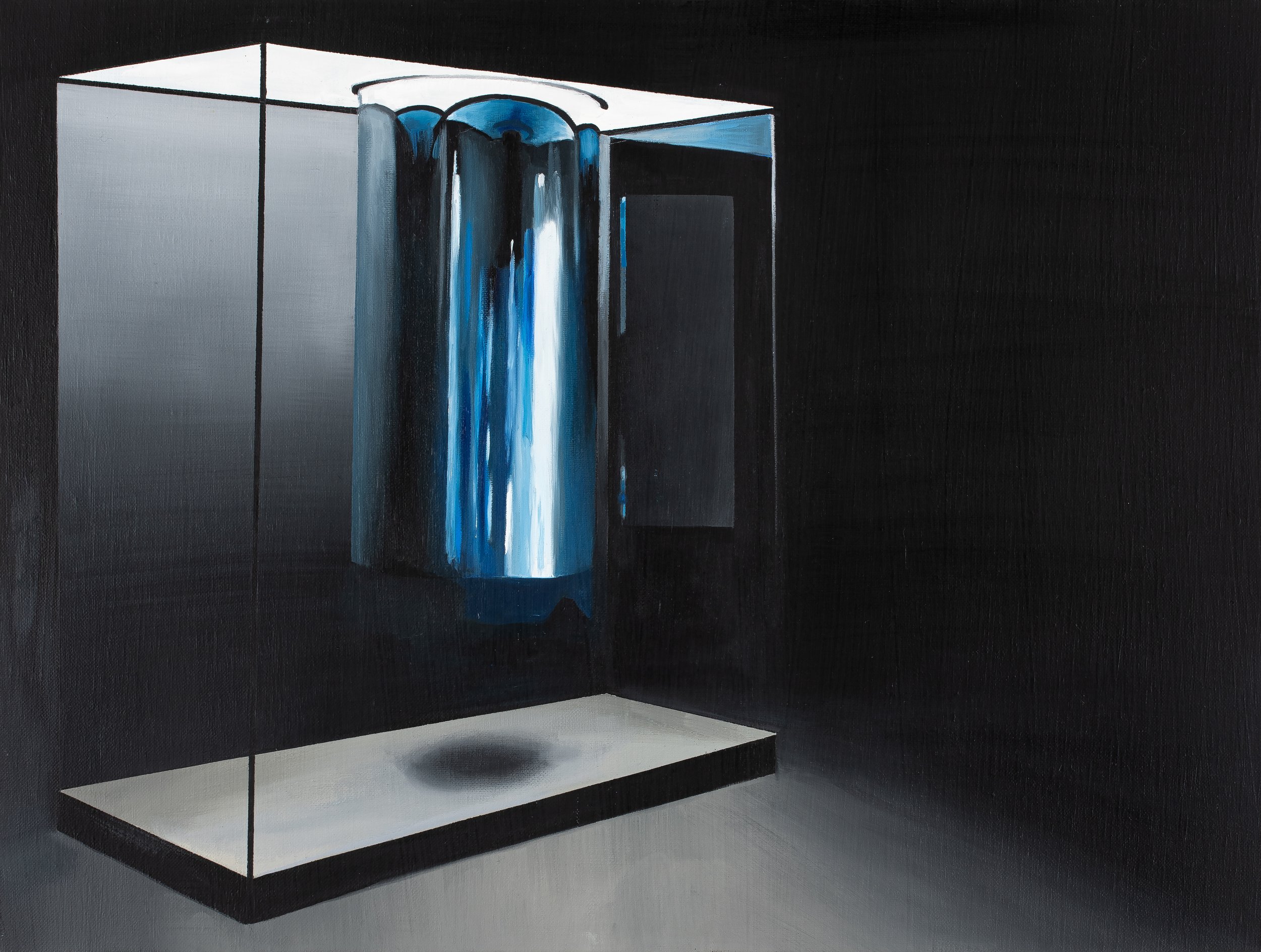
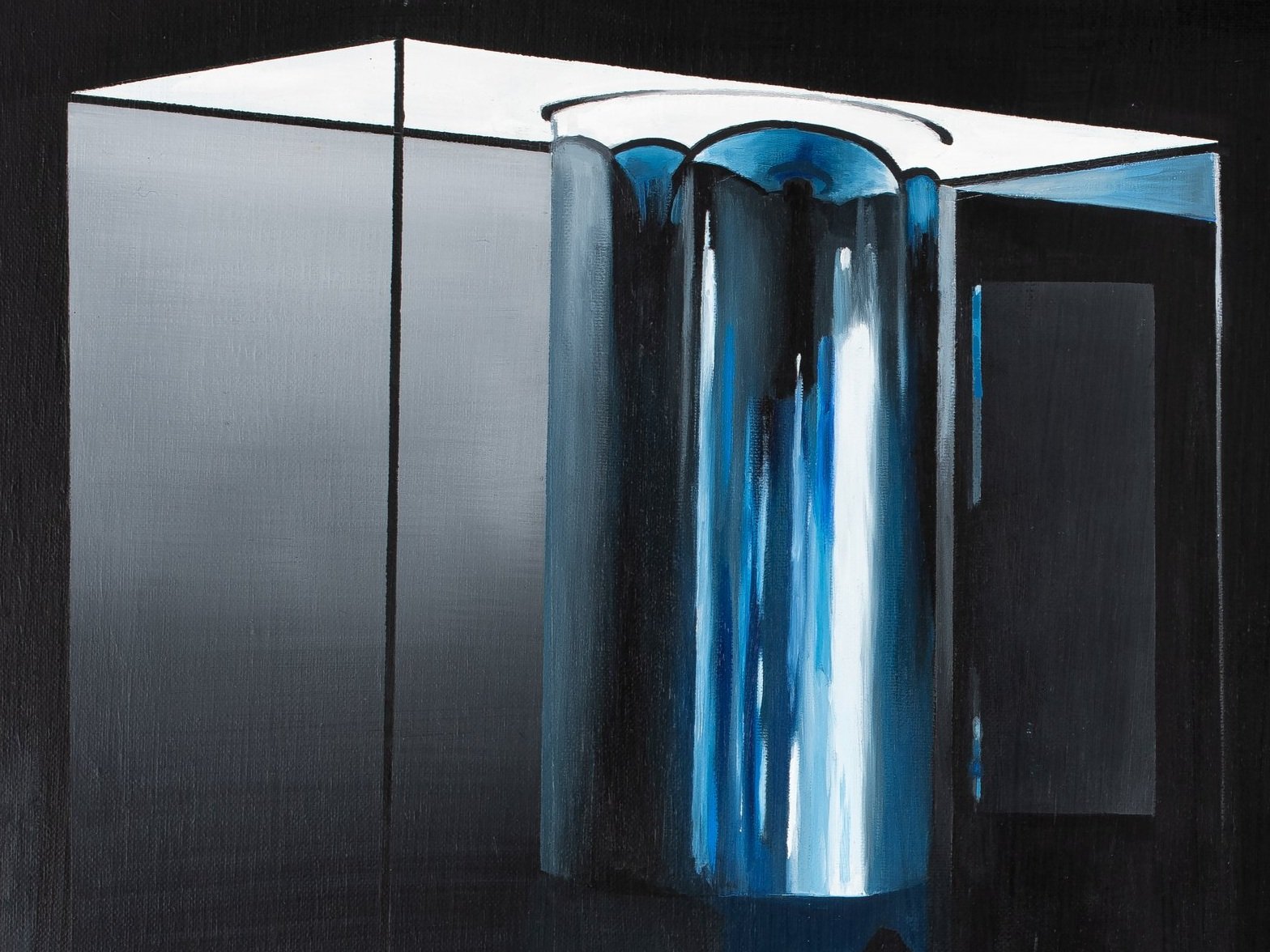
Tan Mu painted Quantum Computer (2020) in the same year the machine was unveiled. The painting does not show the CES booth or the hotel conference room. It shows only the machine inside its glass case, isolated against a field of absolute black, the cryostat rendered in deep blue and reflective silver as a sleek, chrome-like cylinder that appears to float in space. The black ground is not a photographic studio backdrop. It is the color of the void in which the quantum computer operates, the near-absolute-zero environment inside the cryostat where the qubits exist in superposition, processing information in a state that has no analogue in the everyday world. The blue-gray metallic surface of the painted machine catches light from an unseen source, producing highlights and reflections that give the cylinder a three-dimensional presence that pulls it forward from the black ground and toward the viewer. The effect is of a photorealist rendering, but photorealism applied to something that has never been seen by a human eye in the state depicted. The inside of the cryostat, where the qubits are suspended in their superconducting loops, is not visible through the glass case. The painting shows what cannot be seen.
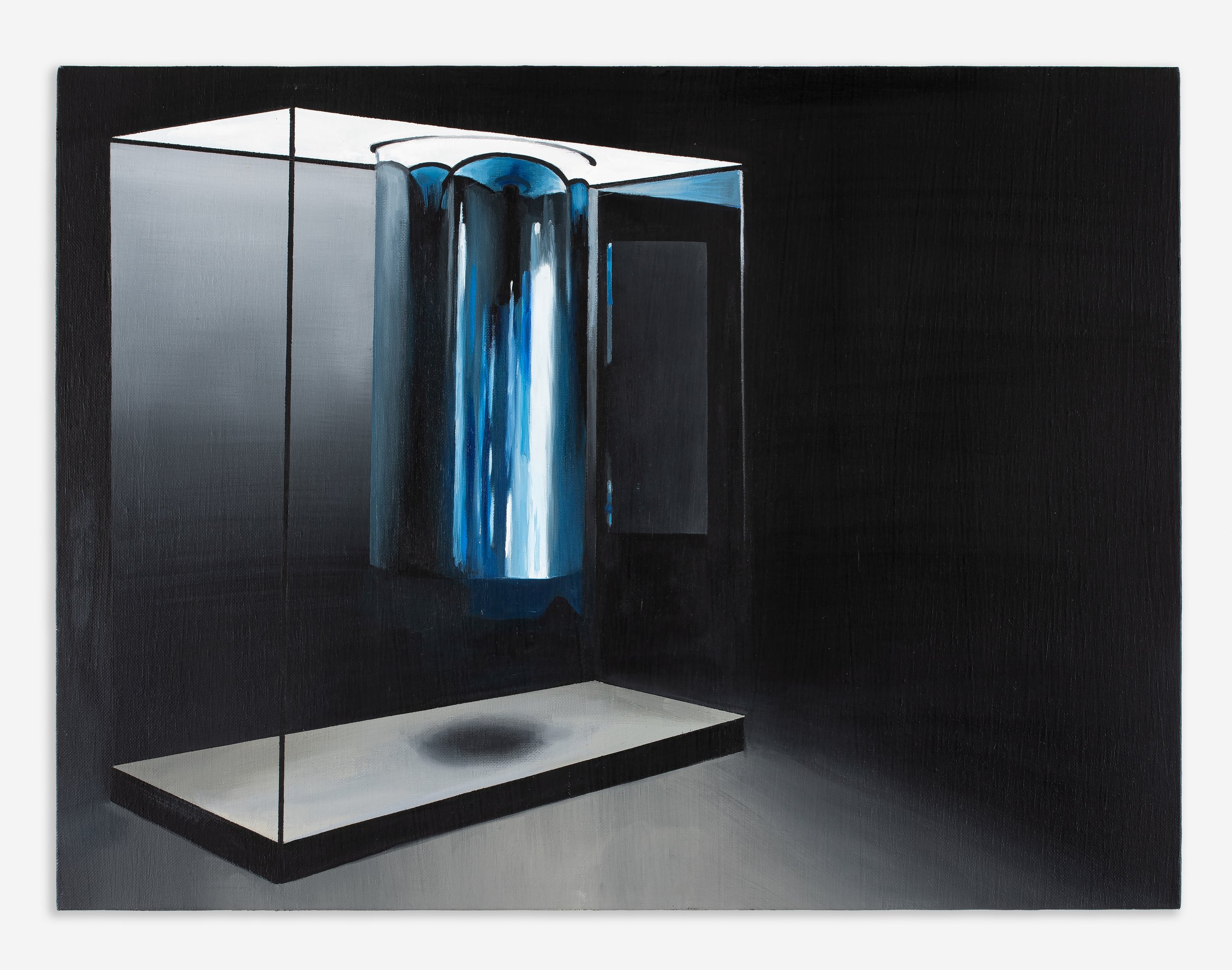
Tan Mu has described the moment of recognizing that the painting felt like a portrait as a turning point in how she understood the work. It changed everything. A portrait is not a still life. A still life arranges objects on a table and asks the viewer to contemplate their arrangement. A portrait addresses its viewer. It looks back. It positions the subject and the viewer in a relationship of mutual attention. When Tan Mu realized she had painted a portrait, she began to understand Quantum Computer as something that does not merely depict a machine but that turns the machine into a subject capable of engaging the viewer as a subject engages a viewer: by being seen, by returning the gaze, by existing in the painting not as an object but as a presence. The quantum computer in the painting is not displayed for contemplation. It is displayed for encounter. The viewer stands in front of the painting and the quantum computer stands in the painting and the two are on opposite sides of a surface, the same way the observers at CES stood on the other side of the glass from the machine. One side looks. The other side looks back. The surface between them is the painting itself, and the painting is not transparent, and the gaze is not resolved.
The paint surface in Quantum Computer (2020) is smooth and highly resolved, the surface of a photorealist painting that has been built up in thin layers until the linen weave is completely obscured and the result is a skin of pigment that approximates the reflective surface of a machine rendered in glossy industrial photography. The deep blue-gray of the cryostat cylinder shifts in tone as the painted surface catches the light of the room in which it hangs. Where the real machine's chrome surfaces would scatter and redirect actual room light, the painted surface holds its own light, an applied surface that generates the illusion of reflection rather than producing actual reflection. This difference is the difference between a photograph and a painting, between emitted light and reflected light. The photograph of the quantum computer shows what the machine looks like in a particular lighting condition at a particular moment. The painting shows what the machine means. It holds the machine's significance in a material form, oil on linen, that will remain exactly as it is for as long as the linen and the oil paint endure, long after the machine itself has been decommissioned and replaced by a faster system. The painting is not documentation. It is consecration. The quantum computer it depicts was consecrated as a portrait because it was recognized as a subject that looks back, a machine that extends the mind that made it.
Joseph Beuys spent the early 1970s developing an expanded concept of sculpture that included materials drawn from the industrial and technological world: fat, felt, iron, copper, honey, blood. In his 1974 performance Coyote: I Like America and America Likes Him, Beuys spent eight days inside a gallery space accompanied by a coyote, the animal serving as a wild counterpart to the domesticating force of the institution. The performance was not a sculpture in any conventional sense. There were no bronze castings, no marble blocks, no steel armatures. There was a man, an animal, a pile of materials, and a structure of attention that the artist had built around them. The materials were not incidental. The fat and felt that Beuys used throughout his practice were not substitutes for more traditional sculptural materials. They were carriers of meaning that the artist's body had invested with significance through use, through rubbing and warming and applying. The materials were not symbolic in the way a flag is symbolic or a word is symbolic. They were material in the way a memory is material: present, physical, carrying charge, available to be touched and experienced by a body that encounters them.
The connection to Quantum Computer (2020) lies in Beuys's understanding of the relationship between material and idea, and in his insistence that the material is not merely a vehicle for the idea but is itself a form of thought. Beuys claimed that every material has a story, that every substance carries within it a history of formation, use, and transformation, and that an artist who works with industrial materials is working with the accumulated histories of those materials as well as with their physical properties. Tan Mu's choice of oil paint to represent a quantum computer is a choice about the material carrying the history of painting, the tradition of representation, the accumulated weight of five centuries of oil painting applied to subjects that ranged from religious scenes to landscapes to portraits to still lifes. When she applies thick layers of deep blue oil paint to create the reflective surface of the cryostat, she is working within that tradition, using the history and the material properties of oil paint to hold something that is, in the quantum computer itself, already beyond the capacities of ordinary representation. The qubit in superposition is not visible. The painting does not make it visible in any literal sense. It makes it present through the tradition of oil painting, through the way oil paint holds light in a form that persists and that can be encountered by a body standing in front of the canvas. Beuys's materials carried the history of their own formation. Tan Mu's oil paint carries the history of painted light, from van Eyck to Rembrandt to the photorealists, and that history is what makes the quantum computer present in the painting rather than merely depicted.
The quantum computer inside the cryostat is a machine for thinking. This is not a metaphor. A quantum computer is a device that processes information using quantum mechanical effects: superposition, entanglement, quantum interference. Where a classical computer uses bits that are either 0 or 1, a quantum computer uses qubits that can exist in a state that is a superposition of both 0 and 1 simultaneously. The machine does not compute by following a sequence of logical steps. It computes by allowing the probabilities of quantum states to interfere with each other, canceling out wrong answers and amplifying right ones, until the measurement at the end of the calculation resolves the superposition into a definite result. The process is not like the process of a classical computer. It is more like the process of thought itself, which does not follow a linear sequence of steps but moves by association and probability, holding multiple possibilities in mind simultaneously before settling on a conclusion. Tan Mu has noted that the relationship between hardware and software in a quantum computer parallels the relationship between body and mind in human cognition. Both are intricate systems that process, interpret, and evolve. Both operate as systems that extend the capacity to think beyond what the unassisted biological substrate could achieve alone. The quantum computer is not a tool in the way a hammer is a tool. It is an extension of cognition, a machine for doing what the mind does, only faster, and only better, and only in ways that would be impossible without it.
Tan Mu has said that Quantum Computer (2020) remains one of the most important works she has created. She compares it to a self-portrait, reflecting her own trajectory as an artist, her long-standing fascination with physical systems, technological evolution, and the nature of human existence.
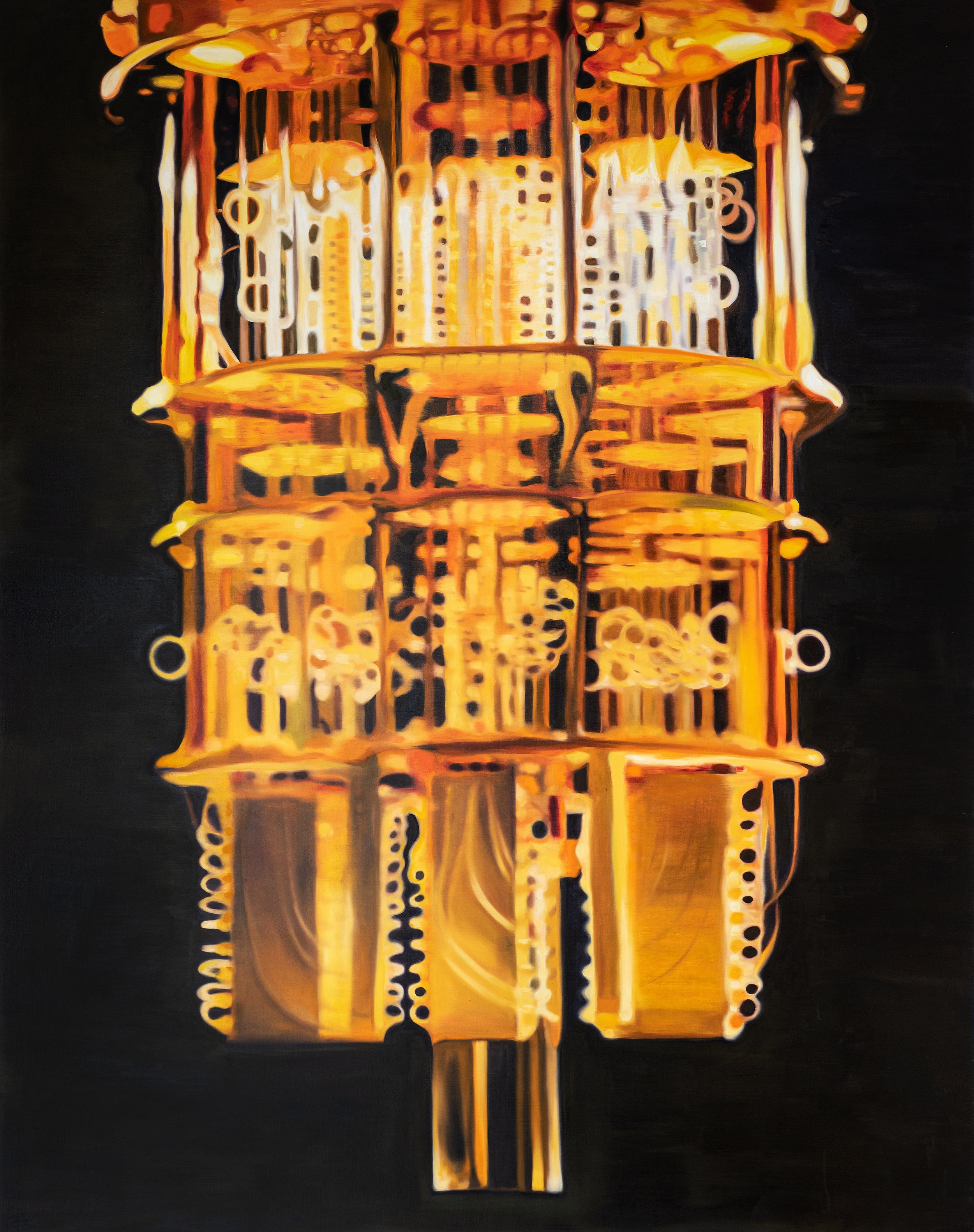
Nick Koenigsknecht, writing in the BEK Forum catalog in 2025, describes Tan Mu's practice as one that treats technological subjects not as external objects but as extensions of the artist's own investigation into cognition, consciousness, and the nature of the self. He argues that the series of paintings that includes Quantum Computer, Quantum Gaze (2023), and the earlier Logic Circuit and Mapping works form a unified inquiry into the question of how structure becomes experience. The quantum computer is not a still life depicting a new kind of machine. It is a self-portrait painted from the outside, a likeness of the human mind extended beyond its biological limits and rendered in deep blue and reflective silver against a field of absolute black. The cryostat is not just a component of the machine. It is a vessel, a container that holds the superconducting qubits in the conditions required for them to maintain their quantum states. The conditions are extreme: temperatures near absolute zero, isolation from every possible source of interference, an environment that is as close to nothing as technology can produce. Inside that void, the qubits do what they do. Outside, the painting holds them.
The glass case that surrounds the quantum computer at CES and that appears, as a tinted rectangular enclosure, in Tan Mu's painting is not a neutral container. It is a frame, a border, a declaration that what it holds is significant enough to be protected from contact with the surrounding air. The case separates the machine from the world in the same way that a museum case separates a relic from the stream of viewers who pass by it. The quantum computer inside is not used. It is displayed. It is shown as a demonstration of what the technology can do, not as a working instance of what the technology does. The glass case performs the same function as the gilded frame around a portrait or the pedestal beneath a sculpture: it consecrates the object, marking it as significant, inviting the viewer to treat it as an encounter rather than a utility. Tan Mu's painting preserves this consecration. The machine inside its glass case floats against the black ground, isolated from every external reference, held in a condition of display that the painting itself provides by the radical simplicity of its composition. The machine is the only thing in the frame. There is nothing else. This is what the quantum computer looks like when it has been made into a portrait.
Saul Appelbaum, writing in the BEK Forum catalog in 2025, observes that Tan Mu's paintings of technological subjects function as self-portraits because they are portraits of the human mind in its most extended and most precise form. He writes: "While observing technology, are we not looking at ourselves? Therefore perhaps these works function more as self-portraits, rather than depictions of external, scientific milestones." The observation applies with particular force to Quantum Computer (2020). Tan Mu has described the painting as feeling like a self-portrait upon completion, and she connects this recognition to her earlier investigations of cells, the brain, and the body as machine. These subjects are not separate. They are different registers of the same question: how structure becomes experience. The quantum computer is the structure. The question is what kind of experience a machine for thinking produces when it thinks. The painting is not the answer to that question. It is the record of the asking. The viewer stands in front of the canvas and the machine is on the other side of the surface, and the surface is the painting, and the question of what it means for a machine to think is held there, in the space between the painted cylinder and the living viewer, the same question that stood unanswered in the room at CES in March 2020, when the people who had come to see the quantum computer stood on the other side of the glass from the machine and nobody knew yet what the machine would do with the time it was given.
Tan Mu has said that Quantum Computer (2020) remains one of the most important works she has created. She compares it to a self-portrait, reflecting her own trajectory as an artist, her long-standing fascination with physical systems, technological evolution, and the nature of human existence. The comparison is not sentimental. It is structural. A self-portrait made by a painter in 2020 is a record of how the painter understood themselves at a particular moment in a particular historical situation. The situation was this: a machine had been built that could perform calculations at speeds that no classical computer could match, by exploiting the quantum mechanical properties of matter at temperatures colder than outer space. The machine was the most powerful computational device humanity had yet produced. It was also, as Tan Mu recognized, a portrait of the human mind pushed to its frontier: the mind that built the machine, the mind that the machine extends, the mind that stands in front of the painting and looks at the machine and asks what it means to think with a machine that thinks. The question has no final answer. The painting does not pretend it does. It holds the question open in a frame of black, a cylinder of deep blue, a surface of oil paint that will not change, that will hold the question in its material form for as long as it lasts, which is longer than the machine, longer than the era, longer perhaps than the language in which the question was first asked. The painting is a portrait of cognition thinking about its own extension. The mind in the painting is looking at the mind looking at the painting. The circuit is closed. The portrait is complete.