The Stars on the Back of the Machine: Tan Mu's Mapping and the Constellation Hidden in the Circuit
Turn a motherboard over. What you see is not what the motherboard shows you when it is installed in a computer and the computer is running and the screen is displaying the output of the programs that the motherboard makes possible. What you see when you turn the motherboard over is the back, the side that faces the metal panel at the bottom of the case, the side that is pressed against the standoffs and hidden from view by the power supply and the cables and the drives, the side that no one looks at because it is not the side that has the components on it, the chips and the capacitors and the heat sinks and the fans, the side that is the face of the machine. The back of the motherboard is the inside of the face, the infrastructure that the face conceals, the network of solder points and signal routes and power layers and connection markings that sustain the entire system, and this network is not designed to be seen, it is designed to function, it is designed to carry electrical signals from one component to another with minimum resistance and maximum speed, and the design is the product of precise calculations that determine the most efficient paths for those signals, and the traces that carry the signals are etched into the surface of the board by a chemical process that removes the copper that is not needed and leaves the copper that is, and the copper that is left is coated with a thin layer of gold to prevent oxidation and to ensure electrical conductivity, and the result is a surface of golden lines on a green substrate, a surface that looks like a map, a surface that looks like a chart, a surface that looks, if you look at it the right way, or the wrong way, or the way that the engineer did not intend, like a constellation, like a night sky filled with stars connected by thin lines of gold against a field of dark green, like a map of the cosmos drawn by someone who did not know they were drawing a map of the cosmos, like a star chart that was never a star chart, that was a circuit diagram, that was a plan for moving electrons, that was a piece of infrastructure, that was the back of a board that no one was supposed to see.
Mapping (2021) is a circuit board mounted on a wood panel, 63.5 x 49.5 cm (25 x 19.5 in), that assembles thirty-five found circuit boards into a single composite surface. The work is not a painting. It is an assemblage, a construction made from objects that were manufactured for a purpose other than the purpose to which they have been put. The circuit boards are found objects, boards that were removed from computers that had been discarded or decommissioned, boards that had served their functional life and were no longer needed, boards that were waste, electronic waste, the fastest growing waste stream on the planet, millions of tons of discarded circuit boards and computers and phones and tablets that are shipped to developing countries where they are dismantled by hand and the valuable metals are recovered and the rest is burned or buried, and the boards that Tan Mu has collected are boards that have been diverted from this waste stream, boards that have been given a second life, not as functional components of a computer but as elements of an artwork, not as infrastructure but as image, not as the back of a machine but as the front of a work of art.
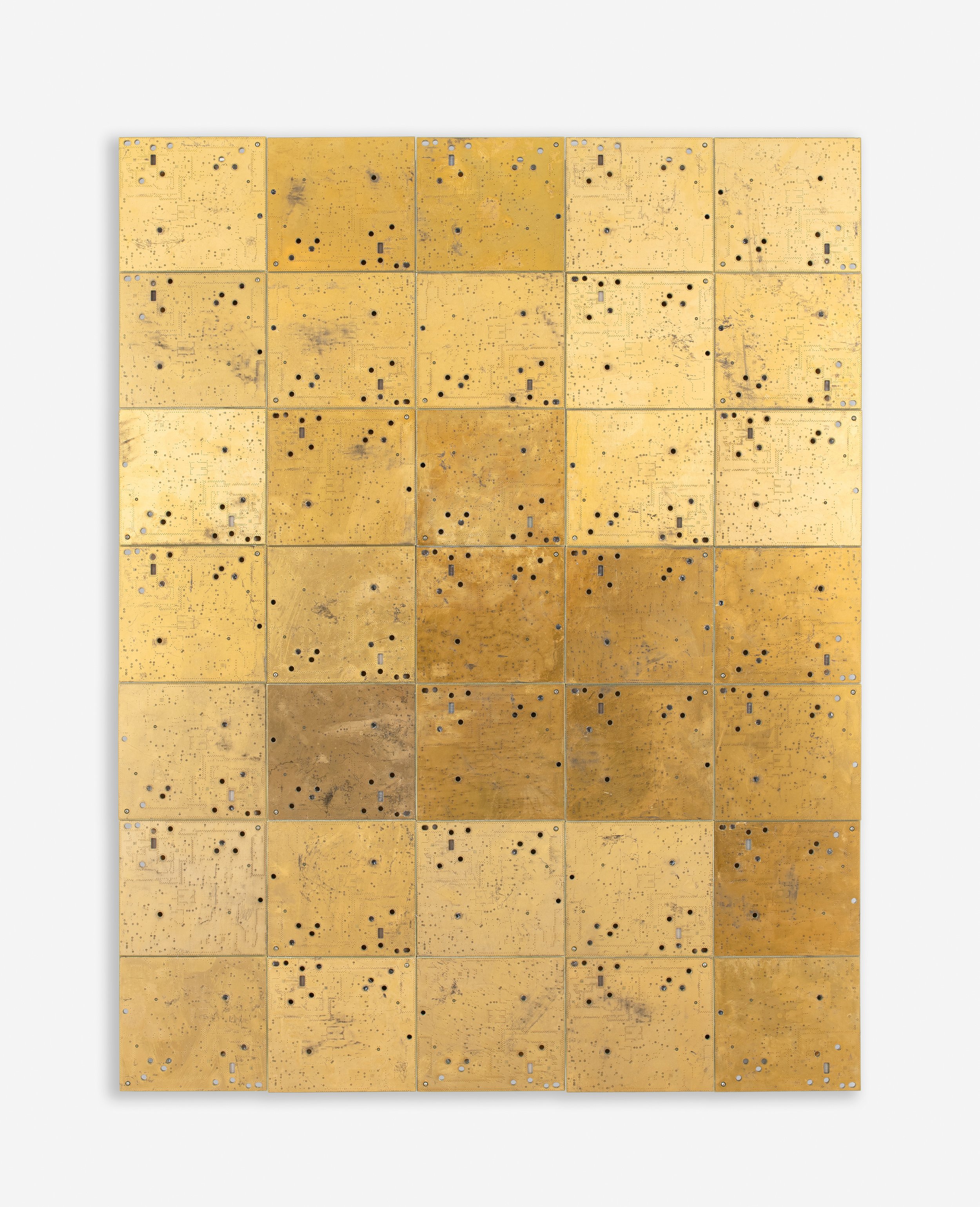
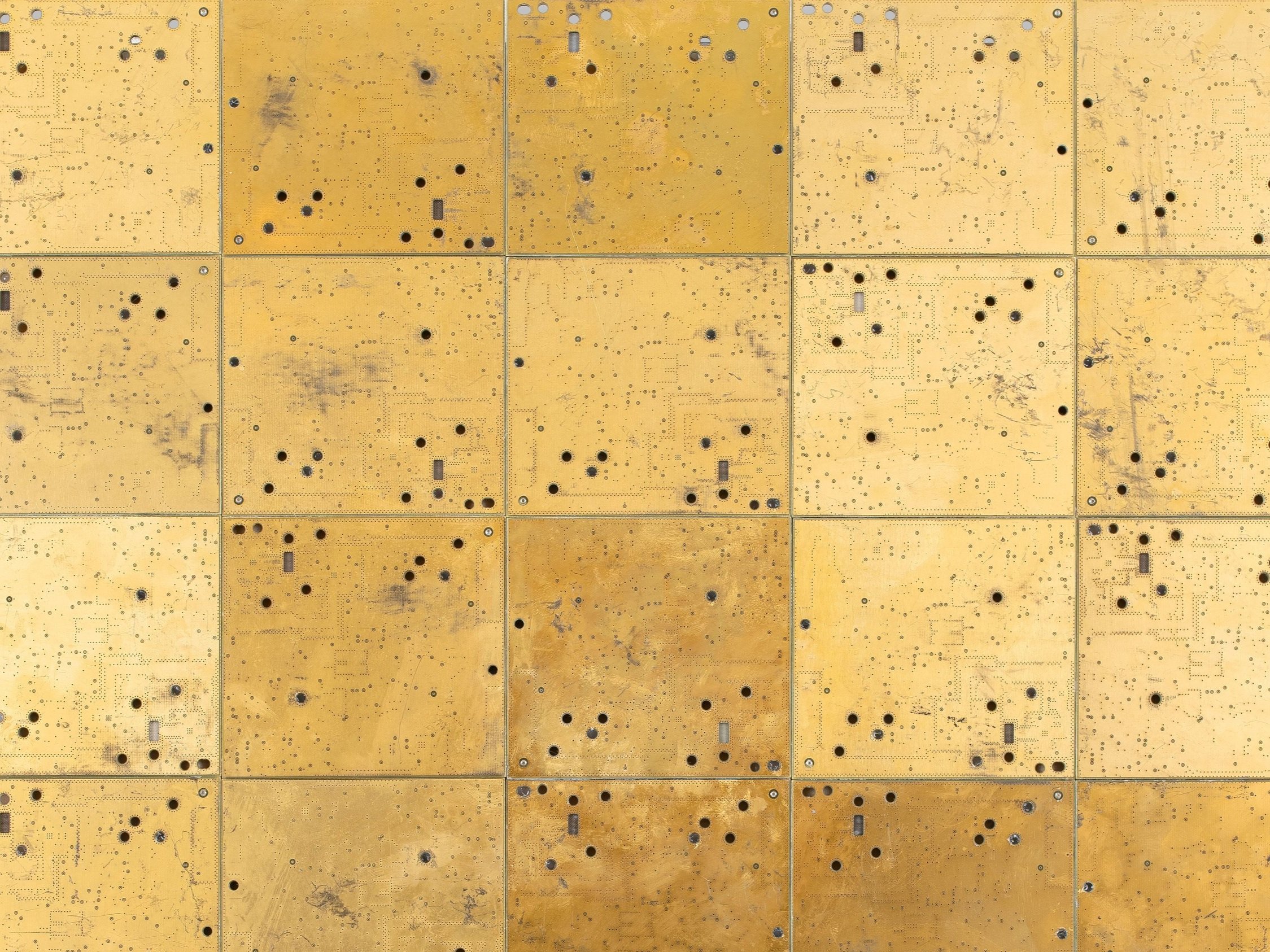
The thirty-five boards are arranged on the wood panel in a composition that evokes an astronomical pattern. The arrangement is not random. The boards have been selected and positioned so that the golden traces on their surfaces align and connect and form a visual field that resembles a map of the night sky, a constellation chart, a planisphere. The individual boards are different sizes and shapes, different form factors for different computers and different applications, some large and rectangular, others small and irregular, some with dense concentrations of solder points, others with sparse traces that wander across the green surface like paths through a landscape, and the differences between the boards are part of the composition, the same way that the differences between the stars in a constellation are part of the constellation, the bright ones and the dim ones, the near ones and the far ones, the ones that are part of the pattern and the ones that are outside it, the ones that the line connects and the ones that the line passes by. The golden color of the traces is the dominant visual feature of the work. Gold is the color of the coating that protects the copper from oxidation, and it is also the color of value, the color of treasure, the color of the thing that is worth recovering from the waste, and the gold in Mapping is both of these things at once, the functional gold of the electrical connection and the symbolic gold of the precious metal, the gold that makes the board work and the gold that makes the board worth saving, the gold that is a means and the gold that is an end, and the work holds both meanings simultaneously, the same way that it holds both the functional meaning of the circuit board and the aesthetic meaning of the constellation, the same way that it holds both the front and the back of the machine, the face and the infrastructure, the operation and the image.
The surface of the assembled boards is not smooth. It is a landscape of solder points and trace lines and mounting holes and component footprints, a surface that is as irregular and as textured as any landscape, a surface that is covered with marks that were made by machines, etched by chemicals, drilled by automated tools, coated by deposition processes, and each mark has a function, each hole accepts a component lead, each trace carries a signal, each pad provides a connection point, and the accumulation of all these functional marks produces a surface that is dense with visual information, a surface that the eye can read the way the eye reads a map or a chart or a diagram, a surface that is legible in two directions at once, legible as a circuit and legible as a constellation, legible as the back of a motherboard and legible as a star chart, and the two readings are not compatible, they are not the same reading, they do not produce the same meaning, they are two ways of understanding the same set of marks, and the work exists in the space between these two ways of understanding, the space where the functional mark becomes the aesthetic mark, the space where the trace that carries the signal becomes the line that connects the stars, the space where the back of the machine becomes the front of the sky.
Mario Merz made the first of his igloo works in 1968. Igloo di Giap is a hemisphere constructed from bundles of twigs tied together with wire, approximately 200 cm in diameter, with a single low entrance that requires the viewer to crouch in order to enter. The igloo is not an igloo in the functional sense. It is not a shelter. It is too small and too fragile and too permeable to protect anyone from the cold. It is a shelter in the conceptual sense, a form that refers to the idea of shelter without providing the function of shelter, a form that is both architecture and sculpture, both dwelling and image, both a place to live and a place to look at, and the tension between these two conditions is the subject of the work, the tension between the function that the form refers to and the function that the form actually serves, the tension between the igloo that the Inuit build to survive the winter and the igloo that Merz builds to be exhibited in a gallery, the tension between the object that is used and the object that is displayed, the tension between the tool and the artwork, the same tension that Mapping holds when it displays the circuit board as a constellation instead of as a component of a computer, the same tension between the function and the display, the use and the exhibition, the operation and the contemplation.
Merz continued to make igloo works throughout his career, using different materials and different scales, combining the hemispherical form with neon text, with stacked newspapers, with bundles of fabric, with found objects that he arranged on the surface of the dome, and each iteration reinforced the same conceptual structure: the igloo is a form that refers to a function that it does not perform, and the reference to the function is what makes the form meaningful, not the function itself but the absence of the function, the function that is named but not provided, the shelter that is described but not constructed, the warmth that is promised but not delivered. In Mapping, the circuit boards refer to a function that they no longer perform. They have been removed from the computers that they served, and their traces no longer carry signals, and their solder points no longer accept component leads, and their mounting holes no longer receive screws, and their function has been displaced by their arrangement, their operation has been replaced by their image, and the image is a constellation, a map of stars that the circuit boards were never designed to represent, a map that the engineers who designed the boards did not intend and would not recognize, a map that exists only because Tan Mu arranged the boards in a way that makes the traces look like stars and the lines between them look like the connections that ancient astronomers drew between the points of light in the night sky, connections that were also not functional in the engineering sense, connections that did not carry signals or power or data, connections that were a way of organizing the visible world into a pattern that could be named and remembered and transmitted from one generation to the next, a pattern that was a form of knowledge that was also a form of art, and this is what Mapping is, a form of knowledge that is also a form of art, a reading of the circuit board as a star chart, a reading that the circuit board does not authorize but that the arrangement of the boards makes possible, a reading that displaces the functional meaning of the traces and replaces it with a celestial meaning, a reading that turns the machine over and finds the cosmos on the back.
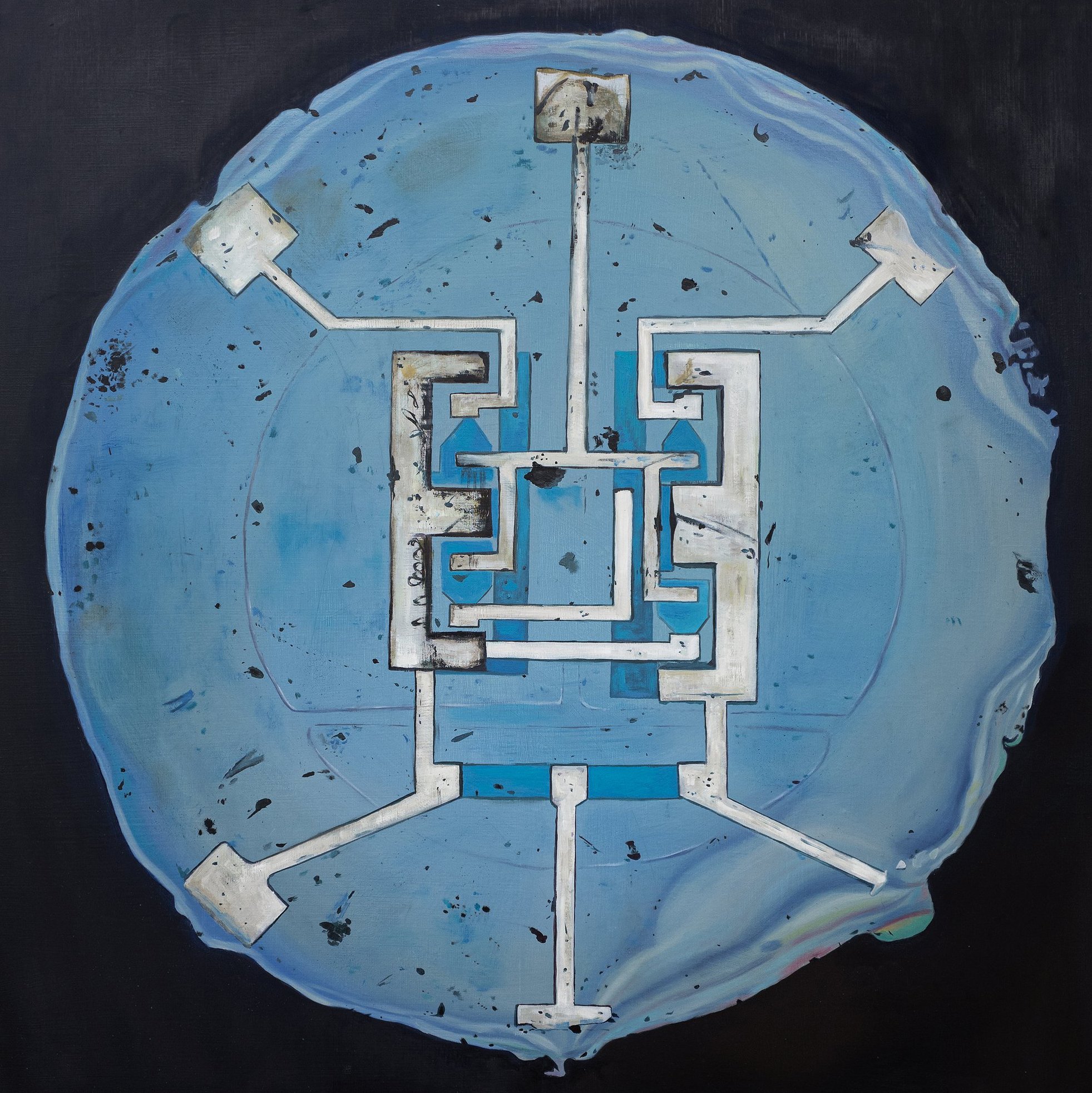
The motherboard is the architectural framework of a computer's functioning mind. It operates on the core principle of manipulating on and off signals to execute logical operations. It mechanically supports and interconnects electronic components, facilitating the flow of these signals. Each hole and engraving etched onto a chip carries its own significance. This is the functional description of the motherboard, the description that an engineer would give, the description that describes what the motherboard does and how it does it, and the description is accurate and it is complete in the sense that it accounts for all of the features of the board that are relevant to its function, but it is not complete in the sense that it accounts for all of the features of the board that are visible, because the board has features that are not functional, features that are the byproducts of the functional design, features that were not intended by the engineer but that are present on the surface nonetheless, features that the engineer would consider irrelevant but that the artist considers essential, the arrangement of the traces that resembles a constellation, the pattern of the solder points that resembles a star field, the texture of the surface that resembles a landscape, these features are not functional, they do not contribute to the operation of the computer, they are consequences of the operation of the design process, they are the formal properties of the engineering solution, and they are the properties that Mapping isolates and amplifies and makes visible, by removing the boards from their functional context and arranging them in a context where the only function is the function of being looked at, where the only operation is the operation of being seen, where the only signal is the signal that passes from the surface of the board to the eye of the viewer, a signal that is not electrical but optical, a signal that is not carried by copper but by light, a signal that is not part of the circuit but is part of the constellation.
Tan Mu has described this displacement of the functional markings as a process in which the engravings coalesce into random, abstract patterns, and the description is precise, because the patterns are random in the sense that they were not designed to form a pattern, they were designed to carry signals, and the pattern that they form when they are viewed as a pattern rather than as a set of signal routes is a pattern that was not intended by the designer, a pattern that emerged from the design process without being designed, a pattern that is the product of the convergence of engineering constraints and manufacturing processes and material properties, a pattern that is the visual expression of the logic that governs the design, a logic that produces a form that the logic did not intend, and this unintended form is what the work makes visible, the form that the function concealed, the constellation that the circuit hid, the stars on the back of the machine.
El Lissitzky made a series of works between 1919 and 1924 that he called Prouns, an acronym for Project for the Affirmation of the New. Proun 2C (1920) is a composition of geometric forms, rectangles and circles and lines, arranged on a flat surface in a configuration that hovers between architecture and abstraction, between the plan for a building and the image of a space that does not exist and could not be built. The forms in Proun 2C are architectural in their precision, in their straight edges and right angles and measured proportions, but they do not describe a building. They describe a system of spatial relationships that could be realized in three dimensions but that is presented in two dimensions, a system that is both a plan and a painting, both a set of instructions for construction and a work of art that is complete in itself, and the tension between the plan and the painting is the subject of the work, the same tension that exists in Mapping between the circuit diagram and the constellation chart, between the functional plan for moving electrons and the celestial plan for connecting stars, between the engineering drawing and the astronomical drawing, between the trace that carries the signal and the line that connects the light.
Lissitzky described the Prouns as interchange stations between painting and architecture, and the description is relevant to Mapping, because Mapping is an interchange station between the circuit and the constellation, between the functional surface and the aesthetic surface, between the back of the motherboard and the front of the night sky. The Prouns were also interchange stations between the rational and the visionary, between the engineering discipline that produced the geometric forms and the utopian ambition that those forms were intended to serve, the ambition to build a new world, a world that was more rational and more just and more beautiful than the old world, and the forms of the Prouns were the language of this new world, a language that was both technical and poetic, both precise and speculative, both grounded in the logic of engineering and directed toward the horizon of a future that had not yet been built, and the tension between these two directions, the grounded and the speculative, the technical and the poetic, the functional and the visionary, is the tension that Lissitzky held in the Prouns and that Tan Mu holds in Mapping, the tension between the trace that carries the signal and the line that connects the stars, the tension between the circuit that computes and the constellation that imagines, the tension between the function that the board was designed to serve and the image that the board was not designed to present, the tension that the work holds in the space between the two, the interchange station where the electron becomes the photon and the signal becomes the star and the back of the machine becomes the front of the sky.
Danni Shen, writing in Emergent Magazine in 2024, positioned Tan Mu's paintings as reflecting the trajectory and continuum of bodily and mediated presence through human technical developments, works that serve as a kind of witness to human socio-technological histories. The formulation is accurate and it is especially relevant to Mapping, which is not a painting but which is nonetheless a witness to the same trajectory, a witness that is made from the material of the trajectory itself, the circuit boards that are the physical substrate of the digital age, the boards that carried the signals and computed the operations and stored the data and connected the networks that have reshaped the world, boards that are now waste, boards that have been removed from the machines that they served and given a new function as elements of a work of art, boards that have been diverted from the landfill and redirected toward the gallery, boards that have been turned over so that the back is now the front and the function is now the image and the circuit is now the constellation, and the constellation is not a representation of the cosmos but a representation of the logic that produced the circuit, a logic that is both rational and random, both calculated and emergent, both designed and unintended, a logic that is the logic of the machine and the logic of the stars, a logic that is the same logic, the logic of the pattern that emerges from the interaction of simple rules, the logic of the form that is produced by the function, the logic of the trace that becomes the line that becomes the constellation that becomes the map of a universe that is shaped by randomness and chance, a universe that is the universe of the circuit and the universe of the sky, the universe that the machine computes and the universe that the eye sees, the universe that the back of the board conceals and the front of the work reveals, the stars on the back of the machine that are not stars but are golden traces that are not golden because they are precious but because they conduct, that are not constellations but are circuits, that are not maps but are plans, that are not images but are functions, that are not art but are engineering, except that now they are art, because the board has been turned over and the back is the front and the function is the image and the circuit is the constellation, and the stars are where they have always been, on the surface of the board, waiting to be seen.