The Shell Around the Star: Tan Mu's Dyson Sphere and the Architecture of Limitless Ambition
A Dyson Sphere would require more material than exists in all the planets of the solar system combined. This is not a rhetorical exaggeration. The mass of the Earth is approximately six septillion kilograms. The mass of Jupiter is approximately two thousand times the mass of the Earth. The combined mass of all the planets, asteroids, and moons in the solar system, excluding the Sun itself, is approximately four thousand times the mass of the Earth, which is approximately twenty-seven septillion kilograms. A solid shell one astronomical unit in radius, the distance from the Earth to the Sun, with a thickness of ten meters, would require a mass of approximately sixty septillion kilograms, which is more than twice the mass of all the non-solar material in the solar system. The shell could not be built from the planets alone. It would require material from the Sun itself, or from other stars, or from material that does not exist, and this means that the Dyson Sphere is not simply a large structure. It is a structure that exceeds the resources available to build it, a structure that would require the civilization that builds it to dismantle its own solar system and reassemble the material into a shell, and the civilization that could do this would no longer be a civilization that lived on planets, because the planets would no longer exist, they would have been converted into shell material, and the civilization would live inside the shell, on the inner surface, where the star that the shell surrounds would provide unlimited energy and the shell would provide unlimited living space, and the civilization would have achieved what Freeman Dyson proposed in his 1960 paper Search for Artificial Stellar Sources of Infrared Radiation, which was not a proposal to build a shell but a proposal to look for shells that might already exist around other stars, shells that would be detectable by their infrared radiation, the waste heat of a civilization that had captured the entire energy output of its star, a civilization that had solved the energy problem once and for all by building a structure that would outlast the star itself, a structure that was the ultimate expression of the ambition to transcend the limits of a planet and to become a species that no longer needed a planet, a species that had become the architecture that enclosed its star, a species that was no longer biological but architectural, no longer terrestrial but stellar, no longer limited but limitless, and the limitlessness was the point, the limitlessness was the proposal, the limitlessness was the reason that Dyson published the paper and the reason that the concept has persisted in the imagination of scientists and writers and artists for more than sixty years, the reason that a painter in the twenty-first century would devote months to depicting a structure that cannot be built, and the reason that the painting would be one of the most ambitious works in her practice, 152 by 183 centimeters of oil on linen, the largest format she had used at the time, a format commensurate with the scale of the subject, a subject that exceeds the scale of the canvas the same way that the Dyson Sphere exceeds the scale of the solar system, a subject that is too large to depict and that is depicted anyway, that is too vast to render and that is rendered in golden tones and layered brushstrokes and dense points of starlight, a painting that is not a representation of a structure but a representation of the ambition to build a structure, the ambition that is the subject, the ambition that is the shell around the star.
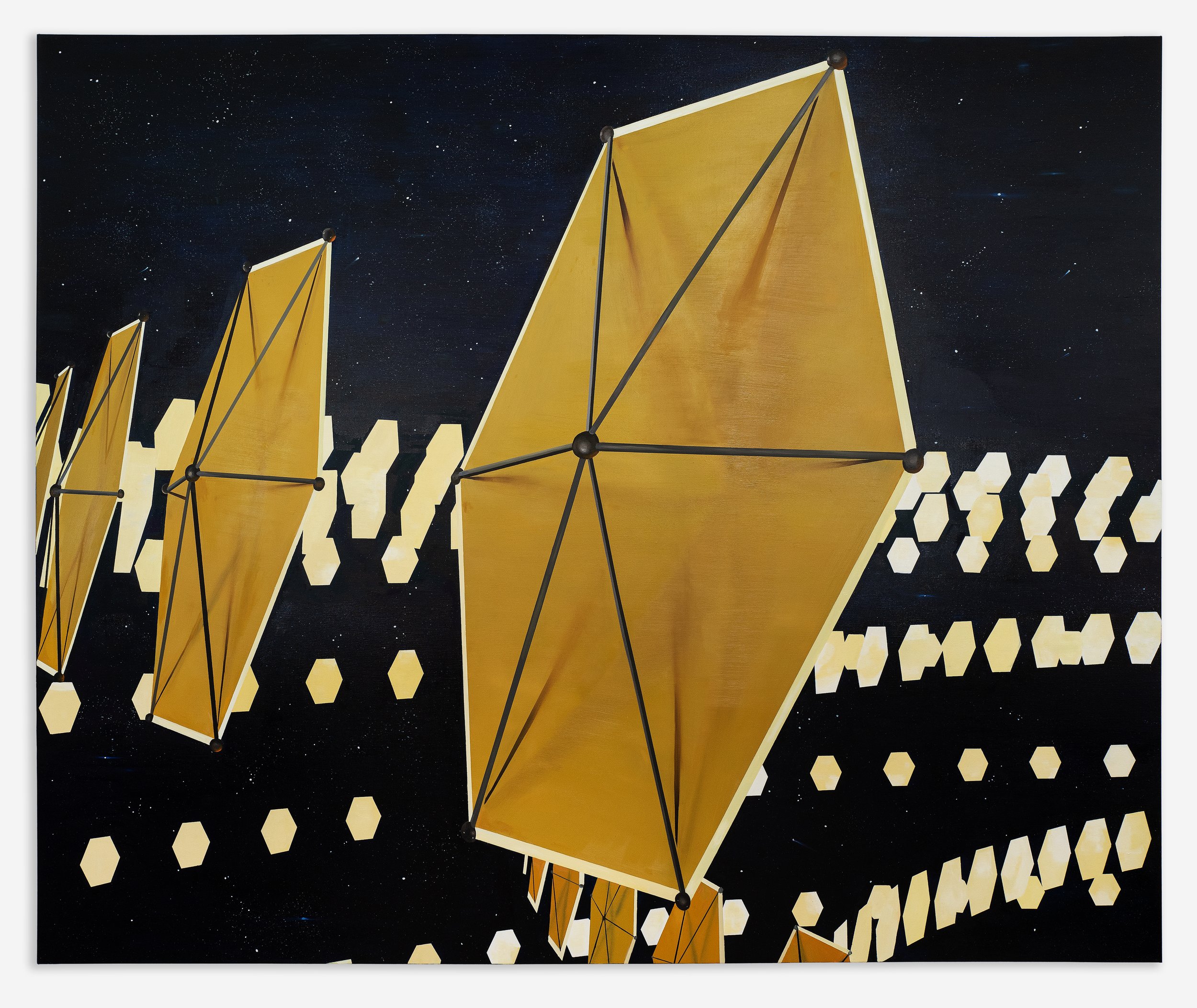
Dyson Sphere (2023) is an oil painting on linen, 152 x 183 cm (60 x 72 in), that depicts a field of golden energy collection panels orbiting a star. The canvas is large, approximately one and a half by two meters, and the scale of the canvas is appropriate to the scale of the subject, because the Dyson Sphere is the largest structure that a technological civilization could theoretically build, a shell with a radius of one astronomical unit, a circumference of approximately six hundred million kilometers, a surface area of approximately two hundred and eighty million times the surface area of the Earth, and the painting cannot depict this scale, no painting can, but the painting can depict the impression of this scale, the impression of vastness, the impression of a structure that extends beyond the frame, the same way that the canvas extends beyond the boundaries of the stretcher bars and the painting extends beyond the boundaries of the gallery wall and the subject extends beyond the boundaries of the physical world into the territory of speculation and imagination.
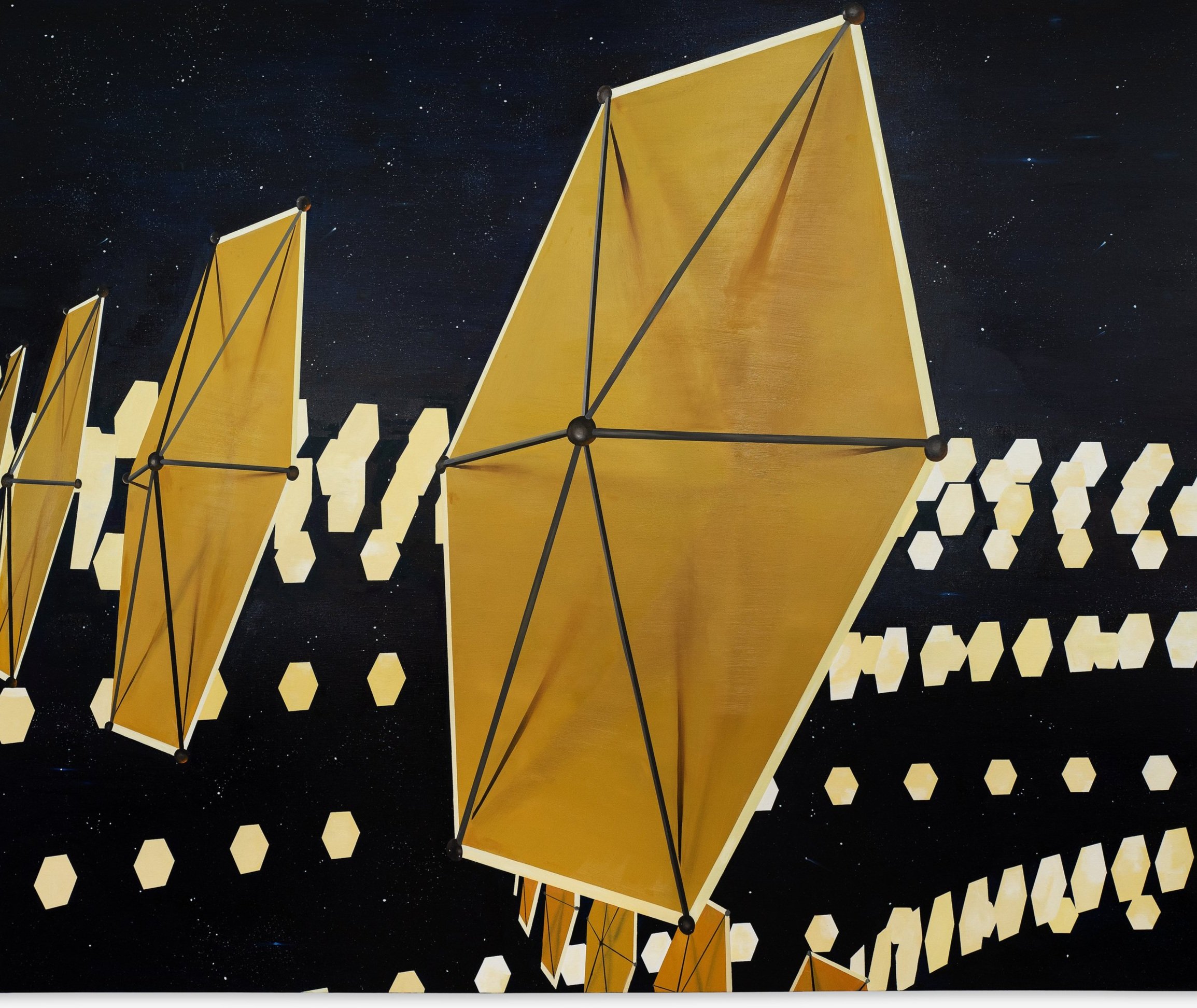
The dominant color of the painting is gold. Tan Mu has described using a field of golden tones to depict the energy collection panels that orbit the star, and the gold is not the gold of ornament or the gold of value but the gold of energy, the gold of the photon, the gold of the light that the star emits and that the panels absorb and that the civilization within the shell would use to power everything that it does, every computation, every communication, every construction, every act of thinking and making and building that a civilization without energy constraints would perform. The gold in the painting is applied in flowing gradients that suggest light being reflected, absorbed, and transformed, and the gradients move across the surface of the panels in waves and curves that evoke the rotation of the panels around the star, the continuous motion of a structure that is always in orbit, always collecting, always accumulating, always turning the energy of the star into the energy of the civilization, and the motion is not depicted as a single moment but as a duration, a process, an ongoing activity that the painting captures and holds in the same way that a photograph holds a long exposure, the accumulation of motion over time rendered as a single image, the rotation of the panels around the star rendered as a pattern of golden light that flows across the surface of the canvas.
Beneath and around the golden panels, the starry sky is rendered in dense points of light. Tan Mu has described Dyson Sphere as her first sustained attempt to depict the starry sky, and the density of the points is remarkable, hundreds or thousands of small marks of white and pale yellow and pale blue distributed across the dark background of the canvas, each point representing a star, each point a separate application of the brush to the linen, each point a decision about where to place a star and how bright to make it and what color to give it, and the accumulation of all these points produces a field of light that is not a representation of the night sky as it appears from the surface of the Earth but a representation of the night sky as it would appear from space, from the vantage point of the shell itself, from the vantage point of a civilization that no longer lives on a planet but inside a structure that surrounds a star, a civilization that would see the cosmos from the inside of the shell, looking outward through the gaps between the panels at the stars that are not enclosed, the stars that are still free, the stars that are still distant and unreachable and unbounded by any architecture, the stars that are the reminder that the shell is a structure and not the universe, that the shell has an inside and an outside, that the civilization that lives inside the shell is still inside, still enclosed, still limited by the structure that it built to transcend its limits, and the stars outside the shell are the image of the limit that the shell cannot enclose, the limit that no structure can enclose, the limit that is the cosmos itself, the cosmos that exceeds every architecture that any civilization could build, and the painting holds both the shell and the stars, the structure and the unstructured, the enclosed and the unenclosed, the architecture and the void, the ambition and the limit that the ambition cannot exceed.
Caspar David Friedrich's The Sea of Ice (1824) is a painting of a shipwreck in the Arctic, a composition of shattered ice plates that have crushed the wooden vessel and pushed it to the edge of the frame, where it is barely visible among the broken ice and the dark water and the grey sky. The painting is approximately 96.7 x 126.9 cm and it depicts a landscape that is hostile to human presence, a landscape that has defeated the human ambition to navigate it, a landscape that is not a setting for human activity but a force that overwhelms human activity, and the ship is not the subject of the painting in the way that a ship is the subject of a maritime painting, it is a detail, a small wooden structure that is almost lost among the ice, a detail that the viewer must search for, a detail that is easy to miss, a detail that is insignificant in comparison to the scale of the ice that surrounds it and that has destroyed it, and the insignificance of the ship in the composition is the argument of the painting, the argument that the landscape is more powerful than the human ambition to traverse it, that nature is more vast than the structures that humans build to navigate it, that the ice will outlast the ship the same way that the cosmos will outlast the Dyson Sphere, and the painting does not depict the defeat of the ship as a tragedy but as a fact, a fact that is registered in the composition without sentiment, a fact that is the visual expression of the relationship between human ambition and the natural world that exceeds it, and the relationship is not one of harmony but of scale, the scale of the ice that dwarfs the ship, the scale of the cosmos that dwarfs the shell.
The connection to Dyson Sphere (2023) is in the relationship between architecture and nature, between the structure that the civilization builds and the cosmos that the structure is built within. Friedrich's painting depicts the moment when the architecture of navigation, the ship, is destroyed by the force of nature that it was built to traverse. Tan Mu's painting depicts the moment when the architecture of energy collection, the shell, is imagined as a structure that would enclose the star and that would, if it were built, become the largest structure in the solar system, a structure that would dwarf every natural feature of the solar system, a structure that would make the planets unnecessary, a structure that would represent the ultimate triumph of architecture over nature, and yet the painting does not depict this triumph as a certainty but as a speculation, a speculation that is held in the tension between the golden panels and the starry sky, between the structure and the void, between the architecture and the cosmos that the architecture cannot enclose, because the stars outside the shell are still there, still distant, still unreachable, still unbounded, and the shell, no matter how vast, is still a shell, is still an inside, is still an enclosure, is still a limit, and the stars outside are the image of the limit that the shell cannot enclose, the same way that the ice in Friedrich's painting is the image of the limit that the ship cannot exceed, the limit that nature imposes on human ambition, the limit that the ambition acknowledges in the act of building the ship and that the painting acknowledges in the act of depicting the ice.
Freeman Dyson published his paper in 1960 in the journal Science. The paper was not a proposal to build a sphere. It was a proposal to look for one. The title was Search for Artificial Stellar Sources of Infrared Radiation, and the argument was that a technological civilization that had reached a level of energy consumption sufficient to require the entire output of its star would likely build a structure around the star to capture that output, and the structure would radiate waste heat in the infrared, and the infrared radiation would be detectable by astronomical observation, and the detection of such radiation would be evidence of the existence of a civilization that had transcended the limitations of planetary living, a civilization that had become what Dyson called a technological species, a species that had solved the energy problem and that could now devote its resources to other problems, problems of knowledge and communication and construction and the expansion of consciousness and capability beyond the limits that had constrained the species when it lived on a planet, and the paper was speculative in the scientific sense, it was a hypothesis that could be tested by observation, but it was also speculative in the literary sense, it was a vision of a future that was not predicted but imagined, a future that was not a projection of current trends but an expansion of current possibilities, a future that was not a continuation of the present but a transformation of the present into something that the present could not yet conceive, and the transformation was the subject, not the structure, not the shell, not the sphere, but the transformation of a species that builds planets into a species that builds shells, a species that lives in architecture rather than in nature, a species that has become the structure that it built to transcend its limits, and the painting holds this transformation in the tension between the gold and the stars, the structure and the void, the ambition and the limit that the ambition cannot exceed, the limit that is the cosmos itself.
Olafur Eliasson's The Weather Project (2003) was installed in the Turbine Hall of the Tate Modern in London. The work consisted of a semi-circular array of mono-frequency lamps that emitted yellow light at a wavelength of approximately 589 nanometers, the wavelength of sodium, and a ceiling of mirrors that reflected the light and doubled the semi-circle into a full circle, creating the appearance of a sun that hung in the upper volume of the hall and that filled the space with a warm yellow glow. The atmosphere in the hall was created by a machine that produced a fine mist of water and sugar that diffused the light and gave the air a hazy quality that resembled the atmosphere of a sunset or a sunrise, and the visitors who entered the hall lay on the floor and looked up at the artificial sun and saw themselves reflected in the mirrored ceiling, and the experience was not the experience of looking at a representation of the sun but the experience of being in the presence of something that was like the sun, something that was artificial and that produced a genuine response, a response of warmth and light and the awareness of being in a space that was larger than the individual who occupied it, a space that was defined by the presence of a source of energy that was not the sun but that functioned like the sun, that emitted light and that produced heat and that created the conditions for visibility and for the experience of being seen, because the mirrors on the ceiling reflected the visitors on the floor, and the visitors could see themselves as if from above, as if from the perspective of the sun, and the experience of being seen from above was the experience of being part of a larger system, a system that included the artificial sun and the artificial atmosphere and the artificial mirror and the real people who lay on the floor and looked up and saw themselves in the reflection of the ceiling, and the system was not a representation of a weather system but a weather system, a system that produced the conditions that it depicted, a system that was both the image and the reality of the weather, both the representation and the thing represented, both the artificial sun and the experience of the sun.
The connection to Dyson Sphere (2023) is in the artificial star, the source of energy that is constructed rather than natural, the light that is produced by a machine rather than by a star, and the experience of being in the presence of this artificial source of light is the experience that both works produce, although they produce it in different media and at different scales. Eliasson's artificial sun is an installation that produces a real experience of light and warmth and atmosphere. Tan Mu's Dyson Sphere is a painting that produces a visual experience of a structure that would produce real energy if it were built, a structure that would produce so much energy that the civilization inside it would never need another source, a structure that would make the star into a power plant and the shell into a habitation and the civilization into the architecture that enclosed the star, and the painting holds this speculative structure in the same way that the Turbine Hall held the artificial sun, as a presence that is not natural but that produces a response that is genuine, a response of wonder and of the awareness of being in the presence of something that exceeds the individual, something that is vast and luminous and that produces the conditions for the experience of being part of a system that is larger than the individual who contemplates it, a system that includes the star and the shell and the civilization and the painting and the viewer who stands in front of the painting and looks at the golden panels and the dense points of starlight and the flowing gradients that suggest light being reflected and absorbed and transformed, and the viewer is part of the system, the same way that the visitors in the Turbine Hall were part of the weather system that Eliasson constructed, the same way that the civilization inside the Dyson Sphere would be part of the energy system that the shell constructed, the same way that every observer of a system is part of the system, and the painting holds this relationship between the observer and the observed, the viewer and the painting, the civilization and the star, the architecture and the cosmos, and the holding is the painting, and the painting is the shell around the star, and the shell is the ambition, and the ambition is the limit, and the limit is the stars that are still outside, still free, still distant, still unbounded by any architecture that any civilization could build, the stars that are the image of the cosmos that exceeds every shell, the cosmos that is the limit that the ambition cannot enclose but that the ambition can see, from inside the shell, through the gaps between the panels, as points of light in the dark, as stars on the back of the gold, as the limit that the architecture acknowledges by being built, the limit that the painting acknowledges by being painted, the limit that is the reason the painting exists, because a structure that would enclose a star is a structure that cannot be built but that can be imagined, and the imagination is the shell, and the shell is the painting, and the painting is the limit and the ambition and the star and the gold and the points of light in the dark, all of them present in the same field, all of them held in the same linen, all of them part of the same system, the system of the painting, the system of the shell, the system of the cosmos that the shell cannot enclose but that the painting can hold.