The Gems That Are Alive: Tan Mu's Epithelial Cells and the Boundary Where Biology Becomes Color
A cell is not a gemstone. A cell is a membrane enclosing a volume of water and protein and nucleic acid, a volume that is organized into compartments and structures that perform the functions of life, the metabolism and the replication and the signaling that constitute the activity of a living system, and the cell is alive in the sense that it performs these functions, in the sense that it maintains itself against the entropy that would dissolve it, in the sense that it divides and produces another cell that is like itself and that will also maintain itself and divide, and the gemstone is not alive, the gemstone is a crystal of carbon or silicon or aluminum or oxygen, a crystal that was formed by geological processes over millions of years, a crystal that has a regular structure that is determined by the atomic structure of the mineral, a crystal that does not metabolize or replicate or signal, a crystal that is a structure without a function, except the function of being beautiful, the function of being cut and polished and set in a ring and worn on a finger and looked at in the light, and the cell does not have this function, the cell does not exist to be looked at, the cell exists to perform the functions of life, and the functions of life are not beautiful, they are necessary, they are the conditions of survival, they are what the cell does to continue being a cell, and the beauty of the cell, if the cell is beautiful, is not the purpose of the cell but a byproduct of the structure that the cell requires to perform its functions, the same way that the beauty of the gemstone is not the purpose of the crystal but a byproduct of the structure that the mineral requires to be a crystal, and the structure that produces the beauty is the same in both cases, the regular arrangement of parts in a pattern that the eye recognizes as ordered and that the mind interprets as beautiful, and the painting holds both of these structures, the biological and the mineral, the alive and the still, the cell and the gem, and the holding is the painting, and the painting is the place where the cell and the gem meet, where the membrane and the crystal face each other across the surface of the canvas, where the function of life and the function of beauty occupy the same field, where the boundary between biology and color is the surface of the painting, and the surface is 122 by 153 centimeters of oil on linen, and the subject is epithelial cells, and the cells have been stained with colors that make their lineages visible, and the colors are gem-like, and the gems are alive.
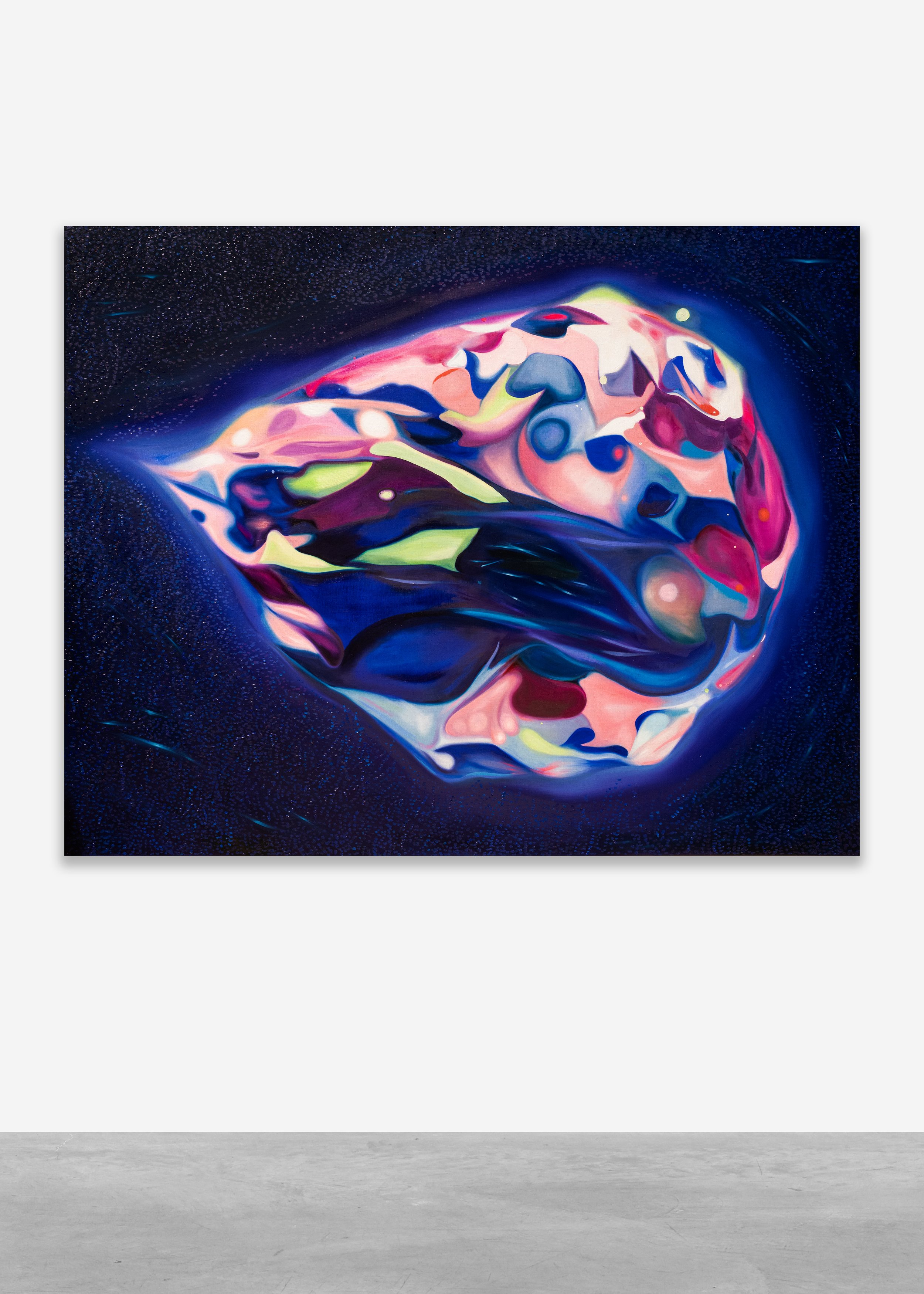
Epithelial Cells (2024) is an oil painting on linen, 122 x 153 cm (48 x 60 in), that depicts human epithelial cells growing in a dish. The cells have been clonally labeled, meaning that cells of the same color are descendants of a single cell at the time of labeling. The process of clonal labeling is a technique that was developed in biological research to allow scientists to trace the lineage of cells as they divide and differentiate, and the technique works by inserting a gene that produces a fluorescent protein into a single cell, and the fluorescent protein is then passed to all of the descendants of that cell, so that every cell in the clonal population glows with the same color, and the color is not a dye that is applied to the surface of the cell but a protein that is produced by the cell itself, a protein that is encoded in the DNA of the cell and that is expressed by the machinery of the cell, and the color is therefore not an external marker but an internal product, not a label that is stuck onto the cell but a substance that the cell makes, and the distinction between the label and the product is the distinction between the representation and the thing represented, the distinction between the map and the territory, the distinction between the color that the scientist applies and the color that the cell produces, and the painting collapses this distinction, because the color in the painting is neither the fluorescent protein nor the dye, the color in the painting is oil paint, a pigment suspended in linseed oil, a substance that is applied to the surface of the linen by the hand of the painter, and the color is therefore a third thing, neither the biological product nor the scientific marker but the artistic medium, and the medium carries both meanings simultaneously, the meaning of the fluorescent protein and the meaning of the pigment, the meaning of the lineage and the meaning of the color, the meaning of the function and the meaning of the beauty, and the painting holds both meanings in the same mark, the same brushstroke, the same application of paint to linen, and the holding is the painting.
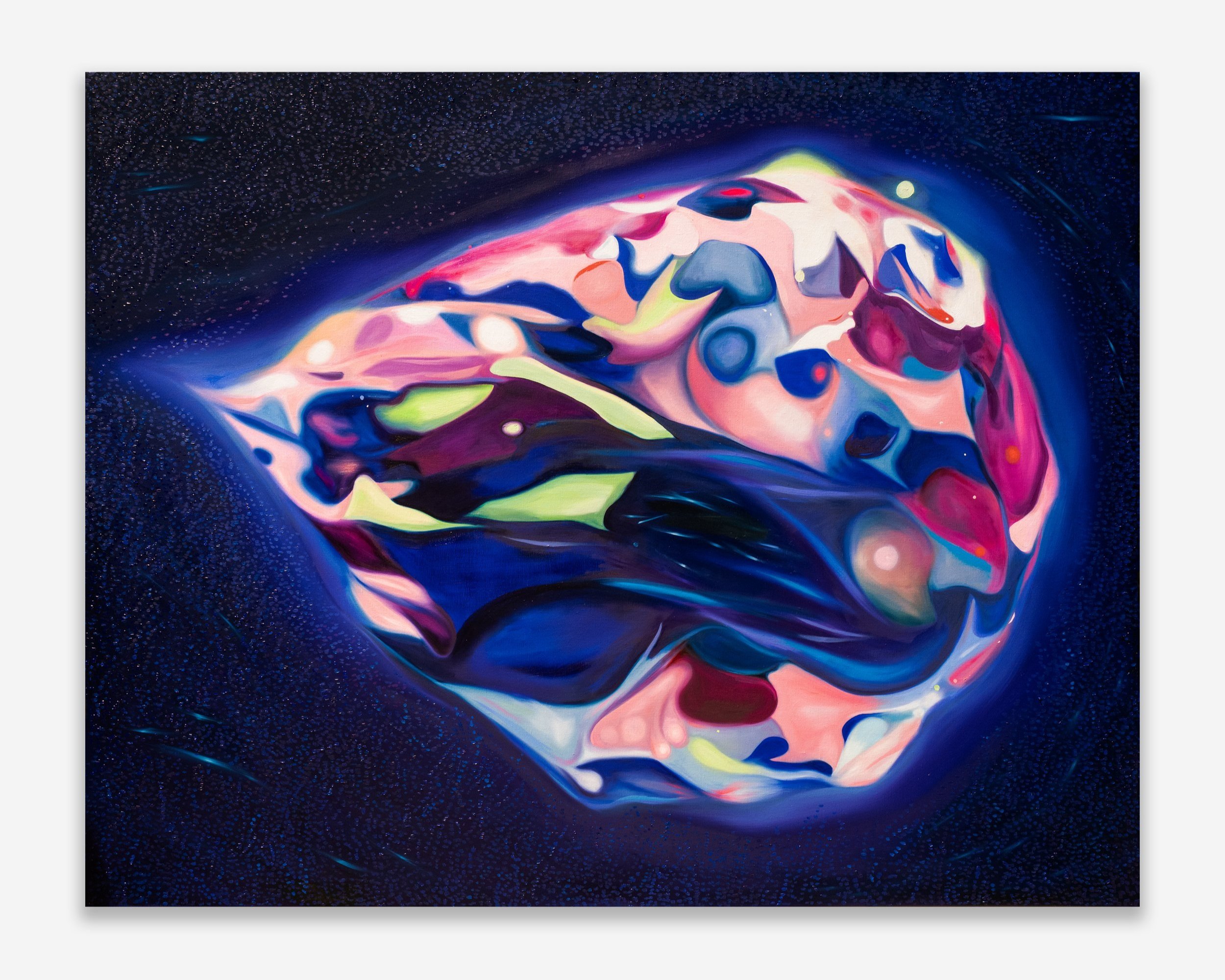
The composition of the painting is organized around clusters of color. Each cluster represents a clonal population of cells, a group of cells that are all descended from the same ancestor and that all carry the same fluorescent protein and that all glow with the same color when they are illuminated with the appropriate wavelength of light. The clusters are distributed across the surface of the canvas in a pattern that reflects the distribution of the cells in the dish, a pattern that is not random but that is the result of the process of cell division and migration and differentiation that produced the clonal populations, a process that is governed by the genetic program of the cells and by the chemical and physical conditions of the dish, the nutrients and the growth factors and the temperature and the pH and the density of the cells and the signals that they send to each other and receive from each other, and the pattern is therefore not an aesthetic pattern, it is a biological pattern, a pattern that is produced by the same forces that produce the pattern of cells in a developing embryo or a growing tumor or a healing wound, and the painting translates this biological pattern into an aesthetic pattern, and the translation is not a distortion but a recognition, a recognition that the biological pattern is already aesthetic, that the distribution of colors in the dish is already a composition, that the clonal populations are already clusters of color that the eye can read as the eye reads a painting, that the cells are already gems.
The colors of the clusters are vivid, saturated, intense. There are reds and blues and greens and yellows and oranges and purples, each color a different fluorescent protein, each color a different lineage, each color a different ancestor that was labeled at the beginning of the experiment and that has since divided and multiplied and produced a population of descendants that all carry the same color, and the saturation of the colors is the saturation of the fluorescent proteins, the saturation of the light that the proteins emit when they are excited, the saturation that is not the saturation of pigments but the saturation of light, and the painting translates the saturation of light into the saturation of pigment, and the translation produces a surface that glows, that appears to emit light rather than to reflect it, that appears to be luminous rather than merely colored, and the luminosity is the quality that connects the biological image to the gemstone, the quality that makes the cell cluster look like a cluster of gems, the quality that makes the living system look like a mineral, the quality that is the result of the same process that produces the color of a sapphire or a ruby or an emerald, the absorption and emission of light by a substance that is organized at the atomic level into a structure that produces color, and the cell and the gemstone are both structures that produce color, and the color is the connection between them, and the painting is the place where the connection is made visible.
Hilma af Klint painted The Ten Largest, a series of ten paintings, in 1907. The third painting in the series, Youth, is approximately 320 cm tall and 240 cm wide, a canvas of extraordinary scale that was unprecedented for a work by a woman artist at the time, a scale that was reserved for history paintings and altarpieces and other works that were intended to occupy the most prominent positions in the most important buildings, and af Klint used this scale for a painting that does not depict a historical event or a religious subject but a biological process, the process of growth and development and the unfolding of life from its origins to its maturity, and the painting is filled with organic forms, shapes that resemble cells and embryos and flowers and shells, shapes that are rendered in vivid colors, pinks and blues and yellows and greens, colors that are not the colors of the natural world as it appears to the eye but the colors of the natural world as it appears to the imagination, colors that are saturated and luminous and that seem to glow from within the surface of the canvas, and the forms are arranged in a composition that is both ordered and organic, a composition that follows a logic that is not the logic of perspective or the logic of the picture plane but the logic of growth, the logic of the cell dividing and the embryo developing and the flower opening, a logic that is not imposed on the forms from the outside but that emerges from the forms themselves, the same way that the pattern of cells in a dish emerges from the process of division and differentiation, the same way that the composition of Epithelial Cells emerges from the distribution of the clonal populations.
The connection between af Klint and Tan Mu is in the translation of biological process into visual composition. Af Klint was a member of a spiritual group that believed in the existence of higher dimensions of reality that could be perceived through meditation and that could be represented through art, and her paintings were intended to depict these higher dimensions, to make visible the invisible forces that she believed governed the development of life, and the result was a body of work that anticipates the imagery of cell biology by decades, paintings that look like microscope images of cells and tissues, paintings that were made before the microscope had revealed the structures that they depict, paintings that are prophetic in the sense that they anticipate the visual language that would later be developed by science to represent the processes of life, and the prophetic quality of the work is not the result of knowledge but of intuition, the intuition that life is organized at a scale that is too small to see but that is nonetheless present and that can be represented through color and form, and Tan Mu's Epithelial Cells is the inverse of this intuition, the translation of the visual language of science back into the visual language of painting, the translation of the microscope image into the oil painting, the translation of the fluorescent protein into the pigment, the translation of the biological pattern into the aesthetic composition, and both translations proceed in the same direction, from the invisible to the visible, from the small to the large, from the function to the form, from the cell to the gem.
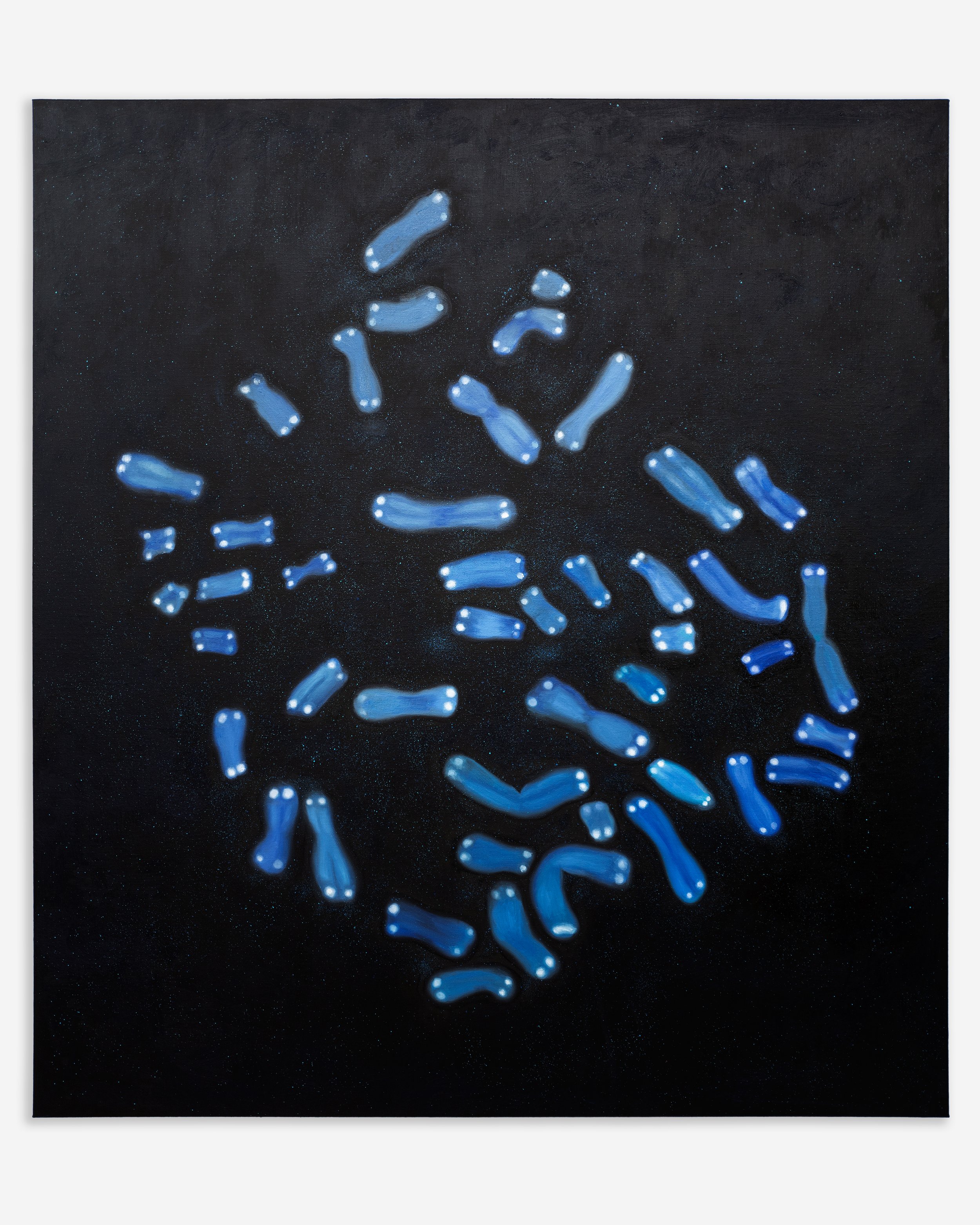
Epithelial cells exist at boundaries. They form tightly packed layers that act as interfaces between internal and external environments, serving protective, sensory, and secretory functions. They are the cells that line the surfaces of the body, the skin and the gut and the lungs and the blood vessels, the cells that are at the edge of the organism, the cells that face the world, the cells that are the boundary between the self and the not-self, the inside and the outside, the protected and the exposed, and the function of the epithelial cell is to maintain this boundary, to allow some substances to pass through and to prevent others from passing, to keep the inside in and the outside out, to be a membrane that is also a wall, a barrier that is also a gateway, a surface that is also a depth, and the boundary that the epithelial cell maintains is the boundary that the painting represents, the boundary between biology and color, between the function of life and the function of beauty, between the cell and the gem, between the fluorescent protein and the pigment, between the scientific image and the artistic image, and the painting holds this boundary the way the epithelial cell holds the boundary of the body, by being the boundary, by being the surface that faces both ways, that faces the inside and the outside, that faces the function and the form, that faces the cell and the gem, and the boundary is not a line but a layer, a layer of paint, a layer of epithelium, a layer of meaning that is thick enough to hold both sides, thick enough to be both biology and art, thick enough to be both information and beauty, thick enough to be both the fluorescent protein that the cell produces and the pigment that the painter applies, and the thickness is the painting, and the painting is 122 by 153 centimeters, and the 122 by 153 centimeters is the boundary, and the boundary is the place where the cell becomes the gem.
Harold Edgerton was an electrical engineer at the Massachusetts Institute of Technology who invented the electronic flash, a device that produced a burst of light that was short enough to freeze motion that was too fast for the human eye to see. In 1936, he used the electronic flash to photograph a drop of milk falling onto a surface, and the photograph, Milk Drop Coronet, captured the moment when the drop hit the surface and produced a crown-shaped splash that rose from the point of impact in a ring of tiny droplets, each droplet caught in mid-air by the flash, each droplet frozen in the instant of its formation, and the photograph revealed a form that no one had ever seen, a form that existed for only a fraction of a millisecond and that was too brief for the eye to register but that the flash and the camera preserved as a permanent record, and the form was beautiful, beautiful in a way that was unexpected and that was not the result of aesthetic intention but the result of physical law, the law that governs the behavior of liquids and surfaces and gravity and surface tension, and the beauty of the form was a byproduct of the physics, the same way that the beauty of the epithelial cell is a byproduct of the biology, the same way that the beauty of the gemstone is a byproduct of the crystallography, and the photograph was not intended to be beautiful, it was intended to be informative, it was a scientific experiment that was designed to study the behavior of liquids, and the beauty was a discovery, a discovery that was made by the technology that was designed to reveal information, and the technology revealed the beauty as information, the beauty was the information, the form was the data, and the photograph was both a scientific document and a work of art, and the doubleness was the discovery, the discovery that the information and the beauty were the same thing, that the form that the physics produced and the form that the eye appreciated were the same form, and the technology that revealed the form was the technology that produced the art.
The connection to Epithelial Cells (2024) is in the technology that reveals the beauty that the biology produces. The clonal labeling technique that makes the lineages of the cells visible is a technology that was developed for scientific research, a technology that was designed to produce information about cell division and differentiation, and the information is visible as color, the color of the fluorescent protein that marks the lineage, and the color is beautiful, and the beauty is not the purpose of the technology but a byproduct, the same way that the beauty of the milk drop coronet was not the purpose of the electronic flash but a byproduct, and the painting makes the byproduct the product, makes the beauty that was discovered by the technology the subject of the art, and the art holds the discovery the way the photograph holds the splash, as a permanent record of a form that exists only briefly, a form that the technology reveals and that the art preserves, a form that is both information and beauty, both data and gem, both the function of the cell and the form of the color, and the form is the boundary, and the boundary is the painting, and the painting is the place where the cell becomes the gem, where the function becomes the form, where the information becomes the beauty, where the biology becomes the color, and the color is red and blue and green and yellow and orange and purple, the colors of the fluorescent proteins, the colors of the lineages, the colors of the ancestors and the descendants, the colors of the cells that exist at the boundary of the body and that are the boundary of the painting, the cells that are the interface between the inside and the outside, the function and the form, the biology and the art, and the painting holds the interface the way the epithelium holds the body, by being the surface that faces both ways, the surface that is the boundary and the boundary that is the surface and the surface that is the color and the color that is the gem and the gem that is alive.