The Grid That Harvests the Sun: Tan Mu's Solar Farm and the Landscape That Was Remade for Energy
Solar panels are not merely technological objects. They are symbols of capital, infrastructure, and humanity's intervention in nature. This is what Tan Mu has said about them, and the statement is a description and a provocation, a description because solar panels are indeed technological objects, they are devices that convert sunlight into electricity, they are manufactured in factories and installed on land that has been cleared and graded and prepared for their installation, and they are indeed symbols of capital, because the installation of a solar farm requires a large capital investment and the solar farm generates a return on that investment through the sale of the electricity that the panels produce, and they are indeed infrastructure, because the electricity that the panels produce is fed into the electrical grid and distributed to the consumers who use it, and they are indeed an intervention in nature, because the land that the solar farm occupies was not producing electricity before the solar farm was built, it was producing something else, it was producing crops or supporting livestock or providing habitat for wildlife or simply being land, being a landscape, being a field, being a place where the sun shone on the ground and the ground absorbed the sunlight and the sunlight warmed the soil and the soil supported the roots of the plants and the plants grew and the cycle of photosynthesis continued as it had continued for hundreds of millions of years before the solar farm was built, and the solar farm interrupted this cycle, not by destroying it but by redirecting it, by intercepting the sunlight before it reached the soil and converting it into electricity and feeding the electricity into the grid and distributing it to the consumers who use it, and the redirection is the intervention, the redirection of the energy of the sun from the biological cycle of photosynthesis to the technological cycle of photovoltaic conversion, from the process that sustains life to the process that sustains civilization, and the two processes are not incompatible, they can coexist on the same land, the solar panels can be installed above the crops and the crops can grow beneath the panels and the land can produce both food and electricity, but the solar farm that Tan Mu has painted is not this kind of agrivoltaic installation, it is a solar farm that has replaced the agriculture, a solar farm that has been built on land that was previously used for farming and that is now used for the production of electricity, and the replacement is the subject of the painting, the replacement of one landscape by another, the replacement of the agricultural landscape by the energy landscape, the replacement of the field of crops by the field of panels, the replacement of the organic by the geometric, the replacement of the irregular rhythms of nature by the rigid and systematic order of the engineered, and the replacement is what the painting holds, the old landscape and the new landscape, the field of crops and the field of panels, the land as it was and the land as it has become, and the holding is the painting.
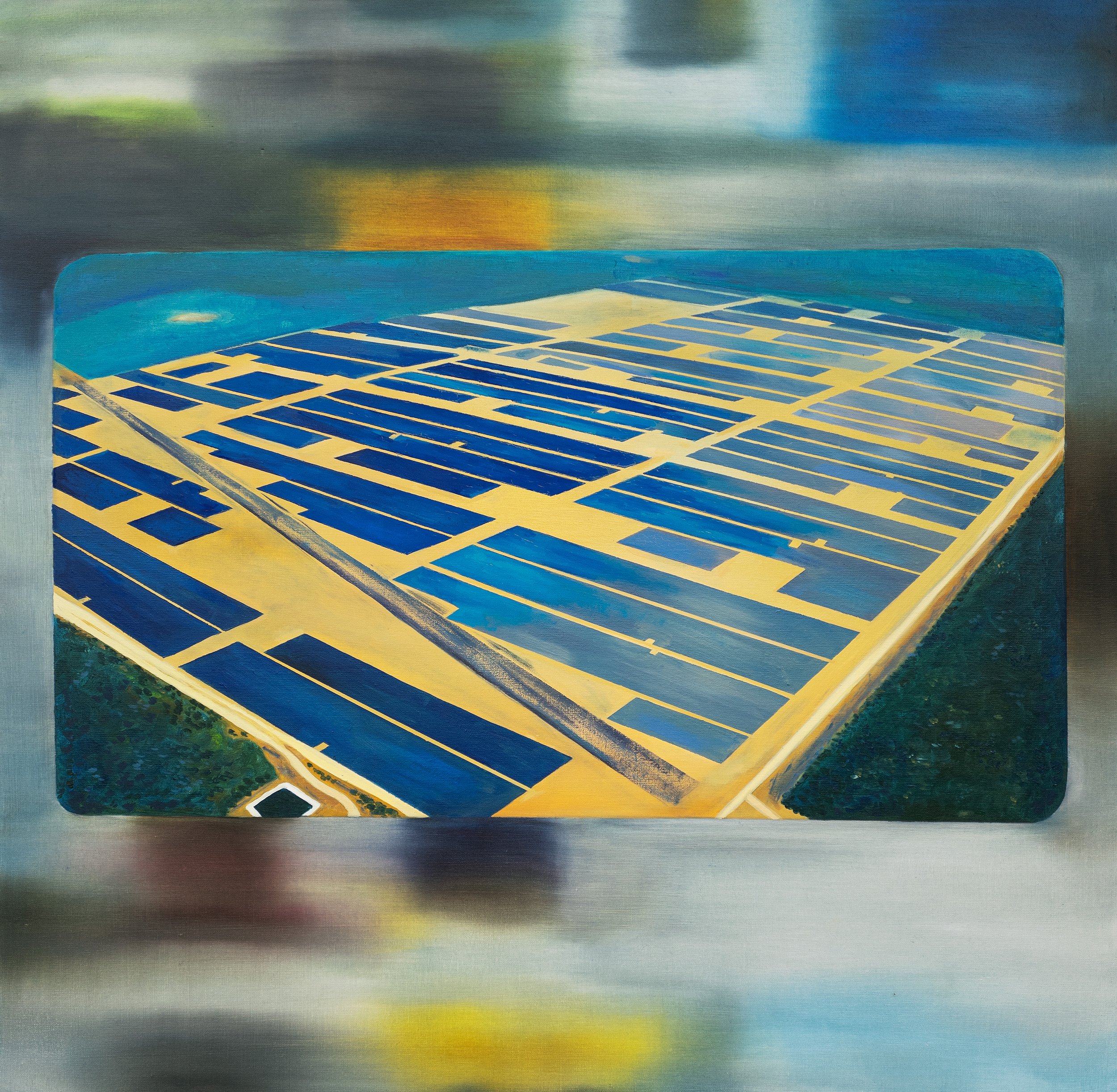
Solar Farm (2022) is an oil painting on linen, 76 x 76 cm (30 x 30 in), that presents an aerial view of a solar farm. The format is square, which is unusual for a landscape, because landscapes are typically horizontal, wider than they are tall, because the landscape extends horizontally across the field of vision, and the square format compresses this horizontal extension into a field that is as tall as it is wide, a field that does not privilege the horizontal over the vertical, a field that treats both dimensions equally, the same way that the solar panels treat both dimensions equally, because the solar panels are arranged in a grid that is as wide as it is long, a grid that extends in both directions, a grid that fills the square format of the canvas the same way that it fills the square of the land, and the grid is the dominant visual element of the painting, the grid of the solar panels that are arranged in rows and columns across the surface of the land, each panel a rectangle of dark blue or dark grey or reflective silver, depending on the angle of the light and the angle of the viewer, each panel aligned with its neighbors in a pattern that is precise and regular and geometric, a pattern that is the product of engineering and planning and the optimization of the orientation of the panels toward the sun, and the precision of the pattern is the precision of the technology, the precision of the system that converts sunlight into electricity, the precision of the grid that harvests the sun.
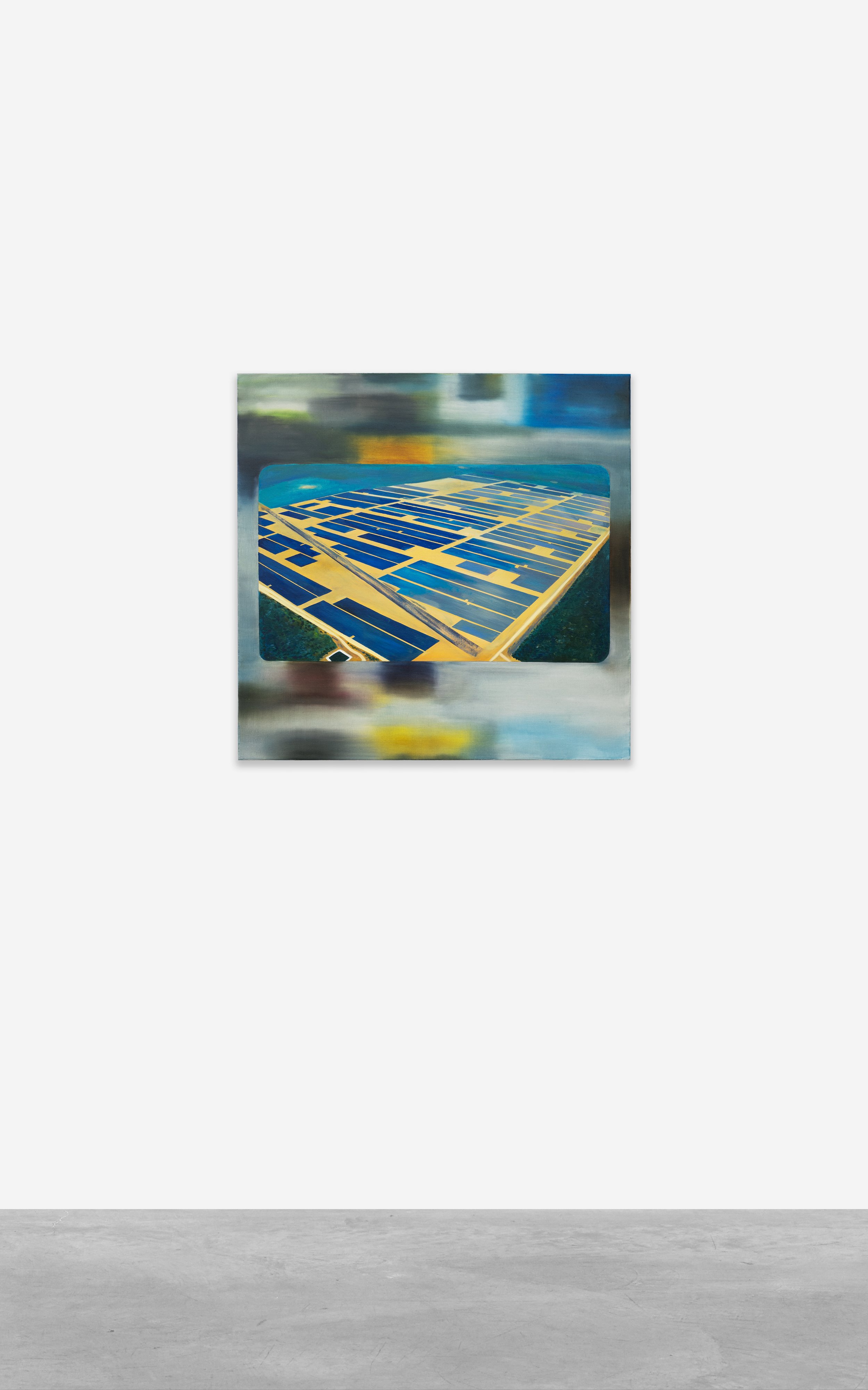
The solar panels in the painting are rendered with a precision that emphasizes their geometric form, the straight lines and the precise repetition that Tan Mu has described as qualities that are rarely found in natural scenery. The panels are dark, reflective, and they produce the subtle shifts in color that she has observed in the solar farms that she has seen while driving on highways or flying near airports in Florida, shifts that are caused by the refraction of sunlight across the surfaces of the panels, the way that the angle of the sun changes throughout the day and the panels reflect different colors at different times, the way that the panels produce a visual effect that is not the color of the panels themselves but the color of the light that the panels reflect, and the reflected light is the color of the sky, the color of the clouds, the color of the sun, the color of the atmosphere that surrounds the panels and that the panels reflect back to the viewer, and the reflection is the visual effect that makes the solar farm look like a mirror laid on the ground, a mirror that reflects the sky and makes the ground look like the sky, a mirror that inverts the landscape and makes the below look like the above, and the inversion is the painting, the painting that shows the ground as the sky and the panels as the mirror and the grid as the frame that holds the mirror in place.
Behind the solar panels, the surrounding environment is rendered in a more abstract and blurred manner. Tan Mu has described this as reflecting the way that modern reality is mediated through technology, where moments are often fragmented, compressed, and fleeting, and the blur of the background is the blur of the digital, the blur of the screenshot that was taken on a phone and that was the source image for the panels, the blur of the photo gallery that is visible in the background of the painting, the blur of the images that dissolve into one another when they are scrolled through on a screen, the blur of the way that contemporary experience is fragmented and compressed and fleeting, the blur of the way that people consume news on politics and environmental issues and technological progress with a swipe, engaging with the world remotely, and the blur is the background, and the panels are the foreground, and the foreground is sharp and the background is blurred, and the contrast between the sharp foreground and the blurred background is the contrast between the technology and the environment that the technology has replaced, the contrast between the grid and the landscape, the contrast between the engineered and the organic, the contrast between the solar farm and the field that was there before the solar farm was built, and the contrast is the painting.
Claude Monet painted the Gare Saint-Lazare in 1877. The Arrival of the Normandy Train, Gare Saint-Lazare is a painting of a train station that depicts a locomotive arriving on the tracks beneath the iron and glass roof of the station, and the locomotive is not a secondary element in the composition, it is the subject of the painting, it is the reason that the painting exists, and the reason that the painting exists is that the locomotive and the station and the tracks and the signals and the smoke and the steam and the iron and the glass are the technologies that were transforming the landscape of Paris in the 1870s, and Monet painted them not as curiosities or novelties but as the new landscape, the landscape that was replacing the old landscape, the landscape of the train and the station and the track that was replacing the landscape of the road and the carriage and the horse, and the replacement was not a catastrophe, it was a transformation, and Monet painted the transformation as a landscape, as a scene that was as worthy of the painter's attention as the countryside and the river and the cathedral, and the painting made the claim that the train station was a landscape, that the locomotive was a subject for painting, that the technology that was transforming the world was a subject for art, and the claim was accepted, because the painting was exhibited at the Second Impressionist Exhibition in 1877 and it was reviewed and discussed and admired, and the admirers were not admiring the locomotive, they were admiring the painting, the painting that made the locomotive into a subject for painting, the painting that made the train station into a landscape, the painting that documented the transformation of the world by the technology of the train and the station and the track, and the documentation is the painting, and the painting is the record, and the record is what Tan Mu has said her paintings may one day become, archaeological records of the current energy infrastructure, records that future scholars will study the way that scholars now study Monet's paintings of train stations to understand the environmental conditions and technological shifts of the nineteenth century.
The connection to Solar Farm (2022) is in the documentation of the transformation of the landscape by a new technology. Monet documented the transformation of the landscape by the train. Tan Mu documents the transformation of the landscape by the solar panel. Both transformations involve the redirection of a natural resource, the train redirects the resource of distance, the solar panel redirects the resource of sunlight, and both transformations produce a new landscape that is organized according to the logic of the technology, the train station is organized according to the logic of the timetable and the track, the solar farm is organized according to the logic of the grid and the orientation of the panels toward the sun, and both logics produce a visual order that is geometric and systematic and precise, an order that is imposed on the land by the technology that transforms the land, and the painting documents this order the way that Monet documented the order of the train station, not as a critique and not as a celebration but as a record, as a record of the landscape that is being replaced and the landscape that is replacing it, as a record of the transformation that is happening now and that will continue to happen until the solar panels are themselves replaced by a newer technology and the landscape is transformed again, and the record is the painting, and the painting is the document, and the document is what remains when the landscape has changed, when the train station has been demolished and the solar farm has been decommissioned and the landscape has been transformed again by a technology that has not yet been invented, and the painting remains, the painting that holds both landscapes, the old and the new, the agricultural and the energetic, the organic and the geometric, the field of crops and the field of panels, the land as it was and the land as it has become, and the holding is the painting, and the painting is 76 by 76 centimeters of oil on linen, and the 76 by 76 centimeters is the record, and the record is the grid that harvests the sun.
Andreas Gursky photographed 99 Cent in 1999. The photograph is a large-scale print, approximately 2 by 3 meters, that depicts the interior of a discount store, a 99 Cent store, where every item on every shelf is priced at 99 cents, and the shelves are arranged in long rows that extend from the foreground to the background of the photograph, and the rows are filled with products that are organized by color and by type and by size, and the organization produces a visual pattern that is almost abstract in its regularity, a pattern of bright colors and regular intervals that fills the frame from edge to edge, a pattern that is the visual expression of the logic of the discount store, the logic of uniform pricing and mass production and maximum density of display, the logic that arranges every product in its designated position and that fills every shelf with the maximum number of items that the shelf can hold, and the logic produces a visual effect that is overwhelming, the effect of too many objects in too little space, the effect of a system that has no room for anything that is not part of the system, the effect of a grid that has been filled to capacity, and the capacity is the point, the capacity of the store to hold and display and sell products that are priced at 99 cents, and the 99 cents is the logic and the logic is the grid and the grid is the image and the image is the photograph, and the photograph is the document of a system that has organized the landscape of consumption into a grid that is as precise and as systematic and as geometric as the grid of the solar farm, and the connection between the two grids is the connection between the grid that harvests the sun and the grid that harvests the consumer, the grid that converts sunlight into electricity and the grid that converts products into revenue, and the conversion is the logic, and the logic is the order, and the order is the grid, and the grid is the pattern that fills the frame, the pattern that organizes the land and the products and the panels and the shelves into a system that is precise and efficient and rational, a system that extracts value from the resource that the system is designed to extract value from, the sunlight in the case of the solar farm and the consumer in the case of the discount store, and the extraction is the purpose, and the purpose is the logic, and the logic is the grid, and the grid is what the painting holds, the grid of panels that harvests the sun, and the grid is the subject, and the subject is the landscape that was remade for energy, and the landscape is the field of panels that extends across the square canvas, and the canvas is 76 by 76 centimeters, and the 76 by 76 centimeters is the frame that holds the grid, and the grid is the pattern that fills the frame, and the pattern is the order that the technology imposes on the land, and the order is the replacement of the agricultural by the energetic, and the replacement is what the painting documents, and the document is what remains when the landscape has changed, and the painting remains, and the grid remains, and the sun remains, and the panels harvest the sun, and the sun shines on the panels, and the panels reflect the sky, and the sky is reflected in the panels, and the panels are the mirror that makes the ground look like the sky, and the sky is the limit, and the limit is the frame, and the frame is the painting, and the painting is the record of the landscape that was remade for energy, and the record is the grid that harvests the sun.