The Spiral That Turns the Ocean: Tan Mu's The Wave 02 and the Propeller Between Nature and Machine
In March 1934, the Museum of Modern Art in New York mounted an exhibition called Machine Art. Curated by Alfred H. Barr Jr. and Philip Johnson, it filled the museum's galleries with ball bearings, springs, propellers, cooking pots, and laboratory glass, all displayed on white pedestals under even lighting, as if they were sculptures by Brancusi or Arp. The propellers were the most photographed objects in the show. Three bronze aircraft propellers, each less than a meter in diameter, stood on metal stands in the center of the third-floor gallery, their blades curved in smooth arcs that caught the overhead lights and distributed them across their polished surfaces in bands of varying brightness. Visitors who had come to see Picassos and Matisses found themselves staring at objects they recognized from engineering catalogs, and many of them reported that the propellers looked more like sculpture than the sculpture did. The exhibition was a success by any measure, and it established a proposition that would shape industrial design for the rest of the century: that a well-made machine part could be as visually compelling as a work of art, and that the criteria by which we judge aesthetic quality, proportion, surface, the resolution of function into form, apply to manufactured objects with the same force they apply to paintings and sculptures. Nine decades later, Tan Mu has returned to the propeller, but the machine part she paints bears the same relation to the MoMA propellers that a cathedral bears to a parish church: the same genus, an altogether different scale.
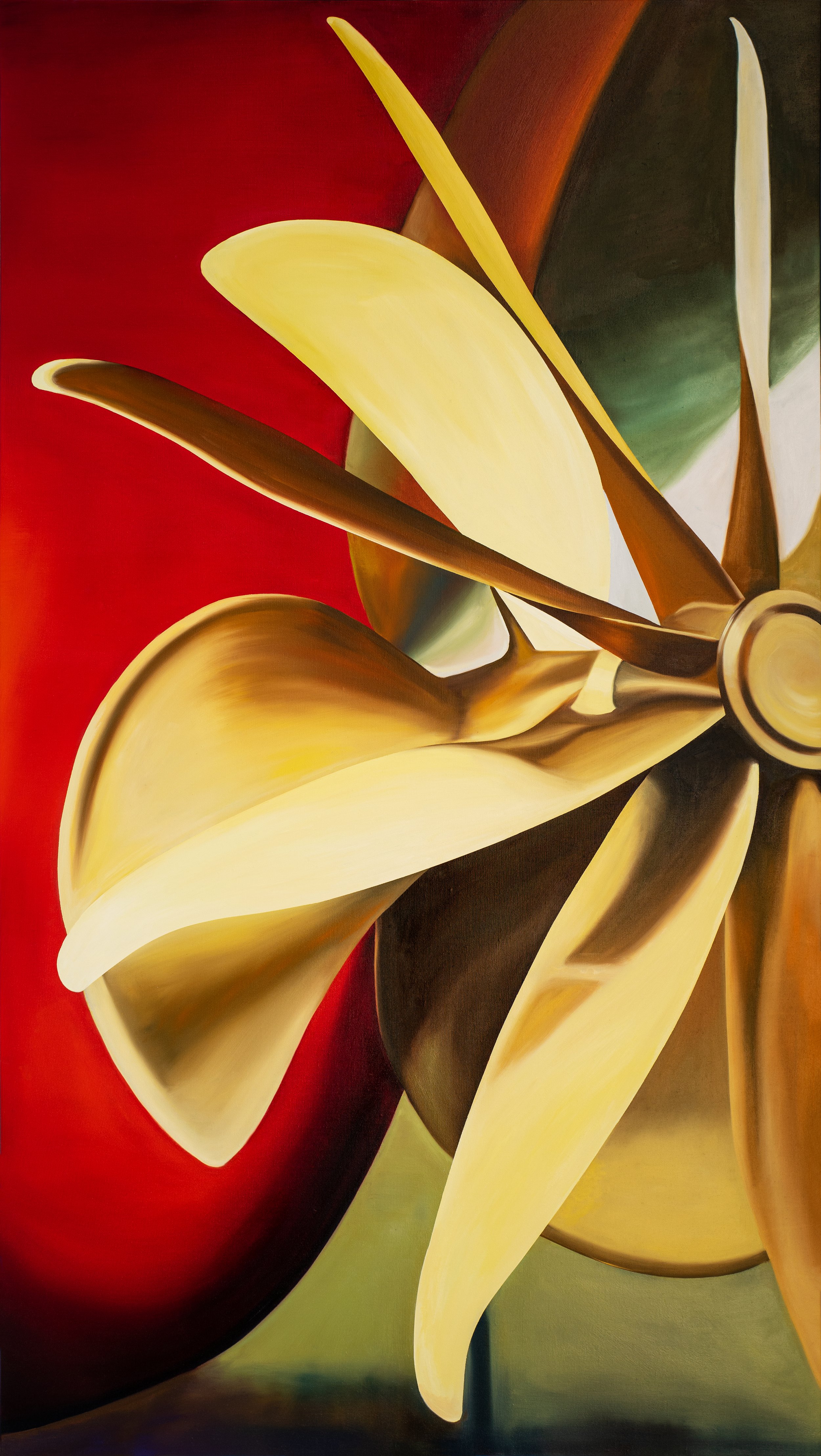
Oil on linen, 165 x 92 cm (65 x 36 in). The format is vertical and narrow, taller than it is wide by a ratio that approaches two to one, and this verticality is the first thing the eye registers because it is the first thing that distinguishes this painting from the horizontal compositions that dominate Tan Mu's oceanic work. Where Container (2021) and the submarine cable paintings spread laterally, following the logic of maps and sea routes, The Wave 02 rises. The propeller fills the canvas from a point just above the lower edge to a point just below the upper, and its blades extend outward in a radial pattern that the vertical format crops on the left and right, so that only two of the four or five blades are fully visible, the others vanishing into the margins like the limbs of a figure that extends beyond the frame. The vertical format does not contain the propeller. It cuts through it, presenting a vertical slice of a form that is, by its nature, rotational and therefore indifferent to the rectilinear logic of the canvas edge.
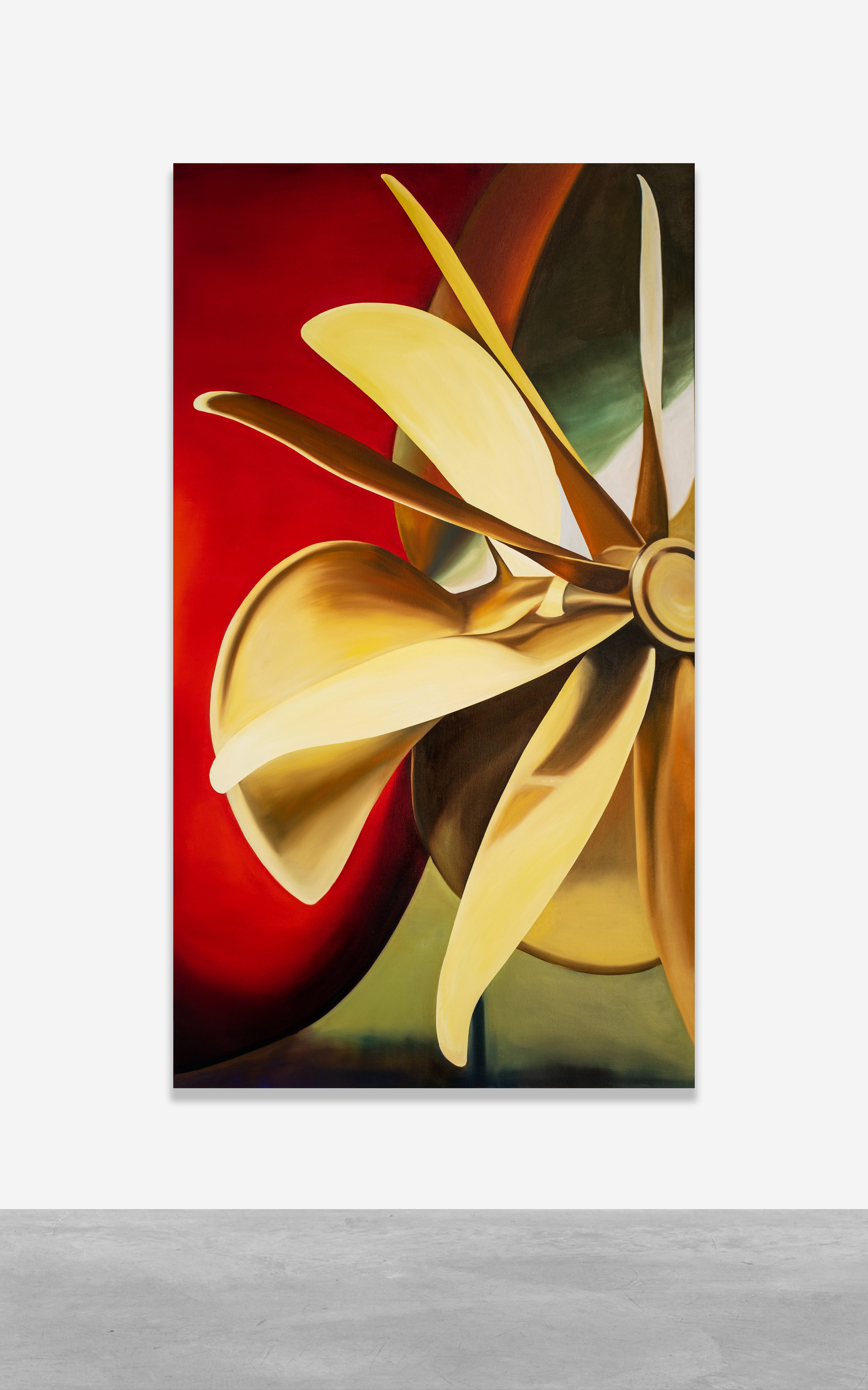
The propeller dominates the composition with an authority that is physical before it is symbolic. The central hub, a cylinder of polished metal, sits at the geometric center of the canvas, and the blades radiate outward from it in curves that combine the sweep of a wing with the twist of a drill bit. Each blade is rendered in a palette that oscillates between gold and umber, with passages of deep amber where the curved surface catches the light at its most direct angle and passages of cool bronze where the surface curves away toward shadow. The gold is not the flat gold of a gilded icon or the decorative gold of a baroque frame. It is the gold of polished brass viewed under strong illumination, a metal that has been machined to a mirror finish and then exposed to salt air, so that its brightness is tempered by a faint oxidation that reads as a warm brown at the edges and a pale, almost greenish patina where the blade meets the hub. The background behind the propeller is a deep, cool teal that darkens to near-black at the canvas edges, a color that reads as ocean water seen from below, the kind of dark green-blue that divers encounter at depth, where surface light has been filtered through meters of water and only the longest wavelengths survive.
The brushwork shifts across the surface of the painting in a way that mirrors the propeller's own motion. The blades are painted with broad, curved strokes that follow the sweep of the metal from hub to tip, and these strokes overlap at the transitions between light and shadow, producing a layered surface that reads as both solid metal and moving air. The background, by contrast, is painted in horizontal bands of varying width and saturation, horizontal brushstrokes laid in with a loaded brush that deposits thick paint in the lighter passages and thins it to a translucent wash in the darker ones. These horizontal bands are not random. They are the visual record of the water's response to the propeller's rotation, the wake and turbulence that an invisible blade generates as it passes through the medium, and they extend from the propeller's circumference to the edges of the canvas like the ripples that spread from a stone dropped into still water, except that here the stone is spinning and the ripples are continuous, not discrete, a standing wave pattern rather than a single event.
The 1934 Machine Art exhibition at MoMA treated propellers as objects of aesthetic contemplation. They were displayed on white pedestals, stripped of their functional context, removed from the aircraft they were designed to propel and placed in a gallery where their formal qualities, their curves, their surfaces, their proportions, could be appreciated for themselves. The exhibition's catalog, written by Philip Johnson, argued that machine parts possessed an inherent beauty that was independent of their function, a beauty that arose from the logical resolution of engineering problems into forms that satisfied the same criteria of economy and proportion that governed the best sculpture and architecture. The propeller was Johnson's star exhibit because it demonstrated this argument with particular force: its form was entirely determined by aerodynamic requirements, and yet it satisfied aesthetic criteria that had been developed over centuries for the evaluation of sculpture, balance, dynamism, the resolution of mass into line.
Tan Mu's treatment of the propeller could not be more different from Johnson's. Where Johnson stripped the propeller of its context and displayed it as a pure form, Tan Mu embeds the propeller in its operational environment and paints it as a moving object in a moving medium. The propeller in The Wave 02 is not on a pedestal. It is in the water, rotating, generating the turbulence that surrounds it, and the painting records not the propeller's form in isolation but the propeller's form in action, its curves producing the wake that fills the background with horizontal bands of teal and blue-gray. The Machine Art exhibition asked viewers to see the propeller as sculpture. The Wave 02 asks viewers to see the propeller as a force that shapes its environment, a mechanical object whose function is inseparable from the fluid dynamics it produces. The difference is not merely curatorial. It is ontological. Johnson's propeller is an object. Tan Mu's propeller is an event.
The propeller in the painting belongs to a class of objects that Tan Mu describes as sites where technology mirrors nature rather than opposing it. "Although it is a mechanical object," she writes of the propeller, "its function relies on fluid dynamics, turbulence, and flow. Its motion echoes natural systems such as ocean currents, air circulation, and even biological structures like DNA. This coexistence of mechanical force and natural rhythm is what draws me to the subject. I am interested in moments where technology does not oppose nature, but mirrors it." The statement is precise about the mechanism of mirroring: the propeller does not look like an ocean current, but it moves like one. It does not look like a DNA helix, but it spirals like one. It does not look like a galaxy, but it rotates like one. The spiral geometry that connects these forms across scales is not a metaphor that the painting imposes on the propeller. It is a structural property of the propeller itself, a consequence of the physics that governs rotational motion in fluid media, and the painting makes this structural property visible by rendering the propeller's surface in gold tones that catch and distribute light in the same way that the propeller itself catches and distributes water, by showing the wake as horizontal bands that extend the propeller's rotational energy into the surrounding space, and by choosing a vertical format that allows the eye to follow the spiral from the hub outward along each blade in a single continuous sweep.
Tan Mu's account of The Wave series connects it directly to her family history. "My great-grandfather was a sea merchant during the Nationalist era, traveling between China and Korea and spending much of his life on international waters. Through his stories, I became aware that the ocean is not only a route for goods, but also a carrier of culture, memory, and exchange." The great-grandfather's maritime life is the biographical fact that anchors the series in personal experience rather than abstract interest, and it provides the link between The Wave 02 and the broader body of oceanic work that includes Container (2021) and the Signal series of submarine cable paintings. The great-grandfather traveled the same waters that the propeller churns, and his passage across those waters, like the propeller's rotation through them, was a mechanical event with cultural consequences: the movement of goods, the exchange of languages, the transmission of memory from one shore to another. The propeller, in this reading, is not only a mechanical device that drives a ship through water. It is the instrument of a larger process of circulation that carries culture as surely as it carries cargo.
Constantin Brancusi's Endless Column (1938, Târgu Jiu, Romania) consists of seventeen rhomboidal modules stacked vertically to a height of nearly thirty meters, each module identical in shape and orientation, repeating upward from a stone base toward an open sky. The column was installed in a park in Târgu Jiu as part of a war memorial ensemble that also includes a gate, a table, and a stool, and its context, a small Romanian town rather than a cosmopolitan capital, is essential to its meaning. Brancusi designed the column to suggest infinite vertical extension, the way a finite number of identical units can imply a series that continues beyond the frame of vision, and the visual effect of standing at its base and looking up is one of being drawn into the column's upward momentum, as if the modules could continue stacking forever and the only reason they stop is that the sky interrupts them. The column does not depict infinity. It performs it, through the repetition of a single module that the eye reads as a segment of an unending series.
The structural logic that connects Brancusi's Endless Column to The Wave 02 is the logic of the module that implies the whole. Brancusi's rhomboid units are not individually infinite. They are segments of a diamond shape, and their repetition creates the impression of an endless vertical axis that extends beyond the physical column into imagined space. The propeller's blades in Tan Mu's painting operate on a similar principle. Each blade is a module, a curved element that radiates from the hub at a fixed angle, and the visible blades imply the blades that the canvas edge has cropped, just as the top of the Endless Column implies the modules that would continue above it. The vertical format of the painting reinforces this implication. By cropping the propeller on the left and right, the format tells the viewer that the rotational form continues beyond the canvas, that what is visible is a segment of a complete object that extends in all directions, and that the painting has selected a vertical slice of that object for reasons that have to do with the logic of the format rather than the logic of the propeller. The propeller, like Brancusi's column, continues beyond the frame. The painting shows only the portion that fits.
Brancusi also gives us a framework for understanding the gold. The Endless Column was originally painted in a metallic silver that oxidized over decades to a dark patina, and Brancusi's other works in polished brass, the Bird in Space series, the Fish, the Princess X, were all designed to be seen under gallery lighting that would make their surfaces flicker and shift as the viewer moved around them. The polish was not decorative. It was functional. It turned the sculpture's surface into a responsive membrane that registered changes in the ambient light and the viewer's position, so that the object was never the same twice and could never be seen in its totality from any single vantage point. The gold in The Wave 02 operates on the same principle. The propeller's surface is painted in warm metallic tones that shift between bright gold and deep bronze depending on the angle of the blade relative to the implied light source, and these shifts are not painted as uniform gradients but as abrupt transitions that follow the blade's curve, as they would on a real polished metal surface viewed under directional illumination. The gold is not a symbol. It is a description of what polished brass looks like when light strikes it, and its function in the painting is the same function that Brancusi assigned to his polished surfaces: to make the object responsive to its conditions of viewing, so that the propeller is not a static image but a dynamic surface that changes as the light in the gallery changes and as the viewer's angle of approach changes.
Tan Mu's own account of the gold, however, goes beyond the functional. "Gold is not simply a visual choice," she writes. "It carries symbolic weight. Historically, gold has been associated with reverence, power, and devotion. In The Wave, I use gold to render the polished surface of the propeller, transforming it into an object that feels almost sacred." The word "sacred" is doing specific work here. It names the register in which contemporary technology is received. Quantum computers, turbines, particle accelerators, and microchips, the objects Tan Mu lists, are not worshipped in the way that religious icons were worshipped, but they are regarded with a species of awe that is structurally similar to religious devotion: a mixture of reverence, incomprehension, and the conviction that the object possesses a power that exceeds the viewer's capacity to understand it. The gold surface of the propeller in The Wave 02 registers this awe by transforming a piece of marine hardware into something that looks like it belongs on an altar rather than in an engine room, and the transformation is not a falsification. The propeller is an object of extraordinary engineering sophistication, a device that converts rotational energy into thrust with an efficiency that approaches theoretical limits, and its polished surface is not a decorative addition but a functional requirement: polished metal reduces drag, and drag reduction increases fuel efficiency. The gold is the propeller's working surface. The reverence is the viewer's response to that surface. The painting holds both.
Nick Koenigsknecht, writing in his 2025 essay "From Signal to Surface," describes Tan Mu's practice as one that "takes the systems that route data, energy, and matter across the planet and returns them to the scale of the individual encounter," arguing that "the painting does not simply depict the system; it reorients the viewer's body within it, so that the submarine cable becomes something you can touch, the propeller becomes something you can feel turning, and the network of signals becomes something you can hear." The observation applies to The Wave 02 with particular force. The painting does not depict a propeller from the distance of an engineering diagram. It reorients the viewer's body within the propeller's rotational field, placing the eye at the level of the hub and allowing the blades to extend outward and downward into a medium that the horizontal brushstrokes identify as water. The viewer is not looking at a propeller. The viewer is looking through water at a propeller that is turning, and the wake that extends from the blades to the edges of the canvas is the water moving in response to the propeller's rotation, which is to say, the viewer is standing in the path of the force that the propeller generates.
The spiral geometry that Tan Mu identifies as a recurring form across her practice connects the propeller to a sequence of earlier works that includes Torus (2020 and 2021), the Gaze series, and the paintings of cells, atoms, and black holes that populate the Signal and Orbital Systems categories. The spiral is not a motif that she applies to these subjects. It is a structural property that these subjects share. A propeller blade spirals because the physics of fluid dynamics requires it. A DNA double helix spirals because the chemistry of nucleotide base pairing produces that geometry. A black hole accretion disk spirals because the physics of angular momentum conservation produces that geometry. The spiral appears at every scale because it is a consequence of rotation in a medium, whether that medium is water, biological tissue, or spacetime, and the painting's argument is not that the propeller resembles a DNA helix or a black hole but that all three are instances of the same underlying pattern, a pattern that the painter can make visible by attending to the formal properties that the pattern produces: curves that sweep, surfaces that modulate light, backgrounds that register the disturbance caused by the object's motion.
The great-grandfather who traveled between China and Korea on international waters is present in the painting not as a figure but as a consequence. He is the reason the propeller matters, the reason a piece of marine hardware carries cultural and emotional weight in addition to its engineering function. His stories, as Tan Mu describes them, made her aware that the ocean carries not only cargo but memory, not only goods but the people who transport them, and the propeller, as the instrument that drives the ship through the water, is the mechanism that makes this carrying possible. The painting does not illustrate this carrying. It makes it felt, by rendering the propeller's golden surface with the attention that a painter brings to a portrait, by surrounding it with the turbulence it generates, and by cropping it in a vertical format that presents it as a figure rising through a field, the way a portrait presents a sitter against a ground. The propeller is not a metaphor for the great-grandfather's journey. It is the machine that made that journey physically possible, and the painting treats it with the seriousness that a portrait painter brings to a sitter who has earned the right to be seen.
What The Wave 02 ultimately proposes is that the propeller is not an exception to nature but an expression of it. The same spiral geometry that governs the blade's curve governs the current it produces, the DNA it resembles, and the galaxy whose shape it approximates. The same gold surface that catches the gallery light catches the sunlight on open water. The same rotation that drives the ship forward drives the circulation of stories across the ocean that Tan Mu's great-grandfather traveled, and the painting's vertical format, which crops the propeller at the edges and extends the wake to the margins, proposes that this rotation does not stop where the canvas ends. The propeller continues turning. The water continues moving. The spiral continues extending outward from its hub into a medium that has no boundary, and the painting is the vertical slice of that extension that a viewer standing in a gallery can hold in a single glance, a glimpse of a force that was turning before the viewer arrived and will continue turning after the viewer leaves.