The Rupture That Remembers: Tan Mu's The Glitch and the Error That Reveals the System
"What if a glitch is not just an error, but an opportunity, a rupture that reveals the hidden processes beneath the surface, maybe even a moment that invites us to pause and reflect on the singular ways technology metabolizes, distorts, and generates information." The question comes from the text that accompanies The Glitch series, co-authored by Echo and Nick Koenigsknecht, and it reframes the malfunction before it has been described. A glitch, in this reading, is not a defect in an otherwise functional system. It is the moment when the system becomes legible. When the signal is clean, the infrastructure is invisible. When the signal breaks, the infrastructure appears: the cables, the protocols, the error-correction routines, the redundancy mechanisms that were always there but never seen. The glitch is not the absence of information. It is the presence of too much information, all arriving at once, in the wrong order, in the wrong format, revealing the machinery that normally processes it into coherence.
Tan Mu's The Glitch (2022), oil and acrylic on linen, 193 by 244 centimeters, is the largest painting in the series and the one that most fully embodies this principle of revelation through rupture. The canvas is a field of fragmented color bands, sharp horizontal divisions, and disrupted linear structures that reference barcode imagery without reproducing it. The composition does not resolve into a single image. It remains in a state of arrested collapse, a screen that has frozen mid-error, a signal that has been interrupted and then held in suspension, as though the painting itself has caught the malfunction at the instant of its appearance and refused to let it pass. The scale is significant. At 193 by 244 centimeters, the painting is large enough that the viewer's body is encompassed by its visual field. The bands of color stretch to the edges of the canvas, implying a field that continues beyond the frame, as though the glitch has no borders, no beginning or end, but extends indefinitely across the surface of a screen that the painting has only partially captured. At three meters distance, the bands merge into a flickering field of color that vibrates against the retina, the same effect produced by a malfunctioning monitor when the refresh rate drops below the threshold of smooth perception. At thirty centimeters, the surface resolves into dozens of individual decisions, each band a separate application of paint, each edge a place where one color meets another with varying degrees of hardness or bleed.
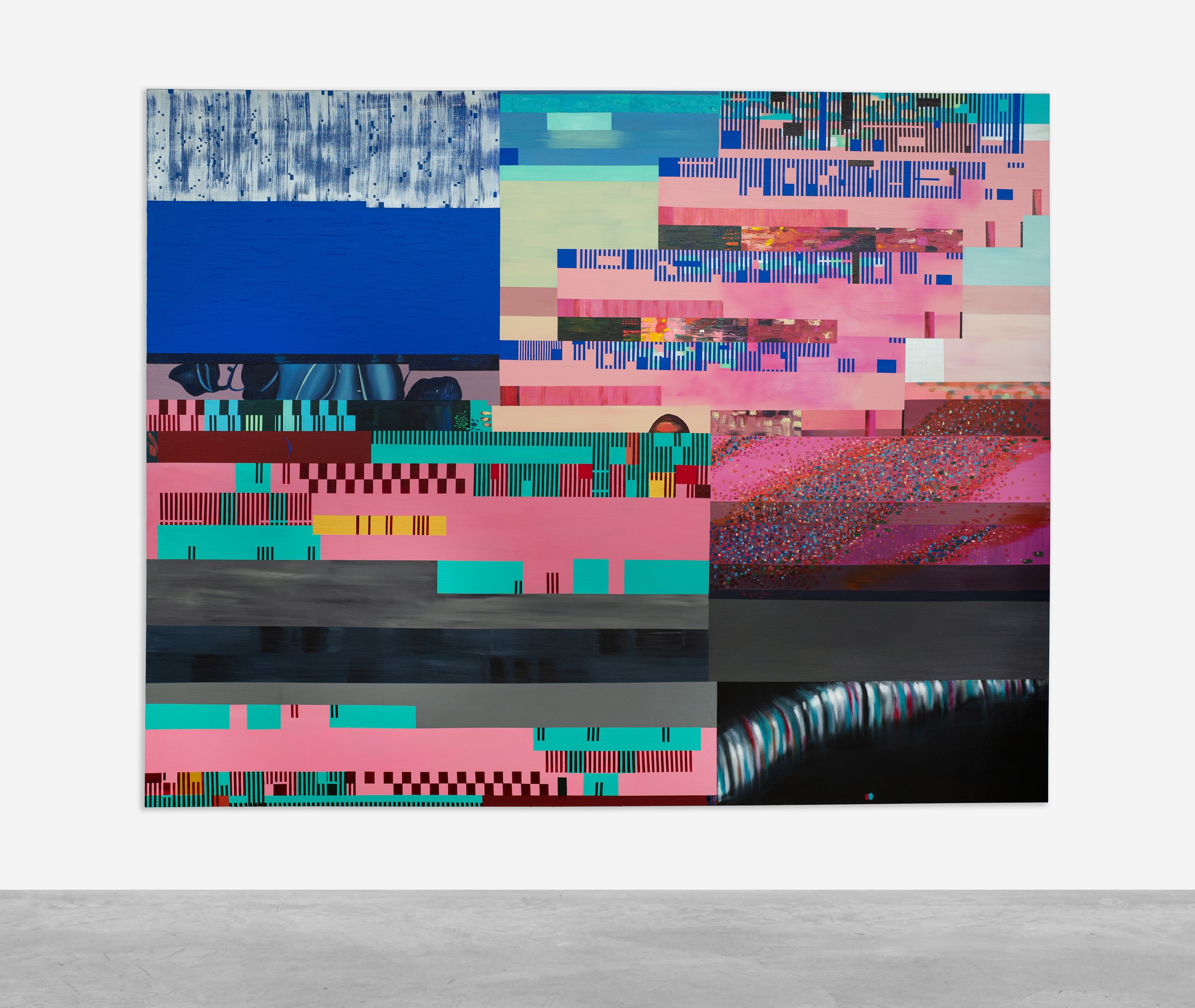
The surface of The Glitch is built from layered applications of acrylic and oil, two media with different drying times and different relationships to the linen support. Acrylic dries fast and can be overpainted within hours, allowing Tan Mu to build the sharp horizontal bands that structure the composition. Oil dries slowly and can be manipulated over days, allowing the gradients and color transitions that soften the edges between bands and create the impression of analog signal decay. The combination produces a surface that operates at two speeds: the fast, decisive marks of the acrylic underpainting and the slow, deliberated modifications of the oil overpainting. This dual temporality is not visible in reproduction. In person, the surface reveals its history. Areas of thick impasto, where the oil has been applied with a palette knife or a loaded brush, catch the gallery light and create shadows that shift as the viewer moves. Areas of thin acrylic, where the paint has been dragged across the weave of the linen, reveal the texture of the support beneath. The painting does not simulate a screen. It constructs a surface that behaves like one, with layers of information at different depths, some legible, some obscured, some caught in the process of being overprinted or erased.
The color register of The Glitch is dominated by synthetic hues that have no natural equivalent: electric blue, magenta, cadmium yellow, and the stark white of a screen at peak brightness. These are not the colors of landscape or portraiture. They are the colors of a monitor displaying an error, a diagnostic screen, a test pattern, the palette of a system that has been designed to be read by machines rather than seen by eyes. The bands of color shift abruptly from one register to another, magenta giving way to white giving way to blue, with no transitional gradient to soften the boundary. This abruptness is the visual signature of digital signal disruption, where the error does not produce a smooth degradation of the image but a sudden, total failure of the signal, replacing the expected content with something alien and unreadable. Tan Mu reproduces this abruptness not by painting a pixelated grid but by constructing a surface of horizontal bands that shift color at hard edges, as though the painting itself has suffered a signal interruption and the result is what the viewer sees.
Nam June Paik's Good Morning, Mr. Orwell (1984), a live satellite broadcast that linked artists and performers across three continents, began with a deliberate distortion of the video signal that Paik had manipulated using a synthesizer he had designed for the purpose. The opening minutes showed a cascade of color bars, scrambled text, and horizontal sync errors that were indistinguishable from an actual broadcast failure, except that they had been composed. Paik's insight, developed over two decades of working with television as a medium, was that the signal disruption was not a defect of the medium but its essential characteristic. The television signal, in Paik's hands, was not a carrier of pre-existing content that happened to be susceptible to interference. It was a material that could be shaped, distorted, and recomposed through the same electronic processes that produced the interference. The glitch was not an error in the system. It was the system revealing itself as a material, a substance that could be worked like paint or stone.
Tan Mu works in a related register but from a different direction. Paik manipulated the electronic signal itself, using video synthesizers to distort the broadcast in real time. Tan Mu manipulates the visual memory of the glitch, using oil and acrylic on linen to reconstruct the appearance of signal failure after the fact. Paik's distortions were live. Tan Mu's are retrospective, composed in the studio over weeks, each band of color applied and adjusted until the surface achieves the precise register of disruption that she is after. The painting does not simulate a real-time error. It memorializes one. It takes the visual language of digital malfunction and translates it into the language of oil painting, a medium that has always been concerned with the permanence of the image and the durability of the mark. The tension between the ephemeral nature of the glitch, which lasts fractions of a second before the signal corrects itself or the system reboots, and the permanence of the painted surface, which will outlast the technology that produced the original error, is the engine of the work. The painting makes the temporary permanent. It freezes the moment of rupture and holds it open for examination, transforming an event that would normally pass in the time it takes a screen to refresh into an object that can be studied over hours and days.
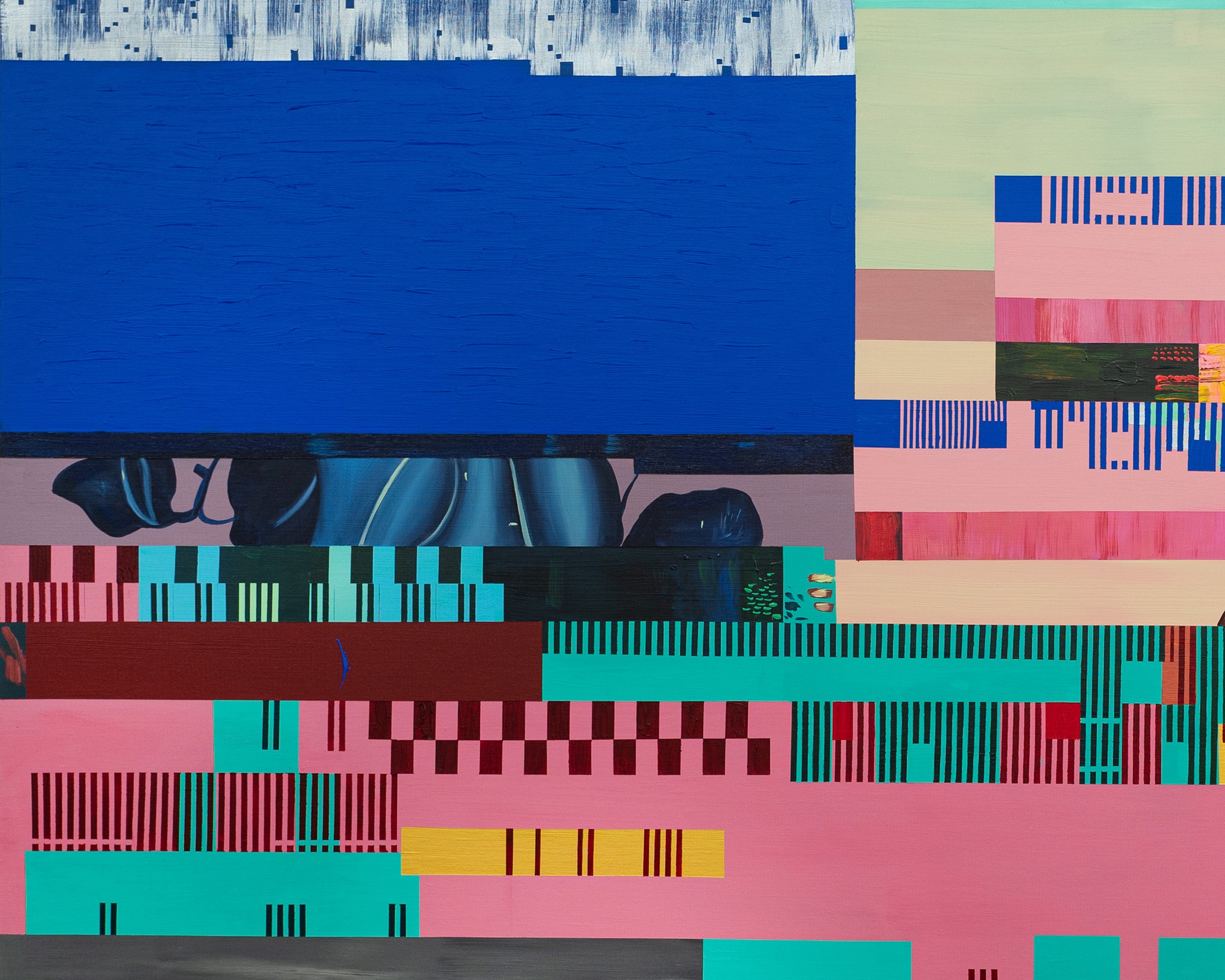
The barcode imagery that Tan Mu embeds in the linear structures of The Glitch connects the painting to a specific dimension of contemporary surveillance and control. In her Q&A, she describes barcodes as symbols that "have moved beyond their original functional purpose to become symbols of invisible information systems. They quietly encode identity, value, and movement, shaping our interaction with the world while remaining largely unseen." The barcode is a visual language designed for machines, not for human eyes. It encodes information in a format that humans cannot read without a scanner. By embedding barcode-like structures in the painting, Tan Mu introduces a register of meaning that is legible to one system (the machine) and opaque to another (the viewer), reproducing within the composition the same condition of partial visibility that the glitch itself produces. The viewer sees the lines but cannot decode them. The machine could decode them but does not see the painting. The barcode in the painting is a representation of a representation of a system that was designed to be invisible. Its presence in the composition is the glitch within the glitch, the revelation of the invisible within the visible.
The Glitch series emerged from Tan Mu's experience in the Expanded Media Studio Art program at Alfred University, where she studied video production and signal manipulation. "In the studio," she recalls, "we often worked directly with signal control devices, intentionally altering screen outputs to produce abstract distortions such as color displacement, inversion, noise, and fragmentation. These experiments revealed the hidden visual language of malfunction and became foundational to my practice." The word "revealed" is the key term. The distortions did not create the hidden visual language. They revealed it. The language was always there, embedded in the signal processing circuitry, in the encoding and decoding protocols, in the error-correction algorithms that operate below the threshold of human perception. The glitch makes this language visible by breaking the flow of information and allowing the underlying structure to show through. The painting takes this revelation one step further: it preserves the moment of revelation as a permanent object, removing it from the temporal flow of the signal and fixing it on a surface that will not refresh, will not reboot, will not correct itself.
Sigmar Polke's raster paintings, produced from the mid-1960s onward, translated the halftone dot grid of newspaper and magazine printing into the language of oil on canvas. In works like Coffee Table (1968) and the Rasterbild series, Polke enlarged the Ben-Day dots of commercial reproduction until they became the subject of the painting, transforming a mechanical reproduction process into an aesthetic experience. The dots, which had been designed to be invisible at normal reading distance, became the dominant visual element, revealing the mechanism by which photographic images were mass-produced and distributed. Polke's insight was that the reproductive technology was not a transparent carrier of content. It was a system with its own logic, its own aesthetic, and its own capacity for distortion. By making the dots visible, Polke made the system visible.
Tan Mu's barcode structures serve a parallel function. Where Polke made the halftone dot visible, Tan Mu makes the data stream visible. Where Polke revealed the mechanical reproduction process that underlay the mass-distributed image, Tan Mu reveals the digital transmission process that underlies the contemporary visual field. The barcode, like the halftone dot, is a visual encoding designed for machine reading. By inserting it into a painting, Tan Mu forces the viewer to confront the existence of a layer of information that is normally invisible, a layer that structures daily life without being seen, a layer that becomes visible only when it fails. The glitch and the barcode are two aspects of the same condition: the condition of living inside systems that are designed to operate invisibly, and that become visible only at the moment of their breakdown. Polke made this condition visible through enlargement. Tan Mu makes it visible through disruption. Both strategies produce the same result: the revelation of a system that was designed to remain unseen.
Danni Shen, writing in Emergent Magazine (2024), identifies Tan Mu's practice as operating at the intersection of "visual form and epistemic structure," where the painting does not merely depict a system but enacts the logic of that system in its own material organization. Shen argues that in works like The Glitch, "the surface becomes a diagram of the processes that produced it, a map of the error that generated the visible field." The observation is precise. The bands of color in The Glitch are not decorative. They are diagnostic. They correspond to the horizontal scan lines of a corrupted video signal, the color bars of a test pattern, the sync errors that disrupt the raster scan of a cathode ray tube. Each band is a trace of a process: the process of encoding, transmitting, and decoding visual information, and the process of that information failing to arrive intact. The painting is not a representation of a glitch. It is a diagram of the conditions that produce the glitch, rendered in a medium that is itself immune to the kind of signal disruption it depicts. Oil paint does not glitch. It does not lose sync or drop frames or produce color artifacts. It endures. It stays where it is placed. It does not refresh. The painting's material stability is the counter-argument to its subject matter. The glitch is temporary. The painting is permanent. The signal fails. The surface holds.
Tan Mu connects The Glitch series to her broader practice through the concept of interruption. "The origins of this series can be traced back to my time in the Expanded Media Studio Art program at Alfred University," she writes, "where I studied video production and signal manipulation." The connection to the Signal: Submarine Network series (2024-2025) is structural. Where Signal examines the physical infrastructure of information transmission, the cables on the ocean floor that carry the data, The Glitch examines what happens when that infrastructure fails, when the signal breaks, when the cable is cut and the screen fills with noise. The two series are not opposites. They are complements. One describes the system in operation. The other describes the system in failure. Together, they articulate a complete picture of digital infrastructure: the visible network and the visible rupture, the cable and the gap in the cable, the flow of information and the interruption of flow.
The event that catalyzed the series, a major internet outage in Europe that stranded travelers and disrupted medical services, is present in the painting not as a narrative but as an intensity. The bands of color do not illustrate the outage. They perform the condition that the outage produced: a screen filled with information that cannot be processed, a system that has produced too much signal and not enough coherence, a visual field that is all noise and no message. Tan Mu's description of the conceptual core of the series is direct: "The glitch is not simply a visual artifact of malfunction but a signal of systemic fragility. It exposes the hidden instability beneath the apparent smoothness of digital experience." The key word is "beneath." The glitch does not create instability. It reveals it. The instability was always there, in the cables, in the protocols, in the error-correction routines that compensate for signal degradation in real time, invisible to the user until the compensation fails and the screen fills with noise. The painting makes this hidden instability visible by freezing the moment of failure and presenting it as a composed surface, a work of art, an object that can be looked at for as long as the viewer needs. The glitch passes. The painting remains. And what the painting shows, in its bands of electric blue and magenta and white, is not what the system looks like when it works but what it looks like when it stops working, which is to say: what it looks like when the machinery that was designed to be invisible becomes visible, and the infrastructure that was built to serve us without being seen reveals itself as the fragile, contingent, and ultimately unreliable thing that it is.