The Path That Remembers: Tan Mu's Signal: Submarine Network 07 and the Stars Beneath the Water
In 1976, a crew of Micronesian navigators sailed the double-hulled canoe Hokule'a from Hawaii to Tahiti using no instruments whatsoever. Mau Piailug, a master navigator from Satawal in the Caroline Islands, read the stars, the swells, the flight patterns of birds, the phosphorescence of moving water, and the taste of sea spray to find land across twenty-five hundred miles of open Pacific. He could not swim. He had never seen a chart. The voyage proved that the Pacific had been settled not by accidental drift, as scholars once assumed, but by deliberate, knowledge-driven navigation across routes that existed in the mind long before they appeared on any European map. Those routes carried people, language, taro, pigs, and the complex social protocols that bound island societies to one another across what outsiders called empty ocean. The same waters now carry something else. Fiber-optic cables rest on the seafloor along corridors that follow, with striking precision, the old canoe tracks: Hawaii to Fiji, Fiji to New Zealand, Papua New Guinea to Australia's eastern coast, branching southward to Sydney and northward to Guam. The routes that moved sweet potato and oral genealogy now move financial data, hospital records, video calls, and satellite telemetry. The medium changed. The path remembered.
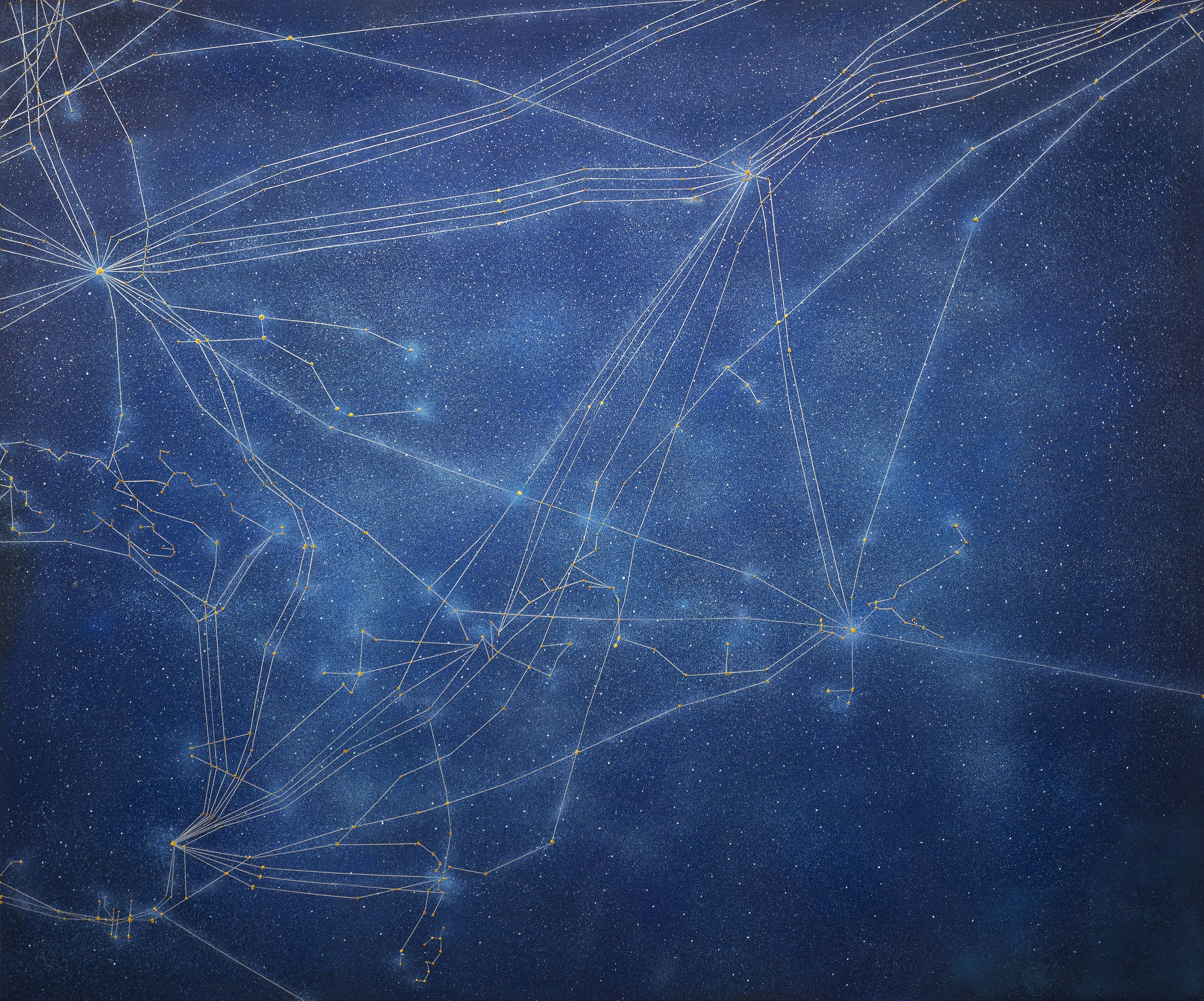
Signal: Submarine Network 07 (Australia), painted in 2025 in oil and acrylic on linen at 152.5 x 183 cm, registers this convergence. The canvas presents the vast spread of submarine cable systems across the South Pacific: lines reaching from Australia's eastern coast toward New Zealand, Papua New Guinea, French Polynesia, and the scattering of Pacific islands that form the stepping stones of a network connecting Australia with the Americas and Asia. The painting does not illustrate a map. It compresses cartographic data into a field of luminous points connected by threadlike lines, a dark oceanic surface from which the network emerges as if the sea itself were generating light. Tan Mu's stated subject is explicit: the nodes and lines that surface in this painting function as "stepping stones" in the cable layout, crucial transit points linking Australia with the Americas and Asia, and "in a region once known for celestial navigation and canoe voyages, these ancestral pathways of movement are now quietly mirrored by fiber-optic threads deep beneath the sea." The painting is about the continuation of paths. The technology is new. The passage is ancient.
Stand at two meters from the canvas and the first thing visible is a constellation. Pale points of light, varying in size and intensity, are scattered across a surface so dark it oscillates between midnight blue and black, depending on the angle of ambient light. Thin lines connect the points, some running parallel for long stretches, others crossing at nodes where two or three converge. The lines are not continuous ribbons. They are drawn in short segments, each one a discrete brushmark, a single decision by the painter's hand. At arm's length, those segments resolve into something unexpected: each line is not a ruled stroke but a trembling mark, slightly irregular, with the faint breath of the linen visible through the paint. The underpainting shows through in the thinnest passages, a deep indigo that the overlay of acrylic has not fully covered, giving the ocean surface a transparency that suggests actual water rather than monochrome ground. The nodes themselves, the landing points and junctions where cables meet land, are built up with thick, wax-heavy oil paint. They sit above the surface. They catch light differently from the connecting lines. They feel soldered, electrical, like the connection points on a circuit board. This is by design. Tan Mu has described her technique: "The access points are built up with thick, wax-heavy oil paint, resembling the soldered connections of electronic circuits. Each connection point has a raised texture." The painting makes you feel this difference in your fingertips before you understand it in your mind. The ocean is thin and luminous. The infrastructure is thick and opaque. Two systems occupy the same surface, and the surface records the difference between them.
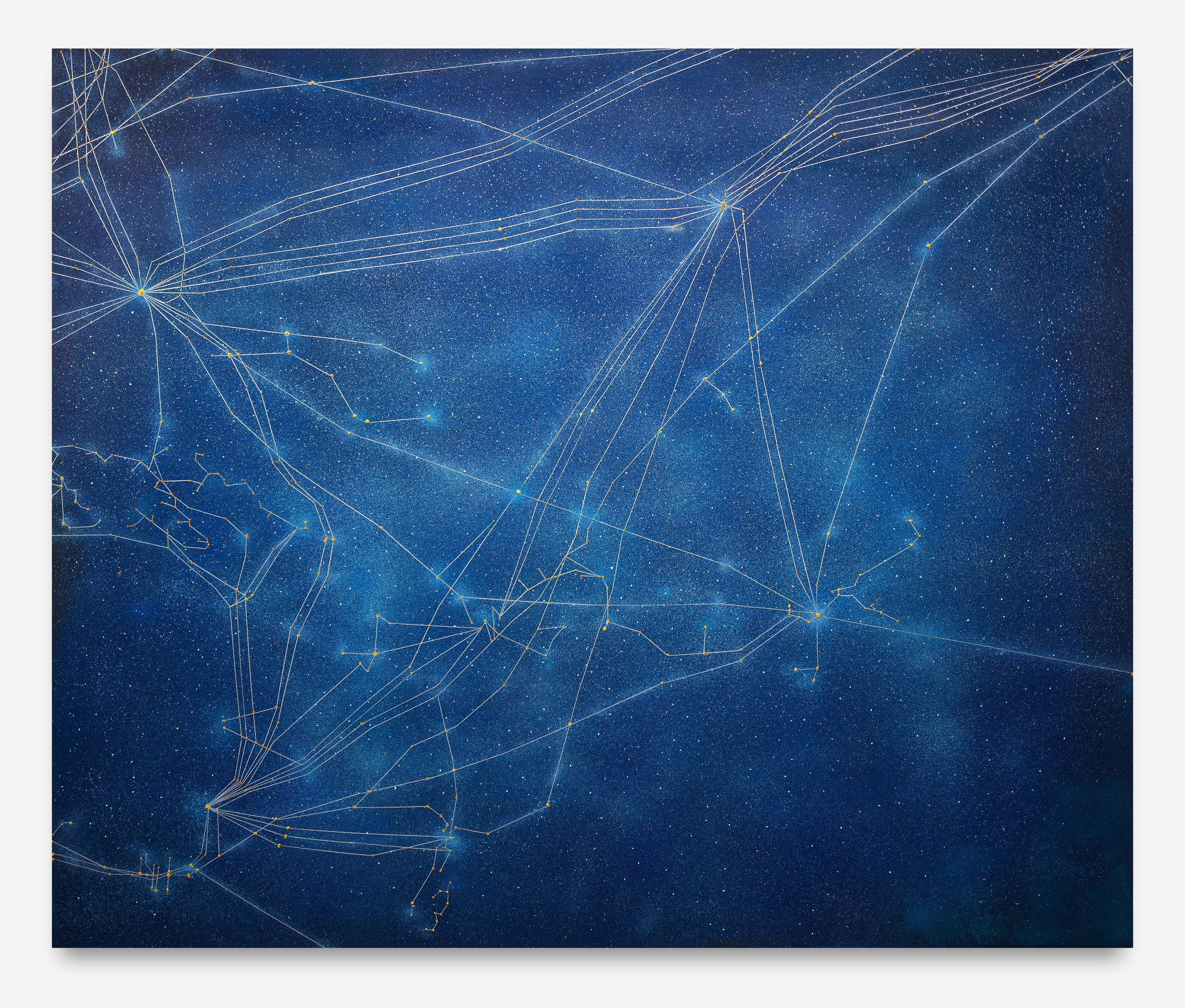
The color register is restricted but not monochrome. The ocean ground is not a flat black but a layered composite of deep blue, violet, and the faintest touch of green where the light catches the linen weave at certain angles. The cable lines are rendered in a cool white that leans slightly toward silver. The nodes glow warmer: pale gold, almost amber at the brightest points, dimming to a muted ivory at the periphery. The overall effect is of a night sky seen through water, or a seafloor seen from above, the distinction between the two impossible to settle. This ambiguity is the painting's central perceptual proposition. Are you looking down at the ocean from a satellite, seeing the cables as if they emitted their own light? Or are you looking up from the seafloor, where the nodes resemble stars glimpsed through water? Tan Mu has described this collapse explicitly: "When you are underwater and look upward, the surface of the ocean reflects light in a way that resembles the night sky. In that moment, sea and sky collapse into a single plane." The painting is the record of that collapse, a visual field where up and down lose their authority and the viewer floats between two directions of depth.
Emily Kame Kngwarreye's monumental batik paintings and later acrylic works from Utopia, north of Alice Springs, register a similar compression of vast terrain into a gestural field. In works such as Earth's Creation (1991), Kngwarreye covered three by four meters of canvas with layered dots and washes of color that her Anmatyerre community read as a map of country: the yellow of seed-bearing grasses after rain, the black of burnt ground, the red of the desert after fire, the white of wildflowers in season. Western viewers saw abstraction. Her community saw a topography saturated with knowledge, every mark a place, every color a season, every layer a geological and ecological truth held in the body across millennia. The dots in Kngwarreye's paintings were not decorative. They were indexical. They pointed to specific locations, specific plants, specific stories that could not be separated from the ground they described. When Kngwarreye painted, she moved across the canvas the way she moved across country, each gesture a step, each dot a named place, the painting itself a form of navigation through territory that her body already knew.
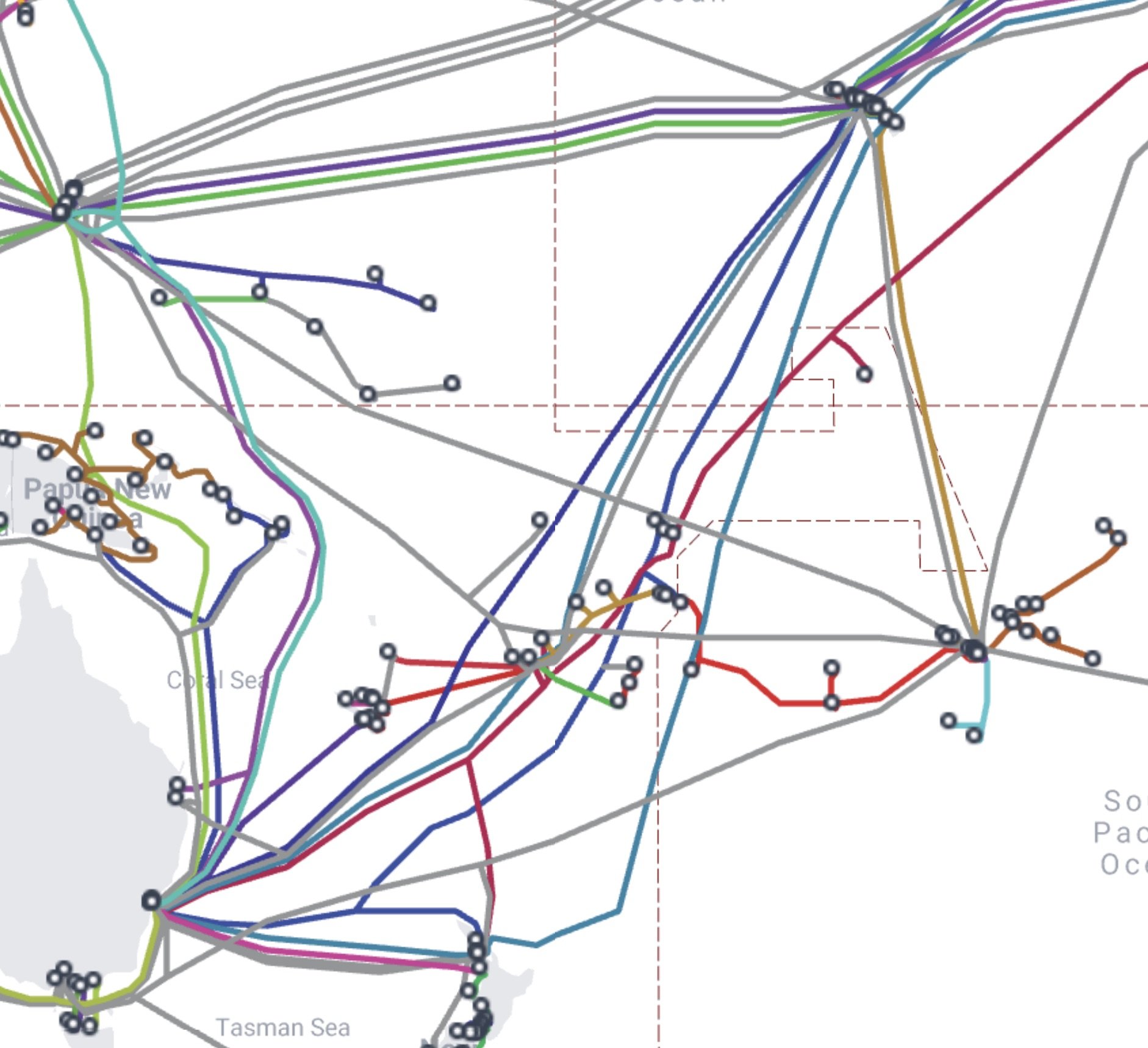
The parallel to Signal: Submarine Network 07 is structural, not decorative. Tan Mu's dots are also indexical. Each one corresponds to a real landing point, a real cable junction, a real stretch of coastline where a fiber-optic cable emerges from the sea and connects to a terrestrial network. The painting's composition is derived from TeleGeography data, the same dataset that maps the world's 597 cable systems and 1,712 landings. The dots are not invented. They are transcribed. And like Kngwarreye's marks, they operate on two registers simultaneously: one visual, one informational. For a viewer who cannot read the data, the dots are points of light in a dark field, a pattern that could be stars, could be settlements, could be data packets moving through a network. For a viewer who recognizes the geography, the dots are Sydney, Brisbane, Auckland, Port Moresby, Papeete, Suva. Each named place carries its own history of arrival, settlement, colonization, trade, and now, data transit. The painting asks its viewer to hold both readings at once, to see the pattern and the place, the constellation and the cable map, the aesthetic field and the infrastructure report. This is the same demand Kngwarreye made: that the painting be legible as both pattern and country, that the pleasure of looking and the precision of knowing coexist without one canceling the other.
The South Pacific stretches across roughly a third of the planet's surface. It contains more water than any other ocean region and more islands than any other mapped area, roughly twenty-five thousand, though most are invisible at the scale of a continental map. Australia's eastern coast runs roughly three thousand kilometers from Cape York south to Melbourne, and the cable network that Signal: Submarine Network 07 traces follows that coastline before branching outward: south to New Zealand, north to Papua New Guinea and the Solomon Islands, east through Fiji and Vanuatu toward French Polynesia. The cable systems named in this region include the Southern Cross Cable, the Australia-Japan Cable, the PPC-1, the Hawaiki cable, and the Tonga Cable, which was severed by the Hunga Tonga-Hunga Ha'apai volcanic eruption in January 2022. That event, which knocked Tonga offline for five weeks, was the catalyst for Tan Mu's painting Eruption (2022) and, by extension, for the entire Signal series. The eruption demonstrated, in the most literal way possible, that the global internet does not travel through satellites in space. It travels through cables on the ocean floor. When the cable broke, a nation of one hundred thousand people vanished from the digital map. The disruption was not an abstraction. It was a severance.
The Polynesian navigators who crossed this same ocean centuries before the first cable was laid did so using a body of knowledge called wayfinding, or in Hawaiian, ho'okele. A master navigator like Mau Piailug could read the direction and height of swells, detect the presence of land thirty kilometers away by observing the refracted waves bouncing off an invisible reef, track the arc of specific stars across the sky, and maintain a mental course for weeks without writing anything down. This knowledge was not supplementary. It was the infrastructure. Without it, the Pacific was undifferentiated water. With it, the Pacific was a network of known routes connecting known places, maintained by memory and transmitted through apprenticeship. The cable network operates on a different material substrate but follows a similar logic. It is infrastructure that makes the ocean legible. It connects known points through known routes. It requires maintenance. It is vulnerable to rupture. And like wayfinding knowledge, it is invisible to anyone not trained to read it. A fiber-optic cable on the seafloor is as invisible to the casual observer as the swell patterns that guided Mau Piailug's canoe. Both require specialized knowledge to perceive. Both turn empty ocean into a space of connection.
Peder Balke's small seascapes from the 1860s register a comparable compression of the ocean into a surface of darkness and light. Balke, a Norwegian painter who traveled to the North Cape and documented the Arctic Ocean's crushing verticality, produced works such as Storm (c. 1860s, National Museum, Oslo) that reduce the sea to a band of turbulent dark paint across the lower third of the canvas, a shard of paler sky above, and a single lighthouse or ship reduced to a vertical stroke of white. The scale is intimate, often no larger than twenty by thirty centimeters, but the experience is monumental. The viewer feels the full weight of the North Atlantic compressed into a surface that could be held in two hands. Balke eliminated middle tones. He worked in near-monochrome, letting the weave of his small canvases show through the thinnest passages of sky while building up the wave crests with dense, almost sculptural applications of white. The contrast between the transparent and the opaque creates a depth that the painting's physical dimensions cannot account for. It is a sea you cannot see the bottom of, rendered on a surface you can touch.
Balke's compression operates in the same register as Tan Mu's, though their materials and subjects differ. Both painters work against the assumption that the ocean must be rendered as a horizon. Balke's seas have no horizon, or the horizon has been consumed by weather. The sea and sky merge into a single field of atmospheric pressure. In Signal: Submarine Network 07, the ocean surface has been replaced by the ocean floor seen from above, a cartographic perspective that eliminates the horizon line entirely. What Balke achieves through the elimination of atmospheric middle tones, Tan Mu achieves through the elimination of the water's surface. You do not look at the sea from a cliff. You look at the sea from a satellite. Or from beneath it. The perspective is unlocatable because the painting refuses to settle on a single viewing position. It asks you to see from multiple positions simultaneously, the way a navigator reads stars, swells, and the taste of salt all at once. Nick Koenigsknecht, writing in the BEK Forum catalog, described Tan Mu's Signal paintings as functioning as "self-portraits" of technology rather than depictions of external milestones. "While observing technology, are we not looking at ourselves?" he asked. The cables are not something out there. They are something we made. They carry what we carry. They route what we route. The painting is a mirror held up to a network, and the network is us.
Yiren Shen, writing in 10 Magazine, observed that Tan Mu's practice operates through a specific kind of translation: the artist receives signals from the world, processes them, and transmits them back through paint. "My approach is almost robotic," Tan Mu told Shen, "receiving and transmitting signals, aided by sensors and systems." The metaphor of the body as receiver and transmitter is not casual. It connects the submarine cable, which receives and transmits data, to the painter, who receives and transmits perception, to the viewer, who receives and transmits the image into thought. The chain is unbroken. The cable on the seafloor, the hand on the brush, the eye on the canvas: each is a node in a network that moves information from one point to another. The painting's material structure encodes this chain. The raised nodes of thick oil paint at each landing point function as the painting's entry and exit ports. They are where the signal comes in and where it goes out. The thin lines connecting them are the cables, the transmission medium. The dark field between is the ocean, which in Tan Mu's diving experience becomes indistinguishable from the night sky: "The surrounding marine life begins to resemble stars, drifting through space." The painting does not illustrate this experience. It reconstructs it. The viewer who stands before the canvas and sees dots of light in a dark field is seeing exactly what Tan Mu saw when she floated at neutral buoyancy thirty meters below the surface, looking up through the water at the light above. The painting is a transmission from that moment of suspension to this moment of looking.
The South Pacific's particular history deepens the painting's argument. This is not the Mediterranean, where cables run short distances between dense coastal cities. This is not the North Atlantic, where the transatlantic telegraph cables of the nineteenth century followed well-established shipping lanes. This is the largest ocean on the planet, where distances between islands are measured in thousands of kilometers and where the population density is among the lowest on Earth. A cable between Sydney and Auckland runs roughly two thousand kilometers across open water with no intermediate landmass. A cable from Fiji to Tonga traverses six hundred kilometers of open sea between two nations whose combined population is smaller than a single Sydney suburb. The infrastructure of global connectivity is built to serve the same routes that Polynesian navigators established through wayfinding: corridors between islands, passages through reefs, channels that minimize distance and maximize access. The technology changes. The path remains. When Tan Mu paints the South Pacific cable network, she is painting two systems superimposed: the ancient system of knowledge carried in human bodies and the modern system of data carried in fiber-optic glass. Both are invisible from the surface. Both make the ocean legible. Both are vulnerable. A volcanic eruption cut the Tonga cable. A cyclone can erase a navigator's reference points. The painting holds both systems in a single field, not to argue that they are the same, but to insist that they occupy the same space, and that the space itself, the Pacific, is not empty. It has never been empty. It has always been a network of paths.
Tan Mu's reference to The Classic of Mountains and Seas, the ancient Chinese text that maps mythical and real geographies, gives the argument its final frame. The Shanhaijing is not a neutral cartographic document. It is a compendium of wonders, a catalog of creatures, peoples, and landscapes recorded at the edge of the known world. It does not distinguish between what has been verified and what has been reported. It treats both as knowledge worth preserving. Signal: Submarine Network 07 operates in a similar mode. The painting presents a verified network of cables, each one corresponding to a real system, a real landing point, a real stretch of ocean floor. But the experience of the painting, the constellation of light against darkness, the trembling of the lines, the warmth of the nodes, the way the field oscillates between star chart and circuit diagram, places the viewer at the edge of the known rather than at its center. You are not looking at a network you control. You are looking at a network that extends beyond your sight, connecting points you have never visited through routes you cannot trace without a map. The painting restores to infrastructure the sense of wonder that the Shanhaijing restored to geography. It makes the cables strange again. It makes the ocean deep again. The path that carried sweet potato and creation stories across two thousand kilometers of open water now carries fiber-optic pulses at the speed of light. The path did not begin with the cable. The path began with a navigator who could read the stars, and the painting insists that the stars and the cable nodes share a single surface, a single logic, a single persistence: the insistence that what connects us is not invented but inherited, not imposed from outside but revealed from within the geography itself.