The Coastline That Became a Switch: Tan Mu's Signal: Submarine Network 08 and the Mediterranean as Convergence
Li Yizhuo, writing in the BEK Forum catalog, noted that almost every visitor's first impression of the Signal series is of constellations. The dots and lines stretching across the dark field resemble star charts, and the resemblance is not accidental: Tan Mu has described the comparison as one of the series' foundational metaphors. But the constellation comparison, Li Yizhuo argued, points away from the sky and toward something more grounded. It "points away from subject or telos toward a telecommunication system." The stars are not the subject. The lines between them are. And in Signal: Submarine Network 08 (Italy), 2025, those lines converge. Where the other Signal paintings trace cables stretching along coastlines or threading through archipelagos, Network 08 presents a landscape of intersection. Sicily, Malta, and the southern Italian coast are not endpoints. They are junctions. The cables arriving here, the SEA-ME-WE 4, UniTirreno, and BlueMed systems among them, carry data from Europe, Africa, and the Middle East, and they meet in a stretch of water that has been a crossroads for three thousand years longer than fiber optics have existed. The Tyrrhenian Sea did not become a node. It has always been one.
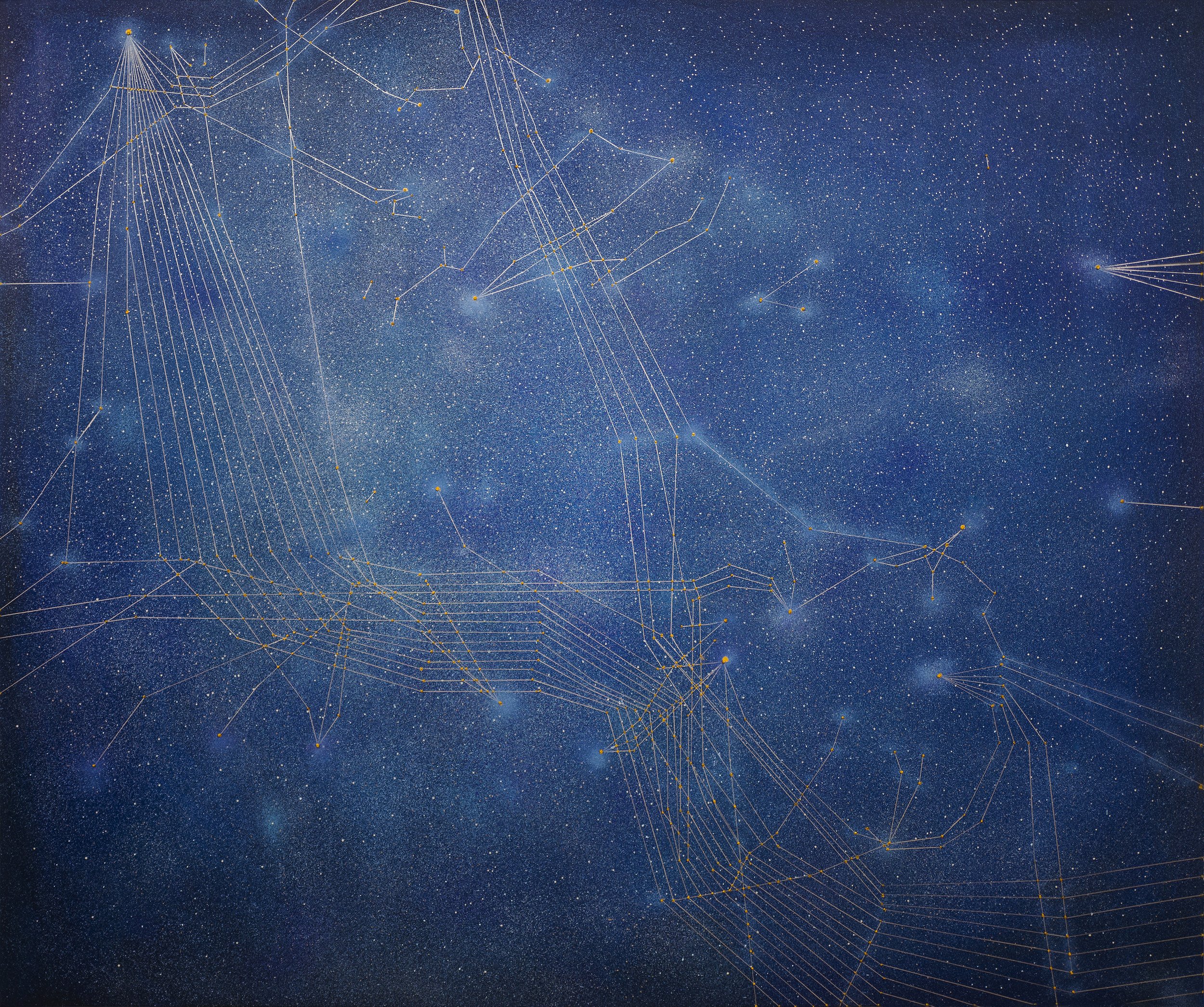
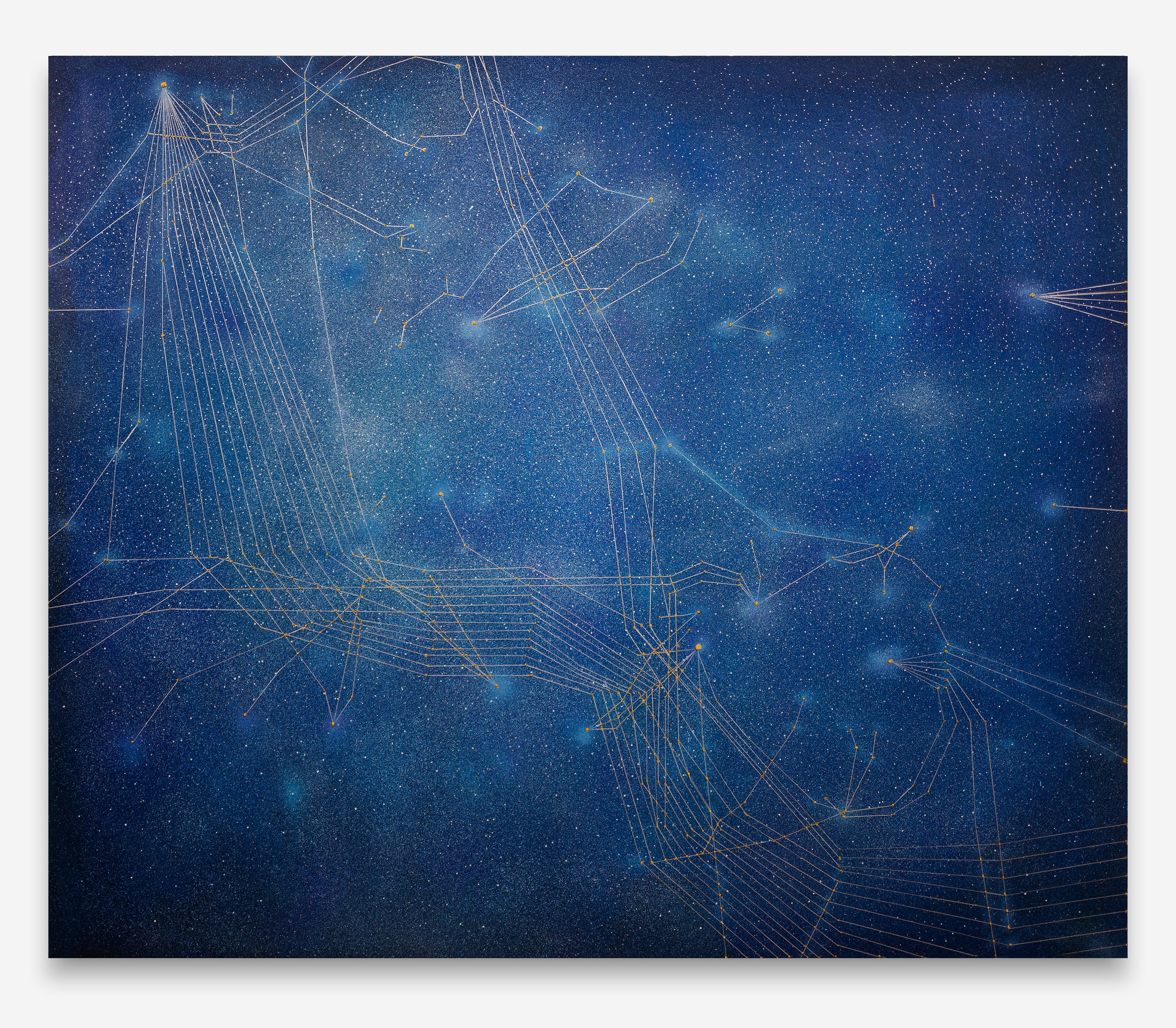
The painting measures 152.5 x 183 cm, oil and acrylic on linen, the same dimensions shared by all five Signal paintings in the BEK Forum series. The format is a horizontal field wide enough to suggest a coastline read from offshore, and at this scale the painting operates on the body. You stand before it and the dark field fills your peripheral vision. The linen ground is coated in a deep mixture of indigo and black acrylic that absorbs light rather than reflecting it, producing a surface that feels less like painted canvas than like water at night. Over this ground, the cable lines are rendered in thin, precise strokes of a cool white that carries a faint blue cast. These are not continuous lines. Each segment is a separate brushmark, visible as such at reading distance, and the slight irregularity of the stroke gives the lines a trembling quality, as though they were vibrating or breathing. At the junctions, where two or more cables converge at a landing point, the paint thickens. Tan Mu builds these nodes with successive layers of oil paint, each one slightly warmer in tone than the white of the lines: ivory, pale gold, amber at the brightest centers. The nodes sit above the surface. They cast tiny shadows under raking light. They feel like hardware, like the soldered connection points on a circuit board, which is precisely how Tan Mu has described her method: "The access points are built up with thick, wax-heavy oil paint, resembling the soldered connections of electronic circuits." The distinction between the thin, luminous lines and the dense, opaque nodes is the painting's most immediate physical proposition. The lines pass through. The nodes stop. The difference is tactile before it is conceptual.
The color register of Network 08 differs subtly from its companions in the series. Where the Norway painting reads as cold blue and the Caribbean painting introduces warmer greens at the edges, Network 08 presents a ground that oscillates between indigo and a deep, warm black, a chromatic ambiguity that evokes the particular darkness of Mediterranean water at depth. The Tyrrhenian Sea is not the Atlantic. It is enclosed, warmer, shallower in its continental shelves, and its color at night carries a density that the open ocean does not. Tan Mu captures this density not through a different hue but through a different weight of paint. The ground feels compressed, as though the water above the cables were pressing down on them, a geological pressure that distinguishes a sea bounded on all sides from an ocean open to the horizon. The nodes along the Italian coast, clustered around Sicily and extending toward Malta and the North African shore, are the densest in any of the five Signal paintings. More lines converge here than anywhere else in the series because more cables converge here than anywhere else in the actual network. Sicily is a switching station. Malta is a relay. The painting makes this density visible not through annotation but through accumulation. The nodes crowd together, their halos overlapping, producing a field of light that reads as a metropolitan area seen from satellite at night, which is of course what it is: the same data that produces those satellite photographs of Europe's illuminated coastlines produces the cable map that Tan Mu has transcribed.
Giotto di Bondone painted the Arena Chapel in Padua between 1303 and 1305. The chapel is small, roughly twenty meters long and eight meters wide, and Giotto covered every surface with frescoes depicting the life of the Virgin and the life of Christ. The building itself, the Scrovegni Chapel, was commissioned by Enrico degli Scrovegni, a wealthy banker whose father had been placed by Dante in the seventh circle of Hell for usury. The chapel was a private devotional space attached to a family palace, but its location in Padua placed it at a junction of trade routes running from Venice through the Alps to northern Europe, and from the Adriatic coast through the Po Valley to the Mediterranean. Padua was not the center of anything. It was a node. Goods passed through it. Ideas passed through it. The university, founded in 1222, attracted students from across Europe. The chapel, built at a crossing point of medieval trade and intellectual traffic, became a switching station of a different kind: a point through which the visual language of late medieval painting passed on its way to becoming the language of the Renaissance. Giotto's innovations in spatial construction, emotional directness, and architectural framing did not stay in Padua. They traveled, along the same routes that carried salt, spice, silk, and letters of credit, to Florence, to Siena, to Avignon, and eventually to Rome. The frescoes at Padua functioned as a node in a network of visual transmission that spread across the Italian peninsula and then across Europe, much as submarine cables at Sicily function as nodes in a network of data transmission that spreads across the Mediterranean basin and then across three continents.
The structural parallel is not decorative. Giotto's chapel was built at a convergence point of medieval infrastructure: trade routes, pilgrimage paths, university networks. The frescoes absorbed influences from Roman painting traditions, Byzantine iconographic conventions, and northern Gothic sculptural forms, and they transmitted a synthesis outward. The chapel was a switching station for visual culture. Sicily is a switching station for data. Both operate at the intersection of multiple incoming routes and multiple outgoing routes, and both gain their significance not from what they produce but from what they pass through. The Signal paintings, as Li Yizhuo observed, "each composition of lines and dots full of tension and anticipation," and the tension in Network 08 is the tension of convergence. Where the other paintings in the series trace cables that follow coastlines, running parallel to land like highways, Network 08 presents cables that cross. The lines arrive from the east, from the south, from the north, and they meet at a cluster of nodes so dense that the painting's center-left region glows with accumulated light. This is not a landscape painting. It is a switching diagram. It shows you where the routes converge, and in doing so it shows you what the Mediterranean has always been: not a boundary between continents but a corridor between them.
The Mediterranean has been a communication corridor since the Phoenicians established trading posts along the North African coast in the first millennium BCE. Carthage, founded according to tradition around 814 BCE, sat at exactly the point where the Tyrrhenian Sea opens into the wider Mediterranean, controlling traffic between the western and eastern basins. Sicily, visible from the North African coast on a clear day, sat at the choke point between the two. Malta, halfway between Sicily and Tunisia, served as a staging post for every maritime power that operated in the central Mediterranean: Phoenicians, Carthaginians, Romans, Arabs, Normans, the Knights of St. John, the British. Every one of these powers used the same islands as relay points for the same reason that submarine cables converge there now: geography makes them unavoidable. The narrowest crossing between Africa and Europe, the Strait of Messina between Sicily and mainland Italy, is roughly three kilometers wide. The crossing from Tunisia to Sicily is roughly one hundred forty kilometers. These are not distances that require advanced navigation. They are distances that invite it. And the cables that now run along these same sea floors follow the same routes that Bronze Age traders followed, for the same reason: these are the shortest crossings between landmasses, and every crossing requires a landing point, and every landing point becomes a node, and every node becomes a settlement, and every settlement becomes a city, and every city becomes a switching station. The SEA-ME-WE 4 cable, running from Marseille to Singapore, lands at Palermo, Catania, and Augusta on the Sicilian coast. The BlueMed cable connects Marseille to Cyprus with landings at Palermo and Catania. The UniTirreno cable links Sicily to the Italian mainland through the Strait of Messina. These are not new routes. They are old routes with new contents.
The Phoenicians carried purple dye, tin, copper, and written contracts on papyrus. The Romans carried grain, olive oil, wine, and the administrative letters that held an empire together. The Arabs carried mathematics, astronomy, paper, and the Arabic numerals that would eventually replace Roman ones across Europe. The Knights of St. John carried military intelligence, diplomatic correspondence, and the financial instruments that funded their naval operations. The British carried telegraph cables, the first submarine communication lines laid in the Mediterranean in the 1850s, running from Malta to Sicily to the Italian mainland, following the same north-south axis that the BlueMed and UniTirreno cables follow today. The contents change. The corridor remains. Tan Mu has described submarine cables as "the veins of the planet, similar to meridian lines in traditional medicine, circulating energy and information through a living body." The metaphor of veins and meridians is not a visual comparison. It is a functional one. Veins do not carry a single substance. They carry whatever the body needs delivered to wherever it is needed. The Mediterranean's veins have carried dye, grain, mathematics, intelligence, telegraph signals, and now data packets, and the structure of the network has remained recognizably the same across four thousand years because the geography dictates it. The painting does not illustrate this history. It encodes it. The density of nodes at Sicily and Malta in the painting is the same density that made these islands strategic in every era that has used the Mediterranean for transit. The painting is a map of a map, a representation of a network that was already representing a network that was already representing a network, going back to the first trader who looked across the water from Tunisia and saw the mountains of Sicily and thought: that is the shortest crossing.
Caravaggio's The Calling of Saint Matthew (1599-1600), hanging in the Contarelli Chapel in San Luigi dei Francesi in Rome, presents a dark interior illuminated by a single shaft of light entering from an unseen source on the upper right. The light falls across the table where Matthew sits counting coins with four companions. Christ stands at the right edge, his hand extended in a gesture borrowed from Michelangelo's Sistine Chapel ceiling, pointing toward Matthew. The light is the signal. It enters the room from outside, from a direction the viewer cannot see, and it selects one figure from a group. Before the light arrives, the five men at the table are undifferentiated. They are going about the ordinary business of tax collection. The light creates the distinction between the called and the uncalled. It is a beam that transforms a dark field into a network of meaning: now there is a center, a direction, a destination. This is how the nodes in Signal: Submarine Network 08 function. Before you know what the painting represents, the nodes are dots of light in a dark field, decorative, indistinguishable from stars. Once you recognize the geography, the nodes become junctions, and the junctions become meaningful in proportion to the number of routes that pass through them. The nodes with the most converging lines are the brightest. They are the ones the light has selected. They are Palermo, Catania, Malta, Augusta, the points where the network switches direction and sends its contents onward to Marseille, to Tripoli, to Alexandria, to Mumbai. The light that illuminates these points is not metaphorical. It is the light of data in transit, passing through a switching station, being read and redirected, and the painting's visual structure mirrors Caravaggio's gesture: the bright nodes stand out against the dark ground the way Matthew stands out against the dark wall, because the signal has passed through them.
Saul Appelbaum, in his essay for the BEK Forum catalog, described Tan Mu's paintings as operating through "arbitration," a term drawn from electro-acoustic music systems where an input passes through a process of decision and emerges as an output. The nodes in Network 08 are arbitration points. Data arrives from one direction, is processed, and is sent onward in another. The painting's composition makes this visible through the convergence of lines at specific nodes where the cable map shows branching. Appelbaum compared the paintings to graphic scores, citing John Cage's chance operations and Iannis Xenakis's stochastic notation as precedents for a visual field that can be "read" as music. This comparison is particularly apt for Network 08, where the density of converging lines is higher than in any other painting in the Signal series. The visual field is not a melody. It is a chord. Multiple routes arrive at the same point simultaneously, and the viewer's eye must hold all of them at once, the way an ear holds the overtones of a chord. Li Yizhuo, also writing about the series, observed that "submarine cables fold some areas into pockets of reliable, near-instant communication, of extreme proximity, and stretch the distance between others, as if assigning register, pitch, timbre, and duration to each configuration of individuals, cities, or infrastructural systems on the world map." The Tyrrhenian Sea is one of those pockets of extreme proximity. Everything converges here. The painting shows you the chord.
The distinction between a painting that traces a route and a painting that shows a convergence is the distinction between a highway and a roundabout. The other four Signal paintings, however dense their cable tracery, still read primarily as routes: cables following coastlines, hugging the edges of landmasses, running parallel to the shore. Network 08 reads as a convergence. The cables arrive from multiple directions and cross. The central cluster of nodes at Sicily and Malta does not follow a coastline. It occupies the middle of the sea. The composition is less linear and more radial than its companions. This is because the geography demands it. Sicily is not a destination. It is a point where routes cross. The island's significance has always been transit rather than arrival, and the painting registers this through its composition. The lines do not run along the edge of the canvas. They cut across it. They arrive from the top, from the bottom, from the left, and they intersect at a cluster of bright nodes that sits not at the periphery but at the center of the visual field. This is the painting's argument, and it is also the Mediterranean's argument. The sea has been called a cradle of civilization, a zone of conflict, a space of exchange. Network 08 proposes a different reading. The Mediterranean is a switching station. Its significance lies not in what it produces but in what it connects. The painting is a portrait of that function, rendered at a scale that fills the viewer's field of vision with a darkness that is not empty but saturated with transit, a surface that appears still but is moving in every direction at once.
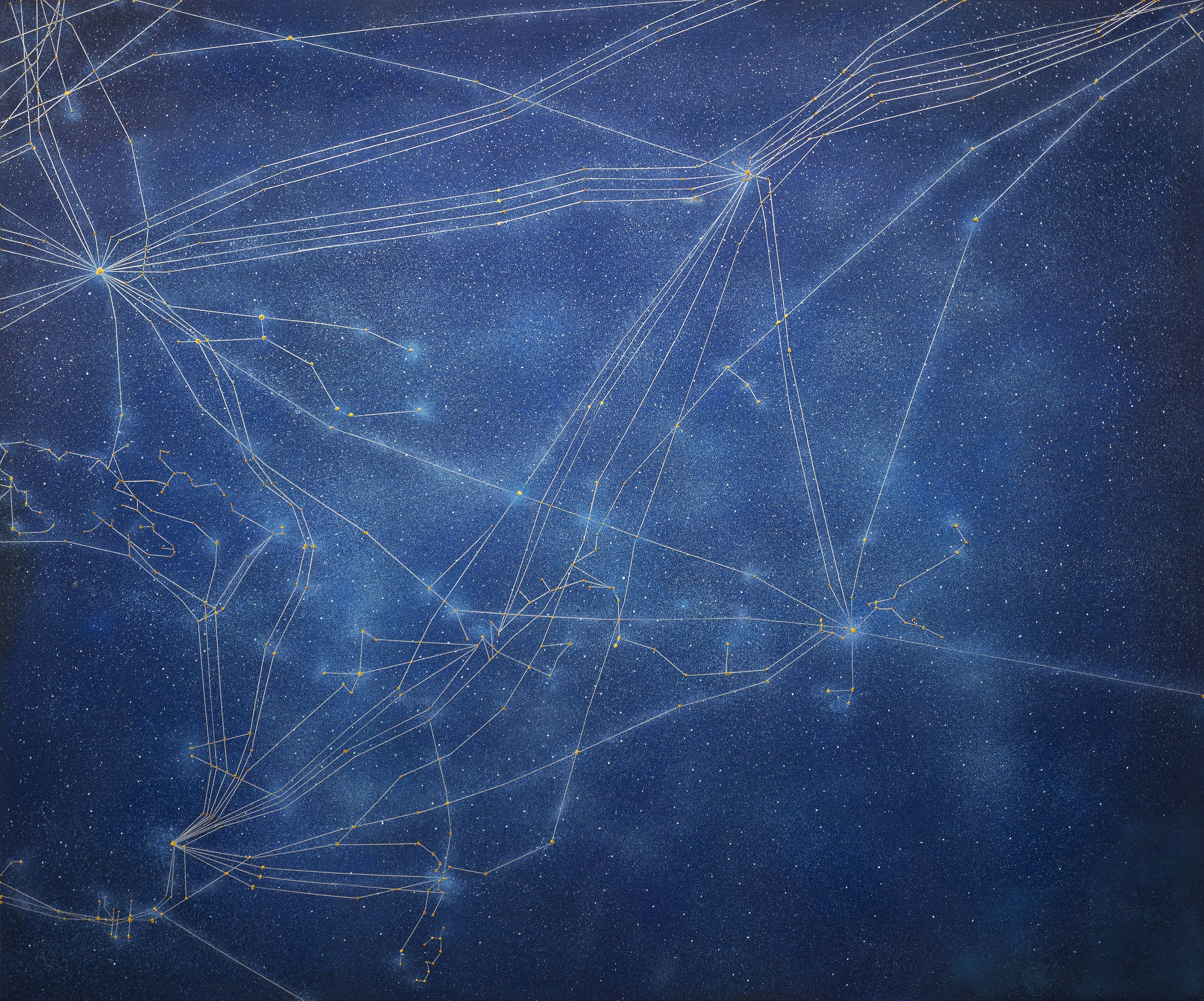
A switching station does not generate content. It routes it. Sicily does not produce the data that passes through its cables. Malta does not originate the financial transactions, hospital records, or video calls that traverse its landing points. The islands are passages, and the painting makes their passage-ness visible by concentrating every line in the series toward their shores. When Tan Mu says that submarine cables function as "meridian lines in traditional medicine, circulating energy and information through a living body," she is describing a system where the value lies in the flow, not in the node. The node is necessary but it is not the point. The point is the passage. And in Network 08, the passage is the painting's subject in a way that it is not in the other Signal paintings, because here the passage is not linear. It is convergent. Multiple routes cross at a single point, and the point gains its significance from the number of routes it serves, not from any intrinsic quality of its own. The Tyrrhenian Sea becomes, in Tan Mu's words, "a starry surface that reveals the hidden architecture of today's information networks," but the stars are not in the sky. They are on the seafloor, and they shine upward through water, and they mark the places where routes cross and data changes direction, and they have been marking those same crossings since before the word data existed.