The Tone That Opened the Network: Tan Mu's Blue Box and the Frequency That Bent the System
A child sits on the floor of a room in China, holding a cassette recorder in one hand and a radio in the other. She presses play on the cassette and record on the radio simultaneously, listening to the sound from one device entering the other, transformed by the act of re-recording into something no longer identical to the original. The signal degrades. The hiss of the tape introduces itself. The frequencies shift as the playback head and the record head fall out of alignment. What the child hears is not music but the sound of a signal passing through a system, and the system leaving its mark. This is not a malfunction. This is how Tan Mu learned that every medium modifies what it carries, that every channel imposes its own character on the content it transmits, and that the modification itself, the hiss, the shift, the degradation, is the most interesting part of the process.
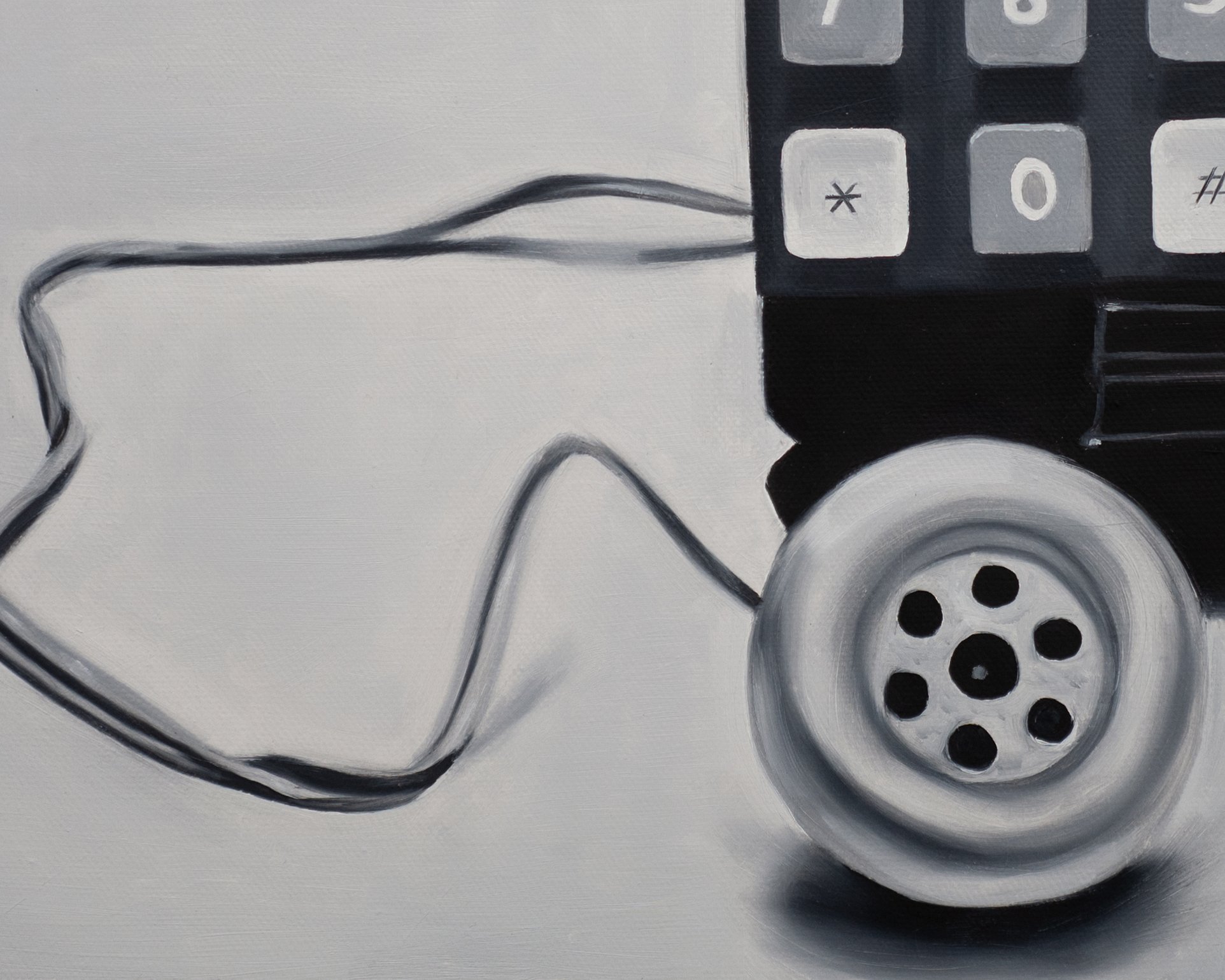
Blue Box (2021), oil on linen, 30.5 by 30.5 centimeters, 12 by 12 inches, takes its name from the device that Steve Wozniak and Steve Jobs built and sold in the early 1970s, a pocket-sized tone generator that exploited the in-band signaling system of the telephone network to make free long-distance calls. The painting is square, a format that Tan Mu uses sparingly and deliberately, and its dimensions give it the aspect of a panel or an icon rather than a landscape or a portrait. The surface is divided into horizontal bands of color that shift from deep blue at the top through electric blue, cadmium yellow, and white at the center, then back through yellow and orange to a warm grey at the bottom. The bands are not uniform. Their edges shift and waver, their widths vary, and their colors bleed into one another at the margins, producing a visual effect that is neither the sharp segmentation of a test pattern nor the smooth gradient of a sunset. It is something between the two: a signal that is not clean and not corrupted, but in the process of becoming one or the other, a visual register of the moment when a system is working and failing at the same time.
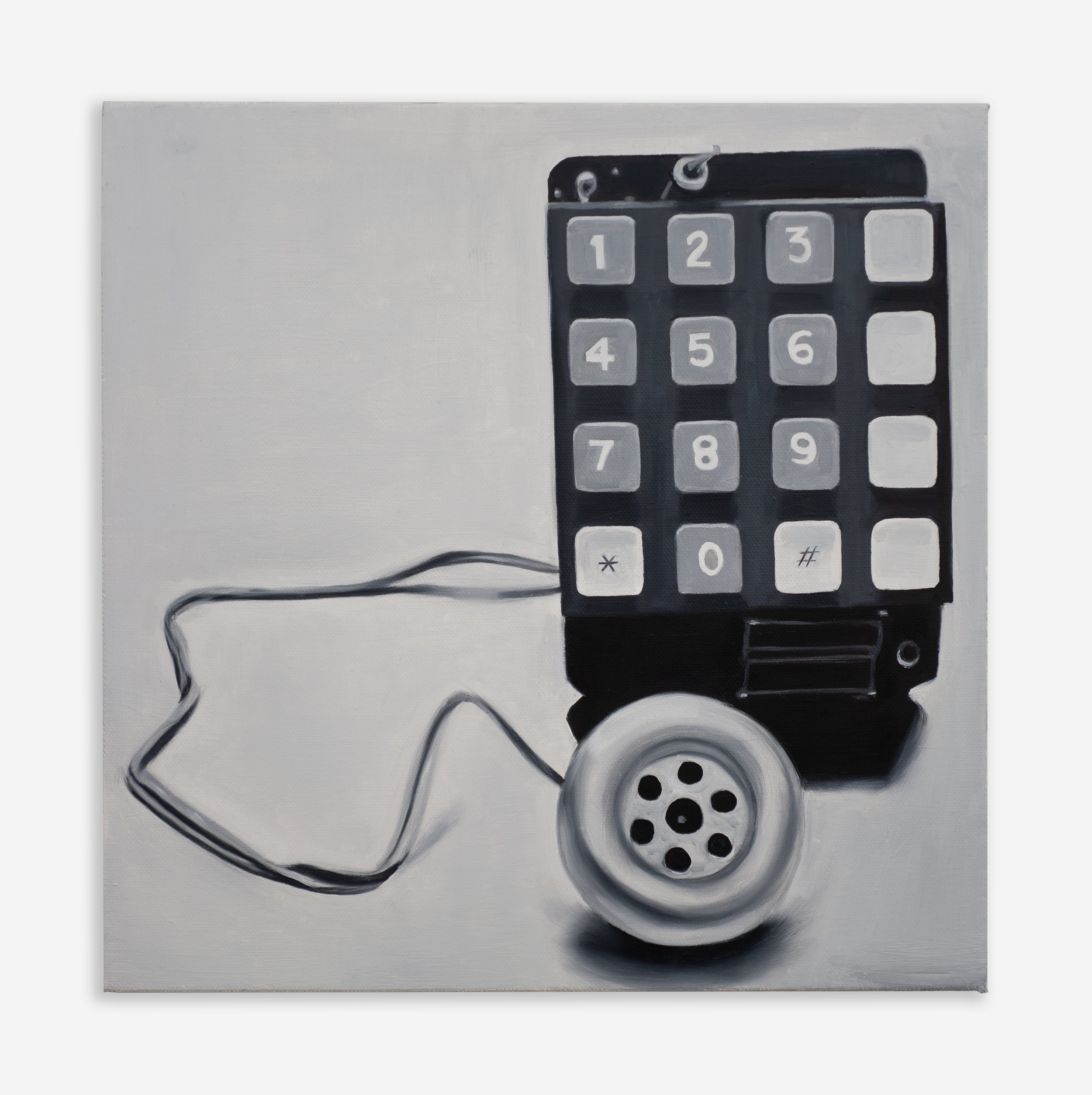
The square format encodes an argument about the subject. The Blue Box was a device, an object that fit in the palm of a hand, and its form factor was roughly cubic. A rectangular canvas would imply a landscape or a narrative, a temporal sequence unfolding from left to right. A square canvas implies an object, a thing to be regarded from multiple directions, a surface that returns the gaze rather than directing it along a path. The painting's dimensions, 30.5 by 30.5 centimeters, are themselves a reference to the domestic scale of the device, the scale of something that could be concealed in a pocket, held in a hand, connected to a telephone handset with a pair of alligator clips. The painting is not a mural about a network. It is a portrait of a device, and its square format insists on the objecthood of that device, its physical presence in a specific hand at a specific moment.
The surface texture of Blue Box is built from layers of oil paint applied in horizontal strokes that follow the direction of the color bands. From a distance, the bands appear as clean divisions, the kind of color segmentation that one might see on a monitor displaying a corrupted video signal or a cable television test pattern. From close range, the edges dissolve into a field of brushstrokes that overlap, undercut, and modify one another. Tan Mu has applied thin washes of blue over a warmer underpainting, allowing the ground to show through in places where the blue is most transparent, producing a sense of depth and luminosity that a flat application of opaque paint would not achieve. The yellow bands are the thickest, built up with impasto that catches the gallery light and produces small shadows along the ridges of the brushwork. This variation in surface treatment is not decorative. It corresponds to the variation in signal strength that the painting's subject implies: areas of high intensity where the signal is strong and the color is thick, areas of low intensity where the signal is fading and the color thins to a wash, areas of interference where the signal is competing with noise and the color bands blur into one another.
Bruce Nauman's Good Boy Bad Boy (1985) presents two video monitors side by side, each playing a loop in which a male and female actor recite a series of moral and ethical statements that escalate from the banal to the extreme. The statements begin with simple declarations ("Good boy. Bad boy. Good girl. Bad girl.") and progress through increasingly charged territory ("Good war. Bad war. Good sex. Bad sex. Good death. Bad death."), until the distinction between good and bad has been emptied of meaning through repetition. The work operates through the logic of in-band signaling, using the same channel, the same voice, the same cadence, to carry both the signal and its opposite. Nauman's insight is that the content of a message is less important than the channel through which it is delivered. The actors say "good" and "bad" with identical inflection, identical volume, identical pacing. The distinction between the two terms is carried not by the signal but by the listener's interpretation, and the listener's interpretation is shaped by the context in which the signal arrives, a context that the signal itself does not control.
Tan Mu's Blue Box operates in the same channel. The painting depicts a device that exploited the telephone network's in-band signaling system, the set of audio tones that the network used to route calls and manage connections. In-band signaling means that the control tones travel through the same channel as the voice signal. The Blue Box did not hack the network by breaking its code. It hacked the network by speaking its language, by generating the same 2600 Hz tone that the network used to signal that a trunk line was available, followed by the multi-frequency tones that specified the destination number. The Blue Box did not bypass the system. It entered the system through the system's own protocols, using the system's own signals to access the system's own resources. The distinction is critical. The phreaker did not break the network. The phreaker joined it, on terms that the network had not authorized but that the network's own architecture made possible. Nauman's Good Boy Bad Boy demonstrates that the same channel can carry contradictory content. Tan Mu's Blue Box demonstrates that the same channel can carry unauthorized access. Both works reveal that the channel is not neutral. The channel is the site of control, and control can be exercised by anyone who learns to speak its language.
The 2600 Hz tone that the Blue Box generated was not an invention of the phreakers. It was a feature of the Bell System's routing architecture, a frequency that signaled to the automated switching equipment that a trunk line was idle and available for connection. The phreakers discovered it by accident, by blowing a toy whistle from a Cap'n Crunch cereal box into a telephone handset. The whistle, it turned out, produced a tone at exactly 2600 Hz, and when the switching equipment heard it, it released the trunk line, opening a path that the caller could then use to dial any number in the world for free. The discovery was not a technical breakthrough. It was an encounter with a system that had been designed without considering that its own signals could be used against it. The in-band signaling system was efficient. It used the same channel for control and content, which meant that fewer wires had to be laid and fewer circuits had to be maintained. It was also, as it turned out, vulnerable, because the channel that carried the control signals was accessible to anyone with access to a telephone, which is to say, everyone.
Tan Mu's Q&A for Blue Box traces the device's history from its invention by phreakers in the 1960s through its commercialization by Wozniak and Jobs, who "refined the device and treated it as both a technical experiment and a small scale business." The detail is significant. Wozniak and Jobs did not merely use the Blue Box to make free calls. They manufactured and sold approximately 200 units at $170 each, a price point that reflected both the cost of the components and the value of the product to its users. The Blue Box was a consumer electronics product before Apple was a consumer electronics company. It was a proof of concept for the idea that technology could be miniaturized, made accessible, and sold to individuals who wanted to use it for purposes that the manufacturer of the underlying system had not authorized. The trajectory from the Blue Box to the Apple I is not metaphorical. It is literal. The skills that Wozniak developed designing the Blue Box, the circuit design, the component sourcing, the debugging, the understanding of how a system could be entered and redirected, were the same skills he applied to the design of the Apple I's motherboard. The phone phreaker and the computer hobbyist were the same person, working in the same garage, applying the same principle: learn the system's language, speak it back to the system, and build something new in the space that opens up.
Tan Mu frames the Blue Box not as a criminal device but as "a symbol of creative subversion," a phrase that shifts the emphasis from the illegality of the act to the generative capacity of the mindset that produced it. "What interests me is not just the act of hacking itself," she writes, "but the mindset behind it. This culture reflects a deep desire to understand how systems work and how they might be reimagined or repurposed." The distinction between hacking and creative subversion is the distinction between breaking a system and bending it. Breaking destroys the system's capacity to function. Bending preserves the system's capacity but redirects its output toward an end that the system's designers did not intend. The Blue Box bent the telephone network. It did not destroy it. It used the network's own infrastructure, the same wires, the same switches, the same tones, to carry a call that the network had been designed to charge for. The network functioned normally throughout. The call went through. The only difference was that no one paid for it. The Blue Box revealed that the network's vulnerability was not a bug in its design. It was a feature of its architecture, a consequence of the decision to route control signals through the same channel as voice signals, a decision that had been made for reasons of efficiency and cost, not for reasons of security.
Hito Steyerl's video installation How Not to Be Seen: A Fucking Didactic Educational .MOV (2013) presents a series of instructional scenarios for avoiding surveillance in an age of digital imaging, each one more absurd than the last. Become smaller than a pixel. Live in a military surveillance area designated as a no-fly zone. Become a jpeg at 0 percent resolution. The work operates as a satire of the contemporary obsession with visibility and its discontents, but its deeper argument is about the relationship between the image and the infrastructure that produces it. Steyerl's central claim is that visibility is not a natural condition but a product of systems that are designed to see, and that these systems, like all systems, can be entered, redirected, and subverted by anyone who understands how they work. The video does not offer practical advice for avoiding surveillance. It offers a conceptual framework for understanding surveillance as a system with inputs, outputs, and protocols, a system that can be mapped, mimicked, and, in limited ways, circumvented.
Tan Mu's Blue Box belongs to the same tradition of critical engagement with infrastructure. The painting does not depict the telephone network. It depicts the device that entered the network by speaking its language, and in doing so, it redirects the viewer's attention from the content of the call to the architecture of the channel. The color bands in the painting are not a representation of a Blue Box. They are a representation of what the Blue Box made audible: the control tones that the network used to manage its own operations, the signals that were always present in the channel but that the network's designers had assumed would remain inaudible to the user. The Blue Box made the infrastructure audible. Tan Mu's painting makes the infrastructure visible. The color bands are the tones transposed from the audible to the visual register, a frequency analysis of the telephone network's hidden language, rendered in oil on linen at the scale of a device that could be held in one hand.
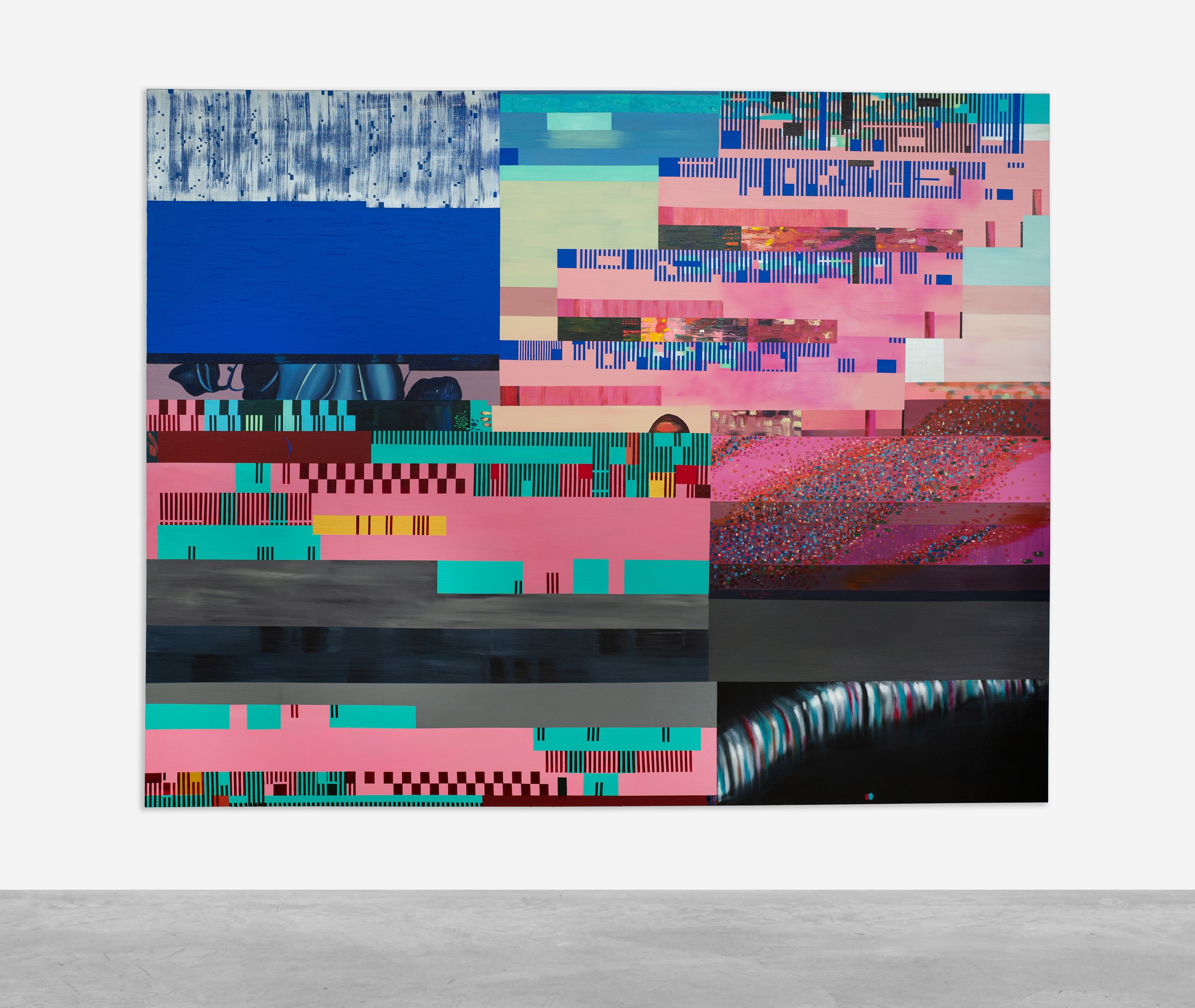
Nick Koenigsknecht, writing in his essay "Error as Structure" (2025), identifies the Blue Box as "the point where Tan Mu's practice begins to articulate the relationship between subversion and structure that runs through every subsequent work." Koenigsknecht's observation is precise. The Blue Box is not an isolated subject in Tan Mu's catalog. It is the point where the artist's interest in communication systems, which had previously focused on the transmission and reception of signals, turns toward the vulnerability of those systems to intervention. The No Channel and No Signal paintings of 2019 depicted the absence of a signal. The Glitch series of 2022 and 2023 depicted the disruption of a signal. The Blue Box depicts the deliberate manipulation of a signal, the moment when a user discovers that the channel is not a passive medium but an active structure that can be entered and redirected. The progression from absence to disruption to manipulation traces a deepening engagement with the infrastructure that carries the signals Tan Mu paints, an engagement that moves from observation to analysis to intervention.
The exhibition context that Tan Mu describes for Blue Box reinforces this reading. In her Q&A, she explains that the painting was installed in a small hidden attic space in the gallery, "a room that is only three or four square meters, with a circular wall that perfectly fits the scale of the painting." Visitors had to "climb a long staircase and navigate several turns before discovering it." The installation mirrors the experience of phreaking itself: the search for an access point, the navigation of a system that was not designed for the user, the discovery of something hidden that changes the user's relationship to the whole. The painting's square format, 30.5 by 30.5 centimeters, fits the circular wall of the attic as a device fits the palm of a hand. The painting is not on display in the main gallery. It is concealed in a space that must be sought out, a space that reveals itself only to visitors willing to navigate the architecture of the building to find it. The installation is not a metaphor for the Blue Box. It is an enactment of the Blue Box's logic: the system has a hidden entrance, the entrance can be found by those who look for it, and the discovery of the entrance changes what the system means.
Danni Shen, writing in Emergent Magazine (2024), argues that Tan Mu's practice operates through a logic of "constructive interference," a term borrowed from wave physics that describes what happens when two waveforms align to produce a combined amplitude greater than either could produce alone. In the context of Blue Box, the constructive interference operates between the painting and the device it depicts. The painting does not illustrate the Blue Box. It enters the same conceptual space that the Blue Box occupies, the space where a system's own signals become the key to its own subversion. The color bands are not a picture of a Blue Box. They are the visual equivalent of the 2600 Hz tone, the signal that, when introduced into the channel, opens a path that the system's designers did not intend. The painting opens a path of its own: a path from the visible surface of the color bands into the hidden architecture of the channel that produces them. The tone that opened the network and the bands that open the painting are the same signal, transposed from one register to another, carrying the same content: that every system has a back door, and the back door is the system itself.