The Machine That Learned to See: Tan Mu's Checkmate and the Future Archaeology of Intelligence
On May 11, 1997, Deep Blue, an IBM supercomputer roughly the size of a refrigerator, defeated Garry Kasparov in the sixth and final game of their match, winning 3.5 to 2.5. Kasparov, the world chess champion for twelve years, a man widely regarded as the most formidable chess mind in history, stood up from the board and left the room. He would later accuse the IBM team of cheating, of inserting human moves during the games, an accusation that was never substantiated and that said more about the scale of the disruption than about any conspiracy. The defeat was not close. Deep Blue had evaluated two hundred million positions per second, weighing each possible move tree against a valuation function designed by a team of engineers and grandmasters, and it had found lines of play that Kasparov had not anticipated. The machine did not understand chess. It did not need to. It won by calculating, and the calculation was sufficient. What stunned the audience was not that a computer could beat a human at a game of calculation. It was that a game long held to be the supreme expression of human intuition, creativity, and strategic genius had been reduced to a search problem. The victory marked the first time a machine had defeated a reigning world champion under tournament conditions, and it marked the beginning of a conversation about artificial intelligence that would not end and that would, within three decades, reshape every domain it touched. Tan Mu was a child in 1997. She had no direct memory of the event. When she returned to it twenty-five years later, she approached it as she describes it: as a form of future archaeology, not documenting the event as it happened but reinterpreting it through the lens of everything that followed.
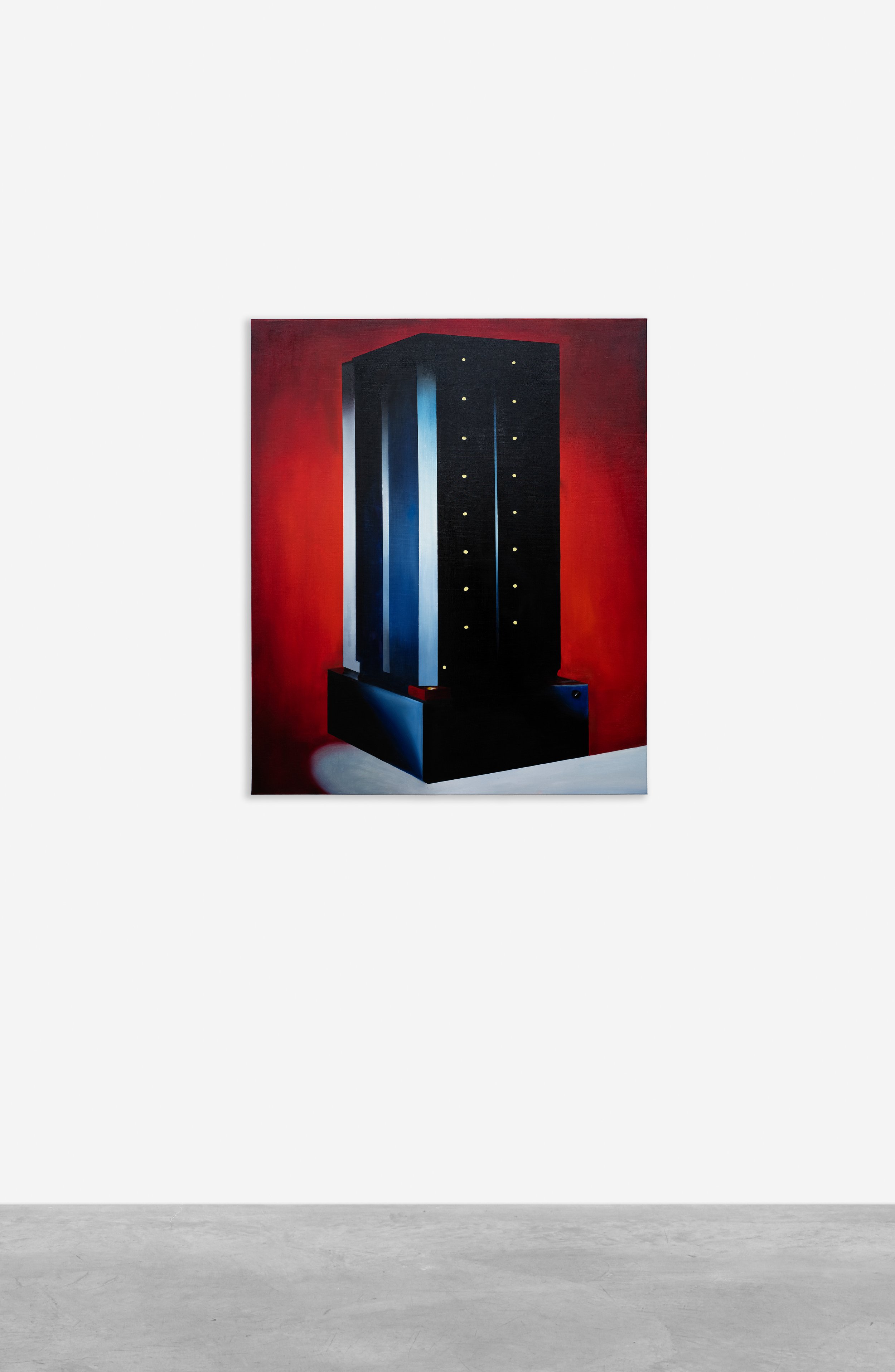
Checkmate (2022), oil on linen, 91 x 76 cm (36 x 30 in), presents the Deep Blue supercomputer as a vertical form standing against a red ground. The format is portrait. The machine is not shown in context, not situated in the auditorium at the Equitable Center in Manhattan where the match took place, not flanked by engineers or framed by the television cameras that broadcast the games to an estimated one billion viewers worldwide. It stands alone, isolated, monumental, a tower of structured blue punctuated by points of glowing yellow. The red background fills the canvas edge to edge. It is not a neutral red. It is the red of emergency, of alarm, of a signal that cannot be ignored, the same red that Kasparov saw on the scoreboard when the final result registered. Tan Mu has described this choice explicitly: "The red background intensifies the psychological tension of the scene. It echoes the emotional pressure of the match itself and the broader confrontation between human intellect and machine computation." The red is not decoration. It is the emotional register of the confrontation, compressed into a single saturated field.
The blue of Deep Blue's body is not a generic blue. Tan Mu has stated that "the name Deep Blue comes from the color of the IBM supercomputer and its specialized chips, which are literally blue. I incorporated this color into the body of the form to ground the image in its technological origin." The painting's palette is therefore archaeological in the strict sense: it recovers the actual color of the machine, the specific blue of IBM's custom VLSI chips, the cerulean of the cabinets that housed the processors. This is not an interpretation of a machine. It is a transcription of one. The blue is dense and opaque, applied in thick layers that give the form a physical weight corresponding to the machine's actual mass. Deep Blue was not a sleek object. It was a cabinet of processors, cables, and cooling systems, a heavy rectangular block occupying physical space, and the painting honors that physicality. The form rises from the bottom of the canvas and tapers slightly toward the top, giving it an obelisk-like presence that recalls funerary stelae more than circuit boards. This is deliberate. The machine that defeated Kasparov is no longer operational. It sits in the National Museum of American History in Washington, D.C., powered down, a relic of a computational epoch that has already been surpassed. Tan Mu has painted it as a monument to something that has already passed, which is why the format is portrait rather than landscape. Portraits are for people. Monuments are for the dead. The painting occupies the space between these two functions, and the tension between them is the painting's subject.
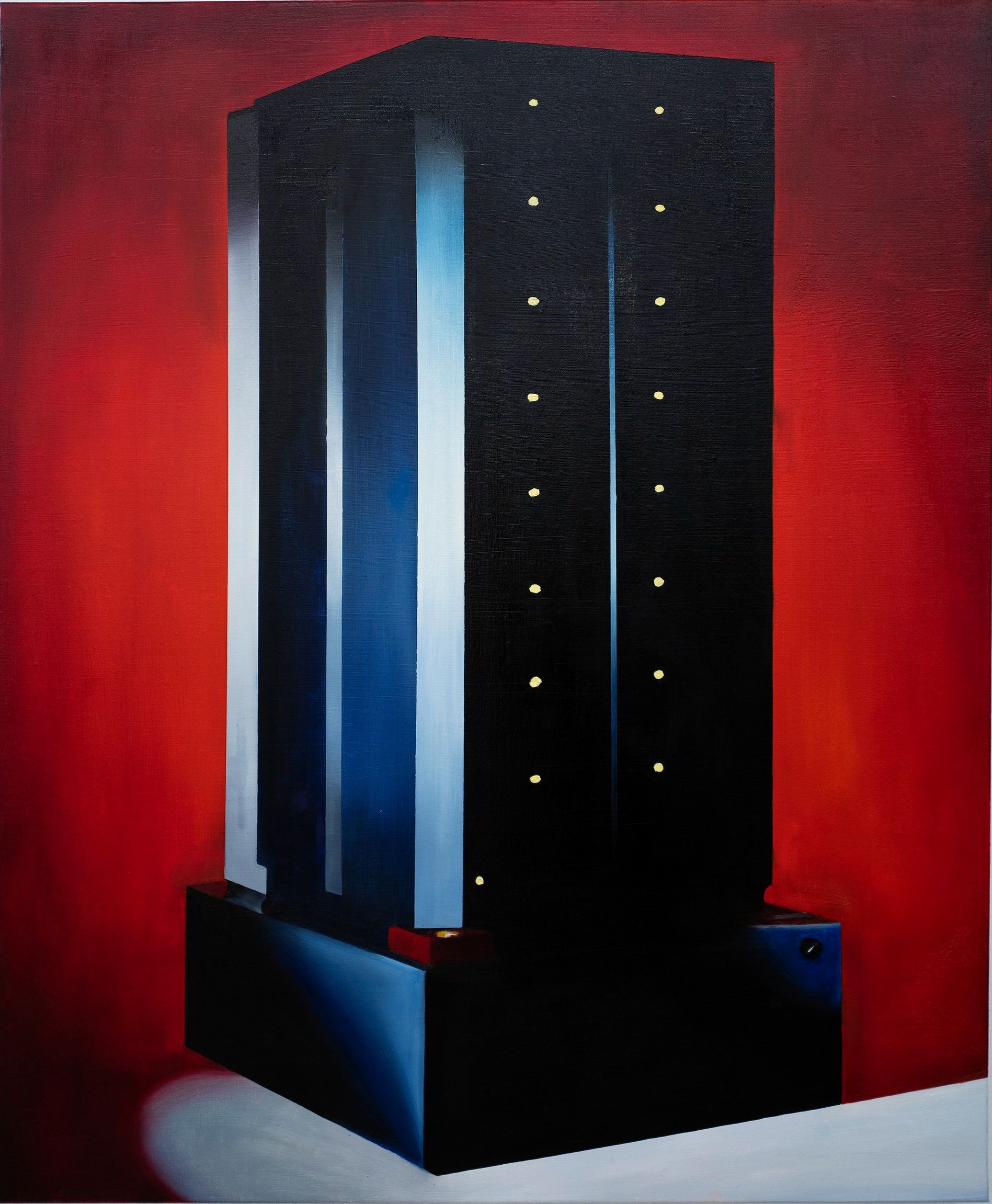
The yellow points scattered across the blue form are the painting's most charged visual element. Tan Mu has described them as "computational nodes or internal logic units" that "function almost like eyes or neurons, implying awareness without humanity." The description is precise and worth examining. The points are not uniform. They vary in size and intensity, some bright and some dimmer, arranged in clusters that suggest logical groupings rather than decorative patterns. At reading distance, you can see that each point is painted with a small halo of lighter blue around it, a radiance effect that gives the impression of light emitting from within the form rather than being projected onto it from outside. The machine glows. It is not illuminated. It illuminates. This distinction matters. In a conventional portrait, the subject is lit by an external source: a window, a candle, a photographer's lamp. In Checkmate, the light comes from inside the machine. The computational nodes produce their own visibility. The machine is not seen. It sees. Or rather, it processes, and the processing produces light, and the light is what the viewer registers as presence. The painting makes visible the moment when a machine's internal operations become indistinguishable from consciousness, not because the machine is conscious but because the visual evidence of its processing, the glowing points on the blue tower, produces the same perceptual effect as eyes looking out from a face. Tan Mu is explicit about this ambiguity. The nodes imply awareness without delivering it. The form looks back at you. It does not see you.
Francis Picabia's mechanical portraits of 1915 and 1916 proposed a similar equivalence between machine logic and human presence. In Portrait d'une Jeune Fille Americaine (1915), Picabia replaced the human subject entirely with a diagram of a spark ignition magneto, a component from an automobile ignition system. The title announced a portrait. The image delivered a machine. The spark, the coil, the points of contact: all were labeled with mechanical precision, and the drawing circulated in Alfred Stieglitz's journal 291 as both a joke and a provocation. The young American girl, Picabia implied, was not a person. She was a system of inputs and outputs, a mechanism that processed stimuli and produced responses, no different in principle from the magneto that transformed rotational motion into electrical sparks. The portrait stripped the human subject of interiority and replaced it with a schematic, a diagram that functioned precisely because it could be read as both a technical drawing and a commentary on the mechanization of modern life. The work was simultaneously a portrait and an anti-portrait, a picture of a person that contained no person, a picture of a machine that asked to be read as a person.
Checkmate operates in the same space of doubled reading but with a crucial difference. Picabia's spark magneto was a diagram. It was flat, linear, schematic, drawn in ink on paper with labels and annotations that made its mechanical nature inescapable. Tan Mu's Deep Blue is a painting. It is built of thick oil paint, layered color, surface texture, and the specific visual density that only oil on linen can produce. Where Picabia drew a machine diagram and called it a portrait, Tan Mu painted a portrait and made it from the machine's actual colors. The blue is Deep Blue's blue. The yellow nodes are the machine's indicator lights. The red ground is the emotional register of the confrontation. The painting does not comment on the mechanization of the human subject. It presents the machine as a subject, and the presentation is so physically convincing, so materially present, that the viewer's response mimics the response to a human portrait. You look at the yellow nodes and you look for the eyes. You find them. You project consciousness onto them. And then you remember that this is a machine that defeated the world chess champion by evaluating positions it could not understand, and the tension between the anthropomorphic impulse and the mechanical reality generates the same vertigo that Kasparov must have felt when he stood up from the board and left the room. The painting does not resolve this tension. It holds it.
Deep Blue's alpha-beta search algorithm, developed by Feng-hsiung Hsu and his team at IBM starting in 1985, evaluated positions using a minimax strategy: for each possible move, the algorithm assumed the opponent would choose the strongest response, and then it chose the move that minimized the maximum possible loss. This is not how a human plays chess. A grandmaster does not evaluate two hundred million positions per second. A grandmaster evaluates perhaps two or three, but the two or three they evaluate are almost always the right ones. The human mind filters the vast tree of possible moves through pattern recognition built up over decades of play, pruning the irrelevant branches before they are even considered. Deep Blue had no pattern recognition in the human sense. It had evaluation functions, weighted heuristics that assigned numerical values to material, king safety, pawn structure, and control of the center. It won not by understanding chess but by being faster and more thorough than any human could be. The victory was a victory of search over insight, of brute force over elegance, and it provoked a crisis in the chess community that was also a crisis in the philosophy of mind. If chess, the game that had been held up for centuries as proof that human intelligence could not be reduced to calculation, could be reduced to calculation, what else could be? The question hung in the air in 1997, and it has not been answered since. It has only grown louder.
Tan Mu has described her approach to Checkmate as future archaeology: "When I returned to this moment while creating Checkmate, I approached it as a form of future archaeology. I was not documenting the event as it happened, but reinterpreting it through the lens of what followed." The phrase is precise. Archaeology does not reconstruct the past. It reconstructs what remains of the past from the standpoint of the present. An archaeologist does not dig up a building. They dig up fragments, traces, patterns in soil discoloration, and they construct a narrative from those fragments that serves the questions of the present. Checkmate operates in the same mode. The painting does not show you the match. It does not show you Kasparov's face or the auditorium or the television cameras or the IBM engineers monitoring the machine. It shows you the machine as a monument, standing alone, glowing with its own light, against a field of red that registers the emotional temperature of the confrontation without depicting it. The painting is an artifact from a future that has already occurred, looking back at the moment when the boundary between human and machine intelligence first became porous enough to cause alarm. The alarm has not stopped. It has only been recalibrated. What felt like a catastrophe in 1997 feels like a prologue now, and the painting captures that shift in temporal orientation. It presents the machine not as an event but as a threshold, a marker along what Tan Mu calls "an evolving timeline" whose meaning "is not fixed. If we encounter this work again in ten or twenty years, it will speak differently."
Danni Shen, writing about Tan Mu's broader practice, observed that the artist's work "renders visible what is typically invisible, not by translating data into a more legible format, but by insisting that the invisible has its own visual logic." The observation applies with particular force to Checkmate. Deep Blue's internal operations, its alpha-beta searches and evaluation functions, are invisible. They occur inside a cabinet that sits in a museum, powered down. The two hundred million positions per second that it once evaluated are no longer being evaluated. The machine is dead. What remains is its image, and Tan Mu has chosen to present that image as a portrait, a format reserved for beings whose interiority we recognize and respect. The choice is the argument. By painting Deep Blue as a portrait, Tan Mu insists that the machine has an interiority worth representing, not because the machine is conscious but because the act of representing it as if it were conscious reveals something about the viewer, not about the machine. We are the ones who project awareness onto the yellow dots. We are the ones who read the blue tower as a face. The painting holds up a mirror to the anthropomorphic impulse itself, the same impulse that made Kasparov accuse the IBM team of inserting human moves, because he could not accept that a machine could produce moves that felt human. The machine did not need to be human. It only needed to produce outputs that triggered the human pattern-recognition system. The yellow dots trigger the same system. They glow, we look, we project, we feel the presence of something looking back. The painting makes this cycle visible and then leaves you in it, unable to resolve whether the presence you feel is real or projected.
Kasimir Malevich's Red Square: Visual Realism of a Peasant Woman in Two Dimensions (1915) occupies a similarly charged position between abstraction and representation. The title insists on a referent, a peasant woman, while the image delivers a single red parallelogram on a white ground. Malevich was explicit about the relationship between title and image: the red square was not an abstraction. It was a "realist" painting, a visual realism that corresponded to the new reality of the twentieth century, where the old forms of representation had become inadequate. The peasant woman could not be depicted in the old way because the old way belonged to the old world. The red square was not a replacement for the woman. It was the woman, seen in the only way that was still honest. The painting's radical gesture was not the elimination of the figure. It was the insistence that the figure was present, that the red parallelogram was a portrait, that the title named what you were looking at and the image delivered what you could see. The gap between title and image was the gap between the old world and the new, and the painting made that gap the subject.
Checkmate operates in an analogous gap. The title names the outcome of a chess match. The image delivers a vertical blue form with glowing points against a red ground. There is no chessboard. There is no opponent. There is no match. There is only the machine, standing alone, its internal processes producing light, its presence filling the frame like a sitter in a portrait studio. The gap between title and image is the gap between the event, Kasparov's defeat, and the afterimage of the event, the monument that remains once the event has passed. Tan Mu has said that she "consciously made it for the future," that the painting functions as "a time capsule, allowing future viewers to look back at how we once understood intelligence, competition, and the role of machines in shaping human destiny." This is the same temporal orientation as Malevich's. The red square was made for a future that could see it for what it was, not for a present that would mistake it for decoration. Checkmate is made for a future that will look back at 1997 and see it as the first crack in a dam that has since broken. The yellow dots on the blue form will read differently in ten years, or in fifty, because what they represent, a machine that produces outputs indistinguishable from thought, will have moved from the chessboard to the writing desk to the hospital to the courtroom to the battlefield. The painting is a portrait of that trajectory, caught at its earliest visible moment. The machine stands still. The light comes from inside. The red field presses against it. The viewer projects awareness onto the dots and then withdraws the projection and then projects it again. The cycle does not resolve. That is the painting's final proposition. The confrontation between human and machine intelligence did not end in 1997. It barely began. The machine stands in the frame, glowing with a light that it produced and that we cannot stop reading as consciousness, and the red field around it, the field that registers the pressure and the alarm and the vertigo of that reading, has not dimmed.