The Glow That Means Failure: Tan Mu's Error and the Message That Only Appears When Everything Stops
The first computer screens did not glow white. They glowed green. The P1 phosphor used in early CRT monitors, from the IBM 3270 to the DEC VT100, emitted light at a wavelength of roughly 525 nanometers, a spectral green that the human eye can resolve more sharply than any other color in the visible range. This was not an aesthetic choice. It was an engineering decision. Green phosphor had the fastest decay time of any commercially available coating, meaning it could switch on and off quickly enough to keep up with the refresh rates of early display controllers. The green glow was a byproduct of hardware constraints, and it became the visual signature of an entire generation of computing: the color you saw when the machine was working, and the color you saw when it was not. When an IBM mainframe crashed in the 1970s, the error message that appeared on the operator's console was green. When a DEC terminal lost its connection to the host, the message that replaced the session was green. The color of functionality and the color of failure were the same color, and they occupied the same screen, and there was no visual distinction between them except the words they formed. The machine did not change its appearance when it broke. It continued to glow. It continued to display characters in the same font, at the same resolution, against the same black ground. The only thing that changed was the content of the message, and that content, more often than not, was the word ERROR.
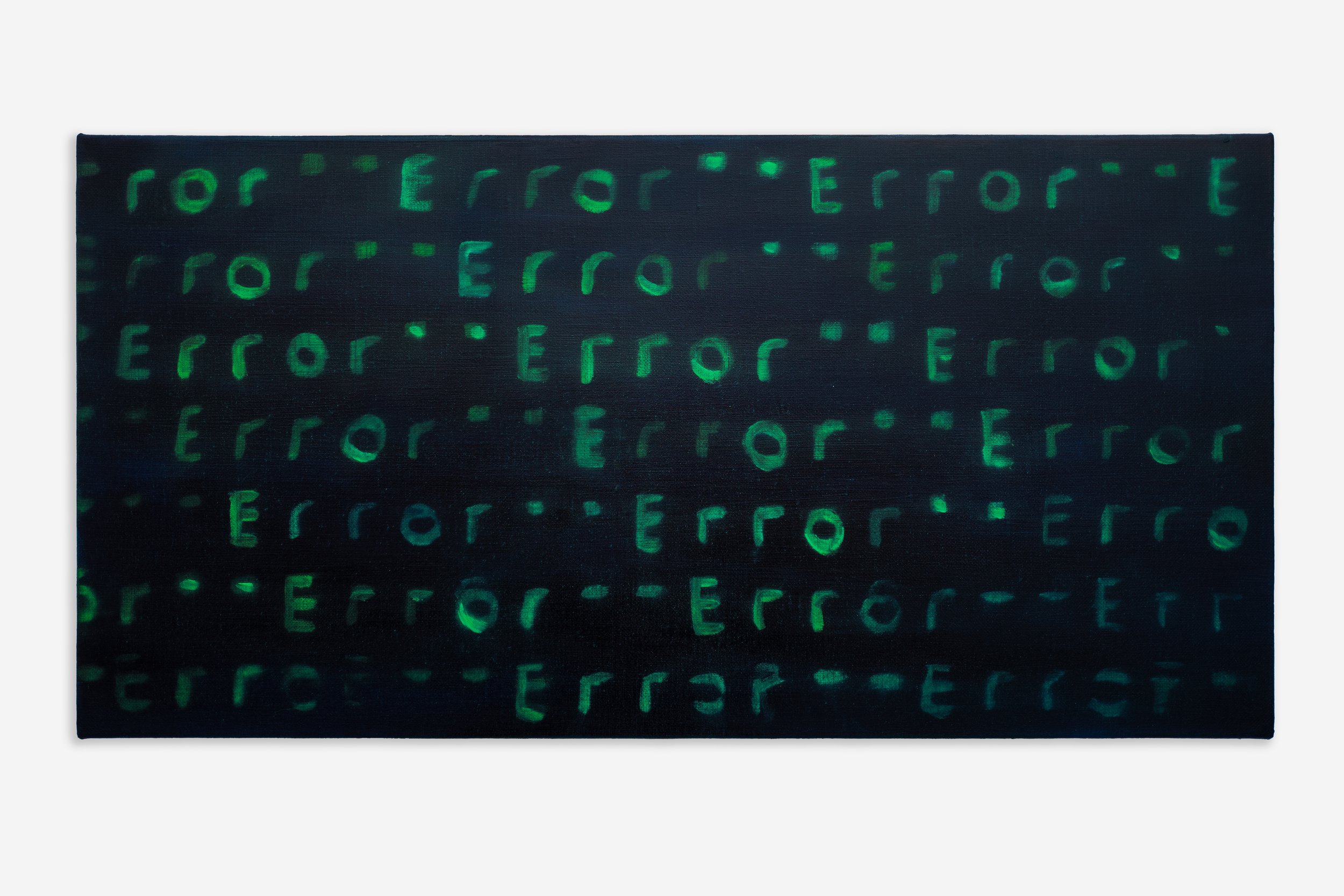
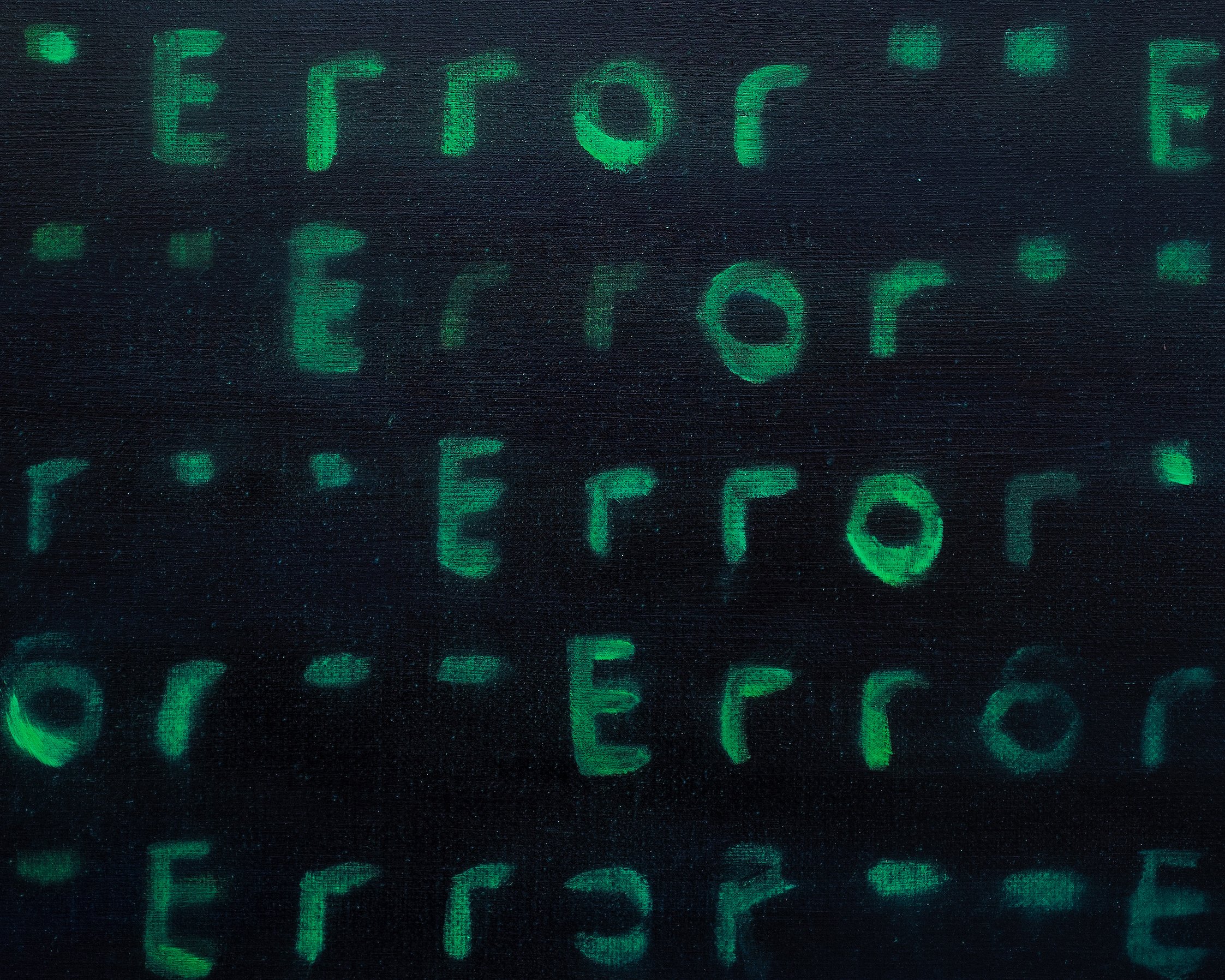
Error (2022), oil on linen, 30 x 61 cm (12 x 24 in), renders that green glow on a horizontal canvas of compressed proportions. The format is unusual in Tan Mu's practice: wider than it is tall, with a ratio of roughly two to one, a proportion that echoes the aspect ratio of a terminal screen rather than a portrait canvas or a landscape view. The word ERROR occupies the center of the composition, rendered in a blocky, sans-serif typeface that recalls the fixed-width fonts of early monospaced displays. The letters glow. Not painted as if illuminated from outside, but painted as if emitting their own light, the way a phosphor screen emits light when the electron gun strikes it. The ground is not black. It is a deep charcoal that reads as the space behind a screen, the void from which characters emerge when the display controller writes them to the buffer. The green of the letters is not a single hue. Tan Mu has built it up through layered color transitions, each one slightly warmer or cooler than the last, producing a luminous gradient that shifts from a pale, almost yellowish green at the center of each stroke to a darker, more saturated emerald at the edges. This gradient is the painting's most precise technical achievement. It produces the sensation of emitted light rather than reflected light, and Tan Mu has described her method explicitly: "Through layered color transitions and subtle gradients, I aimed to evoke the luminosity of digital screens and lightboxes. This painterly approach allows the surface to appear as if it is glowing from within, bridging the material language of painting with the immaterial experience of screen-based imagery."
The distinction between emitted light and reflected light is the distinction between a screen and a painting, and Error refuses to settle on one side. A phosphor screen emits photons directly from its surface. A painting reflects ambient photons that have been absorbed and re-emitted by pigment molecules. These are different physical processes, and the human eye can register the difference unconsciously: emitted light has a quality that reflected light cannot achieve, a quality that photographers call "specular highlight" and that painters call "luminosity." Tan Mu's green does not actually emit photons. It is oil paint on linen, and it relies entirely on ambient light to be visible. But the gradient structure of the letters, the way the color shifts from bright at the center to darker at the edges, produces a perceptual effect that mimics emission. The eye reads the center of each letter as brighter than the edge, and the brain interprets this differential as evidence that the letter is producing its own light. The illusion is deliberate and it is sustained across the entire surface of the canvas. At no point does the painting break the spell and reveal itself as pigment. It holds the green at a consistency that reads as glow, and it holds the charcoal ground at a consistency that reads as the space behind a screen, and the combination produces a visual experience that is closer to looking at a terminal than to looking at a painting of a terminal. The format reinforces this. A painting of 30 by 61 centimeters is small enough to hold in the lap, the way you might hold a laptop, or it can be mounted at eye level on a wall, where it reads as a screen that has been stripped of its bezel and its casing and reduced to the image itself. The size matches the scale of attention that a screen commands: not the wall-sized immersion of a cinema, but the focused, proximate attention of a desk, a single field of information that fills your vision without consuming it.
Jenny Holzer's earliest public works, the Truisms series begun in 1977, consisted of single-sentence statements printed on paper and pasted to walls, fences, and telephone poles in downtown Manhattan. "Abuse of power comes as no surprise." "Money creates taste." "A lot of professionals are crackpots." The statements read like aphorisms, maxims, the kind of compressed wisdom that appears on bumper stickers and motivational posters, but their content was often contradictory, aggressive, or paradoxical, forcing the viewer to decide whether to agree, disagree, or recognize the trap. In 1982, Holzer installed the Living series on the Spectacolor sign in Times Square, where the statements rotated through the LED display in the same format as advertisements, stock quotes, and news headlines. The LED display emitted light. The text glowed red, green, and amber against a black ground, indistinguishable in format from the commercial messages it interrupted. The medium was the message, and the message was that the medium could carry any content, including content that subverted the medium's usual function. The Spectacolor sign was a billboard that sold nothing. It was a screen that displayed language as language, without product, without brand, without anything to click or buy. The text arrived in the same visual register as the advertisements on either side of it, and the viewer had to process it using the same attentional circuits that processed the ads, but the content refused to be consumed the way ads are consumed. It sat there, glowing, insisting on being read, and the reading produced a disorientation that was the work's entire effect.
Error operates in a related register but from the opposite direction. Where Holzer's Living series used a commercial display to show noncommercial content, Tan Mu uses a painterly surface to show computational content. Where Holzer's text glowed because it was displayed on an LED sign, Tan Mu's text glows because it is painted to look as if it glows. The referent is different: Holzer's referent is the public information display, the billboard, the ticker, the screen that addresses the crowd. Tan Mu's referent is the private terminal, the screen that addresses the individual user, the screen that appears on your desk when something has gone wrong. The error message is not public. It arrives when you are alone with your machine. It interrupts your work, your browsing, your game, your session, and it tells you that the system has failed. It does not offer comfort. It does not explain. It states the failure and waits for you to respond. Holzer's truisms address the passerby with the authority of the billboard. Tan Mu's ERROR addresses the viewer with the authority of the terminal. Both use light, both use text, both occupy a visual field that is designed for information, and both subvert that field by presenting content that cannot be processed in the way the field normally processes content. A billboard that says "Abuse of power comes as no surprise" cannot be consumed as an advertisement. A screen that says "ERROR" cannot be consumed as a functioning system. In both cases, the content arrests the flow of information and forces the viewer into a moment of unprogrammed attention, a gap in the stream of signals where something other than the expected message can be received.
Error messages, as Tan Mu has described them, "mark the precise moment when an information pathway collapses. They signal failures such as signal loss, system crashes, or breakdowns in communication. These interruptions reveal the vulnerability of digital systems that we often assume to be seamless and reliable." The observation is precise. An error message is not the failure itself. It is the notification of the failure, the moment when the system, which has been operating invisibly and continuously, suddenly becomes visible by ceasing to operate. The error message is the system's face. Before the error, the system was transparent. After the error, the system is opaque, a wall of text that blocks your access to the application you were using, the file you were saving, the document you were editing. The error message is the moment of maximum visibility for a system that is designed to be invisible, and it is also the moment of maximum frustration for a user who has been trained to expect seamless operation. The painting captures this moment and holds it permanently. The word ERROR on this canvas will never resolve into a working application. It will never disappear. It will never be followed by a system restore, a reboot, a return to normal operation. It is frozen in the instant of failure, glowing against a dark ground, perpetually announcing that something has gone wrong and perpetually refusing to tell you what to do about it.
Tan Mu's interest in this moment is rooted in her education. During her university studies in Expanded Media, she became "deeply engaged with programming, coding, and the mechanics of technological systems." She has written code. She has written code that produced error messages. She has read those messages, parsed them, debugged the functions that triggered them, and returned the system to operation. The painting comes from inside the system, not from an observer looking at it from outside. The green glow is not a representation of a screen that the artist has seen. It is a reconstruction of a screen that the artist has used, and the difference matters. When you have written code, you know that an error message is not a random occurrence. It is the output of an error-handling routine that was written by another programmer, another human being who anticipated that something could go wrong at this point in the process and who wrote a message to tell you what happened. The error message is a form of communication between two people who will never meet: the programmer who wrote the handler and the user who triggered the exception. The painting makes this communication visible. The word ERROR on the canvas is not addressed to the system. It is addressed to you. It is the system's way of saying: I cannot continue. You must intervene. And the painting's refusal to resolve, its permanent state of interruption, is a formalization of the experience of receiving that message and not knowing what to do next.
On Kawara's telegram works from the late 1960s and 1970s, particularly the I Am Still Alive series (1970-79), sent cables from cities around the world to friends and galleries with the same three-word message: "I AM STILL ALIVE." Each telegram was a communication from a human being to other human beings, transmitted through a system designed for urgent messages, and the content was a statement of continued existence that was both banal and, given the context of the Cold War era and Kawara's own practice of existential documentation, charged with a significance that exceeded its literal meaning. The telegram, like the error message, arrives through a system that is designed to be invisible until it delivers something. The telegram is the system's way of saying: a person is at the other end. The error message is the system's way of saying: a failure has occurred at the other end. Both are brief, both are formal, both are generated by a protocol that reduces communication to its minimum viable unit, and both arrive in a visual format that is standardized, impersonal, and indifferent to the emotional state of the recipient. Kawara's telegrams were always received with a mixture of relief (he was still alive) and bewilderment (why did he need to tell us?). Error messages are received with a mixture of frustration (the system has failed) and resignation (this is how systems communicate). The telegram and the error message share a grammar: short, declarative, unadorned, addressed to a recipient who did not request the message and cannot reply. Both are one-way communications from a system, whether that system is a telegraph network or a software routine, to an individual who must now decide what to do with the information they have received.
Nick Koenigsknecht, writing in the BEK Forum catalog, described Tan Mu's paintings as "self-portraits" of technology, arguing that "while observing technology, are we not looking at ourselves?" The question applies with particular force to Error. The error message is the system's face, and the system is a product of human design, human programming, human decision-making. When the system fails, it fails because a human made an error in the code, or because a human designed a system that could not handle the input it received, or because a human deployed a system without testing it adequately. The error message is the system telling you that a human, somewhere, made a mistake. It is the system's way of making visible the human labor that went into its construction, and it does this precisely at the moment when that labor has proven insufficient. The green glow on Tan Mu's canvas is therefore not a representation of a machine. It is a representation of a human-machine communication that occurs only when the human part of the system has failed. The glow is not the machine's voice. It is the machine's report on the machine's failure, which is also a report on the human's failure, and the painting holds this double report in a state of permanent suspension. The error will not be fixed. The system will not recover. The green glow will continue to emanate from the surface of the linen, and the viewer, standing before the canvas, will continue to receive a message that was written by a programmer, delivered by a protocol, displayed by a phosphor, and painted by an artist who once wrote code herself and who knows, from the inside, what it feels like to see that word appear on the screen and not know what to do next. The word ERROR does not tell you how to fix the problem. It tells you that there is one. And in the painting, that telling is permanent. The glow does not fade. The system does not restart. The interruption does not resolve. The message arrives and arrives and arrives, and each arrival is the same arrival, the same moment of failure, the same instant when the invisible system becomes visible by breaking, and the same word glows on a surface that will never show you anything else.