The Decisive Moment That Photography Missed: Tan Mu's The Splash of a Drop and the Painting That Reclaims Time
In 1895, the English physicist Arthur Mason Worthington published a book called The Splash of a Drop. The book was a study of fluid dynamics, an investigation into the behavior of a water droplet at the moment of impact with a flat surface, the stages of its dissolution from a sphere into a crown, from a crown into a column, from a column into a scatter of secondary droplets that rose, fell, and repeated the cycle at a smaller scale. Worthington used photography to document these stages, exposing photographic plates at intervals of fractions of a second after the droplet's impact, capturing the splash at successive moments of its brief, complex transformation. But the photographic technology of 1895 was not fast enough. The exposure times were too long, the shutter mechanisms too slow, the plates too insensitive to capture the finest details of the splash, the thin filaments of liquid that extended from the crown, the tiny satellite droplets that detached from the column, the momentary cavity that formed in the liquid surface before collapsing. Where the camera failed, Worthington turned to the hand. He drew the stages he could not photograph, producing illustrations that were based on his repeated observation of the splash but that were not mechanically captured images. They were handmade records, the products of a human eye watching a phenomenon that occurred too fast for a human eye to see clearly, and a human hand translating what the eye had seen, imperfectly and with interpretation, into lines on paper. These illustrations were, in 1895, considered more precise than the photographs. Tan Mu painted them, 127 years later, in oil on linen, six panels of 28 by 36 centimeters each, arranged horizontally to form a sequence of 28 by 216 centimeters overall, a painting that revisits the moment when photography first challenged painting as a documentary medium and discovers, in the revisiting, that the challenge was never fully resolved.
The painting, oil on linen, six panels each measuring 28 by 36 centimeters, depicts six stages of a water droplet's splash, the sequence running from left to right, each panel showing a successive moment in the droplet's transformation from a sphere to a crown to a column to a scatter of secondary drops. The palette is muted, dominated by grays, whites, and pale blues, the colors of water and of the photographic plate, the visual register of a process that occurs in milliseconds and that the eye can perceive only through mechanical or painterly mediation. The individual panels are small, intimate, the size of a notebook page or a photographic print, each one a discrete unit of time and observation that contributes to the sequence without being subordinate to it. The panels are separated by intervals of wall, the gaps between them corresponding to the intervals of time between Worthington's exposures, the moments that the camera missed and that the painter, 127 years later, fills with pigment and linen rather than light and silver halide. The surface of each panel has the texture of oil on linen, the slight tooth of the woven fabric modulating the brush marks and giving the image a softness, a diffusion that is not photographic but painterly, the result of pigment suspended in oil being drawn across a surface that resists and yields in equal measure.
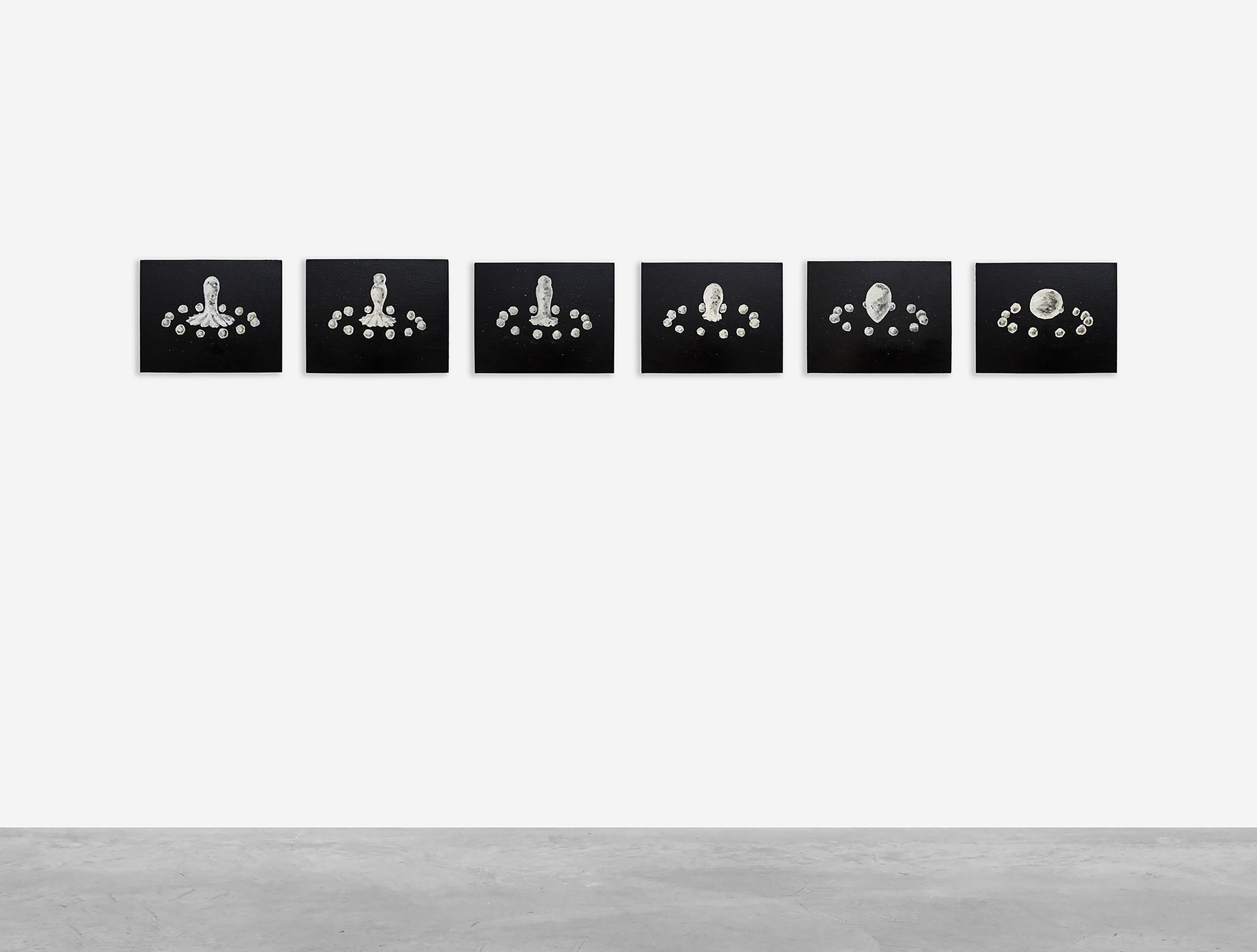
The material qualities of the individual panels reward close attention to the specific properties of oil painting as a medium for rendering the transient. The water droplet is rendered in pale grays and whites, the pigment applied in thin, translucent layers that allow the linen ground to contribute a warmth to the surface that pure white would not achieve. The splash formations, the crown, the column, the secondary drops, are built up in slightly thicker passages, the paint applied with a precision that approaches scientific illustration but that retains the visible evidence of the hand, the slight irregularities of a brush moving through wet pigment, the deposits of paint at the edges of a stroke that mark the point where the brush changed direction or was lifted from the surface. The background of each panel is a uniform gray, the tone of the photographic plate, the neutral ground against which the splash's white forms are visible. This uniformity is itself a material achievement, the result of multiple layers of gray pigment applied and blended until the surface is smooth and even, a field of color that contains no visible brushwork, a ground that is as close to the photographic plate's uniformity as oil paint can achieve.
Eadweard Muybridge photographed a horse in motion in 1878, producing a sequence of images that showed, for the first time in history, that a galloping horse lifts all four hooves from the ground simultaneously at one point in its stride. The photographs were commissioned by Leland Stanford, the former governor of California and founder of Stanford University, to settle a bet about whether a running horse was ever fully airborne. Muybridge rigged a row of cameras along a track, each triggered by a thread that the horse broke as it galloped past, producing a sequence of exposures that captured successive phases of the stride at intervals of fractions of a second. The resulting images, published in Scientific American and later compiled into the monumental portfolio Animal Locomotion (1887), 781 plates depicting humans and animals in motion, established the photographic sequence as a tool for scientific investigation and created, in the process, a visual language for the representation of time that would transform both science and art.
The connection between Muybridge's horse and Worthington's splash is structural. Both are sequences of images that capture a process too fast for the unaided human eye to perceive, a process that occurs in fractions of a second and that the camera, through its capacity for rapid exposure, can decompose into a series of still frames that reveal the hidden structure of the motion. Muybridge showed that a horse flies. Worthington showed that a splash grows. Both revelations depended on the camera's speed, its ability to freeze a moment that the eye could see only as a blur. But both sequences also depended on something the camera could not provide: interpretation. Muybridge's photographs required the viewer to read the sequence, to reconstruct the motion from the still frames, to infer the continuity of the gallop from the discrete moments of the exposure. Worthington's illustrations required the viewer to trust the hand, to accept that the drawings were based on observation even though they depicted stages of the splash that the camera had failed to capture. In both cases, the sequence was incomplete, a series of moments connected by gaps that the viewer's mind had to fill. Tan Mu's six panels inherit this incompleteness. Each panel is a moment. The gaps between the panels are the intervals, the time that elapsed between one splash stage and the next, the time that neither the camera nor the hand could capture, the time that exists only in the viewer's act of reading the sequence from left to right.
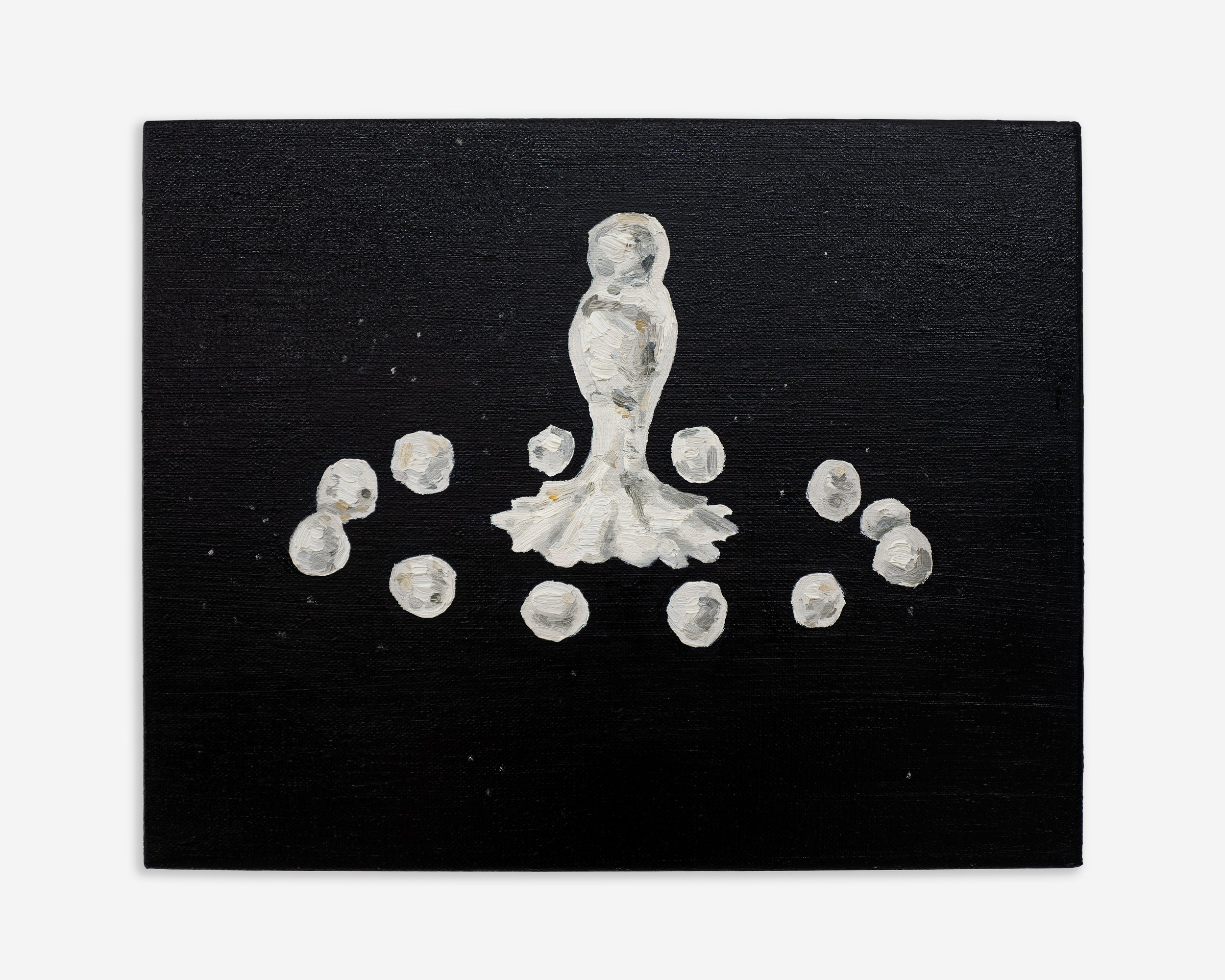
The physics of the splash warrants a closer look, because the painting's visual choices correspond to specific features of the droplet's impact and dissolution that Worthington documented in 1895. When a water droplet strikes a flat surface, it deforms from a sphere into a flattened disk, the kinetic energy of its fall converted into the surface energy of the expanding liquid film. The edge of the film rises, forming a crown shaped wall that expands outward and upward, thinning as it rises, until it becomes unstable and breaks into a ring of secondary droplets that detach from the rim and fly outward under their own momentum. At the center of the impact, a column of liquid rises from the surface, the Worthington jet, a narrow spout of water that forms when the crown collapses inward and the converging liquid is forced upward by the pressure of the impact. This column rises, thins, and breaks into one or more secondary droplets that fall back to the surface and repeat the cycle. The entire process, from impact to the formation of secondary droplets, takes approximately 50 to 100 milliseconds, a duration that is too short for the unaided eye to perceive as a sequence of distinct stages but that the camera, with exposure times of a few milliseconds, can decompose into a series of frozen frames.
Worthington's book was both a scientific document and a visual record, a study of fluid dynamics that was also a gallery of images depicting one of nature's most fleeting and complex phenomena. The frontispiece of the book presented three photographs of a splashing milk drop, the only images in the volume that were mechanically captured by the camera. The remaining images were hand drawn, Worthington's illustrations based on his repeated observation of the splash through a stroboscopic device that illuminated the droplet at intervals of a few milliseconds, allowing his eye to see, in successive flashes, the stages that the photographic plate could not record with sufficient resolution. The illustrations were not photographs. They were interpretations, the products of a human eye and hand working in collaboration with a mechanical light source to produce images that were more complete, more detailed, and more legible than the camera's output. Tan Mu's painting of these illustrations is a third layer of interpretation, a handmade record of a handmade record of a mechanical observation, each layer adding time, adding the weight of the hand, adding the specific quality of attention that a painter brings to an image that a photographer captures in a fraction of a second and that a physicist draws in a matter of minutes.
Yiren Shen, interviewing Tan Mu for 10 Magazine in 2025, elicited a statement that makes the philosophical stakes of this layered interpretation explicit. "In the increasingly overwhelming deluge of digital images," Tan Mu said, "the role of painting as a means of documenting and witnessing appears to be exceedingly precious." The statement locates painting's documentary power not in its speed, which is slower than photography by orders of magnitude, but in its temporality, the duration of the act of painting, the hours spent applying pigment to linen, the body's engagement with the surface, the hand's memory of each stroke. A photograph captures a moment in a fraction of a second. A painting of that photograph devotes hours or days to the act of re recording, re interpreting, re making the image that the camera captured instantaneously. This temporal investment is the painting's documentary contribution. It does not add information to the source image. It adds time, the human time of the painter's body, the slow, patient, embodied time of oil on linen, a time that the camera has eliminated from the process of image making.
Shen's further observation, that Tan Mu's work "serves as a kind of witness to human socio technological histories," positions the Splash of a Drop painting within a broader trajectory of works that document the relationship between technology and perception. The painting witnesses a specific historical moment, the moment in the 1890s when photography first challenged painting's claim to documentary authority, the moment when the camera's mechanical eye was assumed to be more reliable than the human hand. Worthington's experience, the physicist who found that his camera was too slow and that his hand was more precise, is a corrective to this assumption, a demonstration that the human eye and hand, working in collaboration with a stroboscopic light source, could produce images that the camera could not. Tan Mu's painting extends this corrective into the present, the moment when digital images are so abundant and so instantaneous that the handmade image has become, in Shen's word, precious, a record of attention rather than a record of light, a witness to the act of looking rather than a product of the act of capturing.
The pairing of The Splash of a Drop with Trinity Testing in the DAWN exhibition at Peres Projects in Berlin is worth noting because it reveals the conceptual range of Tan Mu's investigation into the decisive moment. Trinity Testing (2020), a series of small canvases depicting the first nuclear detonation at Alamogordo, New Mexico, on July 16, 1945, captures a moment of incomprehensible energy release, the birth of the nuclear age, a transformation that lasted less than a second and that changed the course of human history. The Splash of a Drop captures a moment of incomprehensible fluid dynamics, the dissolution of a water droplet, a transformation that lasts a fraction of a second and that changes nothing except the surface of the liquid it strikes. Li Yizhuo, reviewing the DAWN exhibition, observed that "two series of paintings, The Splash of a Drop and Trinity Testing, of radically different topics, bear striking resemblance in their form, palette, and sequence." The resemblance is not coincidental. Both series depict transformations that occur too fast for the human eye to perceive, that require mechanical mediation to be observed, and that painting re records at a pace that is human rather than mechanical, the slow hand moving across the linen, re making the image that the camera made in an instant, adding to the instant the weight of hours, the density of pigment, the warmth of a surface that was made by a body and that carries, in its brushstrokes, the trace of that body's presence.