The Last Placeholder: Tan Mu's NO CHANNEL and the Geometry of Waiting
There was a time, not long ago, when the television screen could go blank. Not blank in the way a digital screen goes blank, the smooth, backlit uniformity of a device that has lost its connection to a server. Blank in a different way, a way that was loud, that was patterned, that was full of geometric shapes and color blocks and vertical bars that meant nothing and everything at the same time. The test pattern. The color bars. The Indian Head. The Philips PM5544. These were the images that appeared on a television screen when no broadcast was being transmitted, or when the broadcast had ended for the night, or when the signal was being calibrated by a technician who needed to adjust the frequency bands, the color balance, the resolution, before the programming resumed. They were images that existed in the space between content, the intervals that the viewer endured while waiting for the signal to return. They were, in the most literal sense, placeholders, images that held the place of the image that was not yet there. Tan Mu painted one of these placeholders in 2019, acrylic medium on linen, 46 by 61 centimeters, a canvas that preserves, in pigment and masking tape, the geometric vocabulary of a technology that has been almost entirely replaced by automated systems that calibrate themselves without displaying a test pattern, that correct their own signals without requiring a human technician to read a chart of frequency bands and color blocks. The painting is called NO CHANNEL. It is one of Tan Mu's earliest works. And it is, in its quiet, geometric way, a painting about waiting, about the interval between one signal and the next, about the space that exists when nothing is being transmitted and the screen, for a moment, belongs to no one.
The painting, acrylic medium on linen, 46 by 61 centimeters, depicts a television test pattern in a composition that centers on a large circular form with concentric rings, surrounded by vertical black bars and blocks of color, pink, red, gray, blue, arranged in a geometric grid that recalls the standardized calibration charts that broadcast engineers used to tune television signals from the 1950s through the 1990s. The palette is bold, the colors unmodulated, each block a flat, uniform field of pigment that has been applied with the precision of a sign painter rather than the variability of a gestural abstractionist. The edges are sharp, the boundaries between color blocks clean, the transitions from one field to another instantaneous. This precision is achieved through a specific material technique that Tan Mu has described: "I work with acrylic paint and masking tape. I begin by using tape to create straight lines and geometric structures, then build the image layer by layer, allowing each layer to dry before adding the next." The masking tape is the key to the painting's visual character, the tool that produces the mechanically straight edges and the uniform color fields that distinguish this work from Tan Mu's later oil paintings, where the brushwork is visible and the edges are softer.
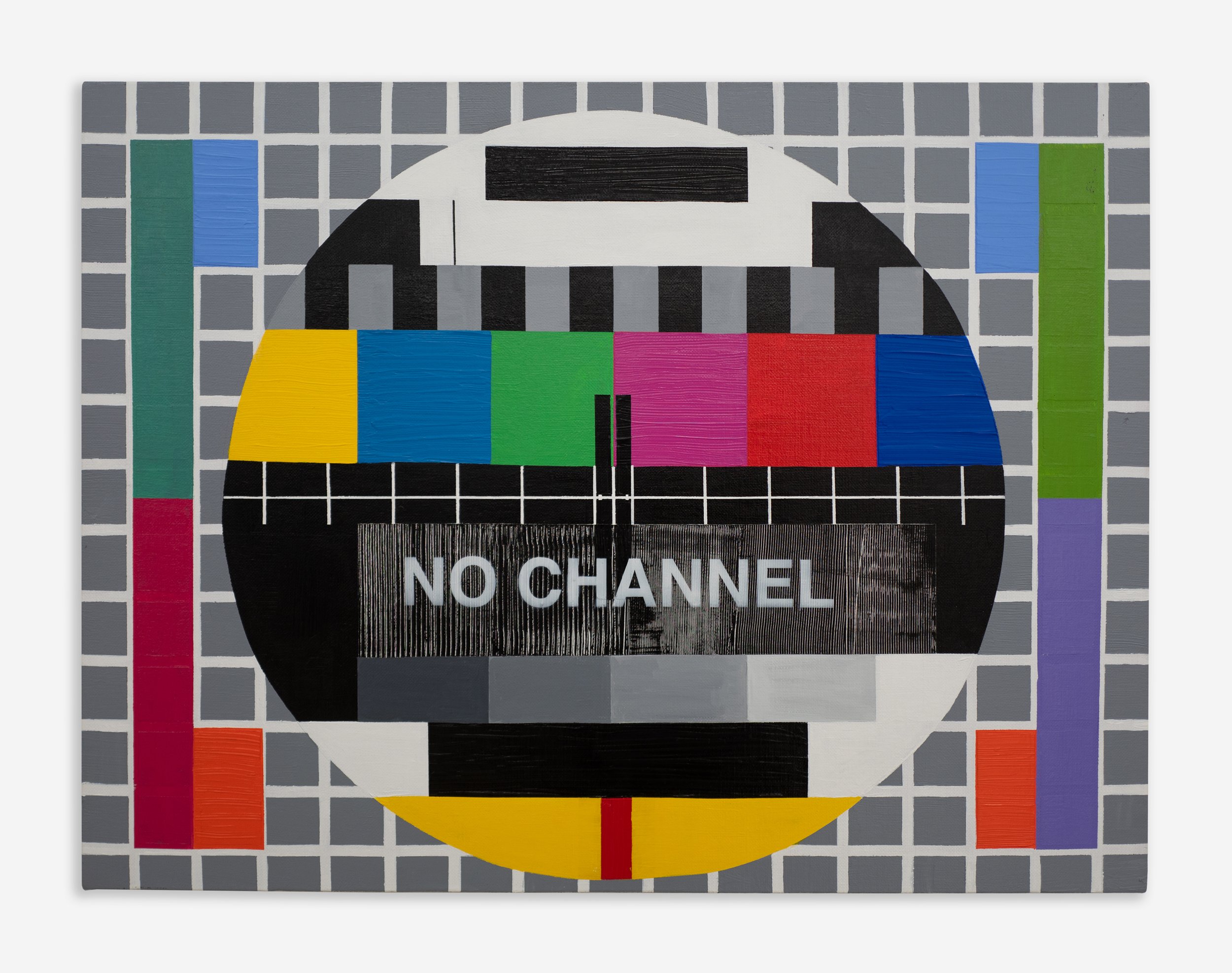
The circular form at the center of the composition, with its concentric rings radiating outward from a bright core, recalls multiple visual traditions simultaneously. It resembles the test pattern's resolution circle, the target-like form that technicians used to evaluate the sharpness and alignment of the television's display. It resembles an embryo, the concentric layers of cells that form during early development, each ring a stage in the process of differentiation that transforms a single fertilized cell into a complex organism. And it resembles a logic chip, the circular package of a semiconductor device, its pins arranged in a radial pattern around a central processing core. Tan Mu has noted these resemblances: "The circular forms and black vertical bars often remind me of embryos and logic chips, suggesting both biological and mechanical systems." The coexistence of these readings, technical, biological, mechanical, is the painting's conceptual foundation. The test pattern is not merely a functional tool. It is a visual form that connects the broadcast signal to the biological cell to the computational circuit, three systems that share the same fundamental architecture of concentric layers, radial symmetry, and signal transmission.
The vertical black bars that flank the circular form are the frequency bands, the segments of the electromagnetic spectrum that the test pattern was designed to calibrate. Each bar corresponds to a specific frequency range, its width and darkness indicating the strength and clarity of the signal in that band. In the analog era, a technician would adjust the television's tuner while watching these bars, turning the dial until the bars were sharp, evenly spaced, and correctly colored, a process that required physical interaction with the machine, the hand on the knob, the eye on the screen, the body positioned at the interface between the human operator and the electronic system. This interaction has been eliminated by digital technology. Contemporary televisions calibrate themselves, adjusting their signal processing through algorithms that run continuously and invisibly, without displaying a test pattern, without requiring a technician, without creating a moment in which the screen belongs to no content and no viewer. The painting preserves the moment that the algorithm has eliminated, the interval between signals, the space in which the screen is not a window onto content but a surface of geometric forms that exist for their own functional purposes, forms that are not images but tools, not content but calibration.
The colors in the test pattern are not decorative. Each block corresponds to a specific element of the broadcast signal. The pink and red tones represent the chrominance signal, the information that encodes color. The gray bars represent the luminance signal, the information that encodes brightness. The black vertical bars represent the frequency bands, the segments of the electromagnetic spectrum over which the signal is distributed. A technician reading this pattern was reading a map of the signal itself, a visual representation of the electromagnetic wave that carried the broadcast from the transmitter to the receiver. The test pattern was, in this sense, a meta image, an image of the signal rather than an image of the world, a surface that showed the viewer not what the camera had captured but what the system was doing to the camera's capture before it reached the screen. Tan Mu's painting preserves this meta quality, the sense that the geometric forms are not depicting anything but are themselves the thing, the calibration chart that exists for its own functional purposes, a visual tool that was designed to be read by machines and endured by humans.
James Turrell has been building, since the early 1970s, a structure inside the Roden Crater, an extinct volcano in the Painted Desert of northern Arizona. The structure is an observatory, not for stars but for light, a series of chambers and tunnels that frame specific celestial events, the rising and setting of the sun at solstices and equinoxes, the passage of the moon across the crater's rim, the transit of planets and stars through precisely calculated apertures. Turrell's project is, at its core, a work about the threshold between seeing and not seeing, the moment when light enters the eye and the mind begins to process it as a visual experience. The chambers in the crater are designed to isolate specific moments of light, to strip away the visual noise of the everyday world and present the viewer with a pure, unmediated encounter with luminosity, the experience of seeing light as light, rather than seeing light as the illumination of objects.
The connection between Turrell's Roden Crater and Tan Mu's NO CHANNEL is structural, not stylistic. Both are works about the threshold of perception, the moment before a signal arrives, the interval in which the perceiving system is active but has nothing to perceive. Turrell's chambers are empty, their walls shaped to receive light that has not yet arrived, light that will arrive at a specific moment on a specific day and that the viewer must wait for, sometimes for hours, sometimes for months, depending on the celestial event being framed. Tan Mu's test pattern is a similar interval, a visual field that exists in the space between broadcasts, between the end of one program and the beginning of the next, between the moment the signal drops and the moment it returns. Both works ask the viewer to wait. Both works ask the viewer to attend to the threshold, to the boundary between signal and silence, between content and void, between the moment when the screen has something to show and the moment when it does not. In both works, the waiting is the point. The threshold is not a failure of the system. It is the system's deepest structural property, the space in which the perceiving mind is most active, most attentive, most open to the possibility that something, anything, might arrive.
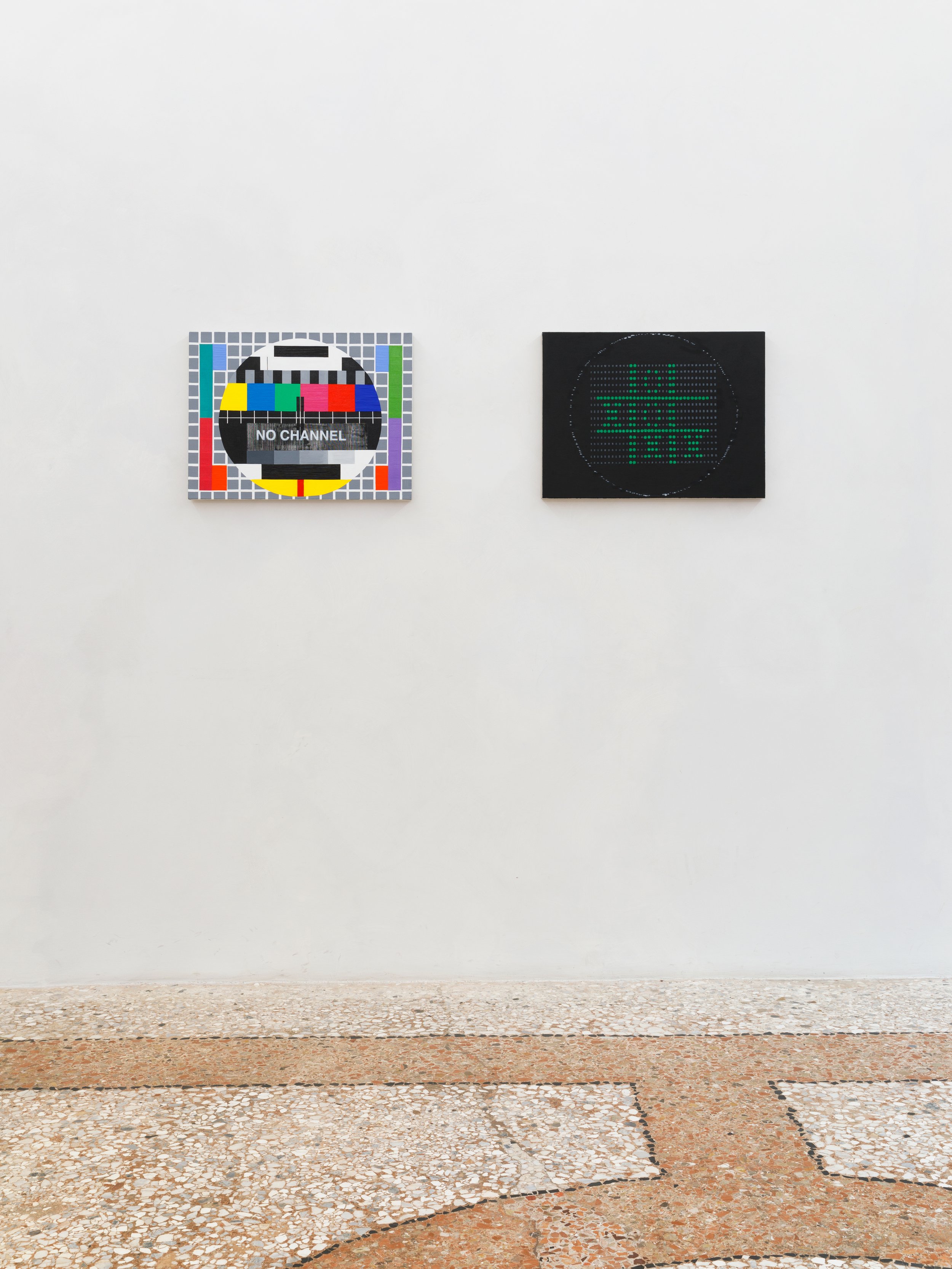
Turrell has described his work as an attempt to make the viewer see themselves seeing, to create a perceptual situation in which the act of vision becomes the content of vision. "We eat light, we drink it through our skins," he has said, and the Roden Crater is designed to intensify this ingestion, to present the viewer with light that has been stripped of everything except its luminosity, its capacity to enter the eye and trigger the neurological cascade that constitutes visual experience. Tan Mu's test pattern achieves a related effect through a completely different means. Where Turrell strips the visual field down to pure light, Tan Mu strips the television signal down to pure function, the geometric forms that exist not to communicate content but to calibrate the system that will, eventually, communicate content. The test pattern is the television's version of Turrell's empty chamber, a visual field that exists in the interval between transmissions, a surface that holds the place of the image that is not yet there, a threshold that the viewer crosses when the signal returns and the content begins.
The material specificity of the acrylic and masking tape technique deserves attention because it connects the painting to a history of geometric abstraction that runs from the hard edge painters of the 1960s through the process artists of the 1970s to the contemporary painters who use industrial materials and techniques to produce surfaces that are mechanically precise. The masking tape, applied to the linen surface before the paint, creates a resist that prevents the pigment from reaching the protected areas, producing, when the tape is removed, edges that are perfectly straight, the boundary between two color fields as clean as the boundary between two frequency bands on a calibration chart. This technique is the material equivalent of the test pattern's function. The test pattern exists to calibrate the television's display, to ensure that the boundaries between colors are sharp, that the frequency bands are evenly spaced, that the signal arrives at the viewer's screen without distortion. Tan Mu's painting uses the same precision, the same mechanical straightness, the same uniform color fields, to reproduce the visual language of the calibration process, translating a functional tool into a work of art that preserves, in its material structure, the logic of the system it depicts.
Danni Shen, writing in Emergent Magazine in 2024, observed that Tan Mu's paintings "serve as a kind of witness to human socio technological histories." The observation applies to NO CHANNEL with particular precision. The test pattern is a witness to a specific technological moment, the analog era of broadcast television, when signals were transmitted through the air as electromagnetic waves, received by antennas, and displayed on cathode ray tubes that required manual calibration by technicians who read the test pattern's geometric forms and adjusted the television's circuits until the image was sharp and the colors were correct. This moment has passed. Digital broadcasting, cable, satellite, and streaming have replaced the analog signal, and the test pattern has been replaced by automated calibration systems that perform the same function without displaying a visual chart. The painting witnesses this passing, not with nostalgia, not with the sentimental longing for a lost technology, but with attention, the sustained, specific attention that the painter brings to the geometric forms and color blocks of a system that no longer exists, the recognition that the test pattern, like the PDP 10, like the submarine cable, like the CRT television, was a material artifact of a specific moment in the history of human communication, a moment that has been superseded but that is not gone, because the painting preserves it, in acrylic and masking tape on linen, at a scale that invites the viewer to look closely and to remember, or to learn for the first time, what the screen looked like when there was no channel.
Shen further noted that Tan Mu's work reflects "the trajectory and continuum of bodily and mediated presence through human technical developments." In the context of NO CHANNEL, this trajectory runs from the manual calibration of the analog television, the hand on the knob, the eye on the screen, to the automated calibration of the digital display, the algorithm that adjusts without human intervention, the system that calibrates itself in the dark. The painting preserves the endpoint of the manual era, the last moment in which a human being was required to read a test pattern and adjust a signal, the last moment in which the screen displayed a visual form that existed for the purpose of calibration rather than communication. After this moment, the screen became, for the first time in its history, a surface that displayed only content, a window that was never blank, a surface that was always full of images that someone had chosen to transmit and that someone else had chosen to watch. The test pattern was the last placeholder, the final image that held the place of no image, the geometric form that existed in the interval between the end of one broadcast and the beginning of another. The painting holds this interval open, keeps the screen blank, keeps the geometric forms visible, keeps the viewer in the space of waiting, the space where the screen belongs to no one and the signal has not yet arrived.