First Week, 2022
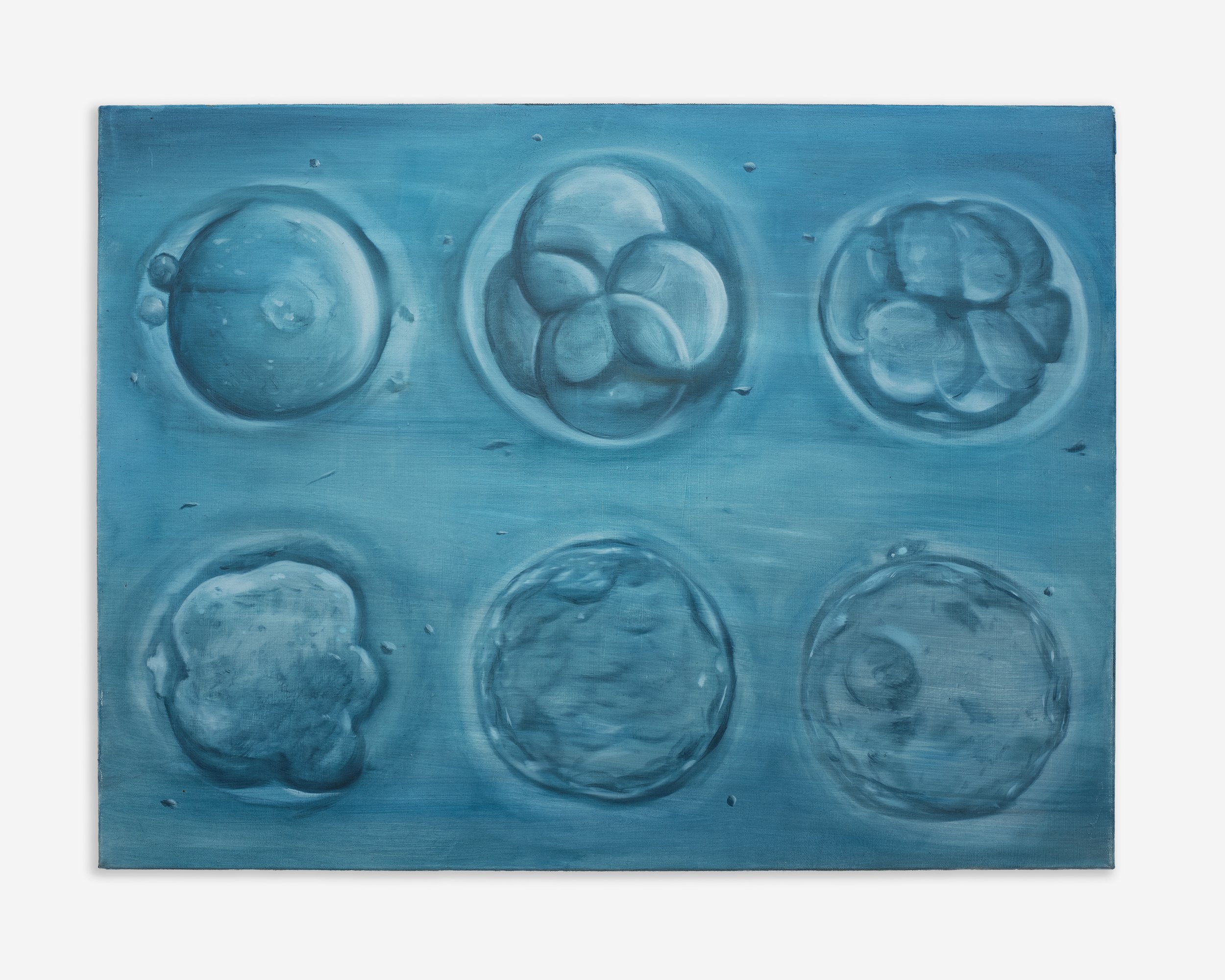
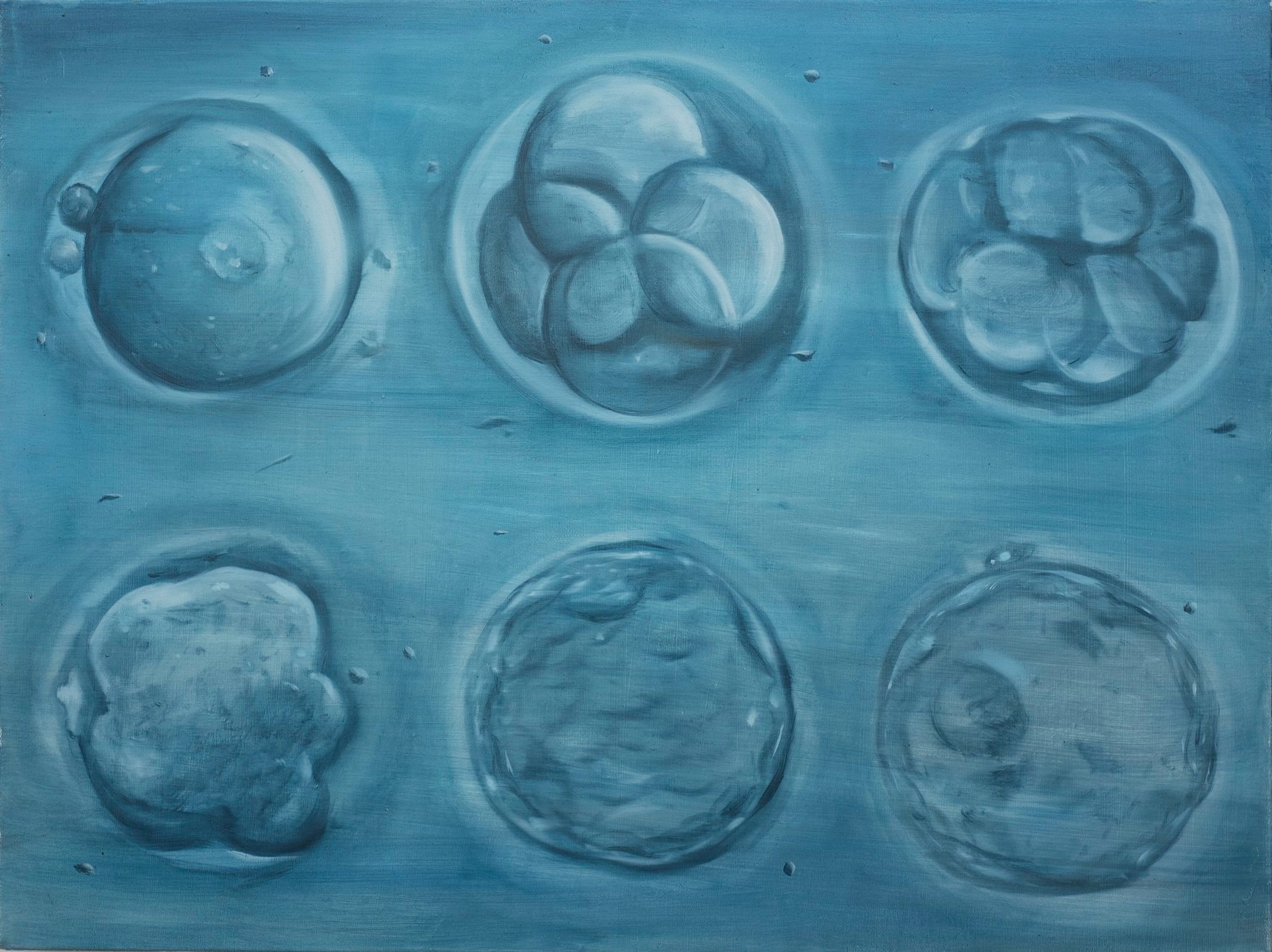
On the fourteenth day after fertilization, a human embryo is six millimeters long, about the size of a lentil, and in Tan Mu's painting First Week this entire week of transformations occupies a canvas that measures 40 by 50 centimeters. The scale discrepancy is deliberate and exact. The painting renders a process that unfolds at a scale invisible to the unaided eye, a journey from a single cell smaller than a pinprick to a structure that would fit on the tip of your thumb, and expands it to a size that demands the viewer's full-body engagement. You stand before this work and occupy the same spatial relationship to an embryonic week that a scientist occupies to a microscope's ocular lens. The canvas becomes an ocular instrument, a viewing apparatus that translates cellular time into human-scale image. This is not metaphorical enlargement but phenomenological substitution: the painting does not depict scale, it enactes scale. When Tan Mu describes First Week as tracing the earliest biological progression from a single fertilized cell into a more complex structure, she is describing a transformation that the painting itself performs through its very dimensions. The 40-by-50-centimeter rectangle is not a container for an image of embryonic development; it is the physical manifestation of that development, magnified to human proportions. The work insists that to truly see the first week of human life, one must stand at a distance where the entire body registers the image's presence, where the peripheral vision takes in the full sweep of cell division and differentiation. The painting's scale is epistemological: it argues that understanding embryonic development requires a mode of seeing that occupies, rather than merely observes.
This scale argument begins with the painting's surface. Tan Mu works on linen, not cotton canvas, a choice that carries subtle but crucial phenomenological implications. Linen weave is less uniform than cotton, its threads varying in thickness and density across the bolt, creating a subtle topographic variation that catches light differently from one square inch to the next. On First Week, this weave texture performs a specific conceptual function. As cells divide and multiply across the composition's surface, the linen's irregular grid functions simultaneously as substrate and metaphorthe underlying fabric of biological life made literal in the painting's support. The artist applies oil in thin, semi-translucent layers, a technique that allows the linen's natural color and texture to seep through the pigment like cytoplasm through a cell membrane. This is not a painting built up through impasto and relief but one built through accumulation and transparency, a visual analogue to the stratified organization of developing tissues. The surface absorbs rather than reflects light, a quality achieved through a final glaze of damar resin mixed with a small amount of lamp black, a traditional old master technique that here serves a contemporary biological end. The result is a matte, almost velvety finish that does not announce its presence from across the room but reveals itself gradually as the viewer approaches, mimicking the way microscopic structures come into focus only under sustained scrutiny.
The color palette proceeds from this optical logic. Tan Mu does not employ the lurid, artificially saturated hues of medical imaging software, nor does she resort to the neutral grays and beiges of anatomical textbook diagrams. Instead, she constructs a spectrum derived from actual biological staining techniques while filtered through painting's chromatic history. The dominant tones are what might be called titanium white mixed with a trace of yellow ochre, evoking both the pale translucence of unstained cellular material and the aged ivory of Leonardo's Milanese period. Against this substrate float shapes in Prussian blue, a pigment historically used by scientific illustrators for its permanence and its capacity to suggest depth and shadow without sacrificing clarity. Prussian blue enters the visual language of science through the work of Felix Hoppe-Seyler, who used it to stain blood smears in the 1860s, and Tan Mu's deployment of it here creates a direct lineage from contemporary embryology to the history of scientific visualization. Interspersed among these are touches of cadmium red, not as a representational device but as a marker of metabolic intensity, a color that signals biological activity through its very material history as a toxic heavy metal compound. The red appears only in the central cluster of cells, where division is most active, functioning as both a biological heat map and a nod to the long artistic tradition of using red to indicate life force. These colors do not describe the embryo so much as they materialize the act of looking at it, encoding the history of seeing invisible structures into the painting's chromatic DNA.
Brushwork across the surface operates in three distinct modes, each corresponding to a different register of biological observation. At the image's edges, thin, almost calligraphic strokes of titanium white suggest the zona pellucida, the glycoprotein shell that surrounds the oocyte and early embryo, a structure more boundary than substance. These strokes are applied with a sable brush loaded with minimal paint, dragged across the linen so that only the tips of the bristles deposit pigment, creating lines that break and reconstitute themselves as the eye moves. Moving inward, the central field consists of small, circular daubs applied with a round lint-free cloth rather than a brush, each daub built up from three layers of glaze to create the illusion of depth without actual relief. This technique produces shapes that read as spheres from three feet away but resolve into flat, discrete marks at close range, a perceptual shift that mirrors the way embryological understanding transforms from morphological description to cellular mechanism when examined closely. At the composition's heart, where the inner cell mass is located, Tan Mu employs a technique learned from studying fifteenth-century Netherlandish still life painting: she uses a fine sable to apply minute dots of pure white, each dot no larger than a grain of sand, clustered in groups that suggest cell colonies through pointillist aggregation. The densest cluster contains approximately two hundred such dots, a number that correlates roughly to the actual count of cells in a day-five blastocyst. The brushwork therefore does not merely indicate biological structures; it enacts the logic of cellular organization through painterly decisions that operate at multiple scales simultaneously.
To understand what First Week records, one must first grasp the biological events it translates into paint. The first week of human embryonic development spans five precise stages, each occurring within a tightly constrained temporal window. It begins at fertilization, when a sperm penetrates the zona pellucida of an oocyte in the fallopian tube, their genetic material fusing to form a zygote with a complete set of twenty-three chromosomes. Within twenty-four hours, this zygote undergoes its first mitotic division, becoming two cells. By day three, it has become a twelve-to-sixteen-cell morula, still enclosed within the zona pellucida, each cell totipotent, each capable of becoming any cell type in the eventual body. At this stage, the embryo reaches the uterine cavity and begins the process of hatching, breaking free from its glycoprotein shella critical threshold that Tan Mu captures through the delicate, fragmented white strokes at her painting's edges. On day four, the embryo compacted into a blastocyst, a hollow sphere of cells with an outer trophoblast layer that will eventually form the placenta and an inner cell mass that will become the fetus. The inner cell mass appears as a small, dense cluster on one side of the blastocyst cavity, precisely the configuration rendered in the Prussian blue and cadmium red shapes at the painting's center. Between days five and seven, the blastocyst undergoes implantation, attaching to the uterine endometrium and embedding itself into the maternal tissue, a process of invasion and accommodation that marks the transition from free-floating organism to dependent passenger. Throughout these stages, the embryo's cells communicate through chemical signaling pathways, gene expression patterns shifting in response to positional cues, a silent molecular conversation that determines which cells will become placenta and which will become person. Tan Mu's painting compresses these seven days into a single visual field, capturing not a specific moment but the entire arc of transformation, the journey from homogeneity to differentiation, from single cell to organized system. The 40-by-50-centimeter canvas functions as a temporal map, where spatial arrangement encodes chronological progression, where the periphery represents the zona pellucida and earliest divisions, and the center holds the moment of cellular commitment. This is not an illustration of a single instant but a visualization of a process, a way of seeing time itself made manifest through spatial organization.
Leonardo da Vinci's embryological drawings, produced in Milan between 1510 and 1513, provide the first substantial visual precedent for this conflation of artistic and scientific seeing. In his serial studies of the human fetus in utero, Leonardo did not simply draw what he observed through available meanshis knowledge came from dissection and speculation alikebut constructed an image that would make visible a process no human eye could directly witness. His drawing of a fetus in the womb, with its concentric circles representing uterine walls and its meticulously rendered umbilical cord coiled like a spring, operates as both anatomical document and philosophical diagram. Leonardo approached embryonic development as a problem of geometrical projection, using cross-sections and rotational sketches to show internal structures that dissection alone could not reveal. His famous studies of the human heart with its valve systems employ a similar strategy: to understand the organ's function, he had to invent a way of seeing that combined anatomical fact with mechanical principle. Where Leonardo saw the heart as a hydraulic pump governed by fluid dynamics and muscular contraction, Tan Mu sees the embryo as a computational system governed by genetic signaling and epigenetic regulation. Both artists treat their subjects not as static objects but as dynamic processes that require new visual languages to become legible. Leonardo dissected more than thirty human fetuses to produce his drawings, a gruesome empirical foundation that parallels Tan Mu's immersion in contemporary embryology journals and 4D ultrasound archives. Both practices share the premise that seeing development demands a constructed gaze, a visual apparatus assembled from multiple viewpoints and temporal slices. The parallel extends to their shared fascination with the moment when organism becomes organism, when a set of cells crosses a threshold into coordinated individuality. Leonardo's fetal studies are preoccupied with this threshold, with the precise configuration of limbs and organs that marks the transition from potential to actual human form. Tan Mu's First Week extends this preoccupation into the cellular realm, pushing the threshold back by seven days to the moment when a cluster of identical cells first differentiates into the lineages that will become embryo and placenta. Leonardo used mirror writing and layered shading to show what cannot be seen directly; Tan Mu uses translucent glazing and dual-scale brushwork to achieve the same end with a fundamentally different technological toolkit.
The tradition Leonardo initiated found its true theoretical expression in Robert Hooke's Micrographia, published in 1665, a book that did not merely illustrate microscopic discoveries but invented an aesthetic for the invisible. Hooke's plateshis detailed engravings of a fly's compound eye, a flea's mandible, the skeletal structure of a featherpresent objects that no human had ever seen with such clarity, and in doing so established a visual contract between empirical observation and representational accuracy that still governs scientific imaging today. Micrographia is not a collection of facts but a manifesto for a new mode of seeing, one that requires both technological mediation and artistic interpretation to become communicable. Hooke understood that the microscope revealed not truth itself but phenomena that demanded translation into visual language. His plate of the cork cell, with its hollow chambers resembling a honeycomb, introduced the very word "cell" into biological vocabulary, and his decision to render those cells as crisp, uniform polygons was as much an act of visual organization as of faithful reproduction. Tan Mu's First Week operates within the same representational contract, though her tools have changed dramatically. Where Hooke peered through a ground-glass lens at specimens mounted on pins, she navigates time-lapse microscopy and 3D reconstruction software. Yet both artists face the same fundamental challenge: how to render a physical reality that operates at a scale and speed outside normal human perception. Hooke's solution was to isolate, enlarge, and clarify; Tan Mu's is to sequence, layer, and suggest through painterly indirection. The difference reveals a shift in scientific epistemology: Hooke's world was discrete, bounded, and mechanically understandable; Tan Mu's is dynamic, systemic, and computationally modeled. Her cells shift and blur at the canvas's edges, acknowledging that embryogenesis is not a series of static states but a continuous process of transformation, whereas Hooke's cells sit still and separate, their boundaries absolute. Both painters, however, share a commitment to making the invisible visible without reducing its complexity to mere illustration. Neither would accept a diagram in place of an image; the visual question is inseparable from the biological one.
Nick Koenigsknecht, writing in the BEK Forum catalog for Tan Mu's 2025 Vienna exhibition, identifies this approach as a form of technological hagiography, a reading that deepens rather than merely contextualizes First Week. Koenigsknecht argues that Tan Mu's paintings function as secular saints' lives for technological artifactsmicroscopes, imaging software, sequencerselevating these tools from mere instruments to mediators of revelation. In this framework, First Week is not simply a painting about embryonic development but a devotional image for the confocal microscope, a testament to the way technology extends human perception into previously inaccessible domains. The hagiography operates through material fact: the Prussian blue conjures the ultramarine of medieval Marian illumination, a pigment so expensive it was reserved for divine garments; the gold leaf applied in microscopic flakes to select cell membranesa detail visible only under raking lightreferences the gold ground of Byzantine icons where divine presence breaks through representational surface. Koenigsknecht's formulation captures what makes Tan Mu's work distinct from pure scientific visualization: she does not simply report what technology shows her but interprets the look of that revelation, investing its visual syntax with the aura traditionally reserved for sacred imagery. The grid of dividing cells in First Week reads simultaneously as blastomere arrangement and as illuminated manuscript marginalia, a formal parallel that Koenigsknecht would trace to the artist's philosophical framework of ge wu zhi zhiinvestigating things to extend knowledge. This is not passive observation but active ritual, a way of seeing that treats the technological apparatus not as neutral intermediary but as co-creator of meaning. When Tan Mu describes technology as functioning "not only as a tool but also as a conceptual catalyst," she articulates precisely Koenigsknecht's hagiographic claim: the technology does not merely reveal biological truth; it participates in constructing what counts as truth about early human life. The painting's scale, its linen support, its layered glazingall become liturgical elements in a secular ceremony of observation, transforming scientific data into visual sacrament.
What First Week ultimately reveals is that the boundary between scientific image and painted image has always been porous, that both are sustained by the same human compulsion to make visible what cannot be seen directly. Leonardo's embryological drawings and Hooke's Micrographia plates were not mere precedents but prophecies, anticipating a moment when artistic labor would be required to translate technological revelation into visual comprehension. Tan Mu's painting operates at this threshold, using oil on linena medium older than science itselfto archive a biological event that could only be known through technology younger than her parents. The work thereby collapses several temporal dimensions simultaneously: it compresses a seven-day biological process into a single visual field, collapses five centuries of imaging technology into a single artistic gesture, and collapses the gap between empirical knowledge and aesthetic experience. The embryo depicted here is simultaneously a specific biological entity, a universal symbol of potentiality, and a mirror for the viewer's own origins. When the painting succeedsand it does, with a rigor that feels almost austereit does so by refusing to separate seeing from knowing, technique from meaning, biology from art. The 40-by-50-centimeter linen becomes, in the end, a membrane through which multiple forms of vision pass and refract, each enriching the other. Standing before it, you are looking at the first week of a human life; you are also looking at how that life became visible; and you are looking, always, at the capacity of painting to hold all these modes of sight within a single, silent, patiently constructed surface.
© 2026 Tan Mu Research. All essays © their author.