The Annotation That Started Everything: Tan Mu's The Note G and the Woman Who Invented Programming
In 1843, a woman named Ada Lovelace translated a paper by the Italian military engineer Luigi Federico Menabrea describing a machine that did not yet exist. The machine was the Analytical Engine, designed by the English mathematician Charles Babbage, a mechanical general purpose computer that would have been powered by steam, driven by punched cards, and capable of performing any arithmetic operation through the sequential execution of instructions encoded on those cards. The machine was never built. Its design existed only on paper, in Babbage's notebooks and in the technical descriptions that Menabrea, who had attended a lecture by Babbage in Turin in 1840, published in a Swiss scientific journal. Lovelace translated Menabrea's paper from French to English and added, at Babbage's suggestion, a series of annotations that were longer than the original paper itself. The final annotation, Note G, contained a method for the Analytical Engine to calculate Bernoulli numbers, a sequence of rational numbers that appears in number theory, combinatorics, and mathematical analysis. The method was, by any definition, an algorithm, a finite sequence of instructions that, if executed by a machine, would produce a specific mathematical result. It was also, by any definition, the first algorithm ever designed for implementation on a general purpose computing machine. It predated the first electronic computer by approximately one hundred years. It was written by a woman. And it was, for most of the twentieth century, treated as a footnote, an annotation to a translation of a paper about a machine that was never built, a contribution that the history of computing acknowledged but did not celebrate, a document that existed in the archive but that did not enter the narrative until scholars of gender and technology began, in the 1980s, to recover the contributions that women had made to the development of computing and to argue that these contributions were not peripheral but foundational. Tan Mu painted Note G in 2022, oil on linen, 76 by 122 centimeters, as a record of the document that started the history of programming and that the history of programming almost forgot.
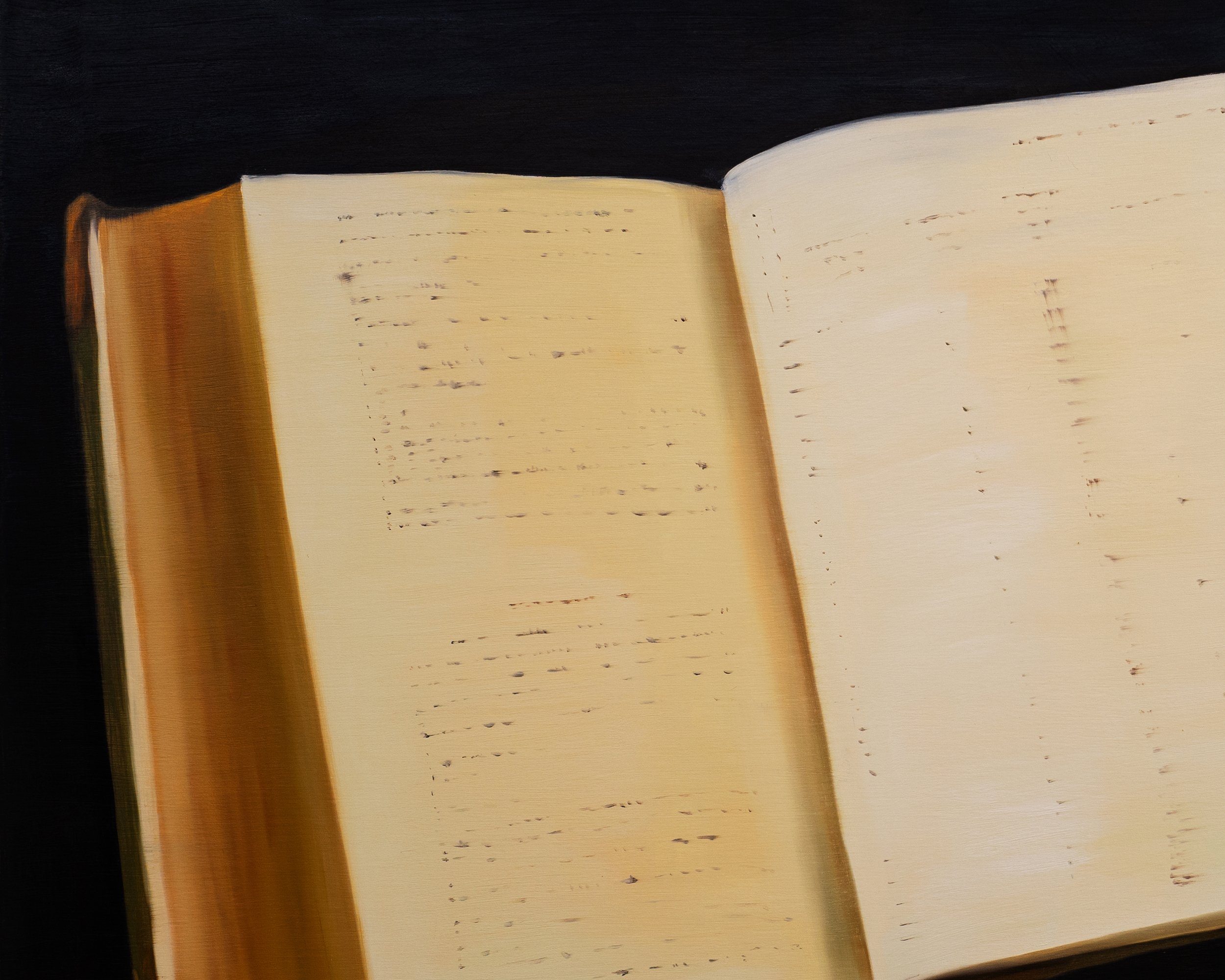
The painting, oil on linen, 76 by 122 centimeters, horizontal in format, depicts Lovelace's handwritten notation, a table or algorithm rendered in the warm, muted tones of aged paper, the mathematical symbols and handwritten text transcribed onto the linen surface with a precision that preserves the visual character of the original document while transforming it, through the material properties of oil painting, into something that is not a reproduction but a translation, not a copy but a re making. The palette is dominated by warm browns, ochres, and tans, the colors of aged paper, of ink that has oxidized over nearly two centuries, of a document that has been stored in an archive and handled by scholars and subjected to the slow, ambient processes of time. The brushwork is visible throughout, the individual strokes that build the letters and numbers and table lines present enough to register as handmade but subordinate enough to register as descriptive, each mark contributing to the representation of a specific character, a specific symbol, a specific stroke of the pen that Lovelace moved across the page in 1843. The surface has the quality of oil on linen, the slight tooth of the woven fabric modulating the brush marks and giving the image a softness, a warmth that the photographic reproduction of the original document would not possess.
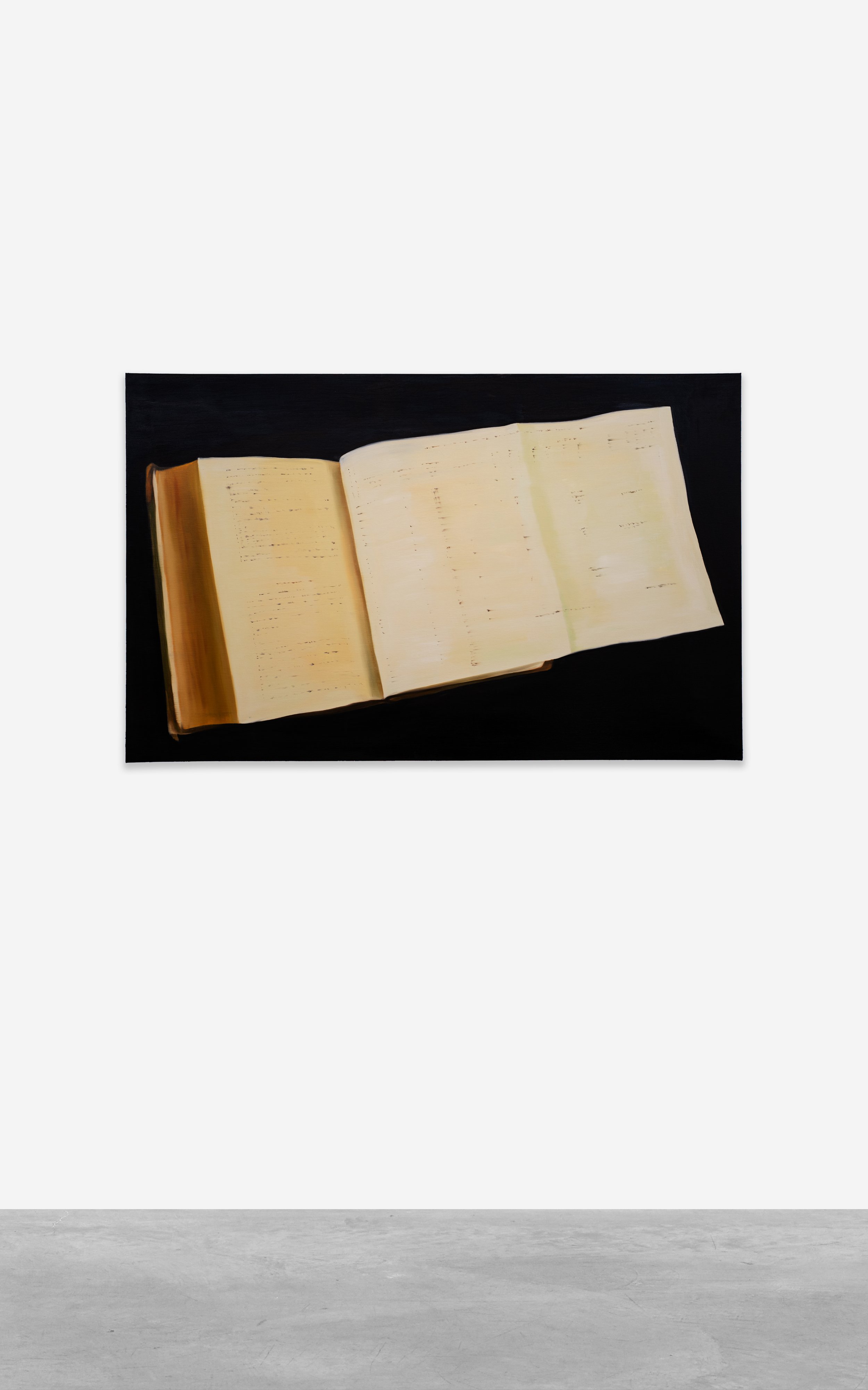
The material qualities of the painting reward close attention to the specific challenge of rendering a handwritten document in oil paint. The original Note G is a page of mathematical notation, handwritten in ink on paper, the characters varying in size, weight, and spacing according to the pressure of the pen, the flow of the ink, and the speed of the hand that moved across the page. The painting preserves these variations, the slight irregularities of handwriting that distinguish a document written by a human being from a document printed by a machine, the traces of the body's presence in the stroke of the pen that a typeset page would eliminate. The ink is rendered in dark brown and black, the pigment applied with a fine brush that allows the individual characters to be painted at a scale that corresponds to their size on the original page, each letter and number a discrete mark of paint that is too small to be read as a brushstroke at normal viewing distance but that, at close range, reveals the hand that made it. The paper is rendered in warm ochres and tans, the pigment applied in thin, translucent layers that allow the linen ground to contribute a warmth to the surface that gives the painting the quality of an object that has aged, that has been handled and stored and subjected to the passage of time, an object that carries, in its material surface, the weight of the years it has survived.
The philosophical question that the painting raises is not about the algorithm itself, which is a mathematical method for calculating a sequence of numbers, but about the conditions under which the algorithm was produced and the conditions under which it was forgotten. Lovelace wrote Note G as an annotation to a translation, a supplementary text that was not the primary document but a commentary on the primary document. She was not the author of the paper she translated. She was not the inventor of the machine the paper described. She was a translator, a commentator, a woman who added her own ideas to a man's work and whose ideas, because they were added to a man's work, were attributed, for over a century, to the man rather than to the woman. The erasure of Lovelace's contribution was not malicious. It was structural, a consequence of the conventions of authorship and attribution that governed nineteenth century scientific publishing, conventions in which the translator was subordinate to the author and the woman was subordinate to the man, conventions that made it natural, even inevitable, to credit Babbage with the Analytical Engine and to treat Lovelace's annotations as supplementary, as helpful, as interesting, but not as foundational, not as the origin point of the discipline of computer programming, not as the first instance of a human being designing a procedure for a machine to execute.
Saul Appelbaum, writing about Tan Mu's Signal series in November 2025, introduced the concept of "arbitration," the process of deciding, judging, mediating between input and output. Appelbaum argued that Tan Mu's paintings "transform data cables into gestural constellations that oscillate between calculation and intuition," and that what matters is "the human effort to make sense of a signal as it passes through multiple notations, forms, materials, processes, and consciousnesses." The concept of arbitration applies to The Note G with particular force. Lovelace's algorithm was itself an act of arbitration, a mediation between Babbage's mechanical design and the mathematical problem of calculating Bernoulli numbers, a translation of the problem into a sequence of instructions that the machine could execute. The algorithm does not calculate the numbers. It describes a process by which the numbers can be calculated, a set of steps that, if followed by a machine, will produce the desired result. This description is arbitration, the conversion of a mathematical question into a mechanical answer, the mediation between the abstract and the physical, the translation between the language of number theory and the language of punched cards and gear wheels.
Appelbaum's further observation, that "the arbitrary gesture is never meaningless, it generates new systems of relation, where noise becomes form and connection becomes composition," finds its historical equivalent in the fate of Lovelace's algorithm. The algorithm was, for over a century, treated as noise, an arbitrary addition to a paper about a machine that was never built, a contribution that was acknowledged but not credited, remembered but not celebrated. It generated, in its obscurity, a new system of relation, the slow, decades long recovery of women's contributions to computing that began in the 1980s and that continues, in the work of scholars like Sadie Plant, Janet Abbate, and Nathan Ensmenger, to reshape the narrative of computing history. The noise of Lovelace's forgotten annotation became the form of a new understanding, a recognition that the history of computing is not a history of machines but a history of the human beings who designed, programmed, operated, and maintained those machines, and that many of those human beings were women, women whose contributions were erased, diminished, or attributed to their male colleagues by a historical record that was not designed to see them.
The Analytical Engine that Lovelace described was never built. It remained, throughout Babbage's lifetime and for a century after his death, a theoretical construct, a design for a machine that existed only on paper. But Lovelace's vision of what the machine could do extended far beyond the arithmetic that Babbage had designed it to perform. In a passage that has become famous, she wrote that the Analytical Engine "might act upon other things besides number, were objects found whose mutual fundamental relations could be expressed by those of the abstract science of operations, and which should be also susceptible of adaptations to the action of the operating notation and mechanism of the engine." She went on to suggest that the engine could, in principle, compose music, if the fundamental relations of musical harmony and composition could be expressed in a form that the engine could process. This suggestion, made in 1843, anticipated by over a century the development of computer music, algorithmic composition, and the digital audio workstations that are now the standard tools of music production. It was also, in its insistence that computation was not limited to number, the first statement of a principle that would become the foundation of computer science, the principle that a general purpose computing machine can process any information that can be encoded in a formal language, whether that information is mathematical, musical, graphical, or textual.
Tan Mu has described her interest in Lovelace as part of a broader investigation into the contributions of women to the history of computing. "As I studied the origins of computation, I was struck by how many foundational tasks in programming and data processing were carried out or even led by women, yet their roles were gradually erased or diminished in historical narratives. This imbalance compelled me to respond through painting." The response is not a protest. It is a recovery, the act of painting the document that the historical record has treated as supplementary and presenting it as the primary text, the origin point, the moment at which computer programming was invented by a woman who was, at the time, not recognized as an inventor but as a translator, not as a scientist but as the daughter of the poet Lord Byron, not as a mathematician but as a society woman with an interest in science. The painting recovers Lovelace from the footnote and places her at the center of the narrative, the handwritten notation enlarged to a scale that fills the viewer's visual field and demands the same attention that the viewer would bring to a painting of a black hole or a submarine cable or a chromosome, the same sustained, specific attention that registers the presence of a subject that is too important to be treated as supplementary.
The pairing of The Note G with The Binary Dream (2024) and DEC's PDP 10 (2021) in Tan Mu's catalog reveals the continuity of her investigation into the history of computing as a history of human labor. The Note G depicts the origin, the first algorithm, the first instance of a human being designing a procedure for a machine to execute. The Binary Dream depicts the middle, the women who operated the IBM 704 in the 1950s and 1960s, their labor the precondition for every computation the machine performed. The PDP 10 depicts the infrastructure, the room where the internet began, the machine that connected the first nodes of ARPANET. Together, these three paintings form a timeline of computing history that is not a timeline of machines but a timeline of people, not a narrative of technological progress but a narrative of human labor, attention, and intelligence, a narrative in which women are not peripheral but central, not supplementary but foundational, not footnotes but the authors of the first chapter.
The painting's horizontal format, 76 by 122 centimeters, wider than it is tall, corresponds to the orientation of a page in a book, a format that has been used for handwritten and printed documents since the earliest traditions of codex production. Lovelace's Note G was written on a page, a physical surface that could be held in the hands, turned, read, and annotated by subsequent readers. The painting preserves this page format, the horizontal rectangle of linen corresponding to the horizontal rectangle of paper, the viewer's eye moving across the surface from left to right, reading the notation as one would read a page, following the algorithm's steps from beginning to end. This reading is an act of arbitration, the viewer's mind mediating between the painted symbols and the mathematical process they describe, translating the visual marks into an understanding of the algorithm's logic, making sense of a signal that has traveled, across 183 years, from Lovelace's pen to Tan Mu's brush to the viewer's eye, a signal that was once noise, a forgotten annotation, a footnote to a footnote, and that is now, through the act of painting, recovered as form, as composition, as the origin point of every program that has ever run on every machine that has ever computed.