The Rule That Generates the World: Tan Mu's Fractal and the Mathematics Before the Painting
The Mandelbrot set is generated by a single rule. Take a complex number, square it, add the original number, square the result, add the original number again, and repeat, indefinitely, for every point on the complex plane. If the sequence remains bounded, the point belongs to the set. If the sequence escapes to infinity, the point does not belong. The rule is simple enough to state in one sentence. The structure it generates is, by any measure of complexity, infinite. Zoom into the boundary of the Mandelbrot set and the pattern repeats, smaller copies of the whole set appearing at every level of magnification, each copy surrounded by spirals, filaments, and branching structures that are unique to that location and that are, at the same time, recognizably part of the same family, the same visual grammar, the same mathematical DNA. The Buddhabrot, a visualization technique developed by Melinda Green in 1993, maps the trajectories of points that escape the set, tracing the paths they follow as they are iterated through the rule, the paths accumulating into a density map that reveals, at certain magnifications, a figure that resembles a seated Buddha, the arms extended, the body centered, the head surrounded by a halo of light. This figure is not designed. It is generated. It emerges from the mathematics, from the repeated application of a single rule to billions of points, without intention, without aesthetics, without the intervention of a human mind that decided, in advance, what the result should look like. Tan Mu painted the Buddhabrot in 2019, oil and acrylic medium on linen, 72 by 60 inches, 182.9 by 152.4 centimeters, as the first work in a series that would, over the following years, develop into one of the most structurally persistent investigations in her practice, the investigation of branching, recursive, self similar systems that connect the Mandelbrot set to neural networks to submarine cables to the architecture of the cosmos.
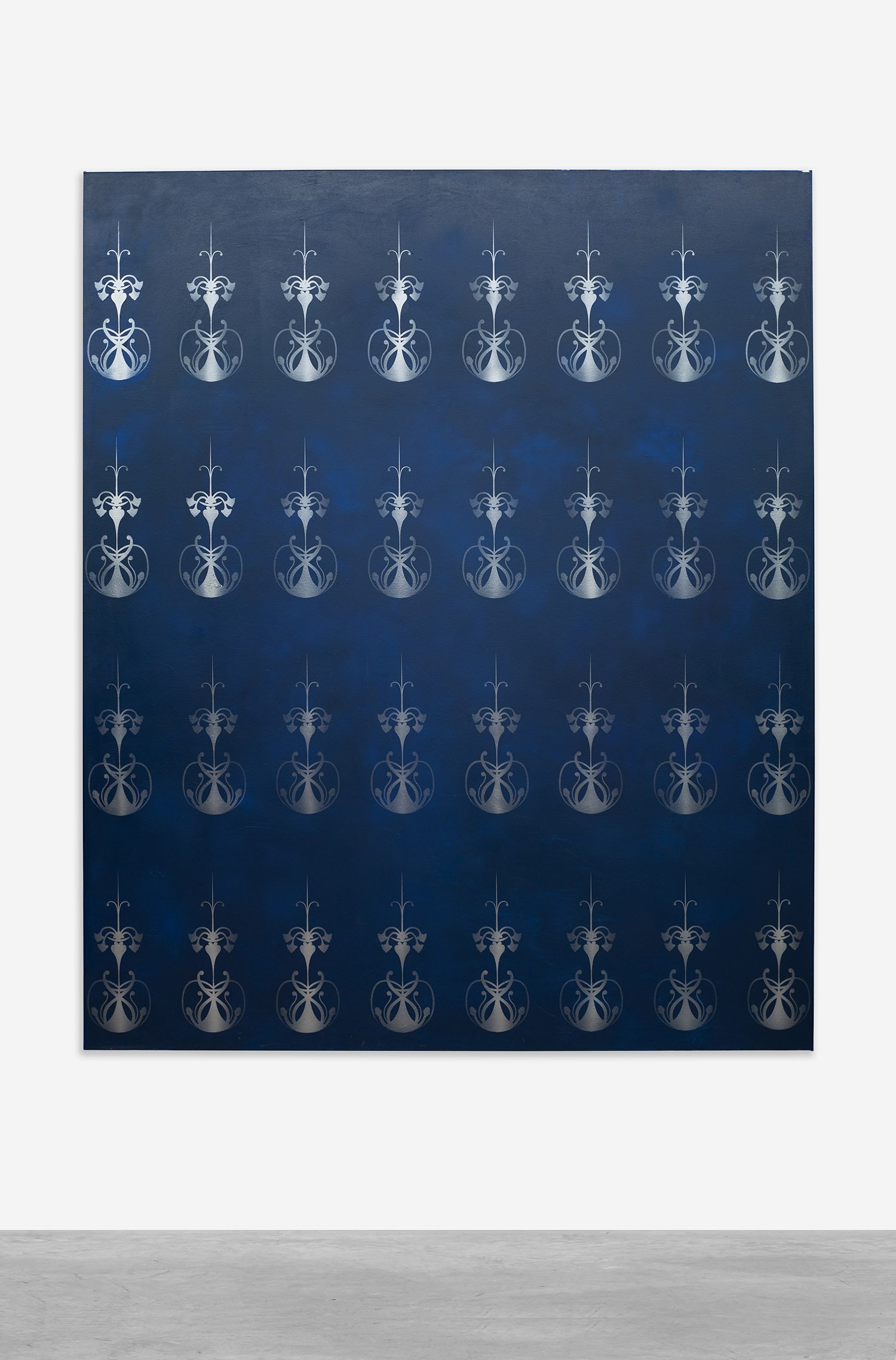
The painting, oil and acrylic medium on linen, 72 by 60 inches, 182.9 by 152.4 centimeters, vertical in format, depicts the Buddhabrot as a field of branching, radiating forms that emanate from a dark central mass and extend outward into a lighter ground, the branches thinning and multiplying as they move from the center to the periphery, each branch splitting into smaller branches that split into still smaller branches, the pattern repeating at every scale of observation. The palette is dominated by muted earth tones, ochres, burnt umber, and blacks, with lighter passages of cream and pale yellow at the tips of the outermost branches where the paint thins and the linen ground contributes its warmth to the surface. The central mass is dark, a dense accumulation of overlapping strokes that create a depth of shadow in which individual marks are barely distinguishable, the branches compressed into a field of near uniform darkness that contrasts with the luminous periphery. The branching forms are rendered with a precision that is not scientific but intuitive, each stroke following the curvature of the branch it contributes to, the brush moving in arcs and spirals that mimic the trajectories of the escaping points, the paths that the Mandelbrot iteration traces as it carries a point from the boundary of the set to infinity.
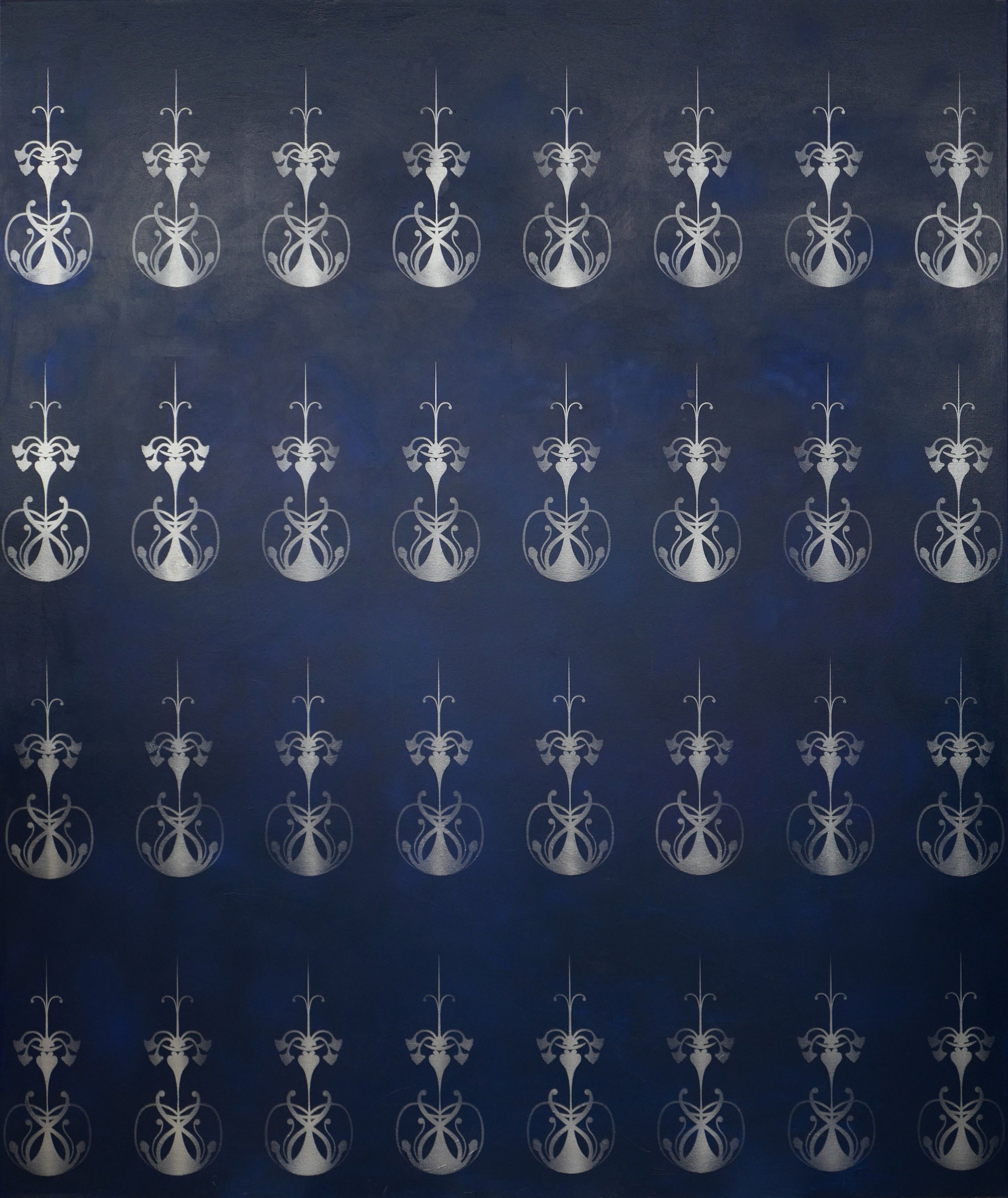
The material qualities of the painting reward close attention to the interplay between oil and acrylic, two media that Tan Mu combines on the same surface to produce effects that neither medium can achieve alone. The acrylic, which dries faster than oil, is used for the underlying layers, the broad fields of color and the initial blocking of the branching forms. The oil, which dries more slowly, is used for the upper layers, the refined details and the passages of greatest luminosity, where the pigment's transparency allows the underlying acrylic to contribute a depth to the surface that opaque coverage would not produce. The two media coexist on the canvas without fully merging, the acrylic visible as a ghost beneath the oil in the thinner passages, the oil sitting on top of the acrylic in the thicker passages, the material relationship between the two layers corresponding to the mathematical relationship between the Mandelbrot set and the Buddhabrot, the static structure and the dynamic trajectories, the bounded region and the escaping paths, two complementary views of the same mathematical object rendered in two complementary media on the same painted surface.
Caspar David Friedrich painted a man standing at the edge of the sea. Monk by the Sea (1808 1810) depicts a solitary figure, small and dark, positioned at the lower center of a vast, empty composition, the sea stretching to the horizon, the sky occupying the upper two thirds of the canvas, the entire painting dominated by horizontal bands of color that register the flatness and the immensity of the North Sea coast. The figure is not observing the landscape. He is being absorbed by it, his small body a point of darkness in a field of gray and blue that extends in every direction beyond the frame, the human presence reduced to a scale that makes the landscape feel not merely large but infinite, a space in which the human body is not merely small but insignificant, a point of consciousness in a field of matter that does not know the consciousness exists.
The connection between Friedrich's monk and Tan Mu's fractal is structural, not stylistic. Both are images of the human encounter with infinity, the confrontation of a finite consciousness with a structure that exceeds its capacity to comprehend. Friedrich's infinity is spatial, the flat, endless expanse of the North Sea, a landscape that has no features, no landmarks, no points of reference, a space that the eye can scan but that the mind cannot map because there is nothing to anchor the map to. Tan Mu's infinity is mathematical, the endlessly branching boundary of the Mandelbrot set, a structure that has no largest scale and no smallest scale, a pattern that repeats at every level of magnification, a space that the eye can enter but that the mind cannot exhaust because there is always more to see, always another level of detail, always another spiral or filament or branching path that was not visible at the previous magnification. In both cases, the viewer is confronted with a structure that is simultaneously finite and infinite, bounded in its physical extent but unbounded in its internal complexity, a system that contains more information than any observer can process.
Friedrich's painting was, at its first exhibition, considered unfinished, a canvas that had not been given enough attention, that was too empty, too flat, too devoid of the incident and the detail that contemporary viewers expected from a landscape painting. The critic and writer Heinrich von Kleist, seeing the painting in 1809, wrote that it produced in him a feeling of being "as though one's eyelids had been cut away." The phrase is precise. The painting does not allow the viewer to look away. It does not provide a focal point, a narrative, a figure that the viewer can follow through the landscape. It provides only the landscape itself, flat, infinite, and indifferent, and it asks the viewer to sit with this indifference, to feel, in the body, the experience of being a small consciousness in a vast space that does not know the consciousness exists. Tan Mu's fractal painting produces a related effect through a completely different means. Where Friedrich strips the landscape down to flat bands of color, Tan Mu fills the canvas with branching complexity, an infinitely detailed structure that the eye can enter at any point and follow in any direction. But both paintings share the same perceptual demand, the demand that the viewer stay, look, and feel the infinity that the painting presents, the infinity of the sea in Friedrich's case, the infinity of the mathematics in Tan Mu's.
The fractal geometry that the painting depicts is not merely a mathematical curiosity. It is the structural principle that governs branching systems at every scale of nature. The branching of trees, the bifurcation of river deltas, the forking of blood vessels, the division of bronchi in the lungs, the growth of neural networks, all of these systems share the same fundamental property: self similarity across scales, the repetition of a basic branching pattern at every level of magnification, from the trunk of a tree to the smallest twig, from the aorta to the capillary, from the cortical column to the individual synapse. This self similarity is the defining property of fractal geometry, the property that Benoit Mandelbrot identified in 1975 when he coined the term "fractal" to describe objects that exhibit the same structure at every scale of observation. The Mandelbrot set is the most famous example of this property in mathematics, but it is not the only example. Every branching system in nature is, to some degree, fractal, and every fractal system in nature shares the property that the Mandelbrot set exhibits: infinite complexity generated by a simple rule.
Tan Mu's subsequent paintings extend this fractal principle into a cross series investigation that constitutes one of the most persistent structural motifs in her practice. The Emergence painting (2022), the monumental canvas of neural architecture, depicts branching pathways that are structurally identical to the branching paths of the Buddhabrot, the same pattern of bifurcation and recursion, the same property of self similarity across scales. The Signal series depicts submarine cable networks that branch and bifurcate across the ocean floor, following the curves of coastlines and the arcs of tectonic plates, their routes determined by the same geological forces that shape river deltas and mountain ranges, systems that are fractal in their geometry. The Synapse painting (2023) zooms into the neural network to the level of the individual junction, the twenty nanometer gap where one neuron hands a signal to the next, a gap that is itself a fractal boundary, a point of infinite complexity at the smallest scale of the system. The Gaze series depicts the observable universe as a circular, radiating field, the cosmic iris that shares the fractal's outward expanding geometry, the concentric rings of the universe's structure echoing the concentric rings of the Mandelbrot set.
Danni Shen, writing in Emergent Magazine in 2024, observed that Tan Mu's paintings "serve as a kind of witness to human socio technological histories." In the context of the Fractal series, the witnessing extends to mathematical histories, the history of human encounters with structures that are too complex for the unaided eye to perceive and too fundamental for the unaided mind to ignore. The Mandelbrot set was first visualized in 1978 by Robert Brooks and J. Peter Matelski, and first rendered in detail by Mandelbrot himself in 1980, using an IBM computer to generate images that revealed the set's extraordinary complexity. The Buddhabrot was first visualized by Melinda Green in 1993, using a different computational method that revealed the set's hidden figure, the seated Buddha that emerges from the density of escaping trajectories. Tan Mu's painting of the Buddhabrot in 2019 is a further act of visualization, the conversion of a computational image into a hand made surface, the substitution of oil and acrylic for pixel and algorithm, the addition of time and body and attention to an image that was generated by a machine in milliseconds. The painting witnesses this act of generation, the moment when a simple rule, applied billions of times, produces a structure of infinite complexity, and it asks the viewer to hold this structure in the eye and the mind long enough to feel, in the body, the mathematical sublime, the experience of confronting a pattern that is too detailed to comprehend and too beautiful to look away from.
Shen's further observation, that Tan Mu's work reflects "the trajectory and continuum of bodily and mediated presence through human technical developments," positions the Fractal series within the same trajectory of mediation and translation that characterizes her entire practice. The Mandelbrot set is accessible only through computation, through the repeated application of the iteration rule to billions of points, a process that is too slow and too repetitive for any human being to perform by hand. The Buddhabrot is accessible only through the visualization of these trajectories, a process that requires the accumulation of billions of path samples into a density map, a process that is, again, computationally intensive and humanly impossible. The painting adds a third layer of mediation, the conversion of the computational visualization into a hand made surface, the substitution of the brush for the pixel, the addition of the painter's body to a process that was, until the moment of painting, purely mathematical. This third layer does not add information to the visualization. It adds time, the hours of the painter's life that went into the making of the surface, and it adds body, the weight of the hand, the resistance of the linen, the viscosity of the paint. The painting is the fractal plus the painter, the mathematics plus the body that looked at it and decided, for reasons that are personal and irreducible, to make it again, on a canvas that is 72 by 60 inches, in colors that are muted and warm and handmade, a surface that carries the trace of the hand that moved through it, stroke by stroke, following the branching paths that the Mandelbrot set generated and that the painter, in her studio, in the quiet, patient hours of oil on linen, re made as her own.