The Stamp That Hides What It Shows: Tan Mu's Privacy and the Tool That Became a Painting
There is a tool that exists in almost every office, every post room, every administrative desk in the world. It is a small roller, mounted on a handle, covered with a pattern of interlocking lines or zigzags or concentric circles that, when rolled across a page of text, obscures the words beneath it with a layer of ink that renders them illegible. The tool is called a privacy protection stamp, or a confidential roller, or a redaction stamp, and its purpose is to conceal information, to make visible the act of concealment, to cover a name or an address or a social security number with a pattern of ink that says, to anyone who looks at the page, that something has been hidden here, that there was once a word in this place and that the word has been removed, not by erasure, not by cutting, not by burning, but by the application of a pattern that is itself a form of writing, a visual code that means "this is private, this is protected, this is not for your eyes." The pattern does not delete the information. It covers it. The information is still there, beneath the ink, in the memory of the paper's fibers, in the indentation of the pen that wrote it, in the chemical trace of the ink that recorded it. The privacy stamp does not destroy the information. It conceals it, and in concealing it, it makes the concealment visible, the act of hiding as legible as the thing that was hidden. Tan Mu rolled this stamp across a sheet of linen in 2021, layering its pattern over a base of gold acrylic, building the surface in successive passes until the pattern accumulated into a dense, rhythmic field of interlocking marks that is simultaneously a record of concealment and a work of art, a tool that was designed to hide information and that now, on the linen surface, reveals the structure of hiding itself.
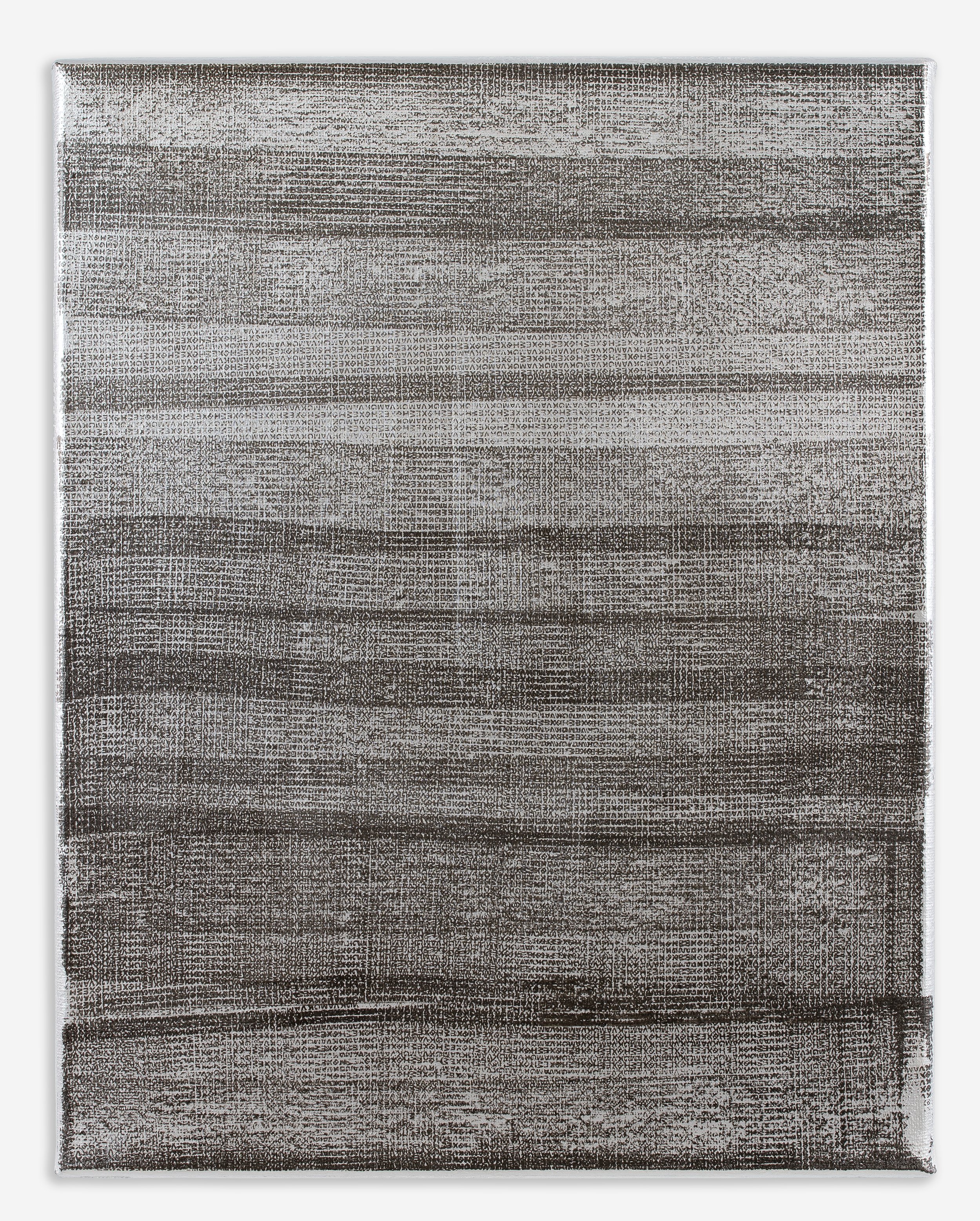
The painting, acrylic and ink on linen, 36 by 28 centimeters, small, intimate, the size of a notebook page or a document, a canvas that corresponds in scale to the page that the privacy stamp was designed to obscure. The surface is built in layers, a base of gold acrylic over which the privacy stamp has been rolled repeatedly, each pass depositing a layer of ink that partially covers the gold beneath it, the gold visible through the ink in the thinnest passages and fully concealed in the thickest, the interplay between gold and ink creating a surface that shifts between opacity and transparency depending on the viewer's distance. From a distance, the surface reads as an ornamental field, a pattern of interlocking lines that could be decorative, could be textile, could be the surface of a gilded manuscript. From close range, fragments of letters, numbers, and symbols emerge from beneath the stamped pattern, the remnants of text that was on the page before the stamp was applied, text that is partially visible through the gaps in the ink, text that the stamp was designed to conceal but that the painting, by applying the stamp to a surface that has no text, reveals as the ghost of an information that was never there.
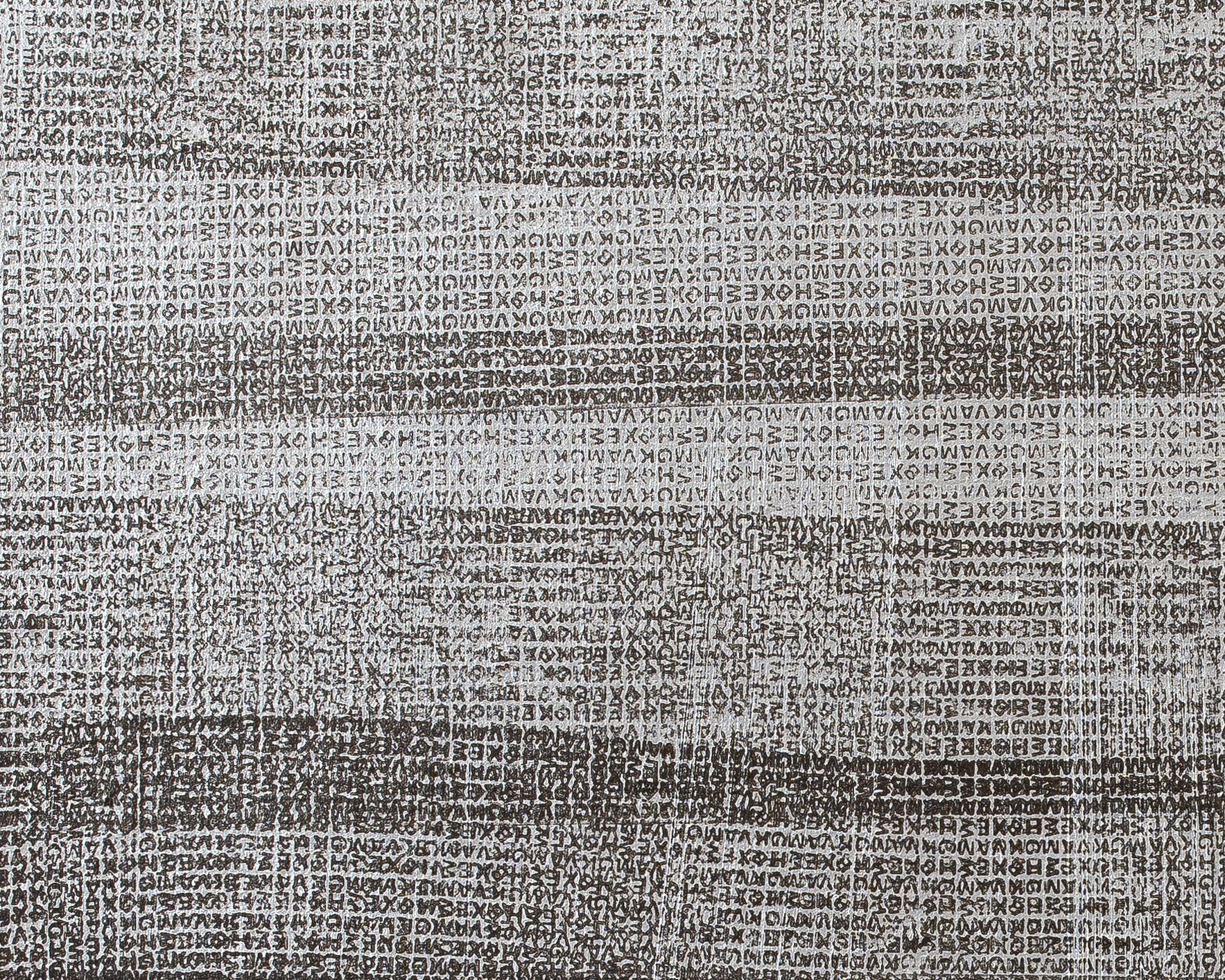
The material technique that produces the painting is the application of two fundamentally different media, acrylic and ink, on the same surface, in a sequence that creates a layered structure in which the earlier medium is partially visible through the later one. The acrylic, applied first, forms a smooth, metallic ground, the gold pigment giving the surface a warmth and a reflectivity that catches the light and gives the painting a quality of preciousness, the gold associated, in every culture that has used it, with value, with permanence, with the preservation of things that matter. The ink, applied second, by means of the privacy stamp, forms a patterned layer over the gold, the stamp's interlocking lines creating a texture that is dense and rhythmic, a visual noise that is simultaneously ordered and chaotic, the product of a mechanical tool that produces a predictable pattern when rolled in a straight line and an unpredictable pattern when rolled in curves or at angles. The interaction between the two layers, the gold and the ink, the precious and the utilitarian, the permanent and the concealable, is the painting's material core, the point at which the medium's physical properties register the tension between visibility and obscurity that is the painting's conceptual subject.
Tan Mu has described the process of making the Privacy series in terms that reveal the conceptual logic behind the material choices. "I began with a base of gold or silver acrylic, then apply ink using a privacy stamp. This tool, commonly used to conceal names, addresses, and personal details, becomes both a functional and symbolic instrument in the work." The distinction between functional and symbolic is important. The stamp is functional when it is used to conceal information on a document, to protect a person's privacy by obscuring their personal data. The stamp is symbolic when it is used to create a painting, to generate a pattern on linen that registers the act of concealment without concealing anything, that makes visible the structure of hiding without hiding any specific information. The painting preserves the stamp's function, the rhythmic pattern of interlocking lines, while emptying it of its content, the specific names and addresses that the stamp was designed to protect. What remains is the form of privacy, the visual structure of concealment, the pattern that means "something has been hidden here" without specifying what.
Jasper Johns painted a flag. His Flag (1954 1955), encaustic and collage on fabric mounted on plywood, three panels, 107.3 by 153.8 centimeters, depicts the American flag, the Stars and Stripes, rendered in a technique that combines encaustic, a wax based paint that dries quickly and preserves the texture of the brushstroke, with collage, fragments of newspaper and other printed material that are embedded in the wax surface and partially visible through it. The flag is a functional object, a symbol that means "this is the United States of America," a piece of cloth that, when flown from a pole or hung from a window, communicates a specific political and national identity. Johns's painting is not a flag. It is a painting of a flag, a representation of a functional object that retains the object's visual properties, the stars, the stripes, the colors, while transforming its function, from communication to contemplation, from identification to aesthetic experience, from the political to the painterly.
The connection between Johns's flag and Tan Mu's privacy stamp is structural, not stylistic. Both artists take a functional object, an object that was designed to do something in the world, to communicate a meaning, to perform a task, and they transform it into a painting, a surface that retains the object's visual properties while emptying it of its functional content. Johns's flag does not mean "this is the United States of America." It means "this is a painting that depicts the visual structure of a flag." Tan Mu's privacy stamp does not mean "this information is protected." It means "this is a painting that depicts the visual structure of protection." In both cases, the functional object is preserved as form and emptied as function, its visual grammar retained while its semantic content is removed, the thing it was designed to do replaced by the thing the painting does, which is to hold the viewer's attention, to invite sustained looking, to present a surface that is simultaneously familiar and strange, a known form in an unknown context, a tool that has become a picture.
Johns's painting was, at the time of its creation, a radical intervention in the landscape of American art. Abstract Expressionism, the dominant movement of the early 1950s, was committed to the expression of subjective emotion through gestural abstraction, the belief that the painter's inner life could be communicated through the physical act of applying paint to canvas, the body's movement recording the mind's state in a direct, unmediated translation from feeling to form. Johns's flag painting refused this commitment. It did not express emotion. It depicted an object. It did not record the body's movement. It reproduced a pre existing design. It did not communicate the painter's inner life. It presented a surface that was as impersonal as a printed flag, as flat as a textile, as un inflected as a piece of cloth. Johns's refusal of expression was itself an expressive act, a statement about the limits of abstraction and the possibilities of representation, a demonstration that a painting could be both a picture of something and a thing in itself, both a depiction of a flag and a painted surface that existed in the room, on the wall, in the viewer's field of vision, as a physical object with weight and texture and presence.
The encaustic technique that Johns used, wax based paint that dries quickly and preserves the texture of the brushstroke, produces a surface that is simultaneously smooth and textured, the wax hardening into a skin that retains the marks of the brush or the tool that applied it, each stroke visible as a ridge or a furrow in the hardened wax. This technique gives the flag painting a materiality that a flat, printed flag does not possess, a surface that the viewer can feel, in the eye, as a physical object rather than a reproduced image. The collage elements, fragments of newspaper embedded in the wax, add a further layer of materiality, the paper visible as a texture beneath the paint, the printed text partially legible through the translucent wax, the combination of painting and collage producing a surface that is simultaneously a picture and an archive, a depiction and a document. Tan Mu's privacy painting shares this layered quality, the gold acrylic visible beneath the stamped ink, the pattern of the stamp preserving the marks of the tool that applied it, each pass of the roller visible as a deposit of ink that partially covers the gold beneath. Both paintings are records of their own making, surfaces that preserve the evidence of the process that produced them, that show the viewer not only what the painting depicts but how the painting was made, each layer a stratum in a sedimentary record of decisions and applications that the viewer can read, at close range, as a history of the painting's production.
Tan Mu's privacy painting participates in this tradition of functional appropriation, the transformation of a tool into a picture, the conversion of a task into a surface. The privacy stamp, like the flag, is a functional object that carries meaning in the world, the meaning "this is private," the meaning "this is protected," the meaning "this information is not for you." The painting preserves this meaning as form, the interlocking pattern of the stamp's lines carrying the visual signature of the concealment that the stamp was designed to perform, while removing the specific content that the stamp was designed to protect. The result is a surface that is simultaneously a record of concealment and a work of art, a tool that has become a painting, a pattern that means "something is hidden here" without specifying what, a visual structure that invites the viewer to look at the act of hiding rather than at the thing that was hidden.
Li Yizhuo, writing in January 2022, observed that Tan Mu's canvases "do not aim at diagnosing the modern spectacles from a distance. They conjure up a kind of vitality and depth of their own." The observation is particularly apt in the context of the Privacy painting, which could easily have become a commentary on cybersecurity, a visual essay about data protection, a didactic illustration of the tension between privacy and surveillance. The painting refuses this didacticism. It does not diagnose the spectacle of digital privacy. It conjures, from the material interaction of gold acrylic and stamped ink, a surface that has its own vitality, its own depth, its own presence as a painted object that exists in the room and invites the viewer to look at it with the same sustained attention that the painter brought to the act of making. The gold gives the surface a warmth that is not the warmth of a warning about data theft but the warmth of a precious material, a metal that has been valued by human civilizations for millennia, a surface that catches the light and holds it, that reflects the viewer's presence back at them, that says, in its material language, that the act of concealment is not merely a technical function but a human gesture, a gesture that is as old as the first time a person covered something with their hand and said, this is mine, you cannot see it, it is private.
Li Yizhuo further observed, in the same essay, that Tan Mu's "way of looking aligns with the Chinese philosophical lineage of ge wu zhi zhi that investigates things to extend knowledge, examining and discerning objects of various scales and conditions." In the context of the Privacy painting, the principle of ge wu zhi zhi operates through the act of investigating the privacy stamp, the sustained attention that the painter brings to a tool that is normally used without thought, a tool that is applied to a document and then set aside, a tool whose function is so mundane, so administrative, so unremarkable that no one looks at it twice. Tan Mu looks at it twice. She looks at it hundreds of times, rolling it across the linen surface, building the pattern layer by layer, each layer adding a stratum of visual information that corresponds to a layer of the concealment's complexity, the first layer covering the gold, the second layer covering the first, the third layer covering the second, the cumulative effect producing a surface that is dense with the history of its own making, a surface that records the act of hiding as a sequence of physical events, each event a pass of the stamp, each pass a deposit of ink, each deposit a small act of concealment that, accumulated over dozens of passes, becomes a field of protection, a surface that means "this is private" without specifying what, a painting that says, in the language of a tool that was designed to hide things, that some things are worth hiding, and that the act of hiding them is itself a form of art.