White Curtains in the White Cube: Tan Mu's Isolation and the Architecture of Separation
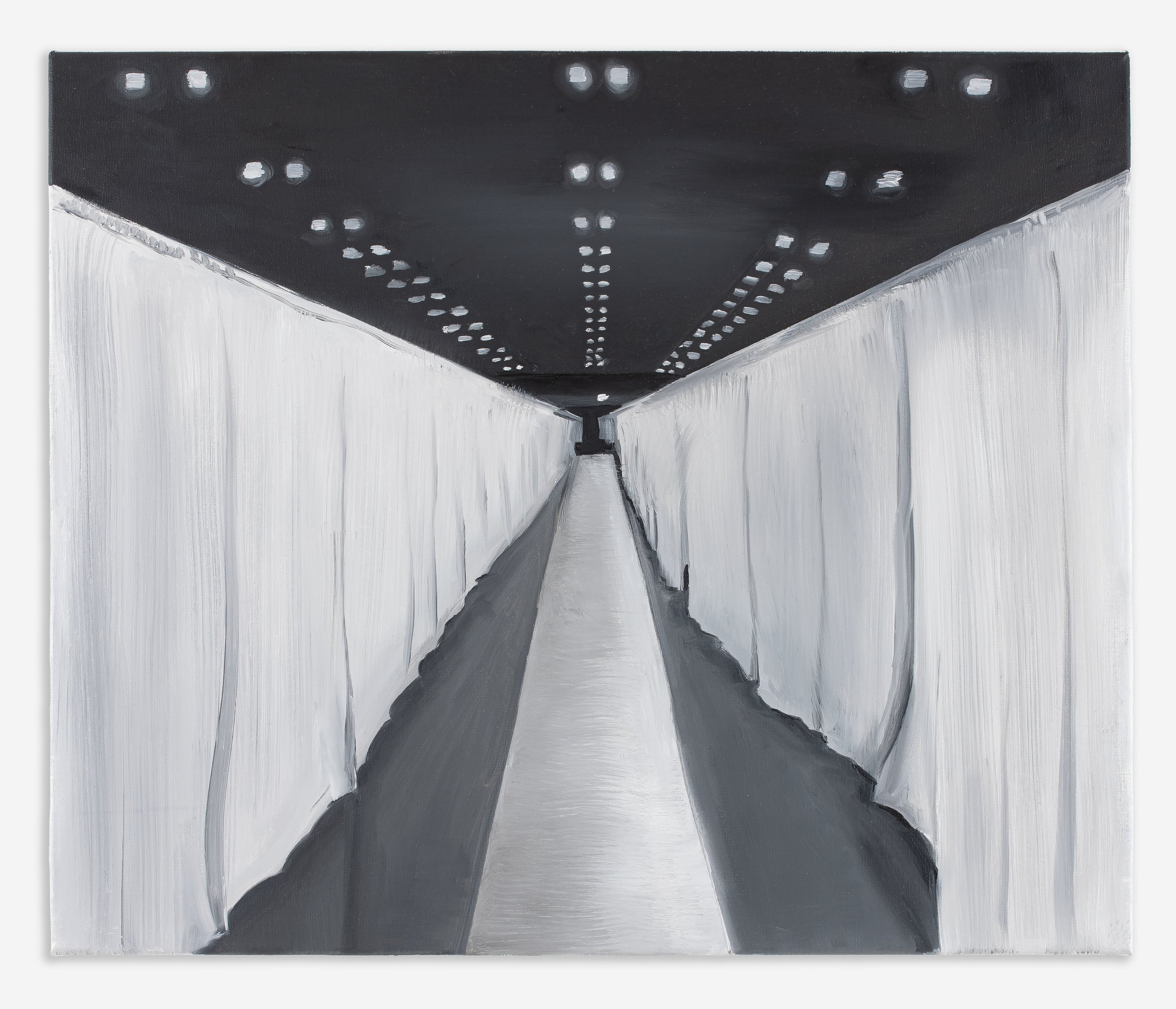
The Jacob K. Javits Convention Center in New York City hosts the International Auto Show, art fairs, and trade expos. In March 2020, it became something else. The 840,000 square foot hall filled with white curtain partitions, dividing open exhibition space into isolated patient units. Construction crews erected tents and beds inside the white cube, transforming a venue of circulation into one of containment. Tan Mu's Isolation (2020) records this shift. The painting centers on a corridor flanked by curtains, receding to a black vanishing point. What was designed for crowds now enforces solitude. Tan Mu witnessed construction during lockdown, screens showing transformation while homebound. Return for Armory Show layered memory, building holding convention, crisis, art uses. Painting captures provisional quality, curtains basic dividers supplementing modular panels.
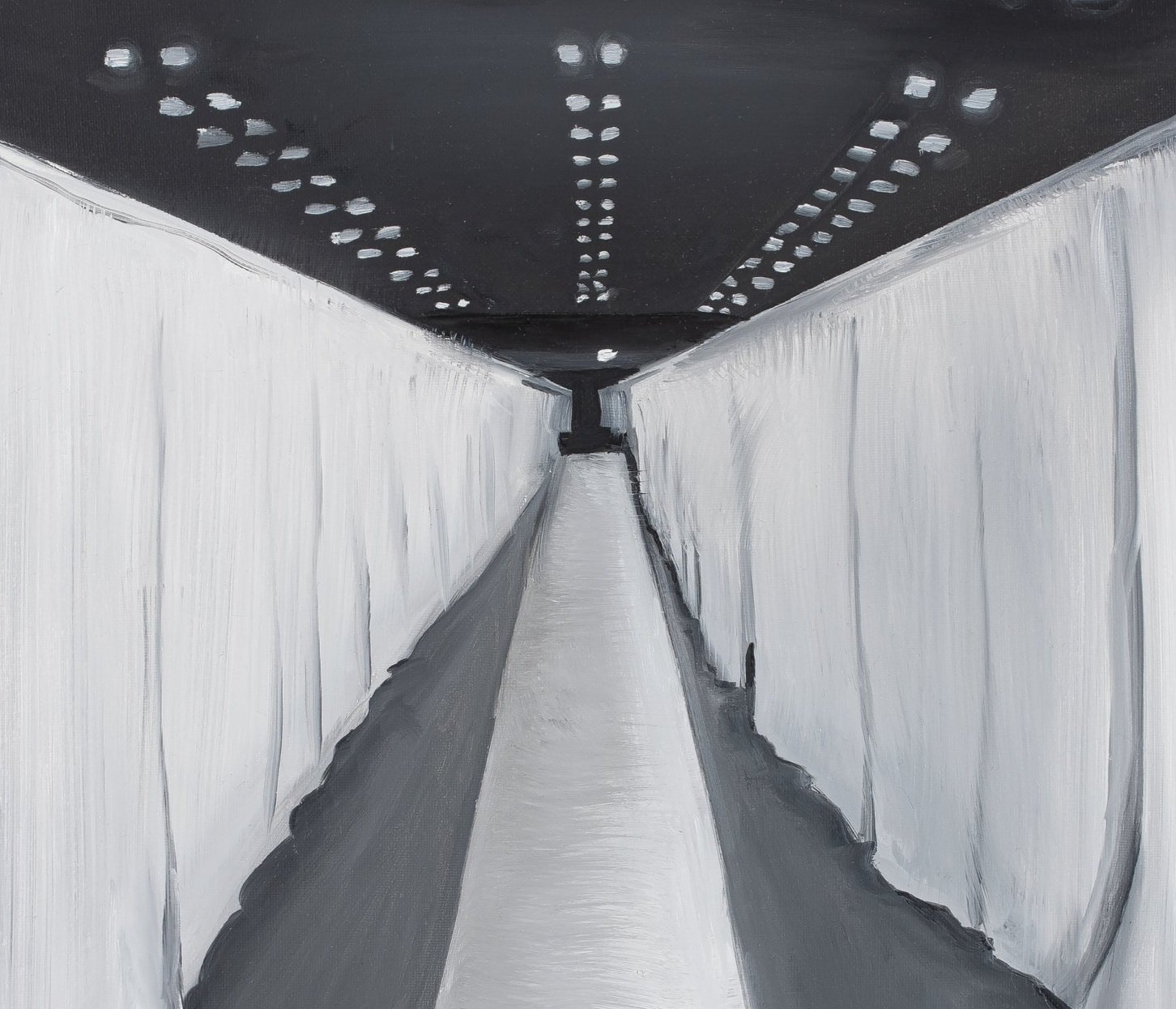
The material facts ground the reading. Isolation is oil on linen, 51 x 61 cm (20 x 24 in). The rectangular format evokes a wide angle view, compressing vast hall into intimate frame. Linen support suits the subject. Its weave absorbs oil unevenly, producing subtle texture under thin glazes. Curtains read as semi translucent planes, light diffusing through white fabric rendered in scumbled cool whites, Payne's gray veils, and faint Payne's gray undertones suggesting shadow in fabric folds. The surface holds breath: smooth where light falls evenly, granular where shadow gathers in weave pockets. Vertical curtain edges cut sharply, horizontal floor lines converge methodically to vanishing point. Scale modest wall hang, desk proximity both possible. Dry brush shadows evoke fabric dust catch.
Composition divides cleanly into symmetrical halves. Left and right curtains frame a central corridor receding to black vanishing point. No figure interrupts the void. Emptiness dominates. Tan Mu uses strict black and white monochrome to strip superficial vitality, letting architecture speak directly. Whites range from stark cool highlight at curtain edges to subtle warm Payne's gray shadow in folds, suggesting fabric volume without color distraction. Vertical lines mark partition edges sharply. Horizontal floor lines converge methodically. Vanishing point pulls eye inward relentlessly, trapping it in narrowing space. Brushwork varies strategically: broad flat strokes for expansive walls, fine dry brush for creases and texture. Edges feather where curtain meets air, producing optical softness that heightens perceptual confinement. Linen weave adds baseline texture, threads visible in shadow, grounding image in tactile reality. Glazes build luminosity, light filtered through material.
Oil layering builds spatial depth with precision. Thin glazes over lean underlayers create translucency, mimicking fabric diffusion as light penetrates veiled white. Thicker impasto passages at folds catch gallery light, producing specular highlight. Linen texture emerges most in shadow areas, grounding ethereal image in tactile reality. Scale encourages close looking. At arm's length, individual weave threads and stroke direction become visible, turning distant architectural hall into proximal skin like encounter. Tan Mu's description confirms intent: white cube becomes isolation symbol through absence of color and symmetrical division. The painting makes that transformation physical, curtain planes slicing canvas surface like actual fabric barriers suspended in space. Glaze buildup creates luminosity gradient, light seeming to filter through material rather than strike it directly. Dry brush shadows evoke fabric folds catching dust, provisional quality captured.
The viewing distance radically alters the painting's impact. At three meters, the monochrome palette unifies the composition, the white curtains and black void merging into a single, flat plane of graphic contrast. The image reads as a symbol, a stark diagram of separation. But at thirty centimeters, the illusion dissolves into material fact. The white is not a single tone but a complex accumulation of titanium white, zinc white, and faint traces of Payne's gray, layered to create the illusion of translucent fabric. The black is not empty but deep, a glazed abyss that seems to recede behind the canvas surface. At this proximity, the viewer is no longer looking at a hallway but at the act of painting itself, the brushstrokes that build the barrier. This shift from symbol to material mirrors the shift in the building's function, from a place of abstract commerce to a site of physical vulnerability.
Viewing distance modulates perceptual effect dramatically. Farther away, composition unifies into stark linear diagram of division and recession. Closer inspection reveals accumulated labor: horizontal stroke direction in walls suggesting planar breadth, vertical dry brush in curtains suggesting hanging fabric, glaze buildup creating luminosity gradient, weave interruption preventing total optical flatness. This duality mirrors Javits functional shift precisely: grand exhibition space for transient masses, then intimate partitioned units for sustained individual containment. Oil's characteristically slow dry time allows subtle blending at critical edges, producing atmospheric recession that deepens corridor pull. Result is space both rigorously measurable through geometry and psychologically elusive through light behavior, architecture asserting spatial control while veiled light dissolves boundary certainty. Return visit for Armory Show layered perception further, pre crisis openness overlaid with crisis memory in single image. Curtain translucency recalls temporary setup, oil capturing fabric movement air currents, dust settle provisional nature.
Edward Hopper's Nighthawks (1942) sets the first parallel. Hopper's corner diner glows against dark street, glass walls framing three figures under fluorescent light. The architecture encloses without comforting, large windows offering transparency that isolates rather than connects. Viewers peer through those barriers at disconnection inside apparent public space. Tan Mu adopts that enclosure logic for Javits hall. Curtains replace glass walls, white cube replaces nocturnal urban corner, yet perceptual effect remains identical: space designed for encounter becomes site of enforced separation. Hopper's figures sit physically close but psychologically remote. Tan Mu's emptiness enforces distance without any bodies present, architecture alone sufficient to convey solitude. Hopper's 1942 composition uses subtle distortions: counter angles slightly off, figures unnaturally rigid. These details amplify unease. Tan Mu employs symmetrical division with perfect bilateral balance, yet vanishing point creates destabilizing pull. Hopper's diner serves late night coffee. Tan Mu's hall serves medical isolation. Hopper's light cold blue green. Tan Mu's diffused sterile white.
Hopper used extreme light contrast to heighten isolation. Bright interior fluorescents against enveloping exterior dark isolate figures further from street and each other. Tan Mu uses tonal contrast within strict monochrome palette: bright white curtains against receding black vanishing point. Hopper's geometry is rigidly rectangular, windows and counters defining rigid sightlines that trap eye inside scene. Tan Mu's geometry mirrors that rectangularity, curtains and corridor framing relentless recession. Both paintings stage looking as inherently frustrated act. Hopper's viewer stands outside diner, unable to enter or touch lives inside. Tan Mu's viewer stands before canvas, unable to penetrate curtain divide or access units beyond. Hopper's urban alienation through lonely modernism finds direct contemporary echo in pandemic architecture, public convention venue turned private partitioned enclosure. Hopper populates with three figures, two couples, one solitary, human disconnection literalized through proximity. Tan Mu empties entirely, letting architecture perform isolation function alone. Curtains imply bodies behind fabric without showing them, heightening absence through suggestion.
Connection to Tan Mu's Yoga Isolation strengthens parallel. Both works use enclosed white space to evoke bodily constraint. Hopper shows figures trapped in lit box. Tan Mu shows empty boxes trapping implied bodies. Shared method: architecture as psychological container, painting revealing spatial effect on human condition. Tan Mu's return to Javits for Armory layered perception further, pre crisis openness overlaid with crisis memory in single image. Hopper's diner eternal loneliness. Tan Mu's hall timely solitude. Yoga Isolation figure constrained pose white room parallels empty corridor, bodily absence spatial. Both monochrome whites sterility confinement. Hopper figures rigid. Tan Mu spaces rigid. Painting series argues architecture shapes isolation physically psychologically, crisis amplifying enclosure logic across scales.
Hopper's Nighthawks is often read as a painting of urban alienation, but it is also a painting of light. The fluorescent glow of the diner cuts through the darkness of the street, creating a stage for the figures within. Tan Mu's Isolation is also a painting of light, but here the light is absent. The black void at the end of the corridor is not just a shadow but a negation of light, a visual representation of the unknown future that faced the city in March 2020. The white curtains, by contrast, are illuminated from within, glowing with a sterile, clinical brightness that offers no comfort. This interplay of light and dark, of sterile illumination and absolute void, creates a tension that is both spatial and psychological. It is the tension of the hospital ward, where life and death are separated by a thin curtain, and where the light of medical science struggles against the darkness of the virus.
Tan Mu anchors subject specific transformation. Jacob K. Javits Convention Center, 840,000 square feet Hudson River, hosted auto shows, art fairs, expos. March 2020, New York converted temporary hospital COVID overflow. Crews built tents, beds, partitions inside white cube. Army Corps installed 1,000 beds, oxygen lines, negative pressure rooms. Curtains created privacy zones vast hall. Tan Mu composition captures duality: symmetrical curtains evoke gallery neutrality, receding black point evokes corridor isolation. Monochrome strips color, focusing spatial psychology. She witnessed change firsthand, homebound lockdown viewing construction news. Negative pressure tents HEPA filters, curtains basic dividers. Oil translucency captures provisional nature, fabric movement air currents.
Building history adds layers. Opened 1986, Javits named senator championing public works. I.M. Pei design, glass skin promised transparency openness. Pandemic repurposed overnight. Tan Mu notes exhibition space interaction versus medical separation. Visual language enacts: curtains divide, corridor confines. Post lockdown Armory Show return layered uses: convention, hospital, art fair. Painting records accumulation, curtains marking pandemic phase specifically, fabric folds light diffusion recalling temporary setup. Tan Mu theme connection disconnection central practice. Javits embodies: space masses enforces solitude. Modular panels curtains hybrid, painting layered setup, glaze suggesting dust settle provisional.
The architectural specifics of the Javits Center deepen the irony of its transformation. Designed by I.M. Pei and James Ingo Freed, the building was a monument to late twentieth-century corporate modernism, its glass curtain walls intended to dissolve the boundary between the city and the spectacle within. It was built for mass gathering, for the auto shows and tech expos that celebrated consumerism and connection. To convert this specific structure, a temple to openness, into a site of enforced isolation was to invert its very purpose. The glass that once invited the public in now kept them out, or worse, kept the virus in. Tan Mu’s painting captures this architectural betrayal, the white curtains acting as a counter-facade, a soft barrier that replaces the hard transparency of Pei’s vision with the opaque reality of crisis.
Related works confirm series. Philadelphia, Minneapolis document urban crisis. Yoga Isolation, Sunday Afternoon lockdown routines. Vaccine medical response. Tan Mu positions Isolation crisis response series, public architecture witness societal pivot. Painting holds moment exhibition openness yielded medical enclosure, architecture registering human fragility. Javits tents modular panels, curtains supplemented. Tan Mu veiled whites capture hybrid, oil suggesting fabric air movement dust. Armory return evoked ghost architecture, convention echoes hospital traces. Painting palimpsest, surface multiple states.
Perceptual shift news photo paint central. Digital image flat instant. Oil layered duration. Flames absent, curtain diffusion crisis light. Tan Mu reconstructs building memory site, layers pre crisis post crisis pigment. Monochrome timeless, anchoring specific moment collective memory. Javits glass walls transparency irony, curtains opacity. Painting argues architecture actively records states, white cube isolation cube through curtain planes light fall spatial compression viewer inhabits transformed hall openness yield separation. Crisis reshapes space; space reshapes crisis perception. Tan Mu oil witnesses reshaping, pigment layering pre crisis post crisis single frame. Building witness, painting witness witness. Curtain translucency recalls temporary, oil capturing movement settle.

Thomas Struth's Pantheon, Rome (1990) provides second frame. Struth photographs architectural interior, visitors dwarfed dome geometry. Light filters oculus, human figures incidental spatial logic. Tan Mu hall shares effect: curtains corridor dominate, no figures. Struth color registers light fall. Tan Mu monochrome registers tonal shift. Both make architecture active agent, space shaping human experience passively. Struth tourists small eternal dome. Tan Mu emptiness temporary partitions. Struth composition centers oculus light source. Tan Mu centers vanishing point dark recession. Pantheon eternal concrete. Javits provisional fabric steel glass.
Struth Pantheon captures timeless enclosure, tourists moving eternal form. Tan Mu Javits timely enclosure, crisis reshaping modern form. Struth scale overwhelms viewer identification. Tan Mu intimate scale invites projection empty corridor. Struth documents perceptual encounter history. Tan Mu perceptual encounter crisis. Both use recession pull eye inward, space psychological vector. Struth color saturation heightens materiality. Tan Mu desaturation heightens abstraction, white cube literalized. Struth family photos show intimate groups public space. Isolation empty public space intimate implication. Shared: space indifferent occupant fate. Tan Mu Armory return layered further, convention ghosts hospital. Painting argues architecture actively records states, white cube isolation cube curtain planes light fall spatial compression viewer inhabits transformed hall openness yield separation.
Li Yizhuo 2025 catalog notes Tan Mu spaces records transformation. Li describes Signal accumulating layers. Isolation extends architecture, building holding pre crisis crisis states. Li observation fits: painting witness pivot moments, architecture carrying collective memory. Struth shows space enduring human passage. Tan Mu shows space altered human crisis. Pantheon light unifies disparate visitors. Tan Mu light divides implied patients. Whiteread connection adds: House casts negative space solid. Tan Mu casts empty corridor solid gaze. Both absence tangible. Li layered depictions evoke connection disconnection. Isolation embodies, curtains veiling dividing. Struth Pantheon dome eternal. Tan Mu Javits tent temporary. Shared perceptual container indifferent occupant.
Struth's tourists pose family groups, intimate against vast. Tan Mu's implied patients isolated behind veil, intimate against vast yet severed. Painting argues architecture records societal states actively. White cube isolation cube curtain planes light fall spatial compression. Viewer inhabits transformed hall, openness yield separation. Architecture designed contact witnesses contact suspension, holding absence enduring presence. Crisis reshapes space space reshapes crisis perception. Tan Mu oil witnesses reshaping, pigment layering pre crisis post crisis single frame. Building witness, painting witness witness. Curtain translucency recalls temporary, oil capturing movement settle dust provisional panels hybrid setup.
Convention centers promise openness. Javits glass walls vast floor invited flow. Pandemic inverted. Curtains subdivided, architecture turned inward. Tan Mu painting holds inversion without nostalgia. Monochrome registers sterility. Symmetry registers control. Vanishing point registers entrapment. Material choices reinforce: oil glazes evoke curtain diffusion, linen grounds texture. Scale intimate forces confrontation vast emptiness. Viewer navigates division corridor walker, glaze light filter fabric movement.
Series continuity clear. Isolation joins Philadelphia Minneapolis crisis documents. Yoga Isolation Sunday Afternoon lockdown routines. Tan Mu charts disconnection scales: urban hall personal practice signal loss. Painting archival tool, space memory carrier. Armory return layered uses, building palimpsest. Monochrome timeless anchors specific moment collective memory. Oil translucency provisional fabric nature. Javits modular panels curtains hybrid, painting layered setup glaze dust settle.
Hopper Struth enclosure precedents. Tan Mu advances crisis specificity monochrome intensification. Painting argues architecture records societal states actively. White cube isolation cube curtain planes light fall spatial compression. Viewer inhabits transformed hall, openness yield separation. Architecture designed contact witnesses contact suspension, holding absence enduring presence. Crisis reshapes space; space reshapes crisis perception. Tan Mu oil witnesses reshaping, pigment layering pre crisis post crisis single frame. Building witness, painting witness witness. Final resonance: architecture designed gather scatters crisis, white cube emptied yet filled memory layers. The curtains remain, not as barriers but as monuments to a time when distance was the only safety, and when a convention center became a cathedral of silence.