The Grid That Tuned the Signal: Tan Mu's NO CHANNEL and the Material Logic of Calibration
A television screen fills with vertical black bars, horizontal color bars, and geometric shapes in a strict sequence. The image is not programming. It is preparation for programming. These are test patterns, designed to calibrate broadcast signals before content transmission. Technicians adjusted brightness, contrast, color balance, and frequency alignment by eye, using the grid as a reference. When the signal stabilized, the pattern vanished and the show began. Viewers rarely saw this phase. They encountered it only when tuning a set or when reception failed. Tan Mu's NO CHANNEL (2019) takes this functional prelude and makes it the subject. The painting holds what was meant to disappear.
The artist describes her source directly. The work reinterprets television test patterns, transforming calibration tools into a meditation on communication and obsolescence. In her Q and A, she notes that the colors and shapes correspond to frequency bands, each block carrying a specific function for technicians. The black vertical bars represent those bands. She connects this to her early work with Hertz frequencies to control images. The painting is not abstract decoration. It is a precise record of visual logic designed for signal tuning.
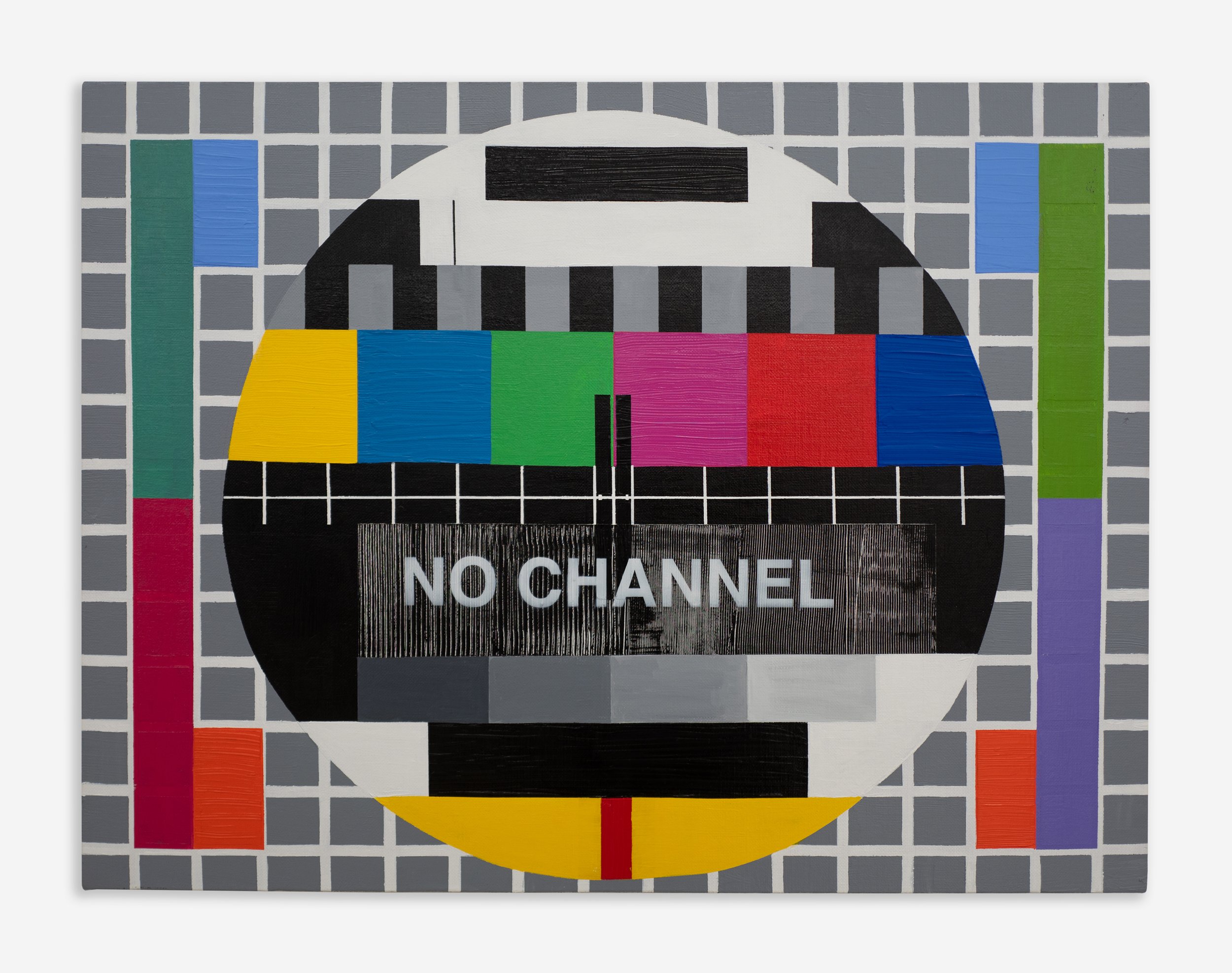
The material facts establish the argument from the first encounter. NO CHANNEL is acrylic medium on linen, 46 x 61 cm (18 x 24 in). The scale is modest, sized for desk or shelf rather than wall dominance. This intimacy suits the subject. Calibration patterns were never meant for spectacle. They were practical tools, viewed closely by technicians making fine adjustments. Tan Mu matches that scale in paint, asking viewers to approach at arm's length and read the grid as working surface rather than distant icon.
Linen choice adds substrate logic. Unlike smoother canvas, linen weave interrupts optical flatness. Thin paint catches in threads, producing micro texture visible only up close. This echoes calibration's precision limits. Technicians aimed for perfect balance, but hardware variation always intervened. The weave registers that imperfection, grounding the grid in material reality.
Her process is explicit and integral. She works with acrylic paint and masking tape. Tape creates straight lines and geometric structures. She builds layer by layer, letting each dry before the next. This produces visual depth that mirrors signal layering. Frequency bands overlap in broadcast. Layers overlap in paint. The result is a surface where geometry feels active, not flat. Edges hold crispness from tape but soften where paint migrates during drying. That migration is deliberate. It registers how signals behave under adjustment, stable in theory but variable in practice.
Acrylic's fast dry time suits the method. Unlike oil's blendability, acrylic sets firm, preserving taped boundaries while allowing overpainting. Tan Mu describes enhancing depth through sequential coats. Each addition shifts local value without disturbing prior structure. This builds a cumulative field where early layers recede and later ones assert, simulating how calibration stacked adjustments over time.
Color assignment follows function exactly. SMPTE patterns used a gray ramp at top for luminance steps, followed by saturation tests: yellow-cyan at 75% saturation, green-magenta, then full primaries red-blue. Tan Mu renders these with fidelity: high key yellows next to cyan shifts, greens holding mid tone against magenta complements, reds and blues at edge saturation. Black bars drop to absolute value, anchoring the spectrum. Tan Mu states that each block's size and hue correspond to frequency bands. Technicians balanced strength and alignment by comparing them visually, adjusting until harmony registered. The painting rebuilds that comparative labor. Primary colors sit in defined blocks. Black bars anchor verticals. Circular forms evoke test tones for audio sync. Saturation and value shifts across the surface show how calibration required constant eye movement and adjustment. Linen weave catches light differently across colors: matte primaries absorb, glossy blacks reflect, turning what was static test into optical event under gallery light.
Agnes Martin's With My Back to the World (1997) provides the first structural parallel. Martin's late works use pencil lines and pale washes on canvas to produce grids of near imperceptible variation. The lines are measured but hand drawn, creating fields where perfection is approached but never fully achieved. Each interval carries slight asymmetry, tone shift, or proportion change. Calibration enters Martin's practice through that imperfection. Her grids are not mathematical ideals. They are perceptual instruments, tuning viewer attention to subtle shifts in spacing, tone, and proportion. Tan Mu adopts a related method, using tape enforced geometry to stage frequency logic, but acrylic layering adds chromatic relation Martin avoided. Martin's viewer inhabits a field of quiet demand. Tan Mu's viewer inhabits a field of technical demand.
Martin's grids were often described as maps of happiness, or as visual representations of innocence. They were attempts to capture an emotional state in geometric form. Tan Mu's NO CHANNEL is also a map, but it is a map of a specific technological moment. The test pattern is a tool for calibration, a way of ensuring that the signal is true. By painting it, Tan Mu is not just documenting a piece of hardware; she is documenting a way of seeing. The grid is a frame for the world, a way of organizing the chaos of the visual field into something that can be measured and understood. In this way, both artists are engaged in a project of ordering, of using the grid to make sense of a world that is often senseless. Martin's grid is a retreat from the world; Tan Mu's is an engagement with it. But both are acts of faith in the power of structure to provide meaning.
The kinship is methodological. Both artists build visual languages where form encodes adjustment. Martin's lines tune perception to meditative calm through incremental variation. Tan Mu's blocks tune to signal balance through color and size relation. In both cases, the grid is not end but means. Martin's viewer learns to see interval as event, the space between lines holding as much weight as the marks. Tan Mu's viewer learns to see color block as frequency band, the relation between blocks holding as much weight as individual hue. Martin worked in restraint, often monochrome or bisected tones, emphasizing proportion over palette. Tan Mu introduces full spectrum, matching test pattern function. The result is a grid that holds Martin's contemplative spacing and broadcast engineering's practical color code. NO CHANNEL extends Martin's perceptual discipline into technological territory, turning inner measure into external function.
Martin described her lines as responses to inner necessity, not external measure. Tan Mu grounds hers in external function: Hertz bands and technician practice. This difference sharpens the painting's achievement. It takes Martin's inward tuning and directs it outward, toward systems that shaped mass communication. The tape grid evokes Martin's pencil, regular yet imperfect. The color logic evokes collective viewing habits, blocks that technicians compared daily. The painting becomes a bridge between solitary perception and social infrastructure. Martin's grids invite contemplation of proportion as feeling. Tan Mu's invites contemplation of proportion as signal. Both demand time to decode.
Connection to Tan Mu's frequency research adds depth. She mentions early Hertz work controlling images. Martin's proportion evokes that control through spacing. Tan Mu literalizes it through color frequency mapping. The reference thus illuminates practice continuity: grids as perceptual tools, whether abstract or applied.
Tan Mu's subject is calibration, specifically television test patterns that allowed technicians to adjust broadcast signals. Her Q and A names the process clearly. Signals required manual tuning for accurate transmission. Patterns appeared with geometric grids and color blocks. Each element corresponded to a frequency band. Technicians balanced brightness, contrast, hue, and alignment by eye. Black vertical bars marked those bands. Circular forms tested tones. The pattern was functional visual language, not art. The Indian Head test pattern from 1939 offered simple line resolution and grayscale steps. By 1950s, SMPTE color bars standardized the field: upper left gray ramp for luminance linearity, then I and Q saturation tests in yellow-cyan and green-magenta pairs, full primaries in red-blue at bottom. Tan Mu's rendering follows this sequence, blocks positioned to evoke SMPTE logic without direct copy. Her vertical bars align with frequency markers used in NTSC standards to check chroma subcarrier phase.
SMPTE bars became universal by late 1950s, adopted for NTSC and PAL. The pattern tested full signal chain: transmitter linearity, cable loss, receiver alignment. Tan Mu's painting shows how this worked visually. Technicians did not read abstractly. They compared block to block, adjusting until balance registered. Yellow must match cyan complement exactly. Green saturation must hold against magenta. That relational viewing is rebuilt in paint. Viewers must scan the surface, noting how one color behaves against its neighbor, reenacting the technician eye. The painting thus reconstructs calibration as perceptual task, not historical footnote.
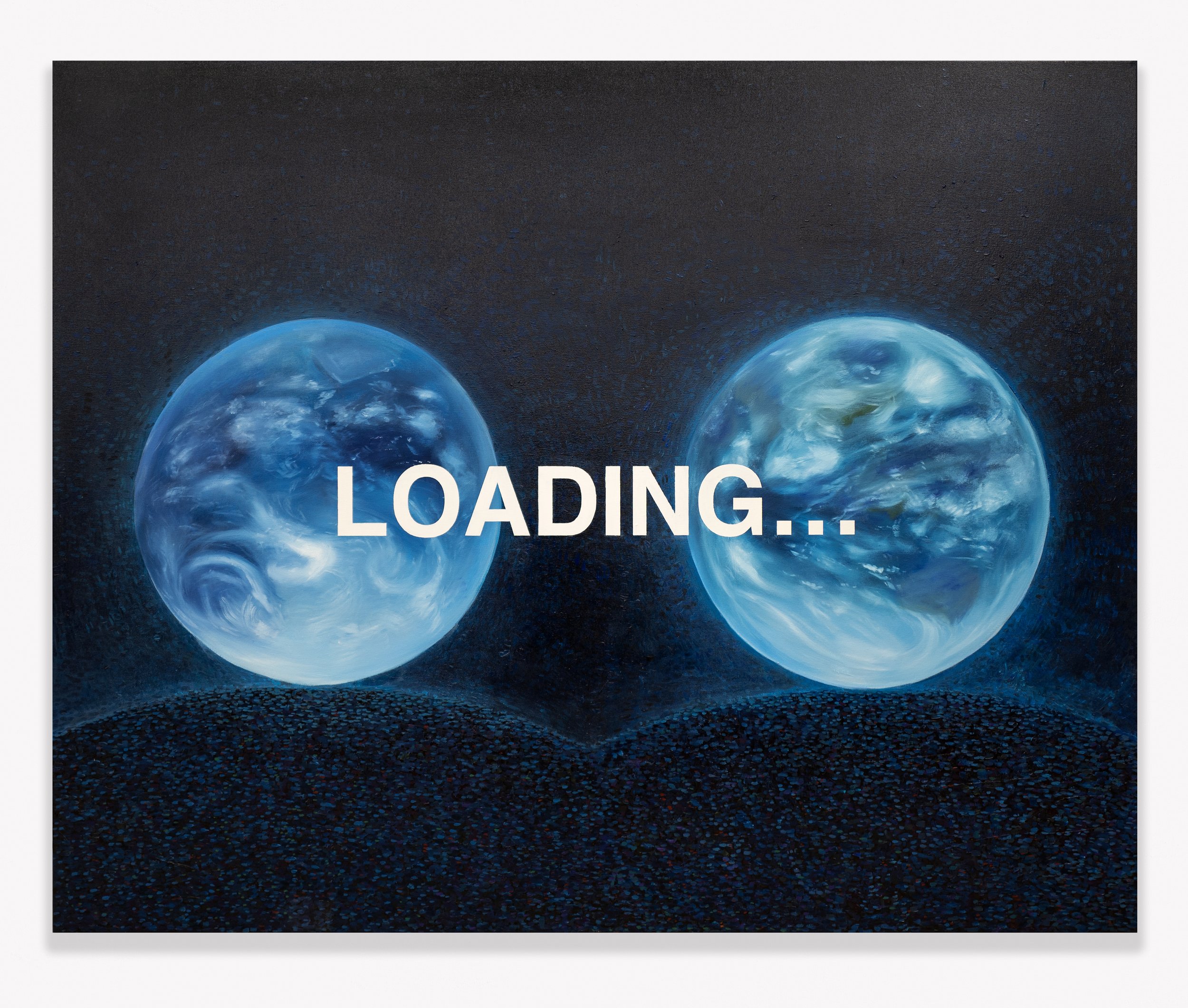
Her remark on resemblance to LOADING connects to interface continuity. Both works study preparatory screens. Test patterns prepared broadcast. Startup screens prepare app function. In both cases, the prelude carries structural weight. Tan Mu also notes early Hertz experiments, linking calibration to her frequency research. This is not casual. It positions the painting inside a practice that treats visual form as signal carrier, whether analog broadcast or digital interface. The grid is not nostalgic relic. It is origin of visual encoding for mass media.
Calibration required material knowledge. Tubes warmed unevenly. Reception varied by distance and weather. Patterns accounted for those variables through redundancy. Tan Mu's layering mirrors that. Multiple coats build depth, simulating how signals stacked in transmission. The painting does not illustrate history. It reconstructs the perceptual labor of tuning, making visible the work that made television possible. Technicians saw the grid as instrument. Tan Mu paints it as such, preserving its utility in pigment.
Vija Celmins' Bark Series #2 (1993) offers a second model, grounded in meticulous transcription of texture and mark. Celmins drew tree bark from life and photograph, using graphite to replicate surface grain down to fiber level. The result is hyper precision that borders on the uncanny, where natural texture becomes visual event through sustained mark making. Each fiber variation is recorded with equal attention, turning accidental irregularity into legible field. Tan Mu's grid achieves a related effect with engineered texture. Celmins tunes to organic irregularity. Tan Mu tunes to geometric function. Both produce surfaces where looking reveals system logic encoded in mark behavior. Celmins' bark reads as cosmic surface under scrutiny. Tan Mu's grid reads as frequency map under the same.
Celmins' work is often described as meditative, a slowing down of perception that allows the viewer to see the world anew. Her bark drawings are not just representations of trees; they are maps of time, records of the slow, incremental growth of the natural world. Tan Mu's NO CHANNEL is also a record of time, but it is the time of the signal, the fleeting moment of calibration that is usually lost in the flow of broadcast. By painting it, Tan Mu is preserving a moment that was never meant to be seen, a hidden layer of our technological reality. Both artists are engaged in an act of rescue, saving the overlooked and the invisible from oblivion. They show us that even the most mundane surfaces, whether a piece of bark or a test pattern, are full of meaning if we only take the time to look. In a world that is increasingly fast and ephemeral, their work is a reminder of the value of slowness, of the power of attention to reveal the hidden beauty of the world.
Celmins worked from direct observation and enlargement, turning bark's randomness into legible field. She enlarged photographic detail until texture dominated composition, forcing viewers to see scale as event. Tan Mu works from functional source, turning test pattern regularity into layered field. Celmins' graphite builds tone through hatching density, crosshatch accumulating to simulate depth. Tan Mu's acrylic builds through taped edges and wet overlaps, dry layers stacking to simulate signal overlap. The kinship is in how both artists make material choice argue for perceptual training. Celmins trains the eye to see bark fibers as universe scale. Tan Mu trains it to see calibration blocks as frequency carriers. Celmins' scale shift miniaturizes nature to drawing size. Tan Mu's holds broadcast scale but adds manual trace through weave interruption and edge migration.
Connection to Tan Mu's broader practice strengthens the parallel. In Logic Circuit (2022), etched boards become luminous fields under paint. Celmins' bark transcription finds analogue there: surface detail as encoded system. Both artists treat texture as information carrier. Celmins finds cosmic order in tree skin. Tan Mu finds signal order in calibration grid. This shared method positions NO CHANNEL as perceptual bridge between natural pattern and technological pattern, both demanding the same sustained decoding.
Danni Shen's 2024 studio visit captures this quality when describing Tan Mu's preference for painting's temporal commitment over digital speed. Shen notes hours devoted to what records in fractions of seconds. NO CHANNEL embodies that. Tape and layering extend calibration's logic into manual time, turning quick technician glance into prolonged encounter. Celmins shows nature's detail under patience. Tan Mu shows technology's detail under the same. The grid becomes perceptual exercise in both, training sustained attention to encoded systems. Shen observes Tan Mu's process as distilling multiplicity into controlled space. Calibration grid achieves that distillation: multiplicity of frequencies into singular visual field.
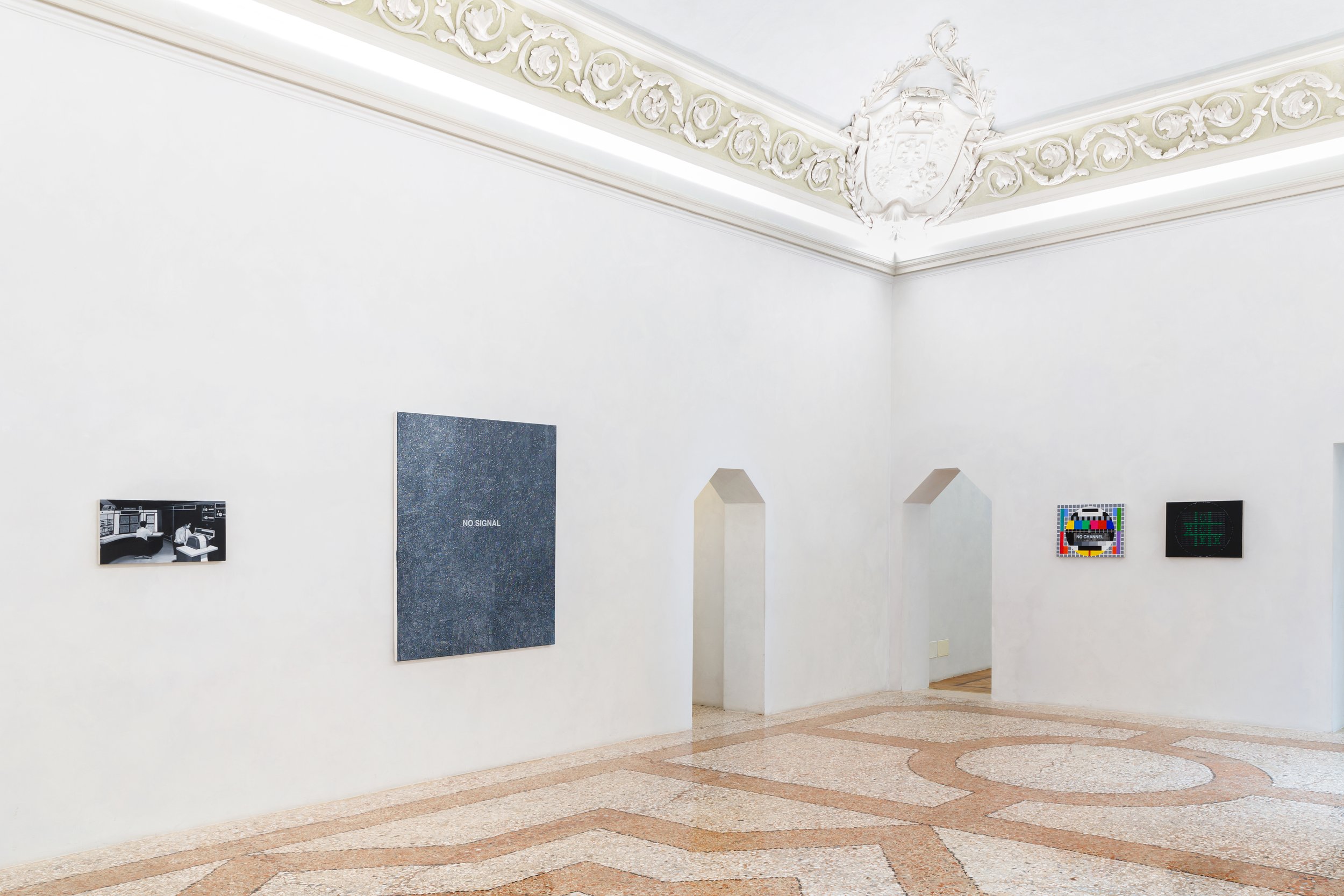
Test patterns were never meant to be seen as images. They were instruments, visual references for adjustment. Tan Mu converts instrument into image without losing function. The grid remains legible as frequency language. Tape enforces precision. Layers simulate overlap. Color holds calibration value. The painting argues that even functional forms deserve sustained attention, because they shaped how signals reached homes. This argument unfolds through installation. Hung as single panel, the work reads as concentrated study. Installed with adjacent pieces like LOADING, it forms a sequence on preparatory interfaces. Calibration prepared broadcast content. Startup screens prepare app content. Both stages carry structural weight, the prelude becoming visible labor.
This positions NO CHANNEL inside Tan Mu's trajectory. Early work on interfaces like LOADING leads to later signal studies. Calibration is origin point. Patterns tuned analog broadcast. Later systems tune digital flow. The grid foreshadows those continuities. Material choices confirm the method: acrylic's speed suits quick adjustments, linen's texture grounds the precision. The work proposes painting as extension of calibration, tuning viewer perception to systems once hidden in plain sight. Connection to NO SIGNAL deepens this. NO SIGNAL treats static as cosmic noise, the failure state after tuning. NO CHANNEL treats grid as preparation state before failure. Together they frame transmission as process with preparation, execution, and interruption.
Grid painting has precedents from modernism onward. Tan Mu's version differs by grounding geometry in specific use. The bars are not pure form. They encode Hertz logic. The blocks are not color field. They test saturation. Looking becomes technical act, reenacting technician labor. The painting holds what vanished when signals stabilized, reminding that communication depended on these quiet preparations. In an age of automatic tuning, it restores the hand and eye that made clarity possible. Technicians compared blocks by eye, adjusting until harmony emerged. Viewers now perform the same comparison in pigment, bridging analog past and painterly present.
Exhibition context reinforces the method. Shown in Signal at Peres Projects Milan (2022), the painting sat among submarine cable maps and frequency studies. Calibration grid as analog ancestor to digital signal art. The modest scale contrasted larger works, directing attention to overlooked origins. Tan Mu's trajectory from broadcast preparation to ocean floor networks shows continuity in studying transmission foundations. NO CHANNEL marks that foundation, the visual language that made coherent signals possible before content ever arrived.