The Eye of Fire: Tan Mu's Gulf of Mexico and the Flame at the Center of the Sea
On July 3, 2021, a gas leak at a depth of approximately 150 meters below the surface of the Gulf of Mexico, west of Mexico's Yucatan Peninsula, ignited and produced a column of fire visible from space. The leak originated from a pipeline connected to a platform operated by the Mexican state oil company, and the ignition produced what witnesses described as an eye of fire, a swirling vortex of flame rising from the ocean surface in a perfect circle, as if something beneath the water had decided to burn. The video footage, shot from helicopters by journalists and by workers on nearby platforms, circulated on social media within hours of the ignition, producing a reaction that was initially astonishment, then alarm, then something that resembled awe at the spectacle of water and fire coexisting in a single form. Tan Mu began painting Gulf of Mexico the same day she saw the footage, working from still images extracted from the helicopter videos. She completed the painting before the fire was extinguished. By the time the official reports confirmed that the blaze had been brought under control, the canvas was dry. The painting had become a document of an event that no longer existed in the world, a record of a moment that had already passed into history even as it was being made.
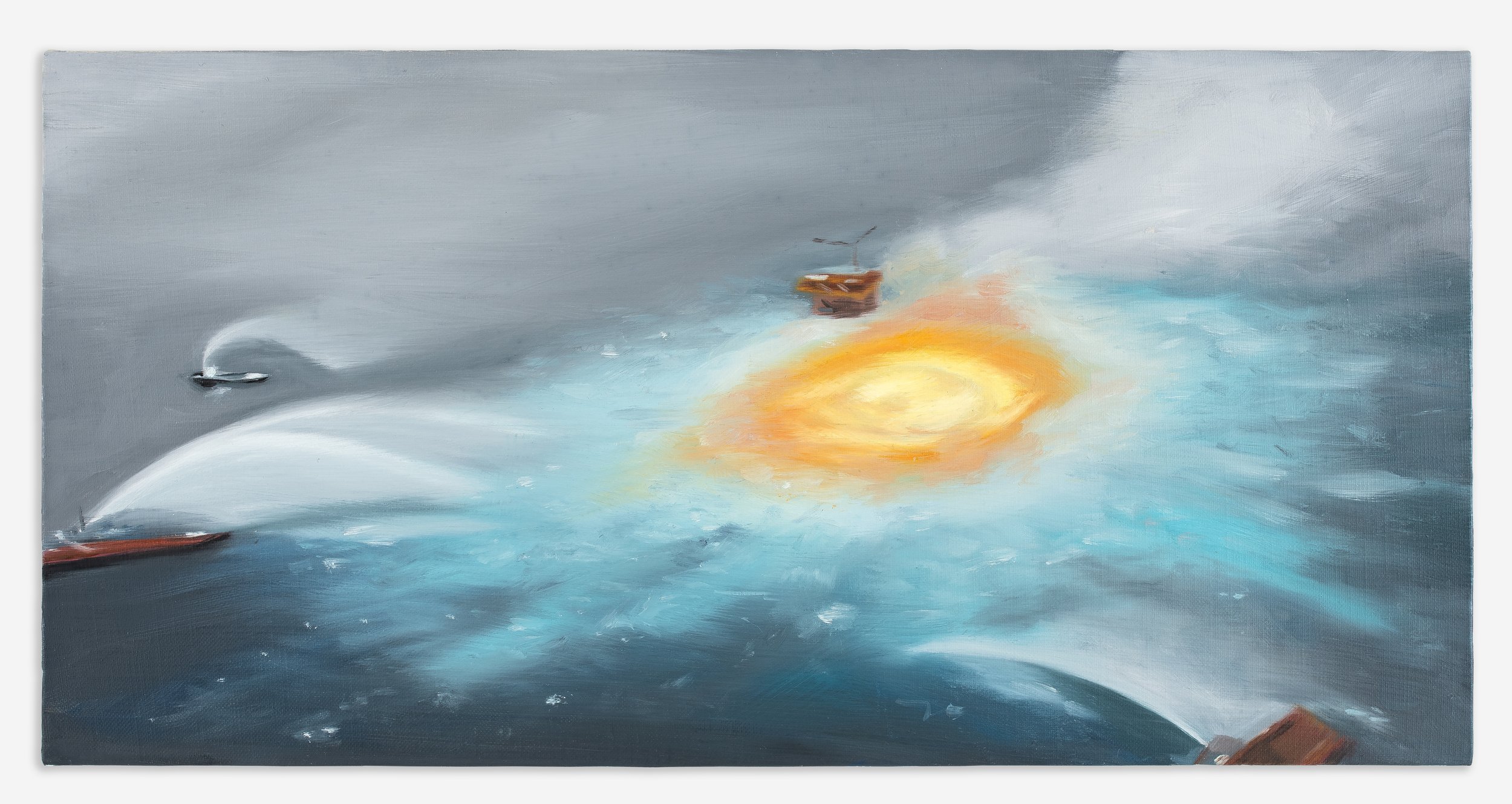
Li Yizhuo, writing about Tan Mu's practice of painting from real-time events, has described the relationship between the speed of digital media and the slower pace of oil painting as one of the most productive tensions in this body of work. "The event is already over by the time the painting is complete," Li Yizhuo observed. "But the painting persists in a way that the news cycle does not, holding the event in a form that can be returned to again and again, that does not refresh or scroll or disappear into the archive of the forgotten." This observation applies with particular force to Gulf of Mexico, where the documentary urgency of the painting's creation is matched by the permanence of the object that resulted. The fire that burned for over five hours on that July afternoon has been out for years. But the painting of the fire continues to burn, held in the slow amber and orange light of oil pigment on linen, available for anyone who encounters it to consider what it meant and what it continues to mean about the relationship between the energy systems that humanity has built and the natural forces that those systems always already depend on and disrupt.
Gulf of Mexico is executed in oil on linen, measuring 31 by 61 centimeters (12 by 24 inches). The horizontal format is appropriate for the subject, which extends horizontally across the frame from the dark mass of the oil platform at the left to the outer edges of the flame at the right. The platform is rendered as a dark, angular form, its industrial geometry reading as a counterpoint to the organic circularity of the fire vortex at the center of the composition. The fire itself is painted in warm tones that range from bright yellow at the innermost portions of the vortex to deep orange and red at the outer edges, where the flame meets the dark water of the gulf. The water surrounding the fire is rendered in dark blue-greens and near-blacks, its surface implied by the contrast with the luminous fire rather than described in any detail. The overall effect is of a small, complete world, a circle of flame floating on a dark ground, isolated from any context that might explain it and presented as a phenomenon to be considered on its own terms.
Tan Mu has described the oil rig structure in this painting as carrying deep personal resonance. She grew up in Yantai, a coastal city in Shandong Province, where offshore natural gas platforms were visible from the coastline throughout her childhood. The sight of these structures, their massive forms rising from the water and their lights visible at night, shaped her early understanding of the relationship between industry and landscape. As a freediver, she has continued to encounter similar industrial landscapes underwater, in locations ranging from the Caribbean to the Pacific. In December 2024, she surfaced off the coast of Curacao to see a towering offshore structure rising above the sea, a moment that reinforced her awareness of how these facilities exist simultaneously above and below the surface, shaping both marine ecosystems and human energy systems. The oil rig in Gulf of Mexico is thus not merely an industrial backdrop. It is an element of personal memory, a form that connects the painting to the artist's own history of observing energy infrastructure from both above and below the waterline.
The palette is restricted to the warm tones of the fire against the cool tones of the water and the dark tones of the industrial structure. This restriction serves the painting's conceptual logic by eliminating any detail that might distract from the central confrontation between fire and water, two elements that Western mythology has treated as fundamental opposites since at least the time of Heraclitus. Tan Mu has described fire as a symbol of primal energy and the origin of human civilization, and the painting treats these associations seriously, presenting the flame not as a metaphor for something else but as the thing itself, the actual burning of actual gas from an actual leak in an actual seabed. The painting does not illustrate the concept of fossil fuel combustion. It enacts the event of that combustion, holding it in a form that allows the viewer to contemplate it as a visual experience rather than a piece of information.
The tradition of painting maritime disasters has one of its earliest and most influential examples in Theodore Gericault's The Raft of the Medusa (1818-1819), a painting that depicts the aftermath of a real shipwreck, the French frigate Medusa, which ran aground on a sandbank off the coast of West Africa in 1816 with resulting in over 140 deaths. Gericault spent months researching the event, interviewing survivors, and studying the physical conditions of survival and drowning before producing a canvas that was over seven meters wide, large enough to make the raft and its occupants life-size or larger. The painting was exhibited in the Salon of 1819 and created a scandal, partly because of its subject matter, which implicated the French government in the disaster through official incompetence, and partly because of its scale and directness, which demanded that viewers confront the reality of mass death without the mediation of narrative or sentiment.
Tan Mu's approach to Gulf of Mexico differs from Gericault's in scale and in the specificity of its documentation, but it shares with The Raft of the Medusa the commitment to making a painting that operates as a document of a real event. The Raft of the Medusa was painted years after the shipwreck occurred, using survivors' accounts and the artist's imagination to reconstruct an event that had already passed into history. Gulf of Mexico was painted within hours of the event itself, using still images from the news footage as direct reference. This difference in temporal relationship to the event does not make Tan Mu's painting more documentary or less artistic than Gericault's. It makes the painting a different kind of document, one that captures the event at the moment of its occurrence rather than in its aftermath, one that does not allow the viewer the distance of retrospection but forces them to confront the fire as if they too were watching the news feed in something close to real time.
The connection to Gericault also illuminates the political dimension of Tan Mu's painting, which is present but understated. The Raft of the Medusa was political because it depicted the result of a specific governmental decision, the decision to use a ship that was not fit for its purpose and to staff it with inadequately trained crew, all because of the nepotism and corruption of the Restoration monarchy. Gulf of Mexico is political in a different register, one that is implicit in the subject rather than explicit in the narrative. The fire in the Gulf is the Resulting of the infrastructure that humanity has built to extract fossil fuels from beneath the ocean floor, an infrastructure that exists because the global economy has structured itself around the assumption that abundant cheap energy is a birthright rather than a temporary condition. The painting does not assign blame. It simply depicts the fire that resulted from that infrastructure, asking the viewer to consider what it means when the system that provides energy also produces spectacles that look like this.
The underwater gas leak that produced the fire in the Gulf of Mexico originated from a pipeline that had been in place for decades, part of an extensive network of infrastructure that crisscrosses the Gulf floor, connecting wells to platforms to onshore processing facilities to the pipelines that carry natural gas to consumers across the United States and Mexico. This infrastructure is largely invisible to the people it serves. The gas that flows through these pipelines arrives at power plants and heating systems and industrial facilities without leaving any visible trace of the journey it has taken or the environments it has passed through. The pipeline on the ocean floor is as invisible to the consumer as the electrical wiring is to the person who plugs in a lamp. The fire in the Gulf of Mexico made the invisible momentarily visible, revealing the infrastructure that had always been there, the conduit through which the gas flowed on its way from the reservoir in the rock beneath the seabed to the burners and turbines and furnaces that consume it.
Tan Mu has described her broader practice as investigating exactly this kind of invisible infrastructure, the systems that make contemporary life possible without being available for direct observation. Her paintings of submarine cables, of data centers, of the superconducting circuits inside quantum computers, all operate in the same register: they make visible the systems that are otherwise hidden, they bring to the surface of the canvas the infrastructure that operates at a remove from ordinary experience. Gulf of Mexico extends this investigation to the energy infrastructure that underlies all the others. Without fossil fuel extraction, without the pipelines and platforms and processing facilities that make hydrocarbon energy available, the submarine cables would not exist, the data centers would not have power, the quantum computers would not cool down. The fire is the legible symptom of a system that is always operating but rarely seen.
The fire vortex itself, the circular form that witnesses described as an eye of fire, poses problems that the painting holds open without resolving. Why did the gas ignite? The mixture of methane and other hydrocarbons that leaked from the pipeline was lighter than the surrounding seawater and rose toward the surface. At some point in that ascent, it encountered an ignition source, a spark or a flame or a surface that was hot enough to trigger combustion. Once ignited, the gas burned at the surface, producing the column of fire that helicopter cameras captured. The circular form of the vortex was produced by the way the gas bubbled up through the water, creating a kind of ring shape as the flames burned above the circular area of rising gas. This is physics, not magic. But the result looked like magic, looked like something from a mythological tradition in which the gods sent fire from the depths to punish the surface world. The painting does not explain the physics or evoke the mythology. It holds both in suspension, presenting the eye of fire as a visual fact that demands to be reckoned with.
The tradition of apocalyptic landscape painting in England reached its most extreme expression in the work of John Martin, whose large-scale paintings of biblical and mythological cataclysms made him the most famous painter in England during the 1820s and 1830s and the subject of fierce criticism from Ruskin and others who considered his approach vulgar and theatrical. Martin's The Great Day of His Wrath (1851-1853) depicts a landscape of crumbling cliffs and collapsing cities under a sky that is being torn apart by divine fire, the flames reaching down from above as if the sky itself were burning. The scale of the human figures relative to the landscape is so reduced that they become elements of the composition rather than subjects in their own right, their smallness emphasizing the scale of the forces that are destroying them. Martin's critics found this theatrical, a sensationalist manipulation of emotion rather than a genuine engagement with the sublime. His audiences found it overwhelming, and it was the overwhelming quality that made his work popular even as it made it controversial.
Tan Mu's Gulf of Mexico operates in a related but distinct register of the sublime. Where Martin's apocalyptic landscapes draw on divine authority to justify their scale and their emotional intensity, Tan Mu's fire vortex draws on documentary evidence to justify its presence on the canvas. The fire in the Gulf of Mexico is not a divine punishment. It is an industrial accident, a failure of infrastructure, a leak that should not have happened and that did happen, producing a spectacle that no one designed and no one wanted but that was witnessed and filmed and shared across the world. The painting does not need to justify its subject's intensity. The subject provides the intensity. What the painting adds is the quality of attention that oil painting demands, the sustained looking that the canvas requires, the invitation to sit with the image rather than scroll past it, to consider what it means rather than to react to it and move on.
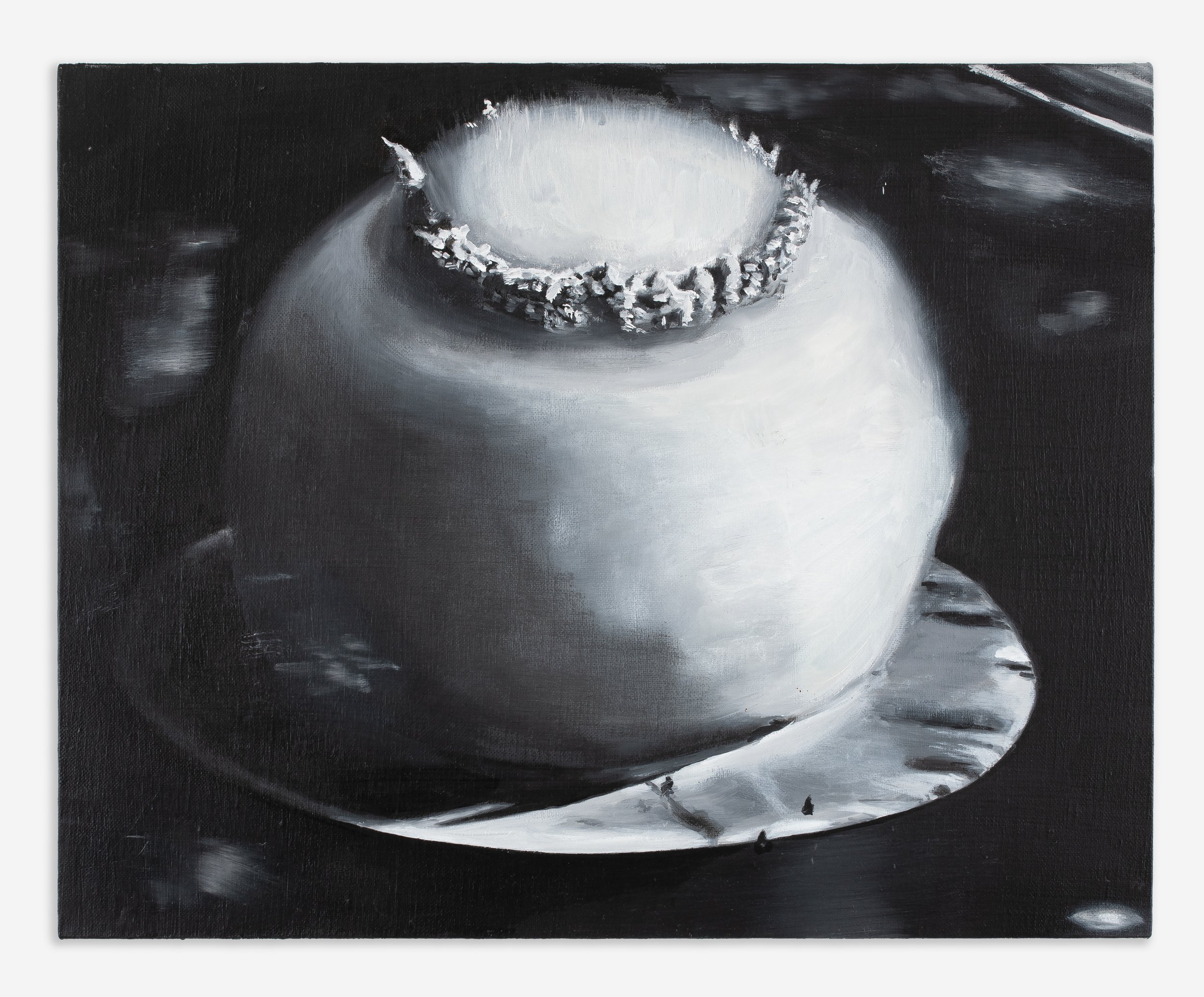
The small scale of Gulf of Mexico, compared to Martin's vast canvases, is precisely what gives the painting its power. Tan Mu has described deliberately reducing the scale of the mushroom cloud in Bikini Atoll to make it resemble a snowball or cotton candy, turning the sublime into the intimate and asking the viewer to reckon with the disproportion between the event and its frame. The same operation is at work in Gulf of Mexico. The fire vortex that rose from the Gulf of Mexico on July 3, 2021 was visible from space. The painting that depicts it is thirty-one by sixty-one centimeters, small enough to be held in the hands, to be examined at close range, to be lived with as an object in a domestic space rather than endured as a spectacle in a public one. The disproportion between the scale of the event and the scale of the painting is not a failure of representation. It is a statement about representation itself, about what it means to make an image of something that exceeds any image that could contain it, and about the power of the small form to hold the large event in a state of permanent contemplation.
Tan Mu has described her paintings as time capsules that preserve specific historical moments, and she has cited a specific experience with Gulf of Mexico as confirming this function. Approximately a year after completing the painting, she was shipping it to an exhibition when the shipping agent mentioned that he vividly remembered the event. He was Mexican, and the oil spill was a major incident connected to his own lived experience. The painting had become, without her intending it, an anchor point that reconnected individual memory with a shared global experience. "That moment reinforced my belief in painting as a vessel for collective memory," she has said. "Beyond being a personal response, the physical presence of the canvas, its weight, thickness, and materiality, pulls viewers back into a precise moment in history."
This function of painting as collective memory vessel is distinct from the function of news media, which records events in the same medium in which they are consumed, at the same speed at which they occur. The news cycle moves on, and the event that was breaking yesterday becomes yesterday's news, archived and scrollable but no longer present in the way that a painting is present. A painting does not refresh. It does not scroll. It sits in the room and waits for whoever enters to stand before it and consider what it shows. The fire in Gulf of Mexico does not continue to burn in the way that the fire burned on July 3, 2021. But it continues to be present, available for contemplation in a way that the original event, which lasted only hours, could never have been. The painting is more real than the moment it depicts because it persists in a way that the moment did not.
The question of what it means to burn fossil fuels in an age of climate crisis is not answered by the painting, because the painting does not answer questions. It holds them open, makes them available for consideration, forces the viewer to sit with the image of fire burning above water and to ask what the burning means, where it comes from, where it goes, who benefits from it and who pays the price for it. The oil platform at the left of the composition is a structure that extracts the gas that burns at the center. The gas that burns produces the fire that was visible from space. The fire produces carbon dioxide that contributes to the warming that produces the extreme weather events that are becoming more frequent and more severe every year. The painting does not make this argument explicitly. It makes it implicitly, by presenting the fire as a fact, by treating it as a subject for contemplation rather than a problem to be solved, by asking the viewer to look at it and to understand that this is what the extraction of fossil fuel energy looks like when it goes visible, when the infrastructure that is always present beneath the surface reveals itself in a blaze that cannot be mistaken for anything other than what it is.
Tan Mu began painting the day she saw the footage. She finished before the fire was extinguished. By the time the official reports confirmed the blaze was under control, the canvas was dry. This temporal coincidence, this capacity of oil paint on linen to outlast the event it depicts, is what makes the painting a time capsule and what gives it its particular power. The fire that burned in the Gulf of Mexico for over five hours on that July afternoon is now a memory, a record in various archives, a story that can be told and retold. The fire in the painting continues to burn, held in the amber light of pigment on linen, not because it refuses to go out but because it was never actually burning. It was always a representation of burning, a trace of the event rather than the event itself, and representations do not burn down or run out or get extinguished. They simply sit in the room, waiting for the next viewer to stand before them and ask what they mean.