The House Inside the Eye: Tan Mu's Vision and the Moment That Sight Recalibrates
Inside every autorefractor, there is a house. Or a hot air balloon. Or a sailboat on a distant horizon. These are the images that appear on the screen of the machine that measures the curvature of the eye, the machine that the optometrist asks you to look into, the machine that projects a small picture at the end of a tunnel of light and asks you to focus on it, and the picture is always a cheerful image, a house with a red roof and a green door, or a balloon floating above a landscape of fields, or a boat on a calm sea, and the cheerful image is the target that the machine uses to keep your eye still while it measures the refraction of your cornea and the shape of your lens, and the measurement is the purpose, the cheerful image is the means, and the means is what Tan Mu has painted, because she has been having eye examinations since childhood, and the images have left a strong and lasting impression on her, the house and the balloon and the boat, the images that are almost universally shared, because the autorefractor uses the same set of images in clinics around the world, and the sharing is the collective visual memory that she has identified as the subject of the work, the memory that millions of people carry from their visits to the optometrist, the memory of looking into the machine and seeing the small house or the small balloon at the end of the tunnel of light, and the smallness is the point, the smallness of the image inside the machine, the way the image appears through the circular aperture of the refractor, the way the image is framed by the black circle of the lens, the way the image is seen through the same structure that the eye uses to see, the pupil that opens and closes to regulate the light, the lens that focuses the light on the retina, the retina that converts the light into the signal that the brain interprets as vision, and the machine mimics this structure, the machine has its own pupil and its own lens and its own retina, and the machine projects the cheerful image through its own optical system and asks the eye to look at it, and the eye looks at it, and the looking is the moment that the painting captures, the moment when the eye looks into the machine and the machine looks back at the eye, and the machine measures the eye while the eye sees the machine, and the measurement is the recalibration, and the recalibration is the subject of the painting, the recalibration of sight by a technology that extends the capacity of the eye to see itself, to see how it sees, to see the mechanism of its own seeing, and the mechanism is the house inside the eye, the cheerful image at the end of the tunnel of light, the image that is the target and the means and the memory and the painting.
Vision (2020) is an oil painting on linen in two panels, a diptych, each panel 11 x 14 inches (27.9 x 35.6 cm). The diptych format is essential to the meaning of the work, because the two panels represent two states of vision, two conditions of perception, two moments in the process of seeing, and the process of seeing is not instantaneous, it is a process, it takes time, the eye does not see everything at once, the eye focuses and refocuses, it adjusts and readjusts, it moves from one point of attention to another, it shifts between the blurred and the sharp, and the shift is what the diptych captures, the shift from one state to another, the shift from the unfocused to the focused, the shift from the organic to the mechanical, the shift from the natural astigmatism of the human eye to the instant clarity achieved through the mechanical calibration of the lens, and the shift is the subject of the two panels, and the two panels are the shift, and the shift is the moment of recalibration, and the recalibration is the technology, and the technology is the machine that measures the eye and corrects the eye and extends the capacity of the eye to see, and the extension is the diptych, and the diptych is 11 by 14 inches times two, and the two panels are the two states, and the two states are the before and the after, and the before is blurred and the after is sharp, and the transition between them is the moment that technology recalibrates sight, and the moment is the painting, and the painting is the diptych, and the diptych is the shift from one state to another, and the shift is what the viewer experiences when looking at the two panels side by side, the shift from the blurred to the sharp, the shift from the organic to the mechanical, the shift from the natural to the corrected, and the correction is the technology, and the technology is the autorefractor, and the autorefractor is the machine that measures the eye and projects the cheerful image, and the cheerful image is the house inside the eye, and the house is the painting, and the painting is the diptych, and the diptych is the two states of vision, and the two states are the blurred and the sharp, and the blurred is the natural and the sharp is the mechanical, and the mechanical is the correction, and the correction is the recalibration, and the recalibration is the moment, and the moment is what the painting holds.
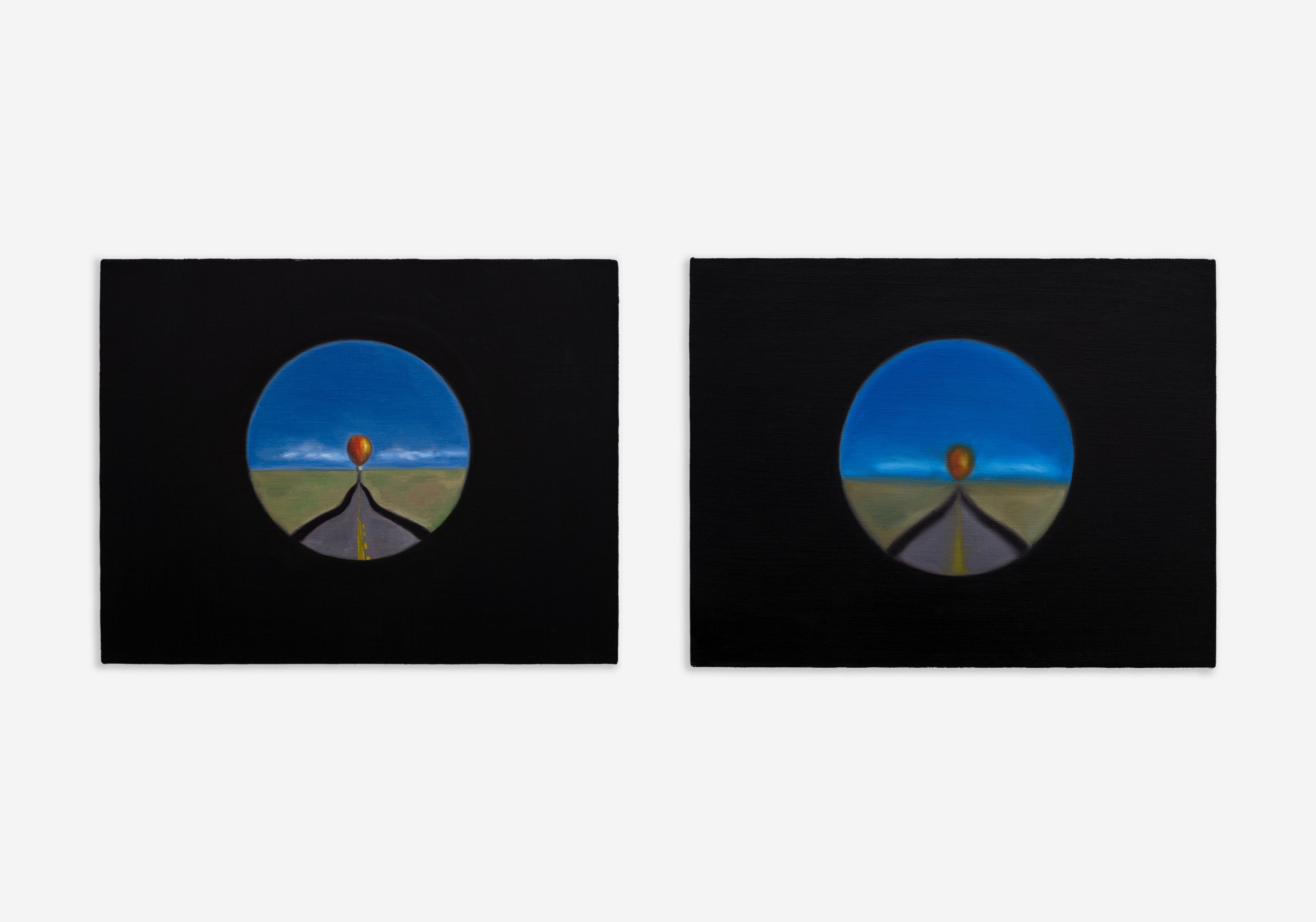
Each panel of the diptych is characterized by a black border and a circular viewing aperture at the center. The black border encloses the image the way that the casing of the autorefractor encloses the optical system, the way that the frame of the machine frames the field of vision, the way that the housing of the instrument defines the limits of what the eye can see when it looks into the machine, and the circular aperture is the pupil of the machine, the opening through which the light passes, the opening through which the eye sees the image that the machine projects, and the aperture mimics the structure of the human eye, the opening that regulates the amount of light that enters the optical system, the opening that expands in the dark and contracts in the bright, the opening that is the first point at which the light is controlled and directed and focused, and the painting recreates this structure, the black border and the circular aperture, the frame and the opening, the enclosure and the window, and the recreation is the argument, the argument that the painting is itself an optical instrument, an instrument that controls and directs and focuses the vision of the viewer, an instrument that frames what the viewer sees and limits what the viewer can see to what is inside the circle, and the limiting is the subject, the subject that the eye does not see everything, the eye sees what the aperture allows it to see, the eye sees through the pupil, and the pupil is the circle, and the circle is the frame, and the frame is the painting, and the painting is the optical instrument, and the optical instrument is the autorefractor, and the autorefractor is the machine that measures the eye, and the machine is the technology, and the technology is the extension of the body, and the extension is what Tan Mu has described, the extension of the human body through tools that expand or alter the visual range, tools like microscopes and telescopes and autorefractors that allow us to see what would otherwise remain invisible, and the invisible is what the painting makes visible, the invisible mechanism of sight itself, the mechanism that the eye cannot see because the eye is the mechanism, and the painting is the mirror that the eye holds up to itself, and the mirror is the diptych, and the diptych is the two states of vision, and the two states are the blurred and the sharp, and the blurred panel shows the image as it appears before the correction, the soft and diffused image that mirrors how the world appears without technological assistance, the image that is organic and imprecise and human, and the sharp panel shows the image as it appears after the correction, the image that snaps into focus through mechanical calibration, the image that is precise and clear and corrected, and the correction is the technology, and the technology is the extension, and the extension is the painting, and the painting is the diptych, and the diptych is the moment of recalibration, and the moment is what the viewer experiences, and the experience is the shift from the blurred to the sharp, and the shift is the recalibration, and the recalibration is the technology, and the technology is the extension of the eye, and the eye is the house inside the machine, and the house is the cheerful image at the end of the tunnel of light, and the tunnel is the aperture, and the aperture is the circle, and the circle is the frame, and the frame is the painting, and the painting is the instrument that makes the mechanism of sight visible to the eye that uses the mechanism to see.
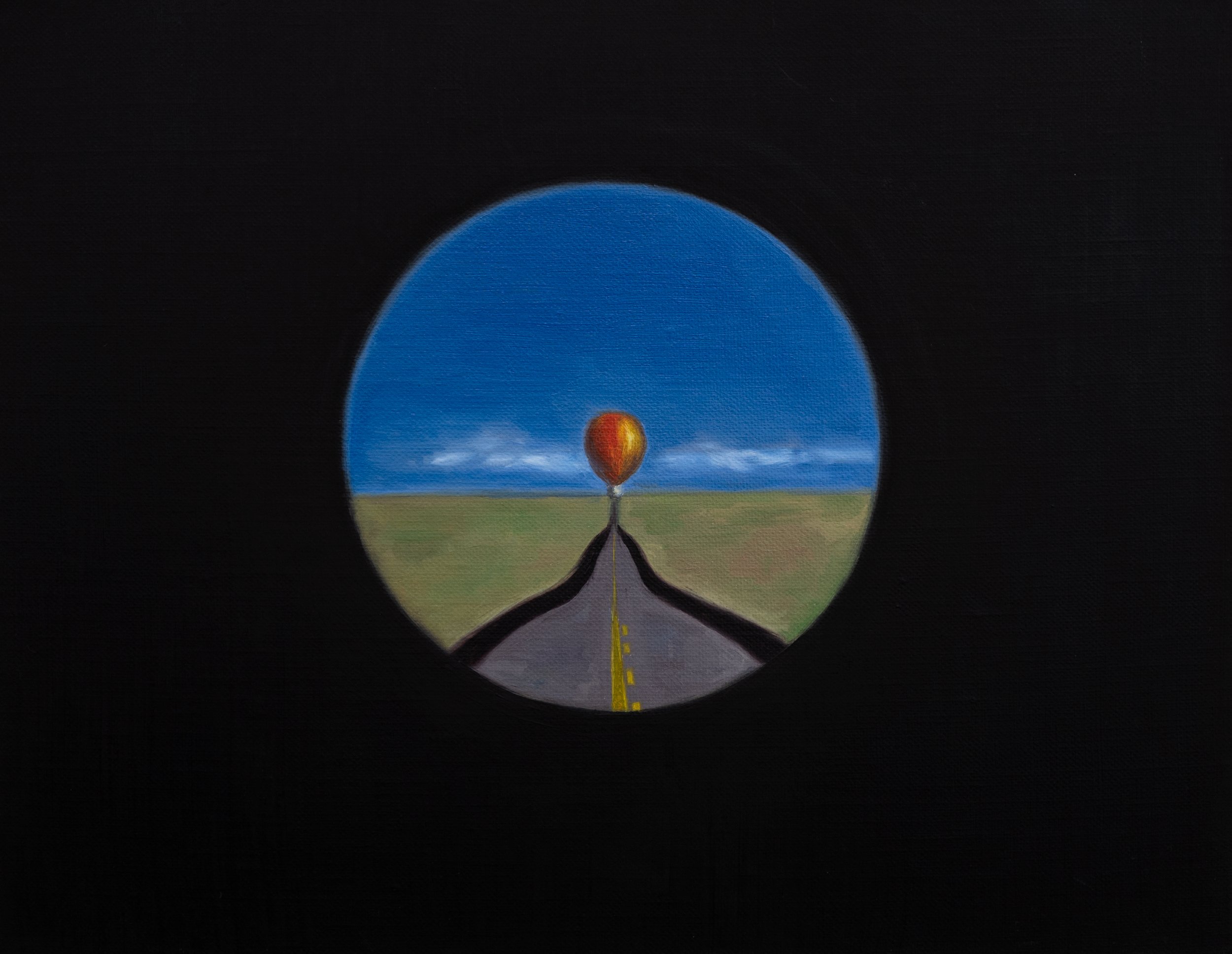
Leon Battista Alberti wrote De Pictura in 1435, and in the first book of that treatise he described painting as a window, a finestra, an opening through which the viewer looks at the world, and the window is the frame, the frame that defines the limits of the picture, the frame that determines what is inside the painting and what is outside the painting, the frame that converts the infinite expanse of the visible world into a finite rectangle that the viewer can comprehend, and the rectangle is the window, and the window is the painting, and the painting is the view through the window, the view that the viewer sees when the viewer stands before the painting and looks through the frame as through a window, and Alberti's metaphor has been one of the founding principles of Western painting for six centuries, the principle that the painting is a window, that the surface of the painting is transparent, that the viewer looks through the surface to the scene beyond, and the scene beyond is the world that the painting represents, the world that exists on the other side of the window, the world that the frame of the painting makes visible and that the frame of the painting also limits, because the window is finite, the window has edges, the window has a frame, and the frame defines what the viewer can see, and what the viewer cannot see is everything that is outside the frame, everything that is beyond the edges of the window, everything that is not in the painting, and the limitation is the condition of vision, the condition that the eye cannot see everything, the eye sees what the window allows it to see, the eye sees through the aperture, and the aperture is the pupil, and the pupil is the circle in Tan Mu's painting, the circle that frames the image the way that Alberti's window frames the scene, the circle that limits what the viewer can see to what is inside the circle, and the limitation is the subject, the subject that vision is always framed, always limited, always partial, always a view through an aperture, whether the aperture is the pupil of the eye or the lens of the autorefractor or the window of the painting, and the painting makes this framing visible, the painting shows the frame, the painting shows the black border and the circular aperture, the painting shows the mechanism that limits and directs and controls the vision, and the showing is the argument, the argument that the painting is not a window but an instrument, not a transparent surface through which the viewer looks at the world but an opaque device through which the viewer examines the mechanism of sight, and the device is the autorefractor, and the autorefractor is the machine that measures the eye, and the painting is the machine that makes the mechanism visible, and the mechanism is the aperture, and the aperture is the circle, and the circle is the frame, and the frame is the painting, and the painting is the instrument, and the instrument is the finestra that Alberti described, except that the finestra has become an instrument, the window has become a device, the transparent surface has become an opaque frame, and the opaque frame is the black border that surrounds the circular aperture in each panel of the diptych, and the black border is the casing of the machine, and the machine is the painting, and the painting is the instrument that makes the mechanism of sight visible to the eye that uses the mechanism to see.
The autorefractor operates by projecting a pattern of infrared light into the eye and measuring the reflection that returns from the retina, and the measurement allows the machine to calculate the refractive error of the eye, the degree to which the eye fails to focus light on the retina, and the failure is the astigmatism, the myopia, the hyperopia, the condition that makes the world appear blurred without correction, and the correction is the lens, the lens that the optometrist prescribes after the measurement, the lens that refocuses the light on the retina and makes the world appear sharp, and the sharpness is the correction, and the correction is the technology, and the technology is the extension of the eye, and the extension is what Tan Mu has described as the recalibration of sight, the instant when technology transforms perception, the instant when the blurred becomes sharp, the instant when the organic vision is corrected by the mechanical lens, and the instant is what the diptych captures, the instant of transition from one state to another, the instant that is analogous to the moment of a nuclear explosion or the moment a droplet hits a surface, the instant that Tan Mu has described as a fleeting transition when perception is abruptly redefined, and the redefinition is the technology, and the technology is the autorefractor, and the autorefractor is the machine that projects the cheerful image, the house or the balloon or the boat, the image that is the target that keeps the eye still while the machine measures the eye, and the image is the painting, and the painting is the diptych, and the diptych is the two states, and the two states are the before and the after, and the before is the blurred vision that the eye sees without correction, and the after is the sharp vision that the eye sees with correction, and the correction is the technology, and the technology is the extension of the body, and the body is the eye, and the eye is the organ that sees, and the seeing is the process, and the process is the shift from blurred to sharp, and the shift is the recalibration, and the recalibration is the moment, and the moment is what the painting holds in the two panels of the diptych, the two states of vision that the eye passes through in the instant of recalibration, and the instant is the house inside the eye, and the house is the image that the machine projects, and the image is the cheerful picture at the end of the tunnel of light, and the tunnel is the aperture, and the aperture is the circle, and the circle is the frame, and the frame is the painting, and the painting is the instrument that measures sight by making sight visible, and the visibility is the diptych, and the diptych is the before and the after, and the before is blurred and the after is sharp, and the transition between them is the instant that the machine measures and the painting captures and the viewer experiences, and the experience is the recalibration of sight, and the recalibration is the technology, and the technology is the extension of the body, and the body is the eye, and the eye is the organ that sees the house inside the machine, and the house is the painting, and the painting is 11 by 14 inches, and the 11 by 14 inches is the frame that holds the two states, and the two states are the blurred and the sharp, and the blurred and the sharp are the before and the after, and the before and the after are the diptych, and the diptych is the instrument, and the instrument is the painting, and the painting is Vision.
Bridget Riley made Movement in Squares in 1961. The work is a black and white composition of alternating vertical stripes that create the illusion of depth and curvature on a flat surface, and the stripes are not all the same width, they are narrower in the center and wider at the edges, and the variation in width produces the optical effect of a surface that appears to fold and undulate, to recede and advance, to create the impression of three-dimensional space on a surface that is entirely flat, and the effect is produced entirely by the arrangement of the stripes, the stripes that are black and white and nothing else, the stripes that are the simplest possible visual material, the stripes that are the most elementary unit of contrast, the unit that the eye uses to distinguish one thing from another, the unit that the retina uses to detect edges and boundaries and the borders between objects, and the stripes are the mechanism of sight reduced to its most basic component, the component that the visual system processes before it processes anything else, the component that is the first step in the construction of vision, and Riley's work makes this mechanism visible, it makes the mechanism visible by arranging the stripes in a way that produces an effect that the viewer cannot help but see, an effect that is not in the stripes themselves but in the way that the visual system processes the stripes, an effect that is produced by the mechanism of sight rather than by the arrangement of the paint, and the effect is the subject, the subject that the visual system constructs the world that the viewer sees, the subject that the world as the viewer sees it is a construction of the visual system, and the construction is the mechanism, and the mechanism is what Riley's work makes visible, and the visibility is the subject, the subject that Tan Mu's Vision also makes visible, the subject that the mechanism of sight is itself a mechanism, a mechanism that can be measured and corrected and extended, a mechanism that produces the world as the viewer sees it, a mechanism that can be recalibrated by a technology that measures the eye and corrects the eye and extends the capacity of the eye to see, and the recalibration is what the diptych captures, the recalibration that is the shift from the blurred to the sharp, the recalibration that is the correction of the mechanism by the technology, the recalibration that is the extension of the body by the instrument, and the instrument is the painting, and the painting is the diptych, and the diptych is the two states of vision, the before and the after, the organic and the mechanical, the natural and the corrected, and the two states are what Riley's work also addresses, the two states of the visual system, the state in which the system is processing the input correctly and the state in which the system is producing an illusion, the state in which the stripes are stripes and the state in which the stripes appear to fold and undulate, and the two states are the mechanism, and the mechanism is the visual system, and the visual system is the eye, and the eye is the organ that sees, and the seeing is the process, and the process is the recalibration, and the recalibration is the moment that the diptych captures, the moment when the blurred becomes sharp, the moment when the organic becomes mechanical, the moment when the natural becomes corrected, the moment when the house inside the eye snaps into focus and the vision recalibrates and the mechanism of sight becomes visible to the eye that uses the mechanism to see, and the visibility is the painting, and the painting is Vision, and Vision is the diptych, and the diptych is the two states, and the two states are the blurred and the sharp, and the sharp is the correction, and the correction is the technology, and the technology is the extension of the body, and the body is the eye, and the eye is the house inside the machine, and the house is the cheerful image at the end of the tunnel of light, and the tunnel is the aperture, and the aperture is the circle, and the circle is the frame, and the frame is the painting, and the painting is the instrument that makes the mechanism of sight visible to the eye that sees through it, and the mechanism is what remains invisible until the machine measures it and the painting captures it and the viewer experiences it, and the experience is the shift from one state to another, and the shift is the recalibration, and the recalibration is the instant that defines the moment when the organic eye meets the mechanical lens and the world snaps into focus, and the focus is the correction, and the correction is the house inside the eye, and the house is the image that the machine projects, and the image is the painting, and the painting is the diptych, and the diptych is Vision.