The Gap Where Thought Passes: Tan Mu's Synapse and the Space Between Connection and Disconnection
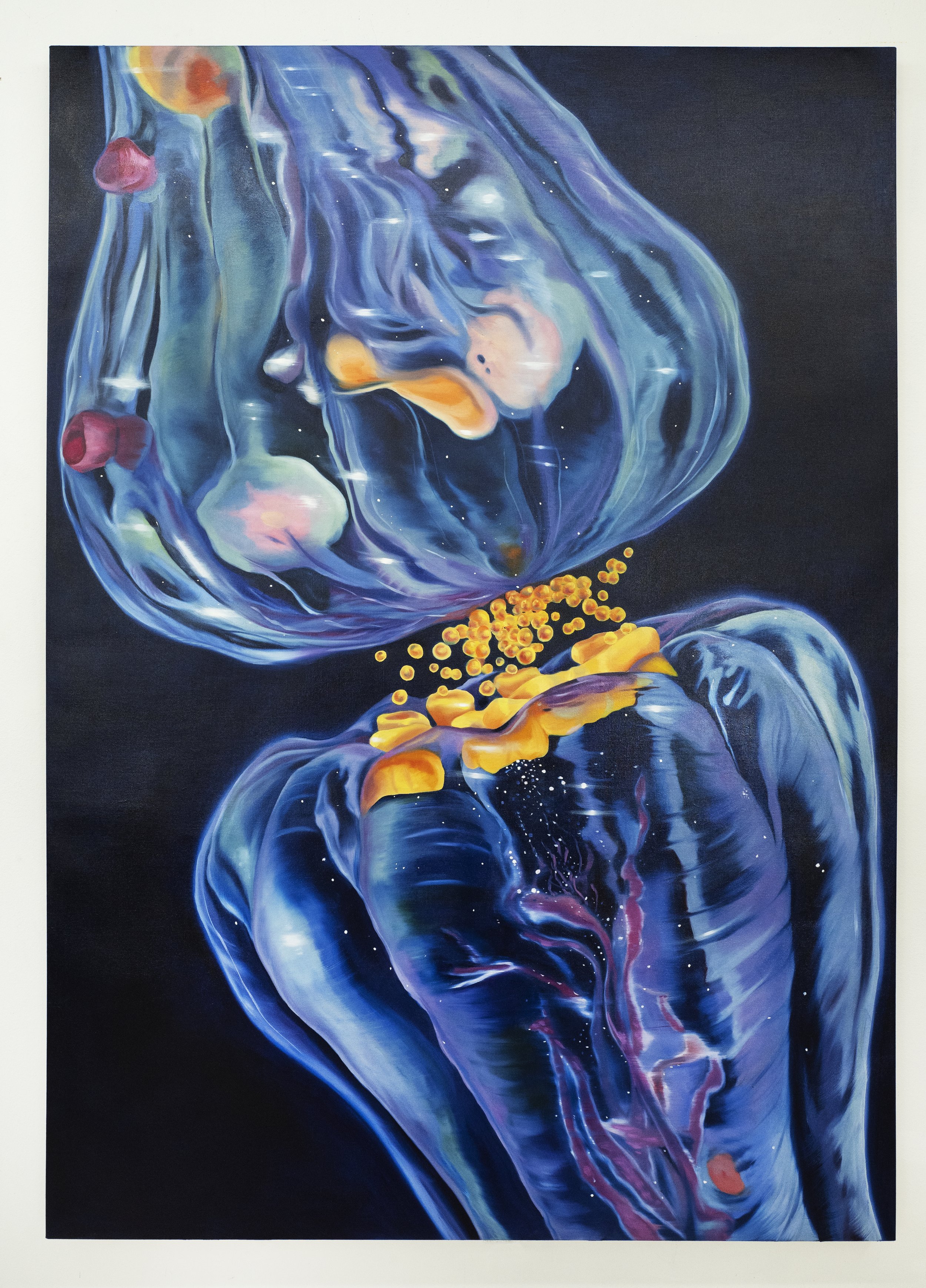
The synapse is not a connection. This is the paradox that the word conceals and that the painting reveals, because the synapse is a gap, a microscopic gap between the terminal of one neuron and the receptor of another, a gap that the neurotransmitters must cross in order for the signal to continue, a gap that is not a bridge but a space, a space that separates the two neurons and that the neurotransmitters traverse, and the traversal is the communication, and the communication is not continuous, it is interrupted, it is a signal that stops at the end of one neuron and crosses the gap in chemical form and arrives at the beginning of the next neuron and is converted back into electrical form and continues, and the conversion is the synapse, and the synapse is the gap, and the gap is where the thought passes, the thought that is not a continuous stream but a series of transmissions that cross a series of gaps, a series of synapses that separate a series of neurons, and each synapse is a gap that the signal must cross, and the crossing is not automatic, the crossing is mediated by the neurotransmitters, the chemical messengers that are released from the terminal of one neuron and that bind to the receptors on the next neuron, and the binding is the switch, the switch that determines whether the signal continues or stops, whether the connection is made or the connection is broken, and the switch operates like an on and off mechanism, and the on and off mechanism is what Tan Mu has described, the moment of transmission that exists between connection and separation, the moment that operates like an on and off switch, the moment that is the synapse, and the synapse is the gap, and the gap is where the thought passes, and the thought is not a continuous stream but a series of crossings that pass through a series of gaps, and the gaps are the spaces where the thought is not connected but disconnected, not continuous but interrupted, not fixed but negotiated, and the negotiation is the painting, and the painting is Synapse (2023), and Synapse is 184 by 132 centimeters of oil on linen, and the 184 by 132 centimeters is the space where the gap is visible, where the disconnection is visible, where the space between the neurons is rendered in luminous hues of blue and yellow, and the blue is the neuron and the yellow is the neurotransmitter and the gap between them is the space where the thought passes, and the thought is the signal that crosses the gap, and the crossing is the communication, and the communication is the painting.
Synapse (2023) is an oil painting on linen, 184 x 132 cm (72.5 x 52 in). The scale is large, larger than most of Tan Mu's works, and the scale is appropriate to the subject, because the subject is the interior of the brain, the interior of the neural network, the interior of the system that produces thought and memory and perception and consciousness, and the interior is vast, the brain contains approximately 86 billion neurons and each neuron forms approximately 7,000 synaptic connections with other neurons, producing a total of approximately 600 trillion synapses, and the number is incomprehensible, the number is too large for the mind to grasp, and the painting does not attempt to represent the number, it attempts to represent the process, the process by which a signal crosses the gap between one neuron and another, the process by which the neurotransmitter is released from the terminal and binds to the receptor and the signal continues, and the process is what the painting holds in its 184 by 132 centimeters, the process that occurs at a scale that is too small for the eye to see, the process that occurs at the scale of the nanometer, the process that occurs in the space between the neurons that are too small and too numerous for any painting to represent in its entirety, and the painting does not represent the entirety, it represents the principle, the principle that the communication between neurons is not a direct connection but a gap that the signal must cross, and the gap is the synapse, and the synapse is the painting, and the painting is 184 by 132 centimeters, and the centimeters hold the gap that the nanometer contains, and the gap is where the thought passes.
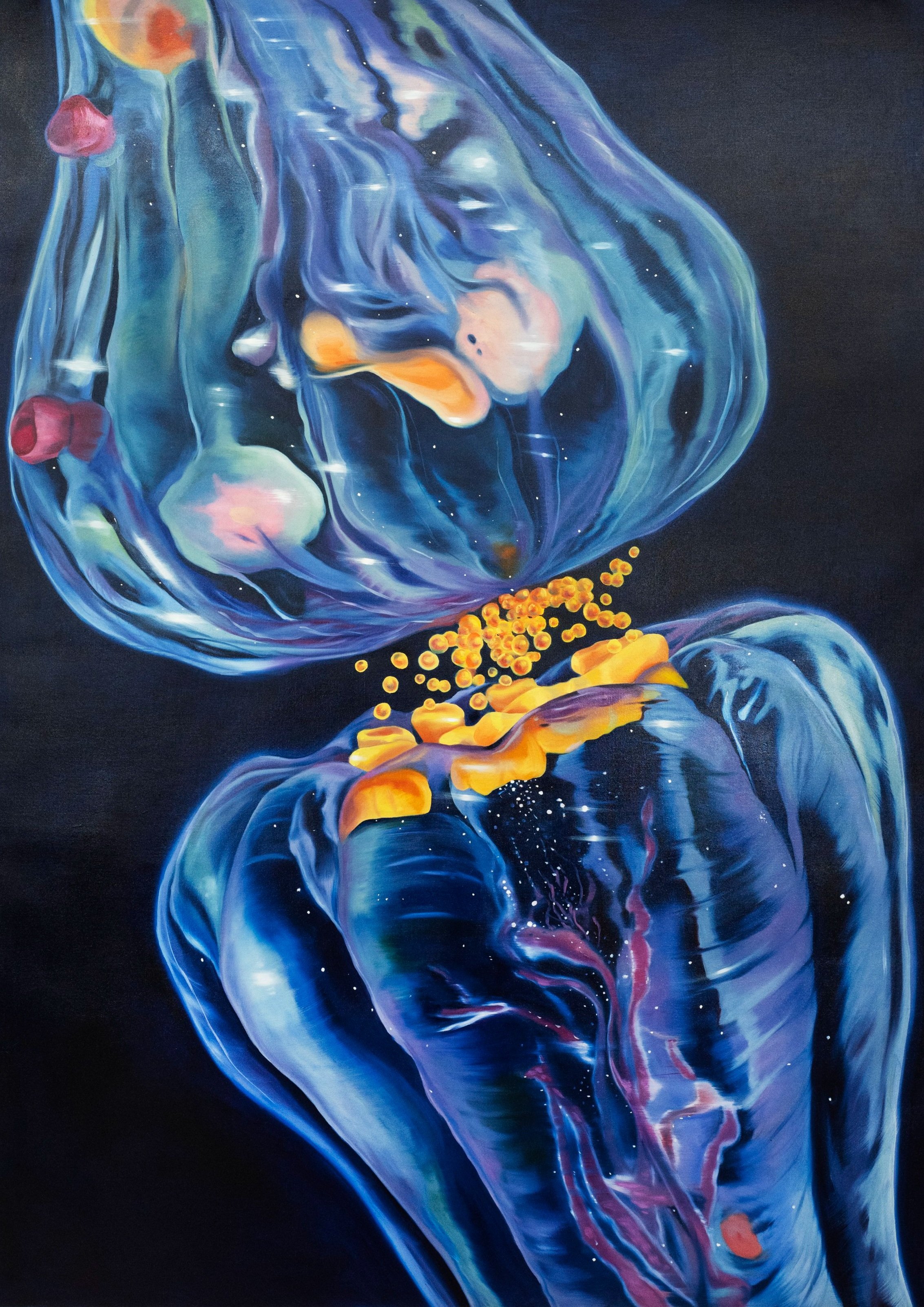
The painting is organized around a contrast between blue and yellow that Tan Mu has described as central to how she visualizes neural communication. The blue forms the structural environment of the neurons themselves, the elongated bodies and the branching dendrites and the extending axons that make up the architecture of the neural network, and the blue is deep and cool and structural, the blue of the cell body and the blue of the myelin sheath and the blue of the membrane that encloses the neuron and maintains the electrical potential that allows the signal to propagate, and the blue grounds the composition, provides the structure that holds the network together, provides the architecture through which the signal travels, and the yellow is the neurotransmitter, the chemical messenger that crosses the synaptic cleft, the messenger that is released from the terminal of one neuron and that binds to the receptor on the next neuron, and the yellow is luminous and bright and active, the yellow that marks the precise moment when the chemical signal becomes an electrical impulse, the yellow that marks the moment of transmission, the moment of connection, the moment when the gap is crossed, and the yellow appears almost alive against the blue, it glows with an intensity that suggests not the reflected light of the blue but the emitted light of the chemical reaction, the light of the electrical impulse, the light of the signal that is being transmitted, and the contrast between the blue and the yellow is the contrast between the structure and the signal, between the architecture and the transmission, between the neuron and the neurotransmitter, between the cell and the chemical that the cell releases to communicate with the next cell, and the communication is the crossing of the gap, and the gap is the synapse, and the synapse is the space where the yellow crosses the blue, and the crossing is the painting, and the painting is the contrast between the blue and the yellow, and the contrast is the communication, and the communication is the thought that passes through the gap between the neurons, and the gap is where the thought passes, and the thought is the signal, and the signal is the yellow, and the yellow is the neurotransmitter, and the neurotransmitter is the chemical that crosses the gap, and the gap is the synapse, and the synapse is the painting, and the painting is 184 by 132 centimeters of blue and yellow and the gap between them where the signal passes from one neuron to another and the thought continues.
Santiago Ramón y Cajal drew the Purkinje neurons of the cerebellum around 1899, and the drawings are among the most influential scientific images in the history of neuroscience, because they showed for the first time what the brain looks like when the brain is seen at the scale of the individual neuron, and what the brain looks like is not a continuous web of connected fibers but a collection of individual cells that are separated by gaps, and the gaps are the synapses, and the synapses were not visible in Cajal's drawings, because the synapse is too small to be seen with the microscope that Cajal used, but the gaps between the neurons were visible, the spaces between the terminal of one neuron and the beginning of the next, the spaces that Cajal could see but could not cross, the spaces that he inferred must exist because the neurons did not appear to be continuous, they appeared to be individual units that were separated by spaces, and the spaces were the evidence for the neuron doctrine, the doctrine that the nervous system is composed of individual cells rather than a continuous network, and the doctrine was the foundation of modern neuroscience, and the foundation was the gap, the gap that Cajal drew between the neurons, the gap that he could see but not fill, the gap that he left empty in his drawings, the gap that the neurotransmitter would later be discovered to cross, and the gap is the synapse, and the synapse is what Tan Mu has painted, the gap between the neurons, the space where the neurotransmitter crosses, the space where the signal is transmitted, the space where the thought passes, and the painting fills the gap with yellow, fills the space between the blue neurons with the luminous yellow of the neurotransmitter, fills the gap that Cajal left empty in his drawings, and the filling is the painting, the painting that makes visible the process that Cajal could only infer, the painting that renders in color the chemistry that Cajal could not see, the painting that shows the gap and the crossing and the transmission and the connection that is not a connection but a gap that the signal crosses, and the crossing is the yellow, and the blue is the neuron, and the yellow is the neurotransmitter, and the gap between them is the synapse, and the synapse is the space where the thought passes, and the thought is the signal that crosses the gap, and the signal is the electrical impulse that propagates along the neuron and becomes a chemical messenger at the synapse and becomes an electrical impulse again on the other side of the gap, and the conversion is the process, and the process is what the painting holds, and the painting holds it in 184 by 132 centimeters of oil on linen, and the oil on linen is the surface where the gap is visible and the crossing is visible and the yellow is visible against the blue and the blue is visible against the dark ground and the dark ground is the space where the neurons float and the neurons float in the extracellular fluid that surrounds them in the brain and the fluid is the dark ground of the painting and the neurons are the blue forms that rise from the dark ground and the yellow is the light that crosses the gap between them and the gap is the synapse and the synapse is the painting and the painting is the gap where the thought passes.
The synaptic cleft is approximately 20 to 40 nanometers wide, a space that is too small for the eye to see and too small for the light microscope to resolve, and the space is the gap between the terminal of one neuron and the receptor of the next, and the gap is where the neurotransmitter is released and where it diffuses and where it binds and where the signal is transmitted, and the transmission is the process that Tan Mu has described as operating like an on and off switch, the switch that determines whether the signal continues or stops, whether the connection is made or the connection is broken, and the switch is the metaphor, the metaphor that connects the biological process to the computational process, the metaphor that connects the synapse to the logic circuit, the metaphor that connects the brain to the computer, and the connection is the analogy that Tan Mu has drawn between the synaptic connections in the brain and the logic circuits in computers, the analogy that both systems depend on simple switching mechanisms that determine whether information flows or stops, and the flow is the signal and the stop is the gap and the gap is the synapse and the synapse is the switch and the switch is the on and off and the on and off is the binary logic that underlies both neural communication and digital computation, and the binary logic is the principle, the principle that the brain and the computer share a common structure of switches and gaps and flows and stops, and the structure is what the painting represents, the structure of the synapse as a switch that opens and closes, that connects and disconnects, that allows the signal to pass or prevents it, and the passing and the preventing are the two states of the switch, the two states that the neuron and the computer share, and the sharing is the analogy, and the analogy is what Tan Mu has described as the parallel between synaptic connections in the brain and logic circuits in computers, and the parallel is the painting, and the painting is the representation of the synapse as a switch, and the switch is the gap, and the gap is the space where the thought passes, and the thought is the signal that crosses the gap or the signal that is stopped at the gap, and the crossing or the stopping is the on or the off, and the on or the off is the logic that the brain and the computer share, and the sharing is the analogy, and the analogy is what the painting holds, and the painting holds it in 184 by 132 centimeters of blue and yellow and the gap between them, and the blue is the structure and the yellow is the signal and the gap is the switch and the switch is the synapse and the synapse is the gap where the thought passes or the thought stops, and the passing or the stopping is the on or the off, and the on or the off is the binary logic that underlies the neural network and the computational network and the network is the painting and the painting is the network of blue forms and yellow crossings and dark gaps and the gaps are the synapses and the synapses are the switches and the switches are the on and off and the on and off is the thought that passes through the gap or the thought that stops at the gap, and the thought is the signal and the signal is the neurotransmitter and the neurotransmitter is the yellow and the yellow crosses the gap and the gap is the synapse and the synapse is the painting.
Julie Mehretu painted Stadia I in 2004, and the painting is a large canvas covered with marks, marks that represent crowds and flags and banners and architectural fragments and the vectors of movement and energy that characterize large public events, stadiums and arenas and protest marches and political rallies, and the marks are organized in layers, some are dense and dark and concentrated in the center of the canvas and others are sparse and light and dispersed toward the edges, and the organization produces the effect of a system, a system of marks that are related to each other through proximity and density and direction, a system of connections and disconnections that forms a network, and the network is the painting, the painting that is a network of marks that are connected and disconnected, that flow and stop, that converge and diverge, that form clusters and disperse, and the network is the visual analogy for the social systems that Mehretu is depicting, the systems of crowds and politics and architecture and media that organize human activity in the contemporary world, and the systems are the networks, and the networks are the marks, and the marks are the connections and the disconnections, and the connections and the disconnections are the flows and the stops, and the flows and the stops are the same binary logic that Tan Mu has identified in the synapse, the logic of the on and the off, the logic of the signal that passes and the signal that stops, the logic of the switch that opens and closes, and the switch is the gap, and the gap is the synapse, and the synapse is the space where the thought passes, and the thought passes through the network of neurons the way that the marks pass through the network of the painting, and the marks are the signals and the signals are the neurotransmitters and the neurotransmitters are the yellow that crosses the gap between the blue neurons, and the crossing is the connection and the gap is the disconnection and the disconnection is the space between the marks and the space between the marks is the same kind of space as the space between the neurons, the space that is not empty but is the location where the transmission occurs, the space where the signal crosses, the space where the on and the off are determined, the space that Mehretu's painting leaves between the marks and that Tan Mu's painting fills with the yellow of the neurotransmitter, the yellow that makes the gap visible, the yellow that makes the crossing visible, the yellow that makes the transmission visible, and the visibility is the painting, and the painting is the gap where the thought passes, and the thought passes through the network of neurons the way that the marks pass through the network of the painting, and the network is the system and the system is the structure and the structure is the blue and the blue is the neuron and the yellow is the signal and the signal crosses the gap and the gap is the synapse and the synapse is the space where the thought passes and the thought is the connection and the connection is the crossing and the crossing is the yellow and the yellow is the luminous color that marks the moment of transmission and the moment of transmission is the moment when the chemical signal becomes an electrical impulse and the impulse becomes a thought and the thought passes through the network and the network is the brain and the brain is the system of neurons and synapses and neurotransmitters and electrical impulses and chemical messengers and the messengers are the yellow and the neurons are the blue and the synapses are the gaps and the gaps are where the thought passes and the thought is never fixed but continuously negotiated through moments of connection and disconnection, and the negotiation is the painting, and the painting is 184 by 132 centimeters, and the centimeters hold the gap and the gap holds the thought and the thought is the yellow that crosses the blue and the blue is the structure and the structure is the network and the network is the brain and the brain is the organ that thinks and the thinking is the process of signals crossing gaps and the gaps are the synapses and the synapses are the spaces where the thought passes and the thought passes through the gap and the gap is the painting and the painting is the synapse and the synapse is the space between connection and disconnection and the space is where the thought is negotiated and the negotiation is continuous and the continuity is the network and the network is the blue and the yellow and the gap and the gap is where thought passes.