The Word That Broke the Machine: Tan Mu's Error and the Message That Only Appears When Everything Stops Working
Error messages appear when something breaks. This is the simplest fact about them and the most important, because the error message is the only moment when the machine speaks to the user in a language that the user can understand, the only moment when the layers of code that normally operate beneath the surface of the interface reveal themselves through the crack that the error has opened, the only moment when the system that has been designed to be invisible becomes visible, and the visibility is the error, the error that appears on the screen in a word or a number or a phrase that tells the user that something has gone wrong, that the system has encountered a condition that it was not prepared to handle, that the information that the user requested cannot be retrieved, that the operation that the user initiated cannot be completed, that the connection that the user relied upon has been lost, and the word is the message, and the message is the error, and the error is the communication from the machine to the human, the communication that only occurs when the machine cannot perform the function that the machine was built to perform, the communication that arrives at the moment of failure and that describes the failure in terms that the human can understand, and the understanding is the purpose of the message, the purpose that the message serves when the system cannot serve its intended purpose, the purpose of telling the user that the system has failed and that the failure is the reason that the message is on the screen, and the message is the word, and the word is ERROR, and the word ERROR is the subject of Tan Mu's painting, the word that appears when the system breaks and the machine speaks to the human in a language that the human can read, and the reading is the communication, and the communication is the interruption, and the interruption is the subject of the painting, and the painting is the word that broke the machine.
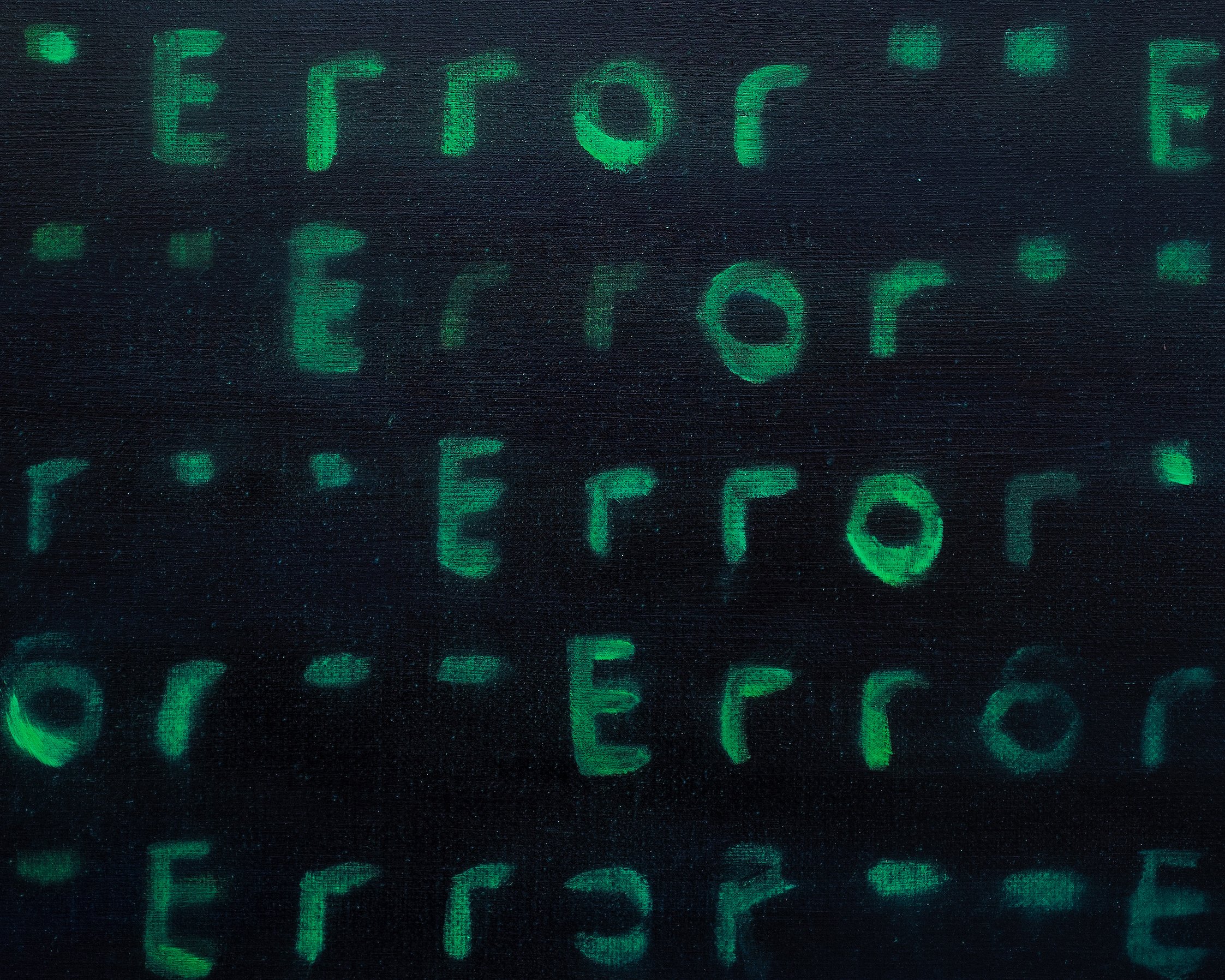
Error (2022) is an oil painting on linen, 30 x 61 cm (12 x 24 in). The format is horizontal, wider than it is tall, the format of a screen, the format of a monitor, the format of the display that shows the error message to the user, and the format is not a coincidence, it is a decision, a decision to make the painting the same shape as the screen that displays the error, the same shape as the interface that the user sees when the system fails, the same shape as the surface on which the error message appears, and the surface is the screen, and the screen is the painting, and the painting is the surface on which the word ERROR glows in green light against a dark background, and the green light is the light of the early pixel-based screen displays, the monochrome green phosphor monitors that were once widely used in computing, the monitors that displayed text in green on a black background because the phosphor that coated the inside of the cathode ray tube emitted green light when it was struck by the electron beam, and the green light is the light of a specific technological era, an era when the screen displayed only one color and the color was the color of the phosphor and the phosphor was the medium and the medium was the message and the message was the word ERROR glowing in green on a black background, and the glowing is the sensation that Tan Mu has sought to recreate in the painting, the sensation of emitted light rather than reflected light, the sensation that the surface of the painting is not reflecting the light of the room but emitting its own light the way that the screen emits its own light, the sensation that the painting is a screen and the screen is a painting and the word ERROR is both a word that the machine produces and an image that the painter produces, and the production is the same, the production of a glowing form on a dark surface, the production of a luminous word on a dark field, the production of the word that appears when the system fails and that tells the user that the system has failed, and the telling is the communication, and the communication is the error, and the error is the painting, and the painting is 30 by 61 centimeters of oil on linen, and the 30 by 61 centimeters is the frame that holds the word that broke the machine.
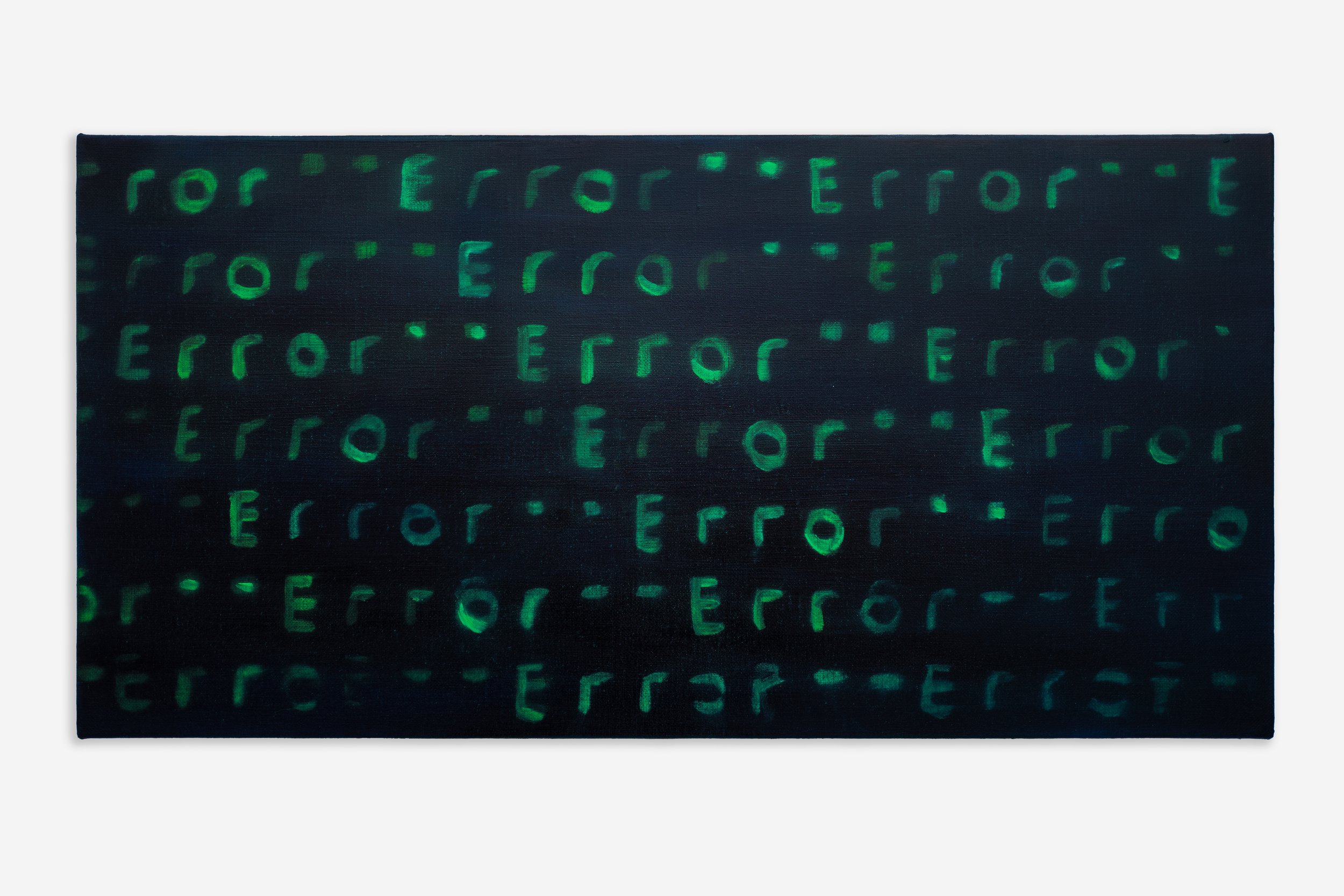
The word ERROR in the painting is rendered in a green that glows against the dark background with the intensity of phosphor light, and the green is not a flat green, it is a green that transitions through layered gradients, a green that is lighter at the center of each letter and darker at the edges, a green that creates the illusion that the light is emanating from within the surface rather than falling upon it from without, and the illusion is the achievement, the achievement of making oil paint behave like emitted light, the achievement of making the surface of the canvas appear to generate its own illumination the way that the surface of the screen generates its own illumination, the achievement of making a material that reflects light behave as though it emits light, and the achievement is the technique, the technique of layered color transitions and subtle gradients that Tan Mu has described as evoking the luminosity of digital screens and lightboxes, the technique that allows the surface to appear as if it is glowing from within, bridging the material language of painting with the immaterial experience of screen-based imagery, and the bridging is the visual tension, the tension between the physical pigment and the simulated light, the tension between the oil that is painted on the linen and the light that appears to emanate from the word, the tension between the hand that made the mark and the machine that made the word, and the tension is the painting, the painting that holds both the material and the immaterial, the oil and the light, the hand and the machine, the mark and the word, and the word is ERROR, and ERROR is the message that only appears when the machine stops working, and the machine stops working and the message appears and the message is painted in oil on linen and the oil on linen glows with the green light of the phosphor screen and the green light of the phosphor screen is the light of a technological era that is now almost gone, an era of monochrome monitors and command-line interfaces and error messages that appeared in green text on a black screen, and the era is the subject, the subject that Tan Mu has described as preserving these error messages as historical artifacts, as time stamps of a particular era in human-machine interaction, as records of technological experience that might otherwise be forgotten, and the preservation is the painting, and the painting is the record, and the record is the word ERROR glowing in green on a dark background, and the green is the color of the phosphor and the phosphor is the medium and the medium is the era and the era is the time when the machine spoke to the human in green text on a black screen, and the time is the subject, and the subject is the message, and the message is the word, and the word is the error, and the error is the communication from the machine to the human, and the communication occurs only when the machine cannot perform its intended function, only when the system has failed, only when the information pathway has collapsed, and the collapse is the moment that the painting captures, the moment when the system reveals itself most clearly, the moment when the invisible infrastructure of code and protocol and signal becomes visible through the crack that the error has opened, and the visibility is the word ERROR, and the word ERROR is the painting, and the painting is 30 by 61 centimeters of oil on linen that glows with the green light of a screen that no longer exists, a screen that has been replaced by screens that display error messages in different colors and different fonts and different formats, but the error message itself has not changed, the error message is still the word that appears when the system fails, the word that the machine produces to tell the human that something has gone wrong, and the word is the same word, and the word is ERROR, and the painting preserves the word as it appeared on the screens of a particular era, the era of the green phosphor and the monochrome monitor and the command-line interface, and the preservation is the painting, and the painting is the artifact, and the artifact is the time stamp, and the time stamp is the record of a moment when the machine spoke to the human and the human listened and the word that the machine spoke was ERROR.
Kazimir Malevich exhibited Black Square in 1915 at the Last Futurist Exhibition of Paintings 0.10 in Petrograd. The painting is a square of black paint on a white canvas, approximately 80 centimeters on each side, and the black square fills the canvas from edge to edge, leaving only a narrow margin of white visible around the perimeter, and the black is not the black of a representation, it is not the black of a night sky or the black of a void or the black of an absence, it is the black of a surface that has been covered with paint, the black of a material that has been applied to a canvas, the black of a mark that has been made by a hand, and the hand that made the mark was the hand of a painter who declared that the black square was the first step of pure creation in art, the first step toward a painting that was not a representation of anything but was itself the thing that it was, a square of black paint on a white canvas, and the declaration was the argument, the argument that painting had reached a point where it no longer needed to represent the visible world, that painting could create its own reality, that the surface of the canvas was sufficient unto itself, and the sufficiency was the black square, the black square that was not a picture of anything, that was not a window onto a landscape or a portrait of a person or a still life of objects on a table, that was simply a black square on a white canvas, and the simplicity was the argument, and the argument was that the painting was the thing, and the thing was the surface, and the surface was the black paint, and the black paint was the mark, and the mark was the gesture, and the gesture was the creation, and the creation was the first step, and the first step was the black square, and the black square is the precedent for Error, because Error is also a surface that is sufficient unto itself, a surface that displays a word that is not a representation of anything but is the thing itself, the word ERROR that appears on the screen when the system fails, the word that is not a picture of an error but is the error, the word that is not a depiction of a failure but is the failure, the word that is the communication from the machine to the human, the communication that occurs only when the machine cannot communicate through its intended channels, the communication that arrives through the crack that the failure has opened, and the crack is the black square, the black square that Malevich painted in 1915, the black square that was the first step of pure creation, the black square that was not a representation but a thing, and the thing that Error presents is not a representation of an error but is the error, the word that the machine produces when the system fails, the word that glows in green on the dark background the way that Malevich's black square glows in black on the white canvas, the word that is the thing itself, the word that is the message, the word that is the communication, and the communication is the painting, and the painting is the word, and the word is ERROR, and ERROR is the black square of the digital age, the monochrome surface that reveals the system through the failure of the system, the surface that shows what the system is by showing what the system cannot do, the surface that makes the invisible infrastructure visible through the crack that the error has opened, and the crack is the painting, and the painting is the surface, and the surface is the screen, and the screen is the dark background against which the word glows, and the word glows in green, and the green is the phosphor, and the phosphor is the medium, and the medium is the message, and the message is the error, and the error is the communication from the machine to the human, and the communication is the word that broke the machine.
The error message in a computational system is a signal that the system has encountered a condition that it was not designed to handle, a condition that lies outside the expected range of inputs or the anticipated set of operations, and the signal is produced by the error-handling routine that the programmer has written into the code, the routine that specifies what the system should do when something goes wrong, the routine that specifies that the system should display a message that informs the user of the nature of the error, the routine that specifies that the system should stop the current operation and return control to the user, and the routine is the code, and the code is the language, and the language is the set of instructions that the programmer has written to handle the conditions that the programmer has anticipated, and the conditions that the programmer has not anticipated are the conditions that produce the error messages that the programmer has not written, the error messages that are generated by the operating system rather than the application, the error messages that appear in the language of the system rather than the language of the user, the error messages that are brief and cryptic and unhelpful, the error messages that tell the user that something has gone wrong without telling the user what has gone wrong or how to fix it, and these are the error messages that Tan Mu has described as interruptions in information flow, the interruptions that signal failures such as signal loss, system crashes, or breakdowns in communication, the interruptions that reveal the vulnerability of digital systems that we often assume to be seamless and reliable, and the revelation is the subject of the painting, the revelation that the system that appears seamless and reliable is in fact a construction of code and protocol and signal that can fail at any moment, that the smooth surface of the interface conceals a complex infrastructure that is fragile and that breaks, and the breaking is the error, and the error is the message, and the message is the word that appears on the screen when the system stops working, and the word is the communication from the machine to the human, and the communication occurs only at the moment of failure, only when the system cannot perform its intended function, only when the infrastructure becomes visible through the crack that the error has opened, and the visibility is the painting, and the painting is the record of the moment when the system became visible, and the moment is the error, and the error is the word, and the word is ERROR, and ERROR is the word that broke the machine.
Ed Ruscha painted OOF in 1962 and returned to it in 1963, and the painting is a word, the word OOF, rendered in bold yellow letters against a blue background, and the word is not a sentence and not a statement and not a narrative, it is a sound, the sound that a cartoon character makes when hit in the stomach, the sound that a person makes when the air is knocked out of them, the sound of impact and surprise and pain, and the sound is also a word, the word OOF, and the word is also a shape, the shape of the three letters that spell the word, the shape of the O and the O and the F, and the shape is the painting, because the painting is not a painting of a word, it is a painting that is a word, a painting in which the word is the image and the image is the word and there is nothing else, no landscape, no figure, no still life, no representation of anything beyond the word itself, and the word itself is the image, and the image is the word, and the word is the sound, and the sound is the painting, and the painting is the collision of language and visual form, the collision that occurs when a word becomes an image and an image becomes a word and the distinction between the two becomes impossible to maintain, and the collision is relevant to Error because Error is also a painting that is a word, a painting in which the word ERROR is the image and the image is the word and there is nothing else on the surface except the word and the dark background against which the word glows, and the word is also a sound, the sound of the system failing, the sound of the machine speaking to the human, the sound of the error message that appears when something breaks, and the sound is the collision, the collision between the language of the machine and the language of the human, the collision between the code that generates the error message and the word that the error message produces, the collision between the invisible infrastructure and the visible surface, and the surface is the painting, and the painting is the word ERROR glowing in green on a dark background, and the green is the color of the phosphor, and the phosphor is the medium, and the medium is the screen, and the screen is the surface on which the word appears, and the word is the message, and the message is the error, and the error is the interruption, and the interruption is the moment when the system reveals itself, the moment when the invisible becomes visible, the moment when the code becomes a word, the moment when the machine speaks to the human, and the speaking is the communication, and the communication is the word ERROR, and the word ERROR is the OOF of the digital age, the word that appears when the impact occurs, the word that appears when the system is hit, the word that appears when the air is knocked out of the machine, the word that the machine produces when it cannot do what it was built to do, the word that is both a sound and a shape and an image and a message, the word that is the collision of language and visual form, the word that is the painting, and the painting is the word, and the word is ERROR, and ERROR is the word that broke the machine, the word that only appears when the machine stops working, the word that only appears when the system fails, the word that only appears when the infrastructure becomes visible through the crack that the error has opened, and the crack is the painting, and the painting is the surface, and the surface is the screen, and the screen is the dark background against which the green word glows, and the green word is the message, and the message is the error, and the error is the communication from the machine to the human, and the communication is the word that Tan Mu has preserved in oil on linen, the word that appears on a screen that no longer exists, the word that glows in green on a dark background, the word that is the artifact of a technological era, the word that is the time stamp of a moment in human-machine interaction, the word that is the record of the interruption, the word that is the error, and the error is the painting, and the painting is the word, and the word is ERROR, and ERROR is the word that broke the machine.