The Mineral That Thinks: Tan Mu’s Silicon and the Substrate Beneath Every Screen
Somewhere in Inner Mongolia, a open-pit mine produces quartz rock that will become the most consequential material of the twenty-first century. The rock is crushed, heated, and subjected to a series of chemical refinements so extreme that the resulting silicon ingot achieves a purity of 99.99999999 percent. Nine nines. For every ten billion atoms, only one is not silicon. At that concentration, the material stops behaving like rock and starts behaving like logic. It can be doped with boron or phosphorus, etched with ultraviolet light, sliced into wafers thinner than a human hair, and patterned with circuits so dense that a single chip now contains more transistors than there are people on Earth. The ingot itself is a cylinder roughly two meters long and thirty centimeters in diameter, with a surface so smooth it reflects light like dark glass. This is the object Tan Mu chose to paint. Not the chip, not the device, not the screen, but the ingot: the raw, purified substrate from which all digital logic will be carved. The choice is deliberate and disorienting, because most people who encounter silicon every day never see it in this form. They see the phone, the laptop, the data center. They do not see the mineral that makes all of it possible. Tan Mu paints what they do not see.
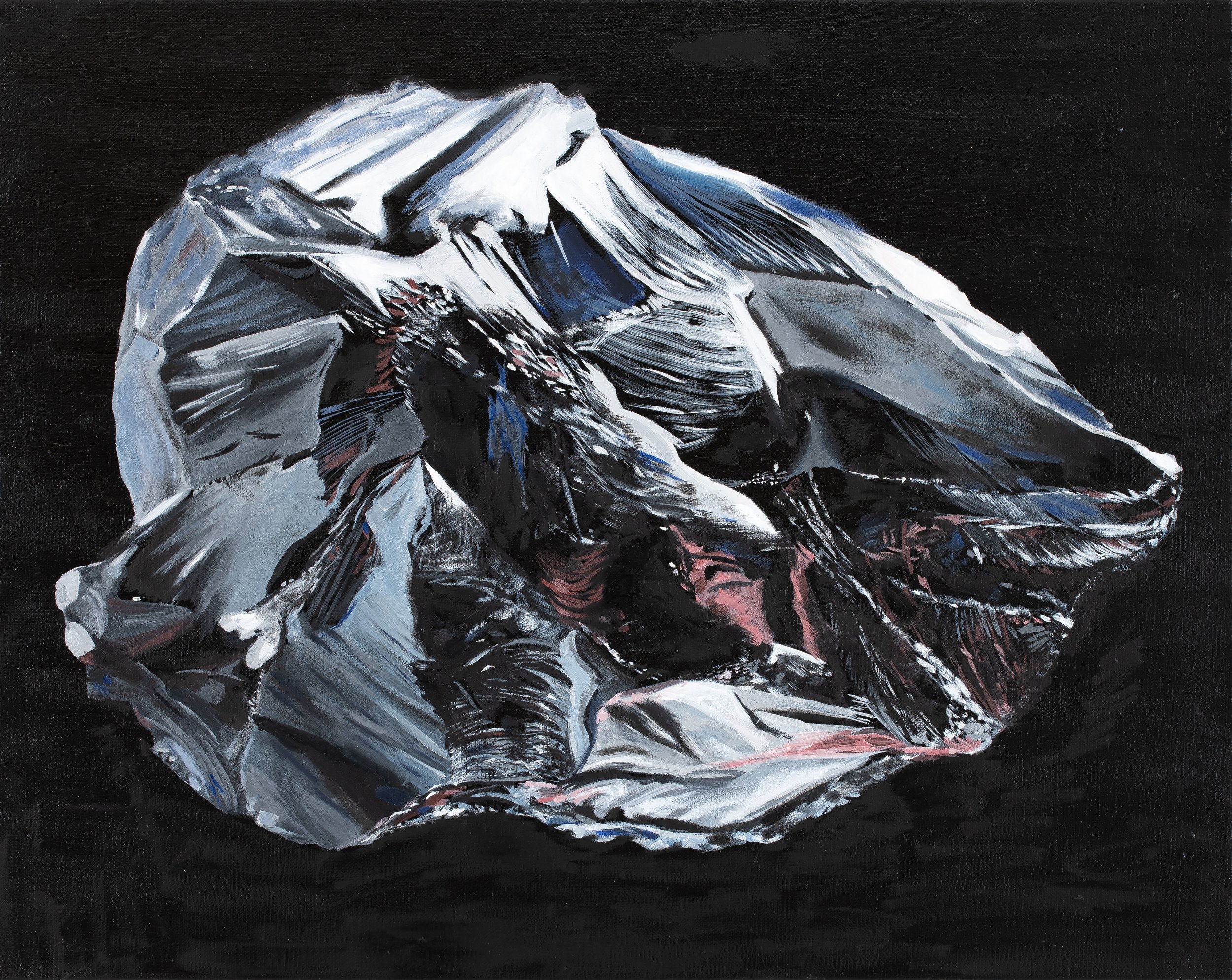
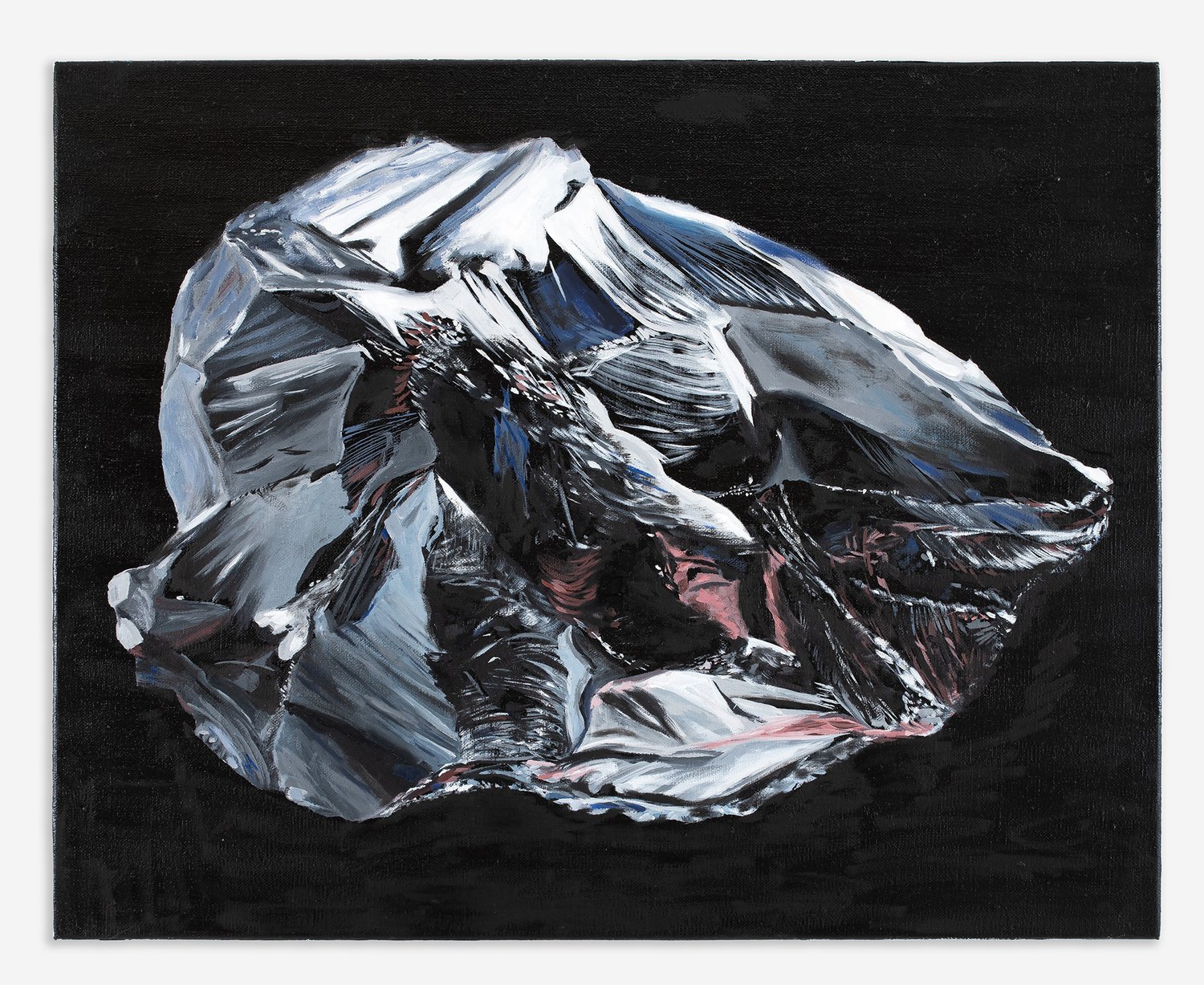
At 40.6 x 50.8 centimeters, Silicon (2021) is an intimate painting. The canvas is small enough to hold at arm's length, small enough that the viewer must step close to register the surface detail. This is not a painting that overwhelms by scale. It overwhelms by density. The ingot fills most of the picture plane, its faceted geometry pressing against the edges of the linen support as though the mineral had been placed on a dark surface and photographed from directly above. Oil on linen, the medium registers every subtlety of the object's refracted light. The ground is near black, a darkness that does not suggest empty space so much as the interior of a clean room or the inside of a semiconductor fabrication facility, where ambient light is controlled to prevent contamination and ultraviolet wavelengths are filtered from the environment because they would expose photoresist coatings on wafers mid-process. Against this darkness, the silicon ingot glows with an interior luminescence that shifts between cool blue, silver, and pale flesh pink depending on where the eye falls.
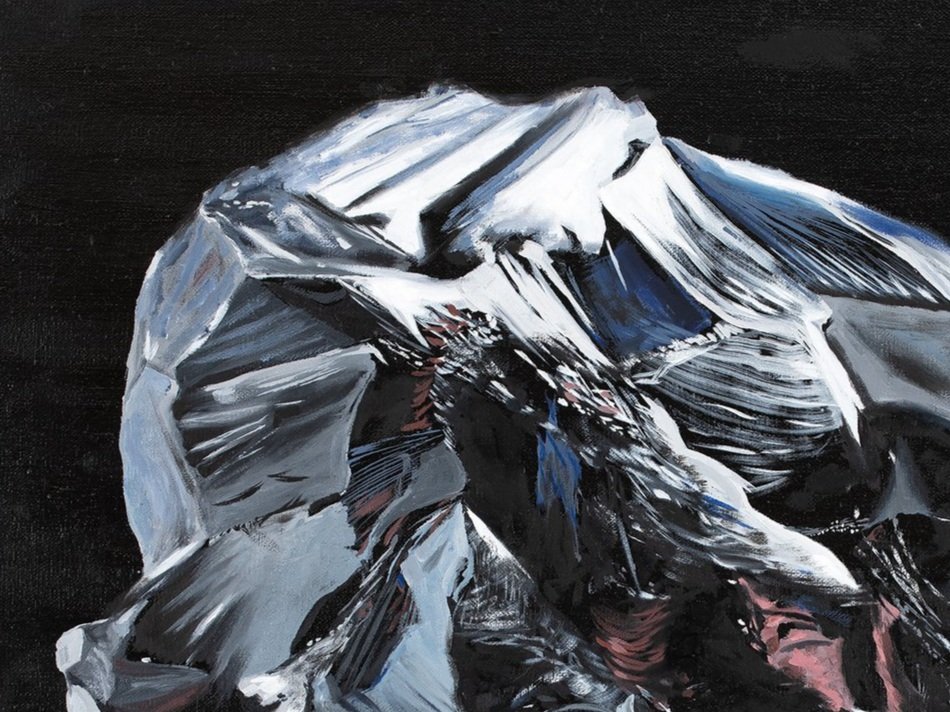
The artist has described this shift with precision. From a distance, the surface resembles a crystalline structure under laboratory lighting, all sharp edges and icy, mechanical clarity. Up close, that hardness dissolves. Subtle flesh pink tones emerge beneath cooler hues, while jewel-like blues flicker across the surface like brief electrical pulses. This oscillation between rationality and sensitivity is not a decorative effect. It is the painting's argument. Silicon is presented not as a dead mineral but as a substance caught between its industrial identity and its latent capacity to become something alive. The flesh pink tones are the key chromatic decision: they introduce warmth into what should by all rights be cold, and they do so at the level where the painting's brushwork becomes visible, where the viewer's eye adjusts from reading the image as a photograph of a mineral to reading it as a surface built from pigment and oil. The transition from cool to warm is also a transition from machine vision to human touch.
The linen itself contributes to this tension. At close range, the weave is visible beneath the paint film, a grid of horizontal and vertical threads that cannot help but recall the circuit board patterns Tan Mu has painted elsewhere, in Mapping (2021) and Logic Circuit (2022). The support and the subject share a structural logic. The linen is a substrate, and so is silicon. Both carry patterns that only become legible when the viewer adjusts their distance and their expectations. The painting enacts, at the level of its own materiality, the same relationship between substrate and information that it depicts.
Albert Bierstadt painted the Sierra Nevada in 1868. His canvas, Among the Sierra Nevada, California, now hangs in the Smithsonian American Art Museum, and it remains one of the most ambitious landscapes of the American West: a vast mountain lake ringed by pines, its surface reflecting the snow-capped peaks above with a clarity that dissolves the boundary between the real and the mirrored. The painting was commissioned, exhibited, and sold during a period when the geological survey of the western United States was also a commercial enterprise. The same railroad companies that funded the surveys that mapped routes through the mountains also commissioned paintings that made those mountains desirable, approachable, sublime. The geological reality of the Sierra Nevada, its granite batholiths and glacial valleys and mineral deposits, was inseparable from the economic logic that required those features to be seen, documented, and claimed. Bierstadt's luminous atmosphere, his theatrical light breaking through clouds, his mirror-still lake: all of these aesthetic decisions served a function. They made landscape into resource, and they made resource into destination.
Tan Mu's Silicon occupies a comparable position, though the terrain it surveys is not geographical but elemental. Where Bierstadt painted mountains that contained gold, silver, and iron ore to make them legible as sites of extraction and settlement, Tan Mu paints a mineral ingot to make visible the substrate that underlies every digital transaction, every communication, every image shared across the network of cables she has mapped in the Signal series. The parallel is structural, not decorative. Both paintings present their subjects with a seductive surface that conceals a system of extraction. Both paintings ask the viewer to admire something that was removed from the earth, refined through industrial processes, and transformed into a form that serves as the foundation for further systems of power and exchange. And both paintings make that seduction part of their critical apparatus. Bierstadt's lake is beautiful, and that beauty is the mechanism by which extraction becomes palatable. Tan Mu's ingot is beautiful, and that beauty is the mechanism by which a mineral that requires open-pit mining, high-temperature smelting, and chemical purification involving hydrofluoric acid, one of the most dangerous industrial chemicals in existence, becomes something people carry in their pockets without thinking about where it came from.
The late twentieth and early twenty-first centuries are sometimes called the Silicon Age, a designation that places silicon alongside bronze and iron as a material whose properties have so thoroughly shaped civilization that the era itself takes its name from the substance. Tan Mu's Q&A on the artwork page states this directly: "I believe we are living in an era fundamentally driven by computational power. Advances in computing have reshaped how we explore the world, communicate, and form connections. At the center of this technological landscape lies silicon." She describes silicon not simply as a chemical element but as "the material foundation of the digital world," existing "within computer motherboards, forming countless on and off switch chips that regulate information flow and quietly structure our perception of reality." The word "quietly" is essential. Silicon does not announce itself. It operates beneath the threshold of awareness, embedded in devices whose interfaces are designed to make the hardware invisible. A smartphone screen presents a world of applications, messages, and images, but the silicon inside it is never seen. It is the substrate that disappears into function. Tan Mu's painting reverses this disappearance. She puts the substrate in the center of the canvas and surrounds it with darkness, as though the clean room, the fabrication facility, and the global supply chain have been compressed into a single visual field.
The global supply chain for silicon is among the most complex and energy-intensive on Earth. Quartz, the raw material, is abundant, but the refinement process requires enormous energy inputs. The carbothermic reduction of quartz to metallurgical-grade silicon happens at temperatures above 1,700 degrees Celsius in electric arc furnaces. Further purification to solar-grade and then semiconductor-grade silicon involves the Siemens process or fluidized bed reactors, each requiring additional rounds of chemical distillation and crystal growth. The resulting ingots are sliced, polished, and etched in fabrication facilities, or fabs, that maintain clean rooms at ISO Class 1, meaning fewer than ten particles per cubic meter of air, compared with a typical urban environment that contains millions. A single semiconductor fab consumes as much electricity as a small city, and the water requirements for ultrapure rinsing stages run into millions of gallons per day. These facts are not footnotes to the painting. They are the conditions that make the ingot in the painting possible, and Tan Mu's decision to paint the ingot rather than the chip, the device, or the interface is a decision to confront the viewer with the material conditions that digital culture tends to render invisible.
In her Q&A, Tan Mu connects Silicon to two other works in the same body of research: Logic Circuit (2022) and Mapping (2021). The three works form a cluster that traces silicon from raw material to logical structure to cartographic representation. Logic Circuit depicts the etched pathways of a circuit board, the silicon already patterned into on/off switches. Mapping presents a found circuit board mounted on wood panel, the silicon substrate transformed into a physical object that resembles a star chart. Silicon is where the sequence begins: before the circuit, before the map, there is the purified mineral itself, not yet carved into logic, not yet patterned into information, still carrying the residue of its geological origin. Tan Mu has described this progression as one in which "the logic of input and output embedded in silicon mirrors human processes of emotion, language, and thought." The mirror is not metaphorical. It is structural. The binary states of a transistor, on and off, 1 and 0, are the physical substrate of every digital operation, and every digital operation, from a text message to a neural network, can be traced back to these mineral switches. The painting locates this logic at its point of origin, before it has been distributed across billions of devices, while it is still a single object that can be held and seen.
Alfred Stieglitz began photographing clouds in 1922. He called the series Equivalents, and his intention, stated in letters to Georgia O'Keeffe and others, was to create photographs that were not about clouds but were equivalents for emotional states, for experiences that could not be named directly. The images refuse the conventions of landscape photography: there is no horizon line, no ground plane, no sky in relation to earth. There is only the cloud, filling the frame, its tonal gradations shifting from brilliant white to deep shadow within a single negative. Stieglitz wrote that he wanted "photographs of clouds to put down my philosophy of life, to show that my photographs were not due to subject matter, to show that here was a photographer who did not depend on the subject, who could do without it." The Equivalents were his demonstration that the photograph could generate meaning through form alone, that the subject was a vehicle for something that exceeded its literal content.
Tan Mu's Silicon operates in a comparable register, though its formal logic moves in the opposite direction. Stieglitz stripped away context to reveal pure form. Tan Mu loads the form with so much context that the ingot becomes legible as a condensation of systems: geological, industrial, computational, geopolitical. But the painting also insists, as Stieglitz did, on a level of experience that exceeds its subject. The flesh pink tones beneath the cool blues are not illustrations of silicon's chemical properties. They are the painting's way of introducing a register that no mineralogical description can account for. The viewer who registers warmth in a surface that should be cold is experiencing what Stieglitz called an equivalent: the image has become a vehicle for something beyond its nominal subject. In Silicon, that "something" is the latent capacity of a mineral to become thought, to become language, to become the invisible architecture of daily life. The ingot is not yet a circuit, not yet a chip, not yet a device. But the painting makes the viewer feel that it could be any of these, that the mineral is pregnant with the logic it will carry, that the substance is on the verge of becoming something that exceeds its material composition.
Li Yizhuo, in her essay "Imaginary of an Image: On Tan Mu's Recent Paintings" (2022), argues that Tan Mu's works "do not aim at diagnosing the modern spectacles from a distance. They conjure up a kind of vitality and depth of their own." This observation is precise in the context of Silicon. The painting does not diagnose silicon's role in global supply chains, environmental degradation, or geopolitical competition, though Tan Mu's own statements acknowledge all of these. Instead, the painting conjures vitality from a mineral that most people associate only with dead, industrial surfaces. The ingot glows. It flickers. It blushes. These are not anthropomorphic projections. They are the result of oil paint applied to linen in a way that registers the refractive properties of a polished silicon surface while simultaneously introducing chromatic warmth that the mineral itself does not possess. The painting adds something to its subject that photography could not capture, because photography is bound to the wavelengths that the object reflects, while painting can invent wavelengths. The flesh pink does not exist on the ingot. It exists on the canvas. And that gap between what the object reflects and what the painting reveals is where the argument lives.
The environmental and geopolitical dimensions of silicon production, which Tan Mu addresses directly in her Q&A, form a counterweight to the painting's seductive surface. "If we understand our era as one shaped by computation," she says, "then we must also acknowledge the environmental cost that supports it." She lists the costs: high-temperature smelting, chemical refinement, the enormous energy consumption of fabrication facilities and data centers, and the concentration of technological infrastructure that "reshapes political relationships, cultural dynamics, and systems of governance." These observations locate Silicon within a network of extraction and power that the painting does not depict but makes visible through absence. The darkness surrounding the ingot is not empty space. It is the space of everything that has been removed from the frame: the mine, the furnace, the fab, the energy grid, the data center, the undersea cable. Each of these is elsewhere in Tan Mu's practice. The mine reappears in Mapping, where a found circuit board becomes a landscape of extraction. The cable system reappears across the Signal series, where the same silicon that powers the devices also powers the network that connects them. The ingot in Silicon is the node where all of these systems converge, and the painting's intimate scale, 40.6 x 50.8 centimeters, is the scale at which that convergence can be held, examined, and felt.
As a child, Tan Mu attended classes in circuit design and flight model construction. She has described these early experiences as introducing her to "the logic of patterns and principles governing the physical world: fluid mechanics, mathematical calculations, blueprints." This biographical detail is not incidental to Silicon. The painting is an extension of the same logic, applied to a mineral rather than a schematic, but with the same emphasis on pattern, structure, and the relationship between visible form and invisible function. The circuit design class taught her to read the logic embedded in a pattern of traces on a board. Silicon teaches the viewer to read the logic embedded in a mineral that has not yet been patterned, to see the potential for computation in a substance that looks, to the untrained eye, like a piece of polished stone. The painting bridges the gap between these two forms of reading. It presents the ingot as a pattern waiting to happen, a substrate that contains, in latent form, every logical operation that will eventually be etched into its surface.
The painting's final register is the one that Tan Mu identifies most explicitly. "Silicon has become an invisible language," she writes, "through which we engage with the world, quietly organizing contemporary life." The word "language" is deliberate. Silicon is not merely a material. It is a medium in the fullest sense: a substance through which information passes, is transformed, and becomes intelligible. Like a spoken language, it operates beneath the level of conscious attention. Like a written language, it requires inscription, etching, patterning. And like any language, it carries within it the capacity for both precision and ambiguity, for clear communication and for noise. The painting's oscillation between cool clarity and warm indeterminacy, between the ingot's industrial identity and its flesh-pink undertones, is the visual equivalent of this linguistic duality. Silicon speaks in on and off, in 1 and 0, in yes and no, but the painting speaks in the space between those binary states, in the warmth that a mineral should not have and the life that a substrate should not possess. The ingot is not thinking. But the painting makes the ingot look as though it could.