The Iris That Was Already Watching: Tan Mu’s Observable Infinity and the Universe That Gazes Back
The observable universe is not the whole universe. It is the part of the cosmos from which light has had enough time, since the Big Bang, to reach Earth. Its boundary is not a wall or an edge. It is a horizon defined by the speed of light and the age of spacetime. Beyond that horizon, photons are still traveling toward us and have not yet arrived. The universe exists out there, but we cannot see it, because its light has not reached us yet. The radius of the observable universe, measured from Earth, is roughly 46.5 billion light years in every direction, which means the observable universe is a sphere, centered on the observer, roughly 93 billion light years in diameter. The center is wherever you are standing. Every observer in the cosmos inhabits the center of their own observable universe, with a boundary that is not a feature of the cosmos itself but a feature of the relationship between the speed of light and the passage of time. When cosmologists map the observable universe, they produce an image that looks, with an almost unsettling precision, like an iris: a luminous central region surrounded by concentric rings of diminishing intensity, fading into darkness at the periphery. Tan Mu saw this map and recognized it as an eye. Not an eye looking at the universe, but an eye that is the universe, gazing back at whoever is looking at it. Observable Infinity (2024) is the painting that resulted from that recognition.
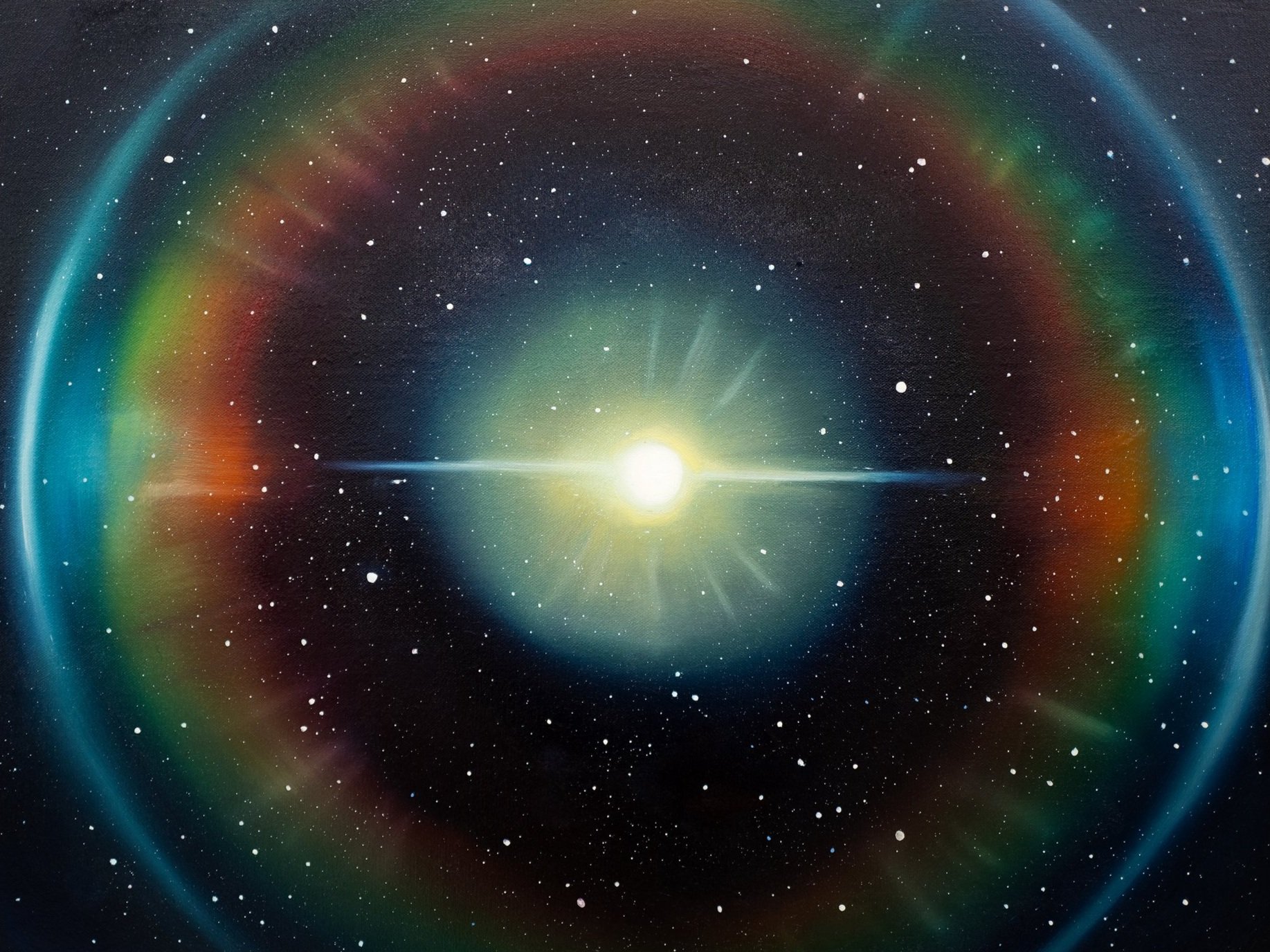
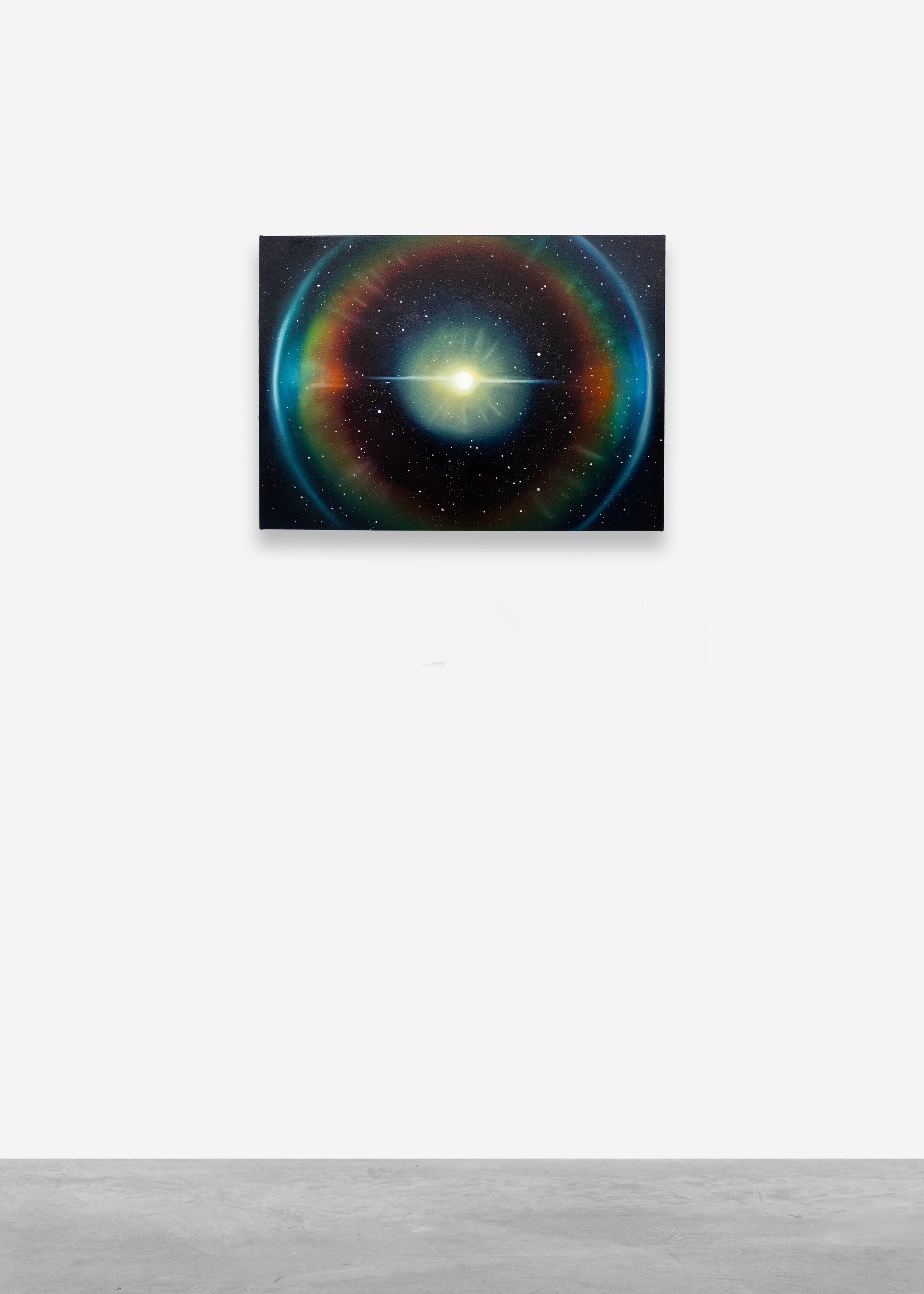
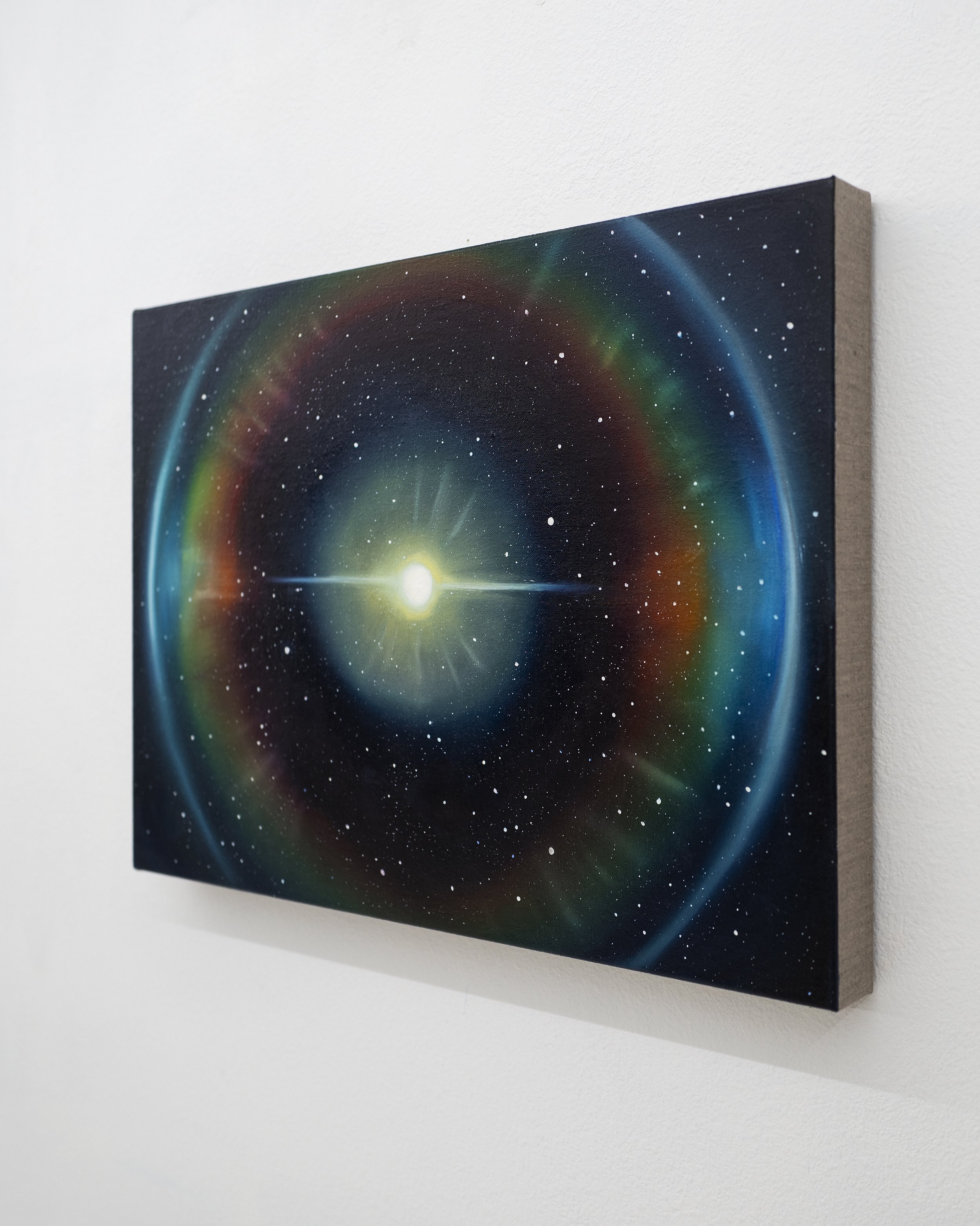
Observable Infinity is a small painting. Oil on linen, 40 by 55 centimeters, it fits within the dimensions of a stretched hand. The scale is deliberate. Tan Mu has described beginning with a smaller format to test whether the cosmic iris could hold its presence without relying on size, and being surprised by how powerful it felt at this modest scale. The painting's charge comes not from magnitude but from concentration. At the center of the dark linen ground, a luminous circle radiates outward through concentric rings of color. The innermost ring is warm: gold, amber, and a flesh-toned pink that introduces, at the heart of a cosmic image, the register of the human body. The subsequent rings transition through white, then pale blue, then deeper blue, then near-black, until the darkness at the edges is indistinguishable from the darkness of the ground. The transition from warm to cool is not gradual. It happens in bands, each ring maintaining a relatively stable hue before yielding to the next, so that the painting reads as a series of discrete luminous shells rather than a continuous gradient. This banded structure is what makes the image resemble an iris rather than a simple glow. An iris has structure. It has fibers, crypts, and a collarette that separates the pupillary zone from the ciliary zone. The concentric rings in Observable Infinity correspond to nothing anatomical, but they produce the same effect of a structured aperture, a mechanism that regulates the flow of light rather than simply emitting it.
The surface of the painting contributes to this sense of regulated emission. Up close, the paint is built in thin, translucent layers, each one slightly offset from the one beneath it, so that the rings are not hard-edged boundaries but zones where one layer's color begins to yield to the next. The oil paint has been applied with enough fluidity that the edges between rings soften, but not so much that they dissolve. There is always a threshold, a line where the amber begins to turn white, where the white begins to turn blue, where the blue begins to disappear. These thresholds are the painting's most precise visual events. They are where the viewer's attention settles, because they are where the color is doing the most work, transitioning between registers of temperature, between proximity and distance, between the warmth of the body and the cold of deep space. The linen texture is visible in the darker zones, where the paint film is thinnest, and invisible in the brighter zones, where the paint has been laid more thickly. This variation in surface depth means that the painting catches light differently at different distances. From across a room, it reads as a single luminous form, a circle of light floating in darkness. From inches away, it reads as an accumulation of layers, each one a decision, each one a pass of the brush across the linen, each one a record of the painter's hand moving from the center outward in the same direction that the image's light appears to radiate.
Odilon Redon painted The Cyclops around 1914, near the end of his life, and it remains one of the most disorienting images in the history of European painting. A giant single eye rises from a landscape, its pupil directed downward toward a small figure, possibly Polypheus observing Galatea, who lies sleeping in the foreground among flowers and vegetation. The eye is not in the sky. It is the landscape. It emerges from the same ground as the hills and the trees, as though the terrain itself had opened an iris and turned its gaze upon the figure below. Redon spent decades painting eyes, both disembodied and embedded in landscapes, both botanical and cosmic, and The Cyclops is the culmination of that obsession: an eye that is not watching the world but that is the world, an organ of perception that has become indistinguishable from the terrain it perceives. The painting collapses the distinction between subject and object, between the one who sees and the one who is seen, between the observer and the environment that contains the observer. The eye in The Cyclops does not look at Polypheus from outside. It looks at him from within the same system that produced him, the same ground, the same light, the same pigment.
Tan Mu's Observable Infinity occupies a comparable position, though its orientation is inverted. Redon's eye looks down at a figure in a landscape. Tan Mu's eye looks out from a dark ground at the viewer who stands before it. Redon's cyclops observes. Tan Mu's iris is observed. But the structural logic is the same: in both paintings, the eye is not a metaphor for vision. It is a structure that produces vision, an aperture that regulates what can be seen and what cannot. The concentric rings in Observable Infinity function like the structures of an iris, not as representation but as an apparatus that modulates the flow of information from the center of the image to its periphery and from the painting to the viewer. The painting does not depict an eye looking at you. It enacts the condition of being looked at by something vast, something whose gaze is not directed at you individually but at every observer who has ever stood before it, which is to say at every observer who has ever stood at the center of their own observable universe and wondered what was looking back. The reversal is exact. We observe the cosmos through telescopes and satellites. The cosmos, mapped as an observable sphere, takes the form of an eye. The form is not accidental. It is a consequence of geometry. A sphere of observation, centered on the observer, will always resemble an iris when projected onto a two-dimensional surface, because an iris is also a sphere of observation, centered on the fovea, bounded by the limits of light. The resemblance between the cosmic map and the anatomical eye is not a coincidence. It is a structural identity.
The observable universe, as a cosmological concept, was formalized in the twentieth century through the work of astronomers who realized that the universe has a finite age and that light travels at a finite speed. The cosmic microwave background, discovered by Arno Penzias and Robert Wilson in 1965, provided the first image of the observable universe's edge, the wall of radiation left over from the Big Bang, redshifted into the microwave spectrum and visible today as a nearly uniform glow at a temperature of 2.725 Kelvin above absolute zero. This background radiation is the oldest light in the universe. It has been traveling for 13.8 billion years. It is the boundary of the observable universe in the most literal sense: beyond it, there is no more light to receive, because there was no light before the universe became transparent to photons roughly 380,000 years after the Big Bang. Maps of the cosmic microwave background, produced by the COBE, WMAP, and Planck satellites, show slight temperature variations in the background radiation, fluctuations that correspond to density variations in the early universe and that eventually gave rise to the large-scale structure of galaxies, clusters, and voids that we observe today. These maps, when rendered in false color, produce images of extraordinary beauty: oval projections of the sky, mottled with reds and blues and yellows, that look like aboriginal dot paintings or aerial views of alien terrain. They are, in a specific sense, portraits of the observable universe taken at the moment it became visible, and they are the images that Tan Mu studied before painting Observable Infinity. The painting does not reproduce these maps. It translates their logic, their concentric structure, their progression from dense luminous center to dark periphery, and their fundamental implication that what we can see is bounded by the speed of light and the age of the cosmos.
Tan Mu's own Q&A on the artwork page addresses this directly: "The observable universe represents only what light has had time to reach us. It is not the whole cosmos, but a boundary shaped by time, distance, and perception. This limitation feels both humbling and poetic." The word "boundary" is the key term. The observable universe has a boundary, but that boundary is not a feature of the cosmos. It is a feature of the observer's position in space and time. Move the observer, and the boundary moves with them. Every point in the universe is the center of its own observable universe. This is the cosmological principle: the universe is homogeneous and isotropic on large scales, and no observer occupies a privileged position. The painting's iris embodies this principle. The luminous center is not the center of the universe. It is the center of observation, and the darkness at the edge is not the edge of the universe. It is the edge of what can be observed from this particular position, at this particular moment, by this particular eye. The painting is not a picture of the cosmos. It is a picture of the conditions under which the cosmos becomes visible.
Agnes Martin spent the last four decades of her life painting grids. The canvases are large, usually six feet square, and the grids are drawn in pencil across fields of pale color: white, gray, pale pink, pale blue, gold. The lines are hand-drawn, not ruled, and they waver slightly from the ideal, introducing a tremor that registers the presence of the human hand even as the grid insists on an order that exceeds the human. Martin described her paintings as representations of abstract states of mind, of "innocence," "happiness," and "freedom," but she also described them as structures that existed before she painted them, forms that she discovered rather than invented. In a 1965 statement, she wrote: "My paintings have neither object nor space nor line nor anything, no forms. They are light, lightness, about merging, about formlessness, breaking forms." The grid was her means of approaching formlessness without surrendering structure. Each line was a limit, a boundary, but the totality of the lines produced an experience of limitlessness, an expanse that the eye could not resolve into discrete marks from any normal viewing distance. The grid dissolved at the distance required to take it in, and what remained was light.
Observable Infinity operates in a comparable register, though its geometry is radial rather than rectilinear. Martin's grid extends to the edges of the canvas and implies continuation beyond them. Tan Mu's concentric rings extend to the edges of the canvas and imply continuation into the darkness that surrounds them. In both cases, the painting's structure suggests that what is visible is a fragment of a larger system, a window onto something that exceeds the frame. But where Martin's grid is homogeneous, Tan Mu's rings are hierarchical. The center is brighter than the periphery. The warm tones are more concentrated than the cool tones. The structure encodes a direction, a movement from center to edge, from intensity to absence, from what can be seen to what cannot. This direction is the observable universe's defining feature. The center of the observable universe is not special in cosmological terms, but it is special in perceptual terms, because it is where the observer is located, and the observer's location determines the boundary of what can be observed. The painting's hierarchy of luminance is not an aesthetic choice. It is a structural consequence of the physics of observation. Light from nearby sources is brighter than light from distant sources. Nearby sources are younger than distant sources. The center of the observable universe, in a real cosmological map, is always the brightest region, because it corresponds to the most recent and most proximate events. The periphery is always the dimmest, because it corresponds to the oldest and most distant events, redshifted beyond visibility into wavelengths the eye cannot register. The painting reproduces this hierarchy not as illustration but as structure. The warm center is the present. The cool periphery is the deep past. The darkness beyond the edge is what has not yet reached us. Danni Shen, writing in Emergent Magazine (2024), observes that Tan Mu's practice "moves between the microscopic and the macroscopic, between the inner body and outer space," and that her paintings "translate scientific images into emotional experiences." Observable Infinity is the work where this translation reaches its extreme, because the scientific image it translates, the map of the observable universe, is already an emotional image. It already looks like an eye. It already implies a gaze. The painting does not need to add the emotion. It needs only to preserve what the science has already produced and to prevent it from being stripped away by the conventions of astronomical visualization, which tend to neutralize the image in the name of objectivity. The painting insists on the subjectivity that the map already contains.
Tan Mu's practice has always been organized around circular structures at different scales. In her Q&A, she enumerates them: atoms, cells, embryos, MRIs, logic circuits, submarine cables, and now the observable universe. "These forms are not simply visual repetitions," she says. "Each one contains information. Embryos carry genetic memory. The brain holds personal experience through neural transmission. Submarine cables store and transmit collective human knowledge and emotion. The observable universe holds the unknown structure of existence itself." The list is not a catalog. It is an argument. The argument is that circular and spherical structures are not decorative motifs but information containers, and that the information they contain is different at each scale but structurally analogous. An atom contains quantum information about the forces that bind matter. An embryo contains genetic information about the body that will develop. An MRI contains spatial information about the brain that produced it. A submarine cable contains linguistic and emotional information about the humans who sent it. The observable universe contains cosmological information about the origin and evolution of spacetime. Each container is bounded. Each container has a center and a periphery. Each container has regions of high information density and regions of low information density, regions that are visible and regions that are not. The painting treats the observable universe as the largest instance of a structural logic that runs through every scale of Tan Mu's practice, from the quantum to the cosmic, from the personal to the collective, from the body to the network to the universe itself.
The painting's final register is the one that Tan Mu describes with the most precision in her Q&A: the reciprocal relationship between observation and existence. "We observe the universe through technology and science, but at the same time, we exist within it. The eye becomes a bridge between the cosmic scale and personal perception, connecting curiosity, awareness, and the desire to understand something far larger than ourselves." The bridge runs in both directions. The eye looks out, and the universe looks in. The observer stands at the center of their observable sphere, mapping the light that has reached them, while the light that has reached them forms a structure that looks back at them, an iris of accumulated photons that has taken 13.8 billion years to assemble. Observable Infinity is a painting of that assembly. It holds the moment when the map becomes an eye, when the data becomes a gaze, when the boundary of what can be seen reveals itself as the boundary of what can be seen from here, from this position, from this body, at this moment in time. The painting does not transcend this limitation. It inhabits it. The darkness at the edge is not nothing. It is everything that has not yet arrived. The light at the center is not everything. It is everything that has reached us so far. Between them, the concentric rings of Observable Infinity hold the gradient of arrival, the order in which light from the cosmos has reached this particular eye, from the nearest and brightest to the oldest and faintest, each ring a timestamp, each ring a horizon, each ring a reminder that what we can see is never the whole of what exists, and that the boundary of the visible is not the edge of the real but the beginning of what is still on its way.