The Switch That Thought: Tan Mu’s Logic Circuit and the Brain Beneath the Chip
In September 1960, two engineers at Fairchild Semiconductor in Mountain View, California, produced the first commercial planar integrated circuit. Isy Haas and Lionel Kattner had etched four transistors and their interconnections onto a single chip of silicon, creating what they called the Micrologic "F" element flip-flop. The chip measured roughly one millimeter on each side. Inside it, transistors acted as switches, turning on and off in patterns that represented the binary logic at the foundation of all digital computation. Before the integrated circuit, computers required individual transistors soldered to circuit boards by hand, each one a discrete component with its own casing, leads, and failure points. The integrated circuit replaced that assembly with a single wafer of doped silicon, reducing size, cost, and failure rate by orders of magnitude. The consequences were not gradual. Within a decade, the Apollo Guidance Computer used integrated circuits to navigate to the moon. Within two decades, microprocessors began appearing in homes. Within three decades, the internet connected those homes to one another. The integrated circuit did not simply make computers smaller. It made computation ubiquitous, and in doing so, it made the logic gate, the fundamental unit of digital switching, into the most manufactured object in human history. By the early twenty-first century, a single fabrication plant produced more transistors in a day than the entire world population of any organism that has ever lived. This is the object that Tan Mu painted in 2022. Not a computer, not a screen, not a network, but the chip itself: the silicon wafer, the etched channels, the switch.
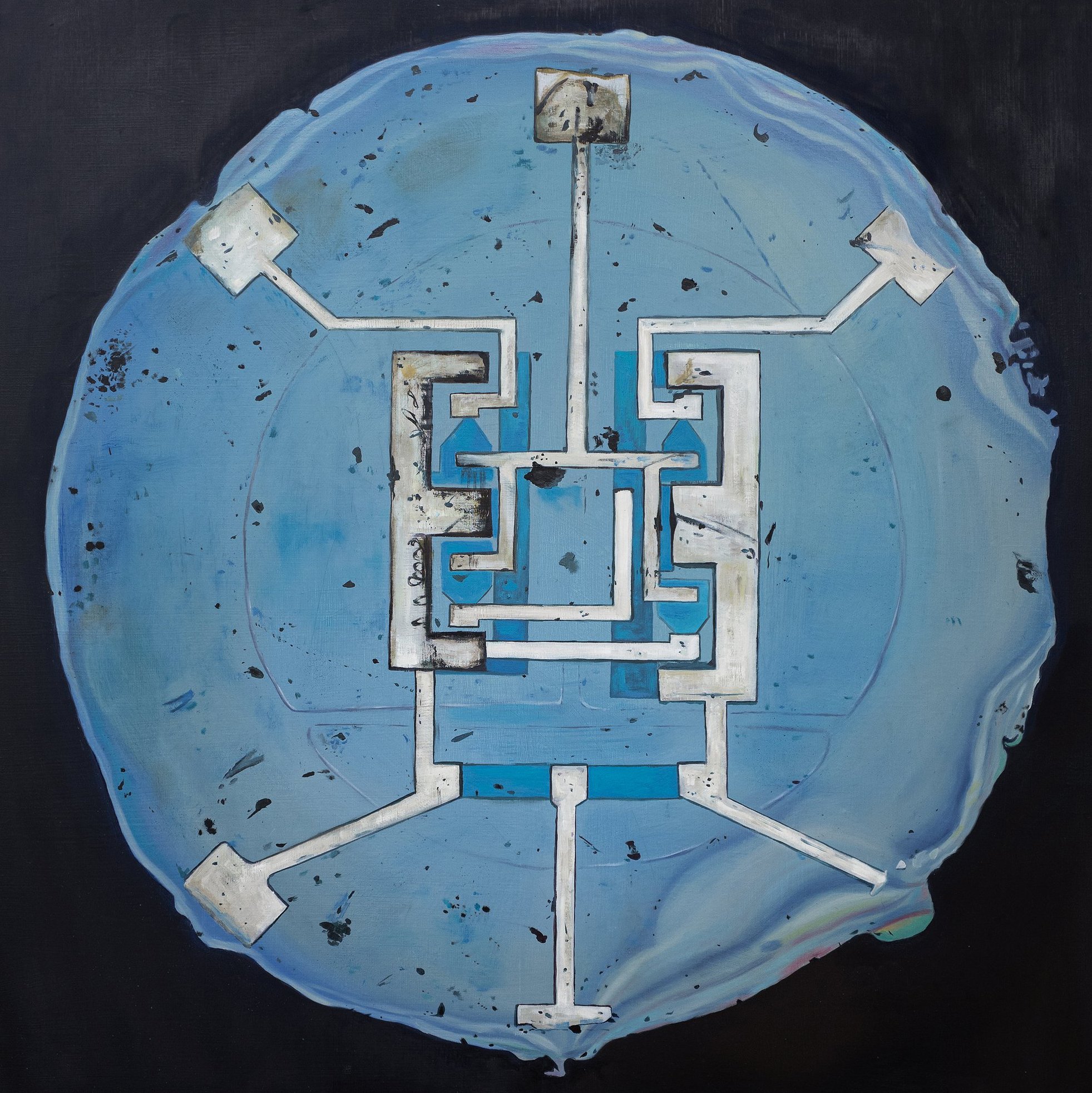
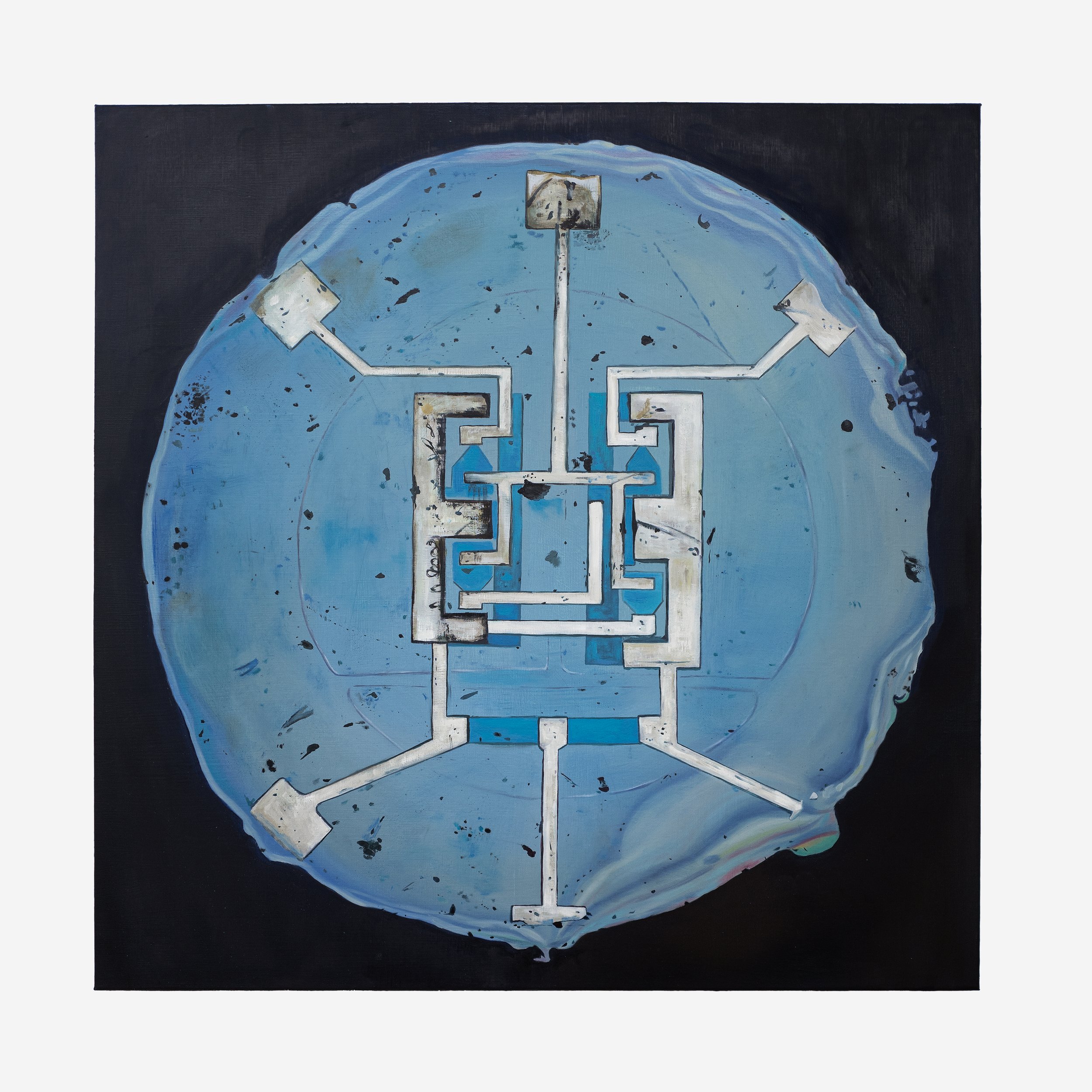
Logic Circuit is a square painting, 76 by 76 centimeters (36 by 36 inches), oil on linen, and its format is not arbitrary. The square canvas mirrors the geometry of the integrated circuit itself, which is fabricated on a circular silicon wafer that is cut into rectangular or square dies. The composition is centered on a prominent circle, rendered in dark blue and near-black tones, with irregular blue edges that bleed outward into the surrounding field. Inside the circle, precise lines and geometric shapes, rectangles, channels, nodes, suggest the etched pathways and contact points of a chip layout viewed under magnification. The contrast between the circle's irregular border and the precision of its interior is the painting's central visual tension. The outer edge of the circle is not smooth. It mottles and breaks, patches of lighter blue interrupting the dark ground, the way a silicon wafer develops surface irregularities after chemical etching or corrosion. These irregularities are not mistakes in the painting. They correspond to a specific material process: the deep channels etched into the back of a silicon wafer after corrosion, filled with non-conductive epoxy resin, a detail that Tan Mu describes directly in her account of the work. The mottled black and blue, the bleeding edges, the places where the paint's surface records a texture that is not brushwork but something closer to erosion, all of these register the physical history of the chip's manufacture rather than its idealized schematic.
Inside the circle, the painting tightens. The lines become deliberate, the shapes precise, the color relationships controlled. Blues darken toward the center, where the logic gates would be, and lighten toward the perimeter, where the input and output connections emerge. The palette is restricted: deep navy, cerulean, touches of teal where the channels widen, and a warm amber that appears at the nodes where pathways intersect, as though the points of logic switching emit a faint thermal glow. The amber is crucial. It is the only warm tone in a painting otherwise organized around cool blues and blacks, and it reads as an index of activity, the places where the current flows, where the switch is on, where the bit is a one rather than a zero. The linen surface is visible in the areas between the etched channels, its weave creating a faint grid that paradoxically reinforces the circuit's geometric order while introducing the organic irregularity of a natural fiber substrate. The oil paint is applied in thin layers in the precise interior zones and built up in thicker impasto at the irregular edges, creating a tactile distinction between the manufactured precision of the circuit's logic and the material degradation of its physical housing.
Between 1915 and 1923, Marcel Duchamp worked in his studio at 80 West 10th Street in New York on a work he would eventually call The Bride Stripped Bare by Her Bachelors, Even, or simply The Large Glass. The piece consists of two glass panels, each roughly 109 by 68 inches, mounted in an aluminum frame, with lead wire, dust, and other materials sandwiched between them. The upper panel contains the Bride, an assembly of geometric and organic forms that Duchamp described as a motor driven by love gasoline, operating as a kind of desire machine. The lower panel contains the Bachelors, nine uniform forms arranged in a grid, each one a mold of a different male garment, connected by a system of tubes and channels to a chocolate grinder and a series of optical devices. The entire apparatus is meant to depict a logic of desire: the Bride emits signals, the Bachelors receive and process them, and the system as a whole operates according to rules that Duchamp specified in his Green Box notes but that no one has ever fully reconstructed. The Large Glass was never completed to Duchamp's satisfaction. In 1926, during transport, the glass cracked, producing a network of fractures that Duchamp eventually accepted as part of the work, declaring that the cracks completed it. The accident introduced a degree of chance that the machine's logic could not account for, and in doing so, it completed the machine by breaking it.
The structural parallel to Tan Mu's Logic Circuit is precise. Duchamp built a machine that depicted logic, a system of connections, channels, and processing units organized around the flow of signals, and he built it in a medium, glass, that was transparent, fragile, and prone to fracture. Tan Mu painted a chip that depicts logic, a system of connections, channels, and processing units organized around the flow of electrical current, and she painted it in a medium, oil on linen, that is opaque, tactile, and prone to the irregularities of hand application. In both cases, the material of the artwork introduces a register of accident and imperfection that the logic of the depicted system cannot contain. Duchamp's glass cracked. Tan Mu's paint mottles. Both accidents are not failures of representation but completions of it, because they register the truth that any logic, once it enters the material world, is subject to conditions that the logic did not anticipate. The switch is either on or off, until the switch corrodes. The bit is either one or zero, until the chip degrades. The Large Glass and Logic Circuit both depict systems of perfect logic housed in imperfect materials, and both argue, by the distance between the system's precision and the material's irregularity, that the logic is never as pure as it claims.
The logic gate operates by switching. A transistor receives an input voltage and either permits or blocks current flow, depending on the voltage's value relative to a threshold. When the input is above the threshold, the transistor conducts, and the output is on. When the input is below, the transistor blocks, and the output is off. This is the physical basis of binary computation: every calculation, every image, every text, every piece of music that passes through a digital device is ultimately resolved into a sequence of these on-off decisions, billions of them per second, distributed across millions of transistors etched into silicon. The integrated circuit's achievement was not the invention of the switch but its multiplication. A single transistor can make one decision at a time. A modern microprocessor contains billions, each one making a decision every few picoseconds, and the aggregate of those decisions, processed through layers of logic gates arranged into adders, registers, multiplexers, and memory cells, produces the phenomenon we call computation. The phenomenon is emergent. No single transistor knows what it is computing. No single gate contains the meaning of the result. The computation exists only in the pattern of switches, and the pattern exists only because the switches are connected in a specific architecture that channels the flow of current through a specific sequence of decisions.
Tan Mu's Q&A identifies this architecture with a biological counterpart. "I am drawn to the strong visual and structural parallels between these components and the internal architecture of the human brain," she states. "In works such as MRI and Synapse, I investigate how neurons connect through synaptic structures, transmitting signals in ways that closely resemble how chips process information through switches." The comparison is not metaphorical in the casual sense. It is structural. A neuron fires an action potential when its membrane voltage crosses a threshold, and it either fires or it does not, a binary decision governed by the same all-or-nothing logic that governs a transistor. A synapse transmits that signal to the next neuron, or it does not, depending on the concentration of neurotransmitters, the state of the receptors, the recent firing history of the connection. The brain's computation, like the chip's, is emergent: no single neuron contains the thought, and no single synapse carries the meaning. The meaning exists in the pattern, and the pattern exists because the connections are arranged in a specific architecture that channels the flow of electrochemical signals through a specific sequence of neural decisions. When silicon wafers age or erode, as Tan Mu observes, "their softened edges, discolorations, and surface irregularities begin to resemble organic forms. These qualities recall anatomical imagery of neural tissue, blurring the boundary between the mechanical and the biological." The painting registers this blur at the level of material. The mottled edges of the central circle, the places where the precise geometry of the circuit gives way to the irregular texture of corroded silicon, are the same places where the chip begins to look like a cell, where the manufactured surface begins to look like a membrane, where the logic gate begins to look like a synapse. The painting does not argue that the chip is a brain. It shows that the chip, when its perfection degrades, reveals a kinship with the brain that its perfection concealed.
In 1967, Eva Hesse produced a sculpture called Accession II at her studio on the Bowery in New York. The work consists of a hollow, cube-shaped form made from vacuum-formed acrylic, open on one side, with hundreds of rubber tubes threaded through small holes drilled into each of the three enclosed faces. The tubes project inward from the walls of the cube, their soft, flexible ends filling the interior space with a dense thicket of gray filaments. From the outside, the cube reads as a minimalist object, a transparent box with the cool, impersonal geometry of industrial manufacture. From the inside, through the open face, the rubber tubes present a wholly different register: organic, tactile, almost vaginal, a cavity lined with soft protrusions that recall intestinal villi, sea anemones, or the cilia that line the respiratory tract. The sculpture's force depends on this contradiction. The same object, viewed from two different positions, presents two entirely different natures: the mechanical exterior and the biological interior, the rigid and the yielding, the serial and the singular. Hesse described her work as occupying a position between extreme order and extreme disorder, and Accession II enacts that position with a precision that still produces a jolt of recognition more than half a century later. The cube is a machine. The tubes are alive. The sculpture exists in the tension between these two statements, neither of which is true and neither of which is false.
Logic Circuit operates in the same register. The painting's exterior, the irregular blue border and the mottled surface that records the physical degradation of the silicon wafer, corresponds to Hesse's rubber tubes: the place where the manufactured object reveals its organic kinship. The painting's interior, the precise lines and amber nodes that depict the logic gates in their ideal state, corresponds to Hesse's acrylic cube: the place where the system asserts its geometric authority. The viewer moves between these two registers by moving their eye, the way Hesse's viewer moves between them by walking around the sculpture, and in both cases, the movement produces an awareness that the boundary between the mechanical and the biological is not fixed but contingent, dependent on the angle of observation, the state of the material, and the degree of degradation that time and chemistry have introduced. Saul Appelbaum, writing about Tan Mu's BEK Forum exhibition in November 2025, observed that her paintings "make the viewer aware that they are looking at a machine that is also looking at them." The observation is apt for Logic Circuit. The chip is a machine that processes information by switching. The brain is a machine that processes information by firing. The painting is a machine that processes attention by presenting these two machines as versions of the same structure, and the viewer, standing in front of it, becomes the third term in the analogy, a biological system looking at a technological system that has been shaped to resemble a biological system, caught in what Tan Mu calls "a continuous feedback loop that reshapes how we think, communicate, and remember."
Tan Mu was five years old when she began painting, and as a child she participated in classes on flight model construction and circuit design. The classes introduced her to the logic of patterns and the principles governing the physical world: fluid mechanics, mathematical calculations, blueprints. This biographical detail is not incidental to Logic Circuit. It is a direct line. The child who learned to read circuit schematics grew into the painter who translated those schematics into oil on linen, and the translation preserves the schematic's logic while introducing the body's presence. The blueprint specifies connections. The painting shows connections. The blueprint assumes perfect conductivity. The painting shows corrosion. The blueprint is a plan for a machine. The painting is a record of what the machine looks like when the machine begins to resemble the body that built it. The circular form at the painting's center, which Tan Mu identifies as both symbolic and structural, represents "connection, continuity, and the flow of information across systems." It echoes the form of the brain, operates like a synaptic network, and resonates with the circular forms of Eastern thought, where circularity reflects cycles of energy and renewal. The circle is not a symbol layered onto the circuit. It is a structure that the circuit and the brain share, a topology of connection that appears at every scale, from the neuron to the chip to the globe-spanning network of fiber optic cables that Tan Mu has called the logic circuits linking global supercities. The switch is either on or off. The neuron either fires or it does not. The cable either carries the signal or it does not. The painting is either a picture of a chip or a picture of a brain. It is both, and the fact that it can be both is the argument that the painting makes, an argument that no schematic could make because the schematic specifies which system it depicts, while the painting, by the deliberate imprecision of its mottled edges and the warm amber of its active nodes, allows both systems to occupy the same surface at the same time, the way both systems occupy the same world at the same time, switching and firing and switching again, in a pattern that no single switch and no single neuron could intend but that emerges, nonetheless, from the accumulated logic of all those tiny, binary decisions, one after another, on and off, on and off, until the pattern becomes indistinguishable from thought.