The Rule That Grew Without End: Tan Mu’s Fractal 1 and the Mathematics That Paints Itself
The equation is four characters long. z equals z squared plus c. A complex number is squared and added to a constant, and the result is fed back into the same equation as the new input, and the process is repeated, again and again, until either the sequence settles toward a stable value or it escapes toward infinity. That is the entire generative apparatus. No design, no composition, no intention, no aesthetic judgment. Just a rule applied to itself, recursively, until the rule produces something that no one designed. The Mandelbrot set, first visualized by Benoit Mandelbrot in 1980, is the set of all complex numbers c for which this iteration does not escape. Rendered as an image, the set produces a cardioid-shaped form with smaller bulbs attached at its boundary, and at every level of magnification, new structures emerge: spirals, antennae, miniature copies of the whole set, and filaments of such complexity that no finite rendering can capture their full structure. The boundary of the Mandelbrot set has a dimension between one and two. It is not a line and it is not a surface. It is something else, a shape that fills more space than any smooth curve but less space than any flat plane, and its complexity increases without limit as the magnification increases. This is what Tan Mu chose to paint in 2019. Not as a mathematical illustration. As a painting. Oil and acrylic medium on linen, 182.9 by 152.4 centimeters, a canvas large enough that the viewer's body registers the scale of the image before the eye resolves its detail.
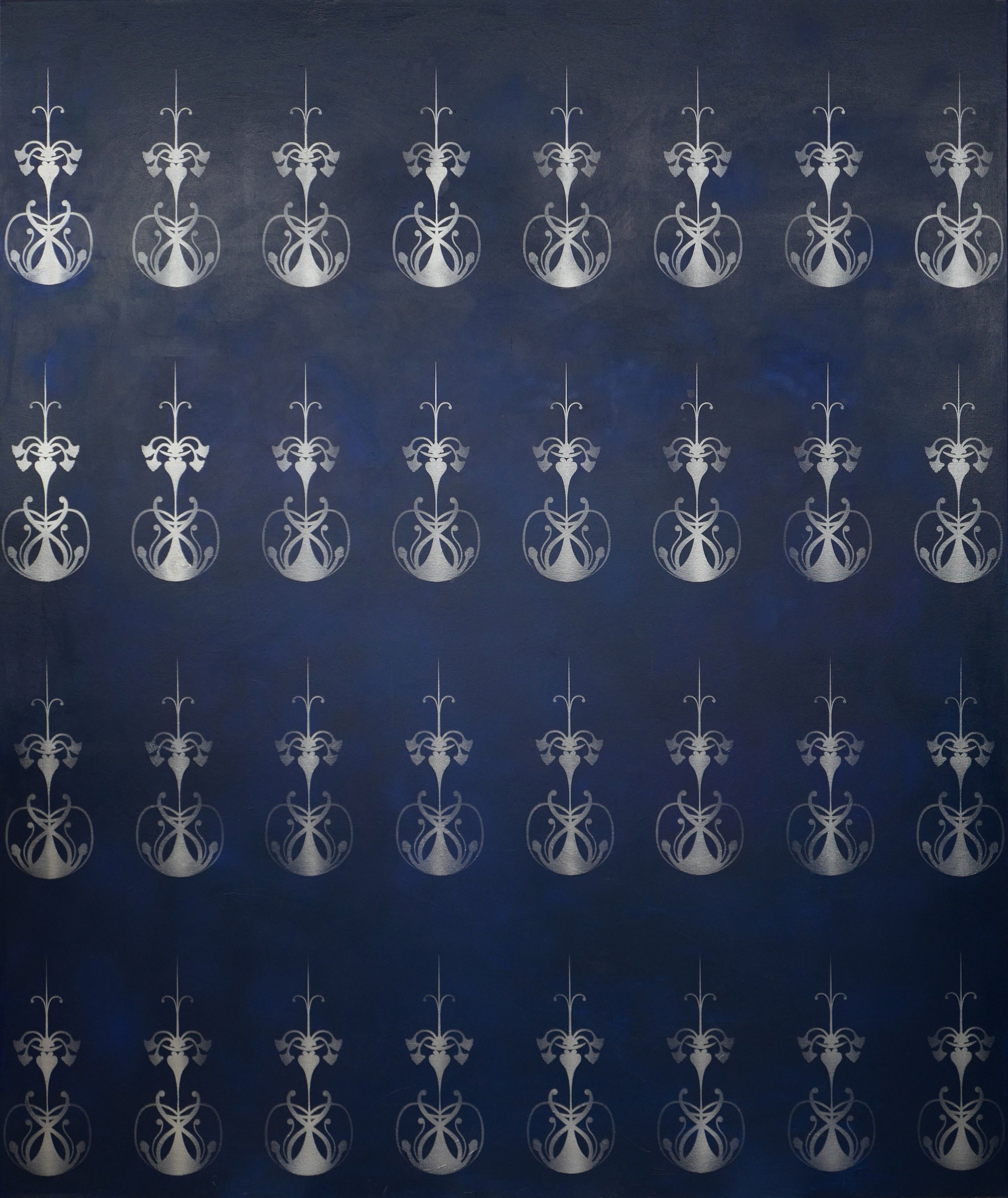
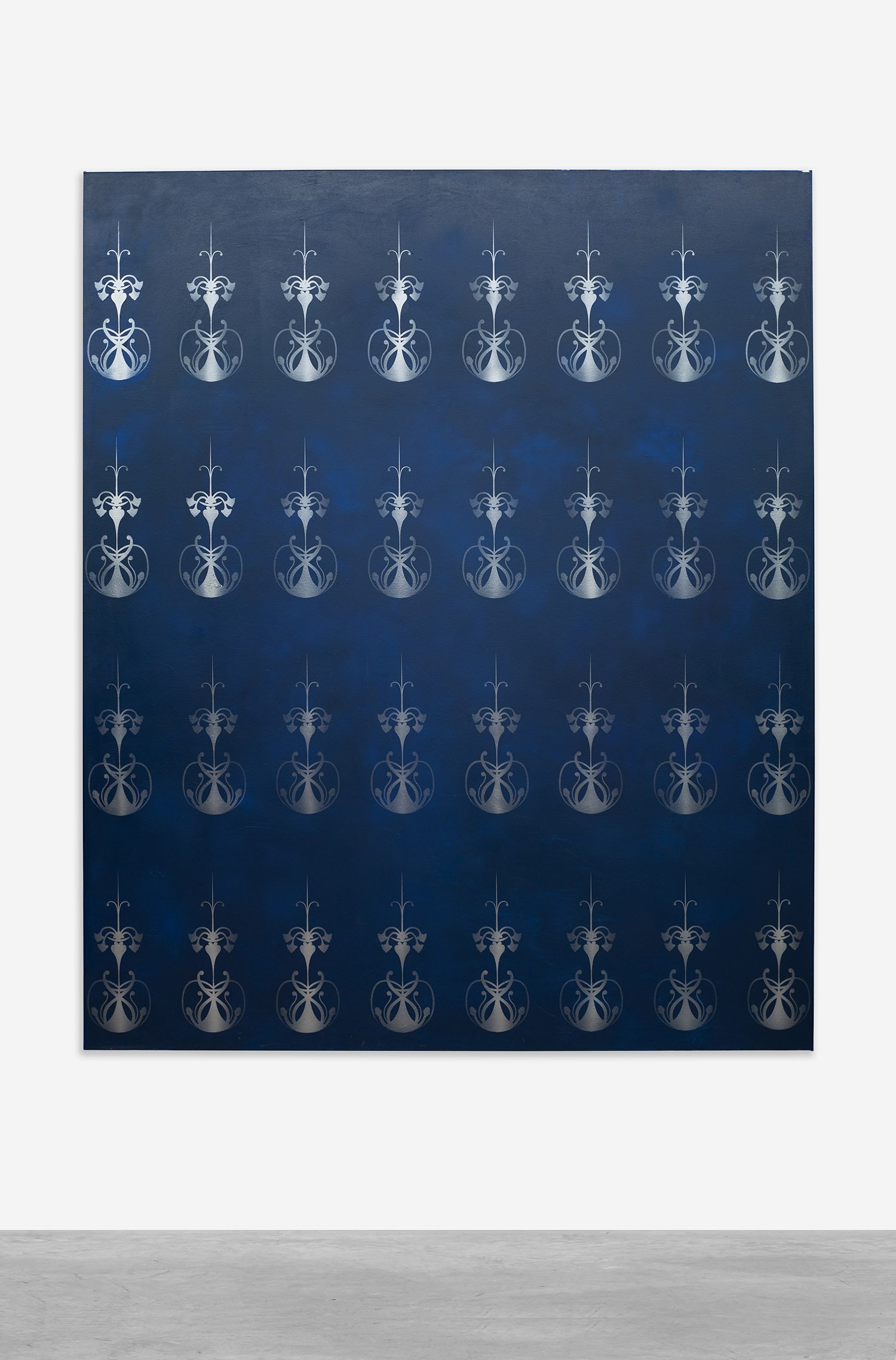
At 182.9 by 152.4 centimeters, Fractal 1 is among the largest paintings in Tan Mu's early body of work. The scale is not incidental. A fractal demands scale because its defining property is self-similarity across magnifications: the structure at one scale mirrors the structure at another, and the experience of that mirroring requires enough surface area for the viewer to register the repetition by moving closer and then stepping back. On a small canvas, the fractal would read as an abstract composition, a pattern of branches and nodes on a dark ground. At this scale, it reads as a territory. The viewer approaches the canvas and sees a dense field of branching lines radiating from a central dark mass. At two meters, the central mass resolves into something that resembles a body, seated or reclining, with arms extended and legs folded, surrounded by halos of luminous color. At one meter, the body dissolves into filaments, and the halos dissolve into clusters of smaller forms, each one repeating the structure of the whole at reduced scale. At thirty centimeters, the filaments themselves open into further structures, spirals and whorls and miniature copies of the original form, each one as detailed as the whole was from across the room. The painting produces the experience of zooming in, but the zoom is not digital. It is physical. The viewer zooms by moving their body, and the painting meets that movement with new detail, the way the Mandelbrot set meets magnification with new structure, the way reality meets attention with new information. The surface never runs out. There is always more.
The medium is oil and acrylic medium on linen, and the combination is deliberate. Acrylic medium, applied in the initial layers, builds the painting's architectural structure: the dark ground, the central mass, the primary branches that establish the fractal's first level of recursion. Acrylic dries quickly and allows for rapid revision, which is essential when building a structure that must maintain its coherence across multiple scales. Oil, applied in the subsequent layers, introduces the chromatic subtlety that the fractal's finer structures require: the warm ambers and golds that Tan Mu associates with the Buddhabrot's trajectory distributions, the cool blues and greens that mark the transition between stable and unstable regions of the complex plane, the near-black of the Mandelbrot set's interior where the iteration converges and nothing escapes. The oil layers are thin, translucent, and applied with a precision that suggests, without reproducing, the pixel-level accuracy of a mathematical rendering. The painting does not replicate the Mandelbrot set's exact boundary. It translates the set's visual logic into the logic of paint, where edges soften, colors blend at their thresholds, and the hand's tremor introduces a degree of variation that the equation, running on a computer, would not permit. This variation is not error. It is the difference between a mathematical object and a painting of a mathematical object, and it is the space where Tan Mu's argument lives.
In 1948, Jackson Pollock laid a canvas on the floor of his studio at 830 Springs Fireplace Road in East Hampton and began dripping paint. The resulting work, Number 1A, 1948, now at the Museum of Modern Art in New York, is a field of interlaced lines, skeins of black, silver, and aluminum paint distributed across the surface in a pattern that appears chaotic at first glance but reveals, on sustained attention, a structure of remarkable consistency. The lines are not random. They follow trajectories determined by the physics of falling paint, the viscosity of the medium, the angle of the stick or turkey baster from which the paint was poured, and the velocity of Pollock's hand as it moved across the canvas. Richard Taylor, a physicist at the University of Oregon, analyzed Pollock's drip paintings in the late 1990s and found that they exhibit fractal scaling: the pattern of lines at one magnification is statistically similar to the pattern at another magnification, with a fractal dimension that increases from roughly 1.4 in the early works to roughly 1.7 in the mature works. Whether or not Pollock was consciously producing fractals, and Taylor's analysis has been disputed, the paintings' visual structure operates according to the same principle that the Mandelbrot set embodies: simple rules, applied recursively, generate complex forms that maintain their coherence across scales. Pollock's rule was gravity plus viscosity plus velocity. Mandelbrot's rule was z equals z squared plus c. The rules are different, but the principle is the same, and the resulting images share a quality that is difficult to name but immediately recognizable: they look like they grew rather than were composed.
Tan Mu's Fractal 1 occupies a position between Pollock's procedural abstraction and Mandelbrot's mathematical visualization. Where Pollock's fractals are implicit, discovered through analysis after the fact, Tan Mu's fractals are explicit, chosen as the subject of the painting before a single stroke of paint touches the canvas. Where Mandelbrot's images are precise, generated by algorithms running on hardware, Tan Mu's painting introduces hand and material into the precision, allowing the body's slight imprecisions to produce variations that the algorithm cannot. The result is a work that is neither purely procedural nor purely mathematical but that inhabits the space between calculation and intuition, the same space that Tan Mu, in her Q&A, describes as the place where "emotion and rationality" converge. Pollock painted the fractal by accident. Mandelbrot computed the fractal with exactitude. Tan Mu painted the fractal on purpose, with her hands, in oil and acrylic, on linen, at a scale that requires the viewer's body to complete the experience of zooming in. The painting is not an illustration of a mathematical concept. It is a translation of that concept into the conditions of painting, where the hand's movement replaces the algorithm's iteration and the drying time of the medium replaces the computation time of the processor.
The Mandelbrot set is generated by a rule so simple that a child could program it: take a number, square it, add a constant, repeat. The complexity of the resulting image is not encoded in the rule. It emerges from the rule's repeated application, the way complexity in nature emerges from the repeated application of physical laws to initial conditions. A snowflake's six-fold symmetry emerges from the molecular structure of ice and the thermodynamics of crystallization, not from a design for a snowflake. A coastline's fractal boundary emerges from the interaction of waves, tides, and geological substrate, not from a plan for a coastline. The Mandelbrot set's boundary emerges from the iteration of a quadratic function, not from a composition for a mathematical object. In all three cases, the complexity is not designed. It is grown. Tan Mu's Q&A addresses this directly: "The Mandelbrot set demonstrates how extremely simple mathematical rules can generate endlessly complex structures, revealing a form of beauty that is both logical and deeply aesthetic." The word "beauty" is not incidental. Tan Mu is making a claim about aesthetics, not just about mathematics. She is arguing that the beauty of the Mandelbrot set is not a coincidence or a projection. It is a property of the system, as inherent as the complexity, and it arises from the same source: the recursive application of a simple rule to its own output, which produces, at every scale, structures that are both ordered and surprising, both predictable in their general form and unpredictable in their specific detail.
The Buddhabrot, which Tan Mu cites as equally important to the Fractal series, is a variant rendering of the same mathematical system. Where the standard Mandelbrot set visualizes which points in the complex plane belong to the set, the Buddhabrot visualizes the trajectories of the points that escape. Each escaping point traces a path through the complex plane before flying off to infinity, and the Buddhabrot accumulates these paths, producing an image that looks, depending on the rendering parameters, like a seated figure, a nebula, or a cloud of luminous gas. The name was coined by Melinda Green in 1993, who noted the resemblance to classical representations of the Buddha seated in meditation. Tan Mu confirms this observation in her Q&A: "The Buddhabrot, in particular, captured my attention because its distribution of trajectories often resembles the posture and symbolic presence of classical Buddha figures, creating an unexpected connection between mathematics, visual form, and spiritual contemplation." The connection is unexpected because the Mandelbrot set and its variants are purely mathematical objects. They contain no references to bodies, postures, or spiritual traditions. The resemblance to a seated figure is a consequence of the mathematics, not an intention of the mathematician, and its persistence across different rendering parameters suggests that it is not a coincidence but a structural property of the system, a way that the trajectories naturally distribute themselves in the complex plane. The painting does not impose the resemblance. It preserves it, translating the Buddhabrot's luminous distribution into the warm ambers and golds of oil paint, so that the seated figure appears not as a representation but as an emergent form, something that the mathematics produced without being asked and that the painting reveals without adding anything that was not already there.
Hilma af Klint began painting abstract works in 1906, years before Wassily Kandinsky, Piet Mondrian, or Kazimir Malevich laid claim to the invention of abstraction. Her series The Ten Largest, completed in 1907, consists of ten monumental canvases, each roughly 320 by 240 centimeters, depicting the stages of human life from youth to old age through radial forms, spirals, and botanical structures rendered in luminous pastels against pale grounds. The paintings were not shown publicly during af Klint's lifetime. She stipulated that they should remain hidden for twenty years after her death, believing that the world was not ready for them. She was probably right. The works were not exhibited until 1986, and their reception, when it finally came, was complicated by the fact that af Klint attributed their imagery not to her own aesthetic judgment but to messages received from spiritual beings during seances. This attribution has been treated variously as evidence of mental instability, as a valid description of a creative process, and as a strategic framing that allowed af Klint to produce work of radical formal ambition without claiming the authority that a male artist of the same period would have been expected to claim. What is beyond dispute is that the paintings themselves are extraordinary: compositions of extraordinary sophistication, combining radial symmetry with asymmetric disruption, botanical precision with cosmic scale, and a palette of pink, lavender, gold, and pale green that anticipates the pastel abstractions of the 1960s and 1970s by more than half a century.
The parallel to Tan Mu's Fractal series is structural rather than stylistic. Af Klint painted what she described as messages from a higher order, received through a medium she could not fully control. Tan Mu paints what she describes as structures generated by a mathematical rule, produced through an iteration she does not direct. In both cases, the artist positions herself not as the author of the image but as its translator, someone who receives a structure from a source beyond their own intention and renders it in paint. Af Klint's source was spiritual. Tan Mu's source is mathematical. But the structural logic is the same: the image exists before the painting, and the painting's task is to make it visible. Li Yizhuo, in her 2022 essay "Imaginary of an Image," argues that Tan Mu's works "do not aim at diagnosing the modern spectacles from a distance. They conjure up a kind of vitality and depth of their own." This observation is precise in the context of Fractal 1. The painting does not diagnose the Mandelbrot set. It conjures vitality from a mathematical object that most people associate with computation, screens, and the cold precision of digital rendering. The warmth of the paint, the slight irregularity of the lines, the flesh-toned undertones that emerge in the Buddhabrot's luminous regions, all of these introduce a register that the mathematics does not contain. They are the painting's contribution, the difference between a mathematical visualization and a painting of one, and they are what makes the work function as a painting rather than as a diagram. The fractal is the subject. The paint is the argument.
Tan Mu trained at the Fine Arts School Affiliated to China Central Academy of Fine Arts in Beijing, where the philosophical principle of ge wu zhi zhi, investigating things to extend knowledge, became a cornerstone of her artistic philosophy. The principle is ancient, drawn from the Great Learning, one of the Four Books of Confucian tradition, and it specifies a method: examine the thing closely, understand its nature, and extend that understanding toward broader knowledge. The Fractal series is an enactment of this method applied to a mathematical object. Tan Mu examined the Mandelbrot set and the Buddhabrot. She understood their generative logic, their recursive structure, their capacity to produce complexity from simplicity. And she extended that understanding toward a broader claim about the relationship between mathematics, nature, and art. The fractal, she argues, is not a special case. It is a general principle. The microscopic structures of atoms mirror the vast scale of galaxies. Neural networks echo the branching of river systems. Embryos echo the radial symmetry of supernovae. The recursion that produces the Mandelbrot set's boundary is the same recursion that produces the branching of trees, the distribution of blood vessels, the structure of coastlines, and the distribution of galaxies in the cosmic web. The painting does not illustrate this claim. It embodies it, at a scale that allows the viewer to experience the recursion physically, by approaching and retreating, by zooming in with their body, by discovering that the detail they noticed from across the room is itself a miniature copy of the whole, and that the whole is itself a detail in a structure that extends beyond the canvas in every direction, into the mathematics that produced it and into the reality that the mathematics describes. The rule is four characters long. The painting is nearly two meters wide. Between the rule and the painting, the recursion happens, and what it produces is neither calculation nor composition but something that has the properties of both, something that looks like it grew because it did.