The Error That Was Already There: Tan Mu’s The Glitch and the System’s Hidden Architecture
At Alfred University in upstate New York, in the Expanded Media studio where Tan Mu worked in the mid-2010s, there was a room full of screens. The room was used for video production, which meant it was used for signal manipulation, which meant it was used for the deliberate production of errors. The students learned to route video signals through devices that were not designed for video, to interrupt the feed and replace it with something else, to introduce noise where there had been image and image where there had been noise. Color displacement, inversion, static, fragmentation, the seizure-inducing flicker of a malformed signal. The errors were not bugs in the system. They were features of the studio, available for use at any time, because the faculty understood what the students eventually understood: that the error is where the system shows you what it is. When the signal works, it delivers content, and you attend to the content, and the system disappears behind what it carries. When the signal fails, the system becomes visible. The infrastructure becomes the subject. The error is the system speaking in its own voice, telling you what it is made of, what it is doing, what it assumes. Tan Mu has described her time at Alfred as foundational, and The Glitch is in many ways the direct product of that room, that practice, that understanding. She did not leave the studio and forget what the screens taught her. She carried the room with her, and in 2022 she opened it again, and this time the screens were the size of paintings, 193 by 244 centimeters, and the signal was not a video feed but oil and acrylic on linen, and the error was not a technical failure but a philosophical one.
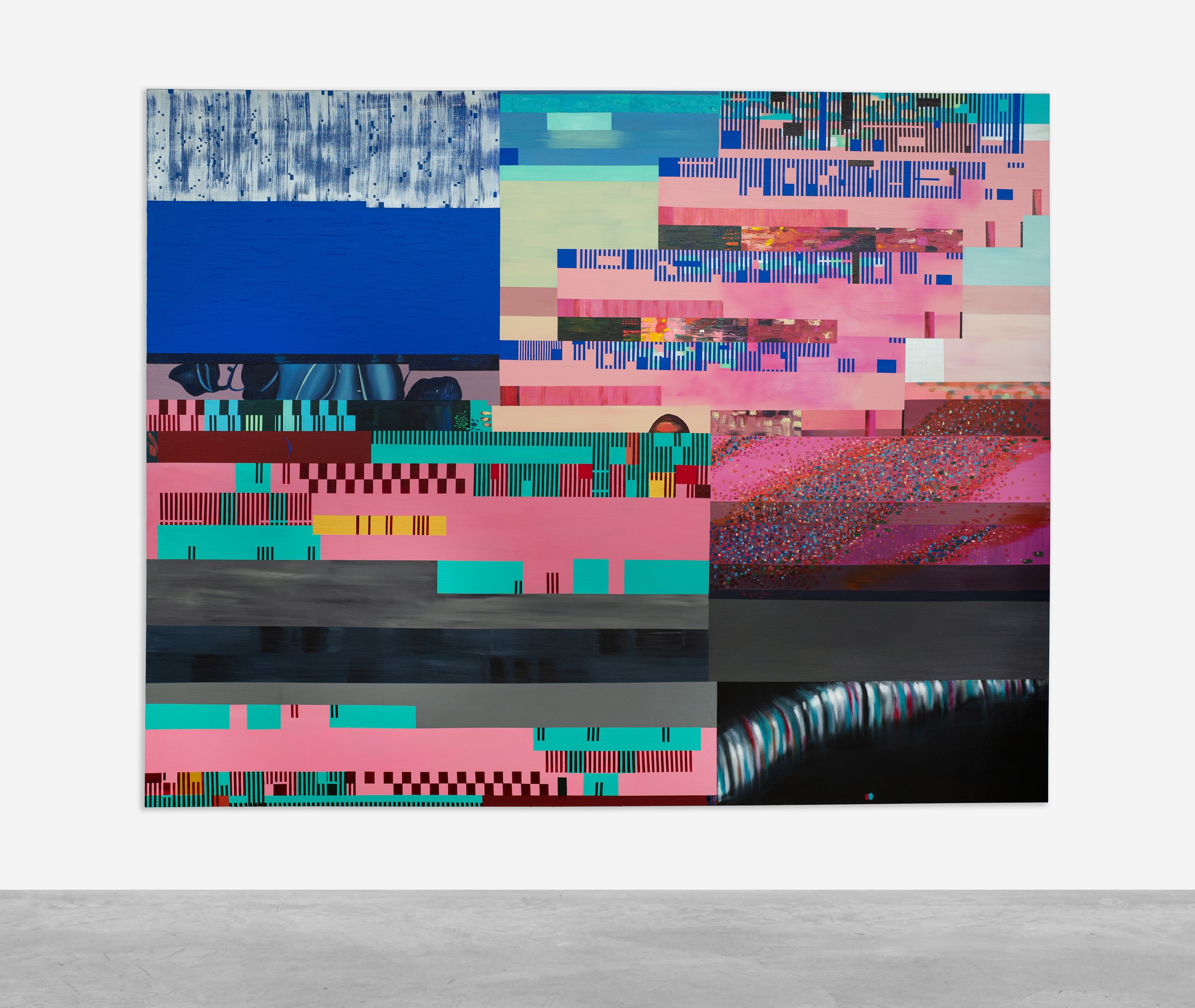
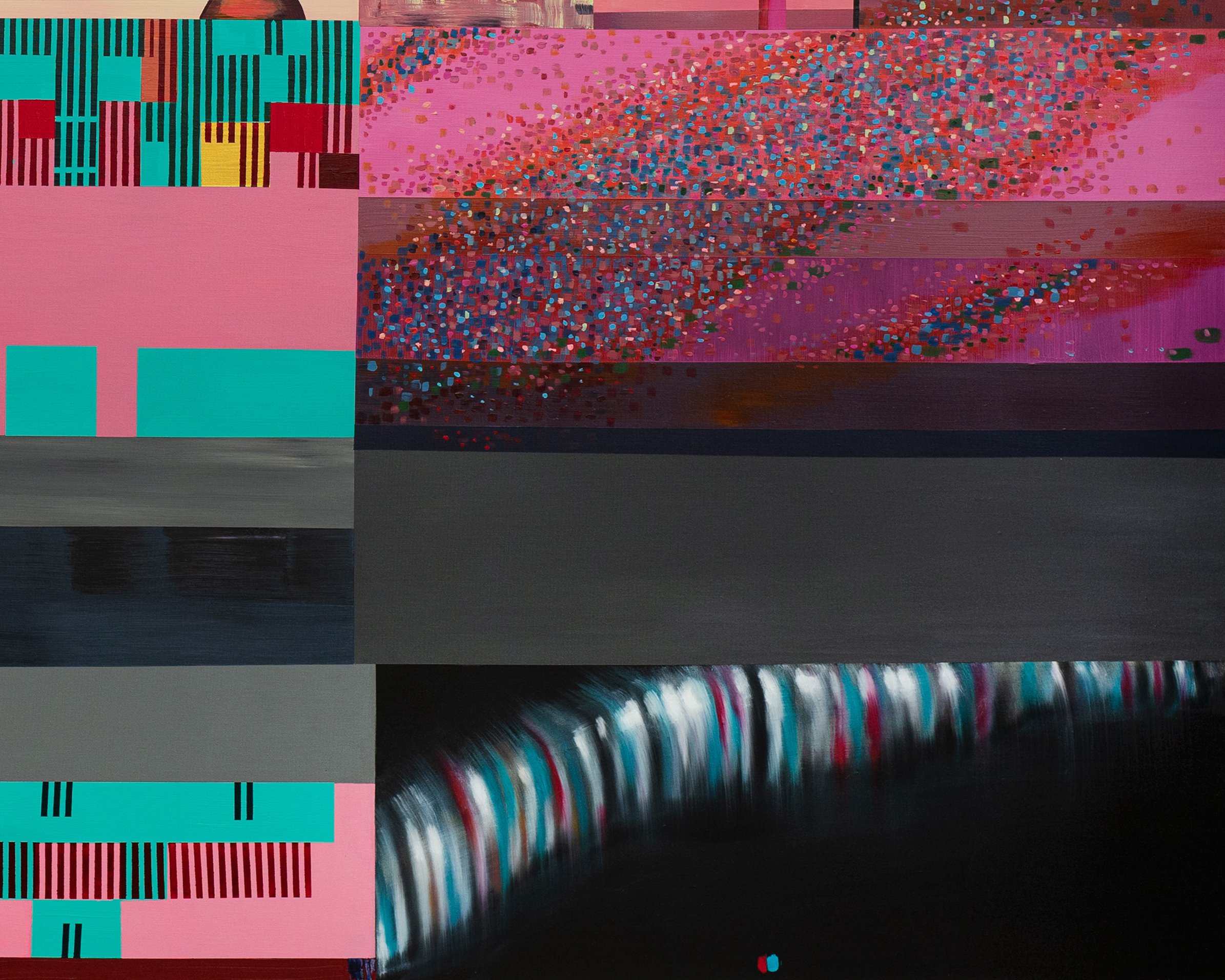
The Glitch measures 193 by 244 centimeters, oil and acrylic on linen, a scale that places the viewer inside the image rather than in front of it. The composition is organized around fragmented color fields and abrupt transitions, areas of saturated color interrupted by zones of static or near-static, the visual grammar of a broken display. Bold colors appear in blocks and slashes, reds and ambers and electric blues cutting across gray and black grounds, the palette of a screen in the instant before it fails or just after it has resumed, the moment when the image is returning from noise but has not yet fully cohered. The surface texture varies dramatically across the canvas. Some areas are smooth, almost polished, where the acrylic has been applied in thin layers that dry to a glassy surface reminiscent of the lacquered screen of a monitor. Other areas are thick with impasto, built up in heavy applications of oil paint that sit on top of the linen like a crust, suggesting density and volatility, the information pressing against the surface of the image from within. Between these two zones, the paint introduces sharp divisions, vertical and diagonal lines that read as boundaries between signal states, the edge where the coherent image ends and the noise begins, the barcode imagery that Tan Mu has identified as a central motif of the series.
The barcodes do not represent barcodes. They are not a commentary on retail logistics or product identification or the invisible codes that organize contemporary commerce. They are a visual language for the structure of information itself, the system of parallel lines that can be read by a machine, that carries content that a human cannot decode without the machine, that translates the world into a format that computation can process. The barcode is a figure for encoding, for the translation of one kind of meaning into another kind of meaning, for the vast systems of representation that operate beneath the surface of visible experience. Tan Mu has described these lines as embedded cues, things that prompt viewers to consider the fragile architecture of the networks that organize modern existence. The architecture is fragile because it is everywhere and nowhere, because it is invisible in its functioning and catastrophic in its failure, because when the network goes down the hospital cannot schedule surgeries and the airport cannot board passengers and the market cannot settle trades, and the failure reveals how much of the modern world was resting on a connection that no one had examined closely enough to know how fragile it was. The barcode lines in The Glitch are not decorative. They are structural. They are the bones of the image, and when the image fragments around them, when the bold colors break against them and the thick paint builds up beside them, the barcodes become the thing the painting is about: the invisible structure that holds the visible world together, and the moment when it gives way.
In 1980, at the Venice Biennale, Nam June Paik presented a work called Robot K-456, a remote-controlled robot equipped with a radio receiver and a tape recorder that played back pre-recorded sounds, including the voice of the artist reading Kafka and Beethoven's Ode to Joy. The robot moved through the exhibition space under Paik's remote control, its movements unpredictable, its sounds overlapping with the ambient noise of the Biennale, its physical presence a disruption in the serene environment of the pavilion. K-456 was not a reliable performer. It broke down. Its batteries ran out at inopportune moments. Its radio signal interfered with other devices in the building. Its movements were not graceful. Paik had designed it to fail, not entirely but partially, not catastrophically but persistently, in the way that all machines fail eventually and in the way that the machine's failure in public reveals what the machine's reliable functioning conceals. The glitch is not different from K-456. The glitch is K-456 without the body, the failure without the robot, the malfunction as a pure event in the signal rather than a malfunction in a physical apparatus. Paik understood that the error was not a failure of the technology but a form of communication from the technology, a message that said: I am a system, I operate according to rules, and here is what those rules produce when they encounter their own limit. The Glitch is a painting that receives that message and translates it into paint, that takes the error that Paik staged in Venice and stages it again in oil and acrylic, at a scale that the viewer cannot simply observe but must inhabit.
The series is called The Glitch, and the glitch is not a metaphor for something else. It is not a symbol of human error or social breakdown or the fragility of civilization. It is a specific technical event: the moment when a digital signal is disrupted, corrupted, interrupted, or transformed by factors that the system did not anticipate, and the image that the signal carries degrades in ways that are not random but structured, determined by the logic of the encoding itself. When a video signal is disrupted, the disruption produces specific visual artifacts, because the encoding has a specific structure and the error interacts with that structure in specific ways. The blocking and pixelation that appear in a corrupted digital image are not arbitrary. They are the signature of the compression algorithm, the visual trace of the mathematical process that was used to encode the image, which means that the glitch is not a departure from the system but a revelation of the system, the moment when the machinery becomes visible because it is no longer hidden behind its output. Tan Mu has said that the series grew out of her investigation into signal disruption and system failure, and that the works examine how interruptions in signal transmission affect both visual perception and the flow of information. This is not a poetic observation. It is a precise description of what the painting does. The image in The Glitch is interrupted, fragmented, disrupted, and the disruption is the subject, not a comment on the subject.
Contemporary digital infrastructure is a system of extraordinary complexity, layered across continents in the form of submarine cables, data centers, wireless networks, and the endpoints that humans carry in their pockets. The system is designed to be invisible, to deliver content without revealing its own architecture, to make the network disappear behind what the network carries. When it functions, the user sees the message, not the medium. The success of the infrastructure is measured by its invisibility, by the degree to which it succeeds in concealing itself. But the system fails, and when it fails, the concealment lifts. The outages that grounded flights across Europe in the years after 2020 were not anomalies. They were glimpses behind the curtain, moments when the infrastructure became briefly visible because it had stopped working and someone had to find out why. Tan Mu has described reading reports about potential large-scale internet failures and then witnessing one of those failures occur, and the experience made the fragility of digital infrastructure feel immediate rather than theoretical. The theoretical fragility had always been there. The reports documented it. But the failure was what made it real, and the painting is what Tan Mu made from that experience of reality, from the gap between knowing intellectually that a system is fragile and feeling in your body what the fragility means when the system stops working.
Iannis Xenakis was a Greek-French composer who trained as an architect under Le Corbusier before turning to music, and his compositions were shaped by his architectural background in ways that remained visible even when the music was fully abstract. His piece Metastaseis, composed in 1953 for orchestra, introduced what he called stochastic music, compositions in which the probabilities of certain sounds occurring are determined by mathematical functions, so that the overall texture of the music is controlled but the specific events within that texture are left to chance. The piece begins with a gradual accumulation, individual instruments entering one by one until the texture reaches a density that is no longer a collection of individual sounds but a continuous noise field, a wall of sound that then begins to shift and evolve according to the stochastic rules that govern it. Xenakis was interested in the threshold between order and disorder, in what happens at the edge where a pattern becomes too complex to perceive as a pattern and the perception shifts from structure to texture, from signal to noise. His architecture had taught him about this threshold. The façade of a building is a surface that can be read as a pattern until the window spacing becomes too irregular or the surface geometry too complex, at which point the façade becomes something else, a texture, a field, a noise. Metastaseis translates this architectural knowledge into sound, and The Glitch translates it into paint.
The connection between Xenakis and Tan Mu is not merely conceptual. It is procedural. Xenakis developed his stochastic compositions using a method that he described in detail in his 1963 book Formalized Music. He would define a set of mathematical functions that governed the probability distributions of sonic events across time: how many instruments would play at any given moment, what register they would occupy, how long each sound would last, how dense the overall texture would be. He then used these functions to generate the specific events of the composition, calculating each note by hand or, in later works, with the assistance of computers. The result was a score that looked like a graph, with lines sweeping across the page in glissandi that moved from one register to another, each line representing the trajectory of a single instrument, the collection of lines producing a visual density that corresponded to the sonic density that the audience would hear. The score of Metastaseis, when reproduced as a graphic image, looks like a glitch. It looks like a corrupted signal, a field of parallel lines that cluster and diverge and cluster again, a visual representation of information that is simultaneously ordered, because it was generated by a mathematical function, and disordered, because the function produced a density of events that exceeded the capacity of the eye to resolve them into individual units. The threshold that Xenakis identified between order and disorder, between signal and noise, between pattern and texture, is precisely the threshold that The Glitch occupies, and it is precisely the threshold that a corrupted signal occupies when it stops delivering coherent content and starts delivering the visual signature of its own encoding process.
Saul Appelbaum, writing about Tan Mu's Signal paintings in 2025, introduced a concept that is equally applicable to The Glitch: arbitration. The word names the act of deciding, judging, mediating between input and output, the human effort to make sense of a signal as it passes through multiple notations, forms, materials, processes, and consciousnesses. Appelbaum argues that Tan Mu's paintings do not offer a direct alignment between system and representation. They offer instead the act of arbitration, the moment when the viewer encounters an image that was produced by a system and must decide what the image means, where it came from, what it is trying to do, what it reveals about the system that produced it. The Glitch asks the viewer to arbitrate. The image is disrupted, fragmented, broken, and the disruption is not an accident of the painting's creation but the subject of the painting, the thing that the painting is asking the viewer to attend to. The viewer must decide what the disruption means, what system produced it, what the system looks like when it fails, what the failure reveals about the system's normal functioning. This is not a passive activity. It requires the viewer to bring knowledge to the image, to recognize the visual language of digital error, to know what a corrupted signal looks like and what that visual signature implies about the infrastructure that the signal traveled through. The painting is addressed to a viewer who already knows, who has encountered a frozen screen or a pixelated video or a barcode that will not scan, and who has wondered, even briefly, what the failure means about the world that the failure interrupted.
The glitch, Tan Mu has said, is not simply a visual artifact of malfunction. It is a signal of systemic fragility. The distinction matters. The visual artifact is the symptom. The systemic fragility is the condition. The painting is not interested in the symptom. It is interested in the condition, which means it is interested in the gap between what the system promises and what the system is, between the smooth surface of the functioning image and the chaotic infrastructure that produces it, between the network as it appears in the marketing materials of the companies that sell it and the network as it appears when a single point of failure brings down an entire system. The glitch closes that gap, briefly, temporarily, at the cost of the image's coherence. It shows the system to the viewer who had been attending only to what the system carried. The Glitch takes that brief moment of revelation and extends it, holds it, gives it scale and weight and permanence, so that the viewer can examine it at length rather than encountering it in passing, so that the moment of failure becomes an object of sustained attention rather than an inconvenience to be dismissed. The painting is a record of what the error reveals, and what the error reveals is that the architecture was always fragile, that the smoothness was always a performance, that the system was always one failure away from showing you what it was. The glitch was already there, before the failure, in every component and every connection and every assumption built into the design. The failure did not create the error. The failure only made it visible.