The Burning Image: Tan Mu’s Philadelphia and the Night the News Would Not Stop
The pandemic made everyone a viewer. In the spring of 2020, the streets emptied because the disease spread through proximity, and proximity was what the modern city existed to produce. People retreated to their apartments, their houses, their rooms, and they watched the world through screens. The news showed hospitals overflowing in Milan and New York. It showed empty highways in Wuhan and empty restaurants in Paris. And then, in late May, it began showing something else. It showed cities burning. Not forests at the edge of the world, not factories in countries whose names appeared in headlines only when they caught fire, but American cities, Philadelphia and Minneapolis and Atlanta and Los Angeles, their downtowns lit by flames that the networks broadcast in a continuous loop, each ignition replacing the last, a scroll of burning cars that could have been any car, a scroll of broken windows that could have been any window, the news as a fire that fed on its own repetition. Tan Mu was in New York, then. She had moved her practice from the studio back to wherever she could work, which was home, which was the same condition as everyone else's home. She watched the news. She had always watched the news, she says, since she was young, and that watching shaped how she processed the world. The burning car appeared on her screen one evening, and she could not stop looking at it. It was a photograph, not a video. It was a still image, arrested in the moment before the fire department arrived, and it showed something overturned and on fire in a street whose name she did not know, surrounded by debris whose origin she could not determine, and behind it the blank faces of buildings that might have been any buildings in any American city. The image condensed the chaos of that moment into a single frame, and the frame was what she painted. She painted it not from memory but from the photograph, which is to say she painted the news, which is to say she painted the thing that stood between her and the event.
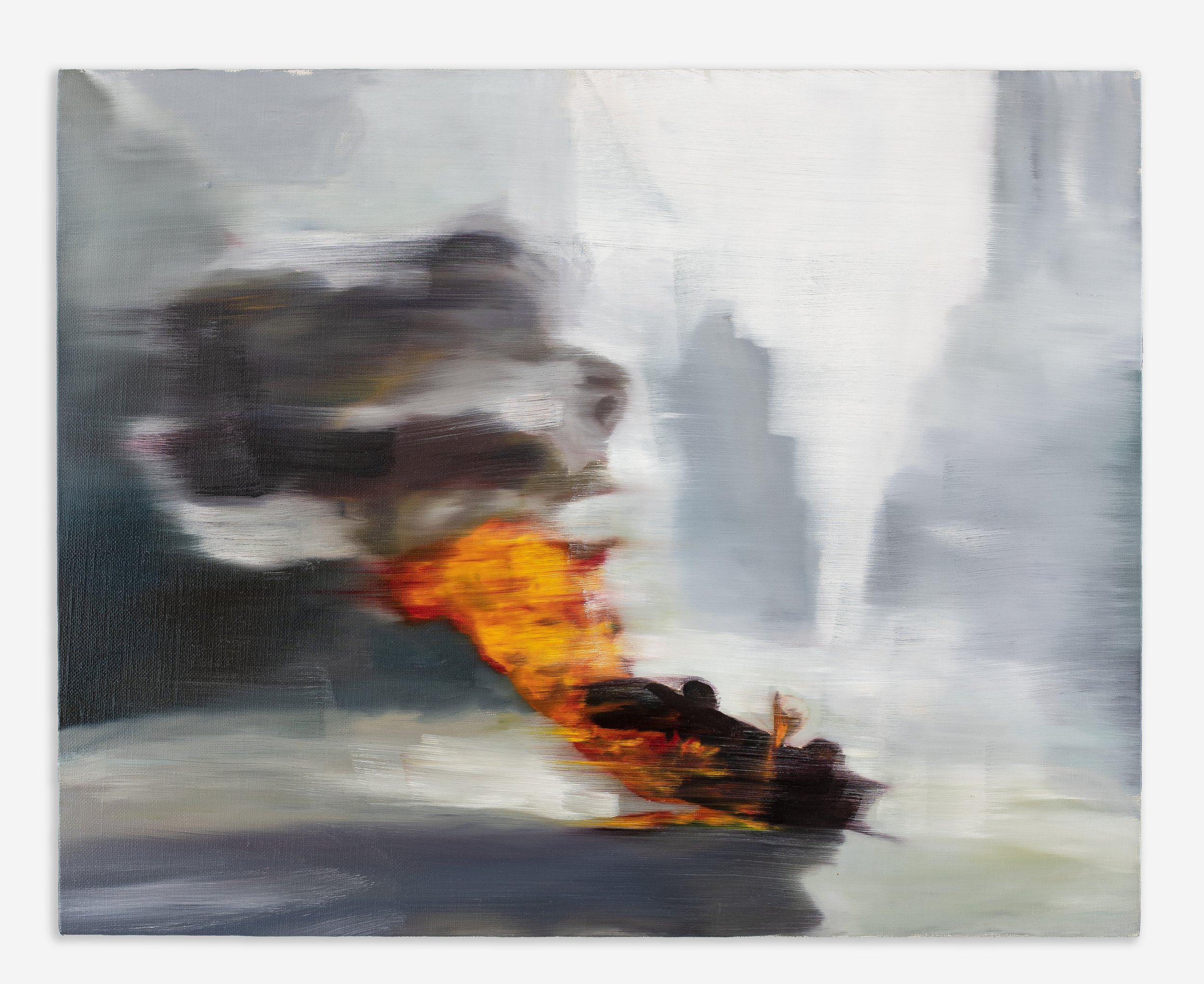
Philadelphia is 41 by 51 centimeters, oil on linen, small enough to hold in the lap or set on a desk, large enough for the eye to travel across it. The scale is intimate, and the intimacy is deliberate. Tan Mu describes watching the news in a room, in private, at a distance from the events she watches. The painting reproduces that condition. It does not present a monument to civic unrest. It presents a screen, a surface that the viewer encounters at the distance of a screen, 41 centimeters wide, at arm's length. The composition is organized around a central burning form, an overturned car rendered in dark tones against a background that shifts between black and gray and pale silver, the palette of a photograph taken at night with a flash, or the palette of a memory that has been overexposed. The car is not identifiable as a make or model. It is a shape, a heavy industrial form that has been turned on its side by some force that the painting does not explain, and the fire that rises from it is the only element in the work that breaks the monochrome into color: red, orange, yellow, the palette of combustion, the palette of emergency, the palette of the dashboard warning light that says something has gone wrong and you must stop now. The flames cut across the gray surface like an interruption, a violent intrusion of the real into the composed, the way a notification interrupts a evening, the way the breaking news banner interrupts the program you were watching, the way the burning car interrupted whatever the city was before it burned.
The surface of the linen is visible in the areas between the flames and the dark form of the car, and the weave of the fabric introduces a texture that the paint does not fully obscure, a grain that reads as a kind of noise, the way a digital image degrades when it is compressed and transmitted and recompressed and transmitted again. Tan Mu's process, she has said, often follows the path of an event, beginning with its physical occurrence, moving through its digital dissemination, and finally returning to a material form through painting. Philadelphia enacts that path. The event was physical, a car on fire in a street in Philadelphia in May 2020. The photograph of the event was digital, captured by a photojournalist, transmitted to a server, distributed to screens, encountered by Tan Mu on her screen in her room in New York. The painting is the final step in that journey, and it bears the marks of the journey. The horizontal brushstrokes that Tan Mu describes as suggesting motion and instability are also suggesting transmission, the horizontal lines of a signal being broadcast, the lines of a screen refreshing, the lines of the news scroll that replaced one burning image with another. The paint does not reconstruct the event. It reconstructs the path the event took to reach her, and the reconstruction is itself an argument about what seeing has become.
On May 1, 1937, the Condor Legion of Nazi Germany bombed the Basque town of Guernica. The attack lasted three hours. The town was destroyed. Between 200 and 1,600 people died, the numbers uncertain because the attack targeted civilians fleeing across a bridge, and the bridge was bombed, and the counts of the dead were made by counting what remained. Pablo Picasso was in Paris when he heard the news. He was already working on a commission for the Spanish Pavilion at the Paris World's Fair, a large mural depicting the struggle between the Spanish Republic and its fascist opposition. After Guernica, he abandoned the original concept and began again. The result, completed in June 1937, is a canvas 3.49 meters tall and 7.76 meters wide, painted in the gray, black, and white that Picasso had come to associate with the photography of war, with the news photograph that could not be printed in color because color was not yet available in newspapers, or that could be printed in color but was more often printed in the cheaper monochrome, or that was most often encountered in memory as a gray shape against a gray ground, the fire and the smoke and the rubble all reduced to the same tonal register. The bull is present in the painting. The horse is present. The woman with the dead child is present. The soldier with the severed arm is present. The lamp is present. But the painting is not a representation of the bombing in the sense that it shows what happened. It is a representation of what the news of the bombing did to a painter in Paris who had to make something when he heard that a town had been destroyed by an air raid, and what the news did to him was to produce a need to depict the thing that the news could only announce.
The parallel to Tan Mu's Philadelphia is structural rather than stylistic. Picasso did not paint Guernica from witness. He painted it from the newspaper, from the wire service report, from the photographs that were taken after the bombing and distributed to newspapers in Paris and London and New York. He was in Paris. Guernica was in Spain. The distance between the event and the painter was not geographic but medial. He encountered the event through the same medium that everyone else encountered it, the news photograph and the news report, and his painting was a response to that medium, to what the medium could show and what it could not, to what it revealed and what it concealed. Tan Mu is explicit about this process. She did not witness the protests in Philadelphia. She witnessed the photograph of the protests, and her painting is a response to the photograph, to what the photograph showed and what it could not, to the way the photograph condensed an event into a frame and the frame into a story and the story into a feeling that the painting tries to recover from the story. Guernica and Philadelphia are separated by eighty-three years and two continents, but they share a condition: the painter responding to an event that arrived as an image, the painting trying to make something that the image could not, the attempt to move from the announcement to the thing announced, from the report to the thing reported, from the news to the knowledge that the news was about something that happened to real people in a real place and that the image of it was not the thing itself.
The protests of 2020 were among the most photographed events in American history. This is not a comment on their importance relative to other events. It is a comment on the condition of documentation in the twenty-first century, when every phone is a camera and every camera is connected to a network and every network distributes images instantaneously to every other camera on the planet. The protests were documented from every angle, by every participant who had a phone, by every journalist who was present, by every surveillance system that happened to be pointed in the right direction, by every drone that was deployed to survey the damage. The result was a volume of images so vast that no single person could have seen them all, and so redundant that seeing some of them was, in a sense, the same as seeing all of them, because they showed the same things: cars on fire, windows broken, people running, police in riot formation, flames rising. The repetition was not incidental. It was the content. The news cycle did not simply report the protests. It produced them as images, and the images were the protests' public face, the form in which they existed for most people who encountered them, which is to say the form in which they existed for most of the world, which is to say the form in which they entered history. Tan Mu describes this directly: "By transforming these moments into painting, I wanted not only to reflect on the events themselves but also to examine how such images circulate, are consumed, and are interpreted within the highly mediated environment we live in." The painting is not about Philadelphia. It is about the condition of encountering Philadelphia through images, which is to say it is about the condition of encountering any distant event, which is to say it is about what seeing has become when seeing is mediated by networks that move faster than understanding.
The COVID-19 pandemic was also a documented event, but its documentation was different. The pandemic was documented in charts and graphs, in case counts and death counts, in hospital bed occupancy rates and ventilator availability percentages. Its characteristic image was not a burning car but a curve, an exponential rise and fall rendered in blue and red on a black background, the image of a process that no one could see directly because the process was happening inside bodies and between bodies and across distances that the body could not perceive without the instrument that measured it. The pandemic made people prisoners of their own homes, and in their homes they watched the numbers rise, and the numbers were not images of the dying but numbers about the dying, and the distance between the number and the person it described was the same distance that Tan Mu describes between her painting and the burning car: the distance of the mediated, the distance of the translated, the distance of the thing that stands for the thing itself when the thing itself cannot be reached. The protests that coincided with the pandemic were, in this sense, a different kind of event. They were visible. They produced images that could be watched in the same way that a fire can be watched, with the same combination of horror and fascination, the same sense that one is seeing something that one should not want to see but cannot stop watching. The protests were also a different kind of documentation of the pandemic's conditions: the inequality that the pandemic exposed, the economic precarity that the lockdowns intensified, the accumulated grievance that had nowhere to go except into the street.
Robert Longo began his Men in the Cities series in the early 1980s, producing large-scale charcoal drawings of men and women in the midst of violent motion, bodies caught in the instant before or after impact, suits intact and faces contorted, the pristine surface of the corporate world disrupted by the violence that it contained. The works were based on photographs from newspapers and magazines, images of riots and car accidents and street violence, and Longo's drawings translated those photographs into a medium, charcoal on paper, that introduced a quality of shadow and highlight that the photographs lacked, a depth that the flat print could not achieve, a sense that the violence was occurring not on a screen but in a space that the viewer could enter. The drawings were exhibited in New York in 1983 and caused a sensation, not because they depicted violence but because they depicted violence with a precision and detachment that felt new, clinical, as though the artist had removed himself from the moral weight of the subject in order to document the subject's visual structure. Longo was interested in what he called the "sublime violence" of contemporary American life, the way that violence had become ordinary, backgrounded, available for consumption as entertainment or information without requiring any change in the viewer. His drawings were a response to that condition, a set of images that made the viewer look at what the viewer had learned to look past.
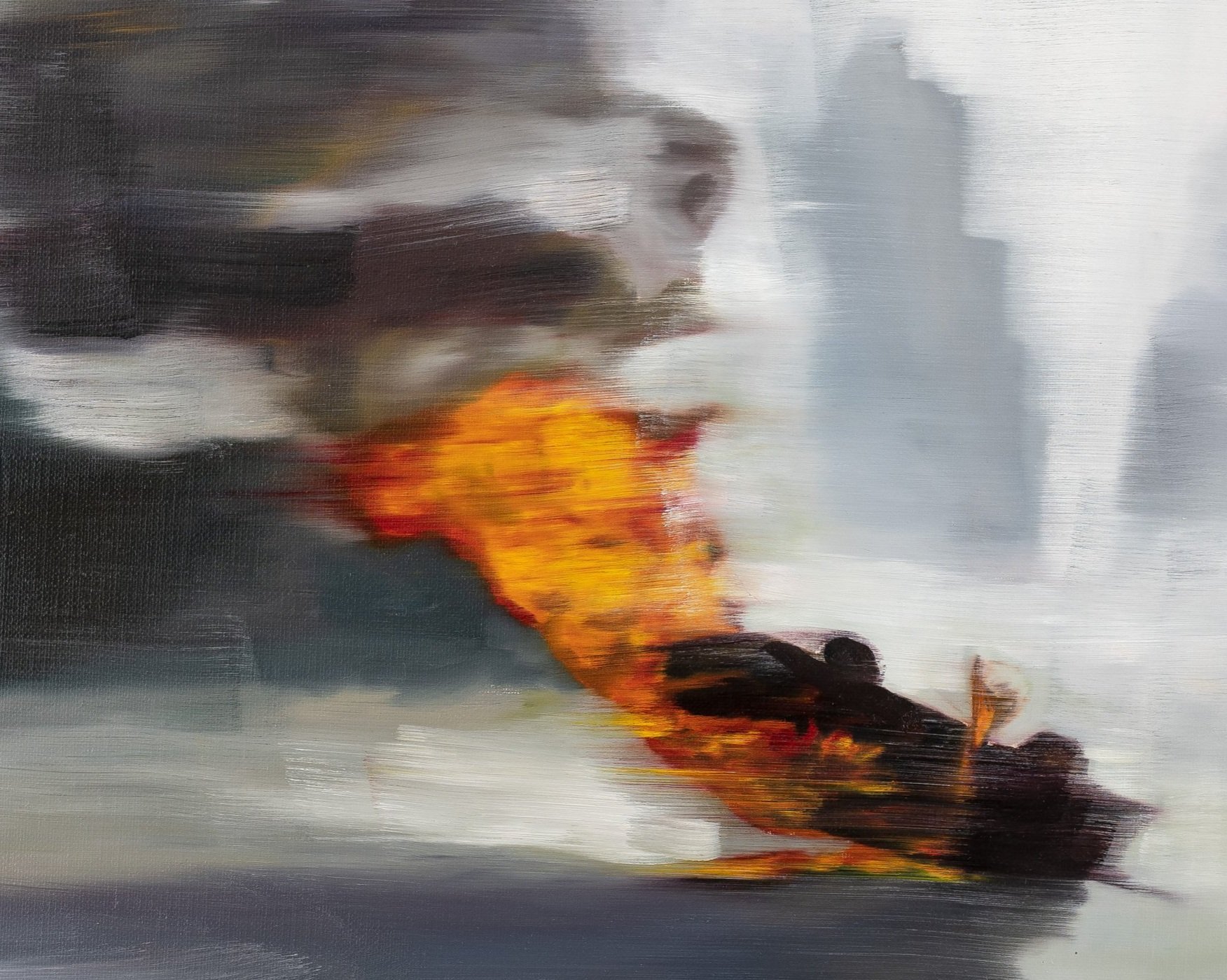
Tan Mu's Philadelphia occupies a related position. The burning car is not a pleasant image. It is not an image that one seeks out for its aesthetic qualities or its representational interest. It is an image that one encounters in the news and that one cannot unsee once it has been seen, the way the images of the World Trade Center in 2001 became permanently lodged in the visual memory of anyone who saw them, the way they became available for in the mind at any moment when the mind was unoccupied. The painting does not soften this quality. The flames in the painting are red, orange, yellow, colors that the painting's monochrome surface does not prepare the viewer for, interruptions of the gray scale that function as interruptions of the viewer's defenses, the way the actual flames were interruptions of the night's darkness. Yiren Shen, writing about Tan Mu's Signal series in 10 Magazine, observed that "the access points are built up with thick, wax-heavy oil paint, resembling the soldered connections of electronic circuits," and this technique, this building-up of surfaces into raised textures that resemble technological junctions, appears also in Philadelphia in the handling of the flames, where the paint is thicker, more impastoed, more present, more insistent, more resistant to the viewer's desire to look away. The painting is designed to make looking away difficult, because looking away is what the news cycle depends on, the quick switch from one image to the next that keeps the viewer in a state of constant low-level stimulation without ever requiring sustained attention, and the painting is a refusal of that switch, a demand that the viewer stay with the image long enough for it to become something other than information.
The news cycle and the painting operate on opposite temporal logics. The news cycle wants the image to be consumed and discarded, replaced by the next image before the viewer has time to feel anything, the scroll that delivers one burning car and then another and then another until the burning car becomes a genre rather than an event, a visual category that the viewer has learned to process without processing. The painting wants the viewer to stop. It wants the image to be examined, turned over, held in attention long enough for its content to register, for the specific to replace the generic, for the particular burning car in the particular Philadelphia street to stop being any burning car and become what it was: an object that someone owned, that someone had parked or abandoned or fled in, that was now overturned and burning in a photograph that someone took and transmitted and that Tan Mu received and painted. Tan Mu has described her interest in news watching as a lifelong habit, something she has done since she was young, and this habit shaped how she processed the world. The habit produced the painting. The painting is the record of what the habit produced when the habit encountered the specific image that demanded more than the habit could give, the image that stopped the scroll, that demanded to be held, that refused to become just another image in the stream. The pandemic kept people in their homes and the homes kept them at the screens and the screens delivered the burning car and the burning car demanded something from the viewer that the viewer, locked down and isolated and watching alone, could not give to the streets. The painting is what the viewer gave instead, the hours that the viewer would have spent in the studio applied to the image that the viewer could not stop watching, the painting as the form that attention takes when attention is the only resource available and the image demands everything.