The Woman at the Console: Tan Mu’s The Binary Dream and the Hands That Made Computing Human
The photograph shows a woman seated at a console. She is wearing a short-sleeved blouse with a collar, her hair is pulled back, her right hand rests on a stack of punch cards, and her left hand reaches toward a panel of switches and dials on the face of a machine that fills the frame behind her. The machine is an IBM 704, introduced in 1954 as the first mass-produced computer with floating-point arithmetic hardware, and the woman is one of the people who operated it, which meant feeding it punch cards, reading its output from printers and cathode-ray tubes, setting its switches by hand, monitoring its vacuum tubes for failures, and performing the thousands of small physical actions that a computer required before it required nothing, before the interface became invisible, before the machine learned to receive its instructions from other machines rather than from the hands of a woman sitting at a console in a room full of other machines. The photograph is historical. It was taken at a NASA facility in the 1950s or early 1960s, during the period when the agency was using IBM mainframes to calculate orbital trajectories and launch windows and reentry angles, and the woman in the photograph was one of the people performing those calculations, not by running the numbers in her head, though she could have, but by running them through the machine, by translating the mathematics into punch cards and the punch cards into electrical impulses and the electrical impulses into results that were printed on paper or displayed on a screen, and the translation required her hands, her eyes, her attention, her knowledge of the machine's operating procedures, and her physical presence in the room where the machine lived, because the machine could not operate without her. Tan Mu found this photograph and painted it in 2024, and the painting is called The Binary Dream, and the dream is not the machine's. It is hers.
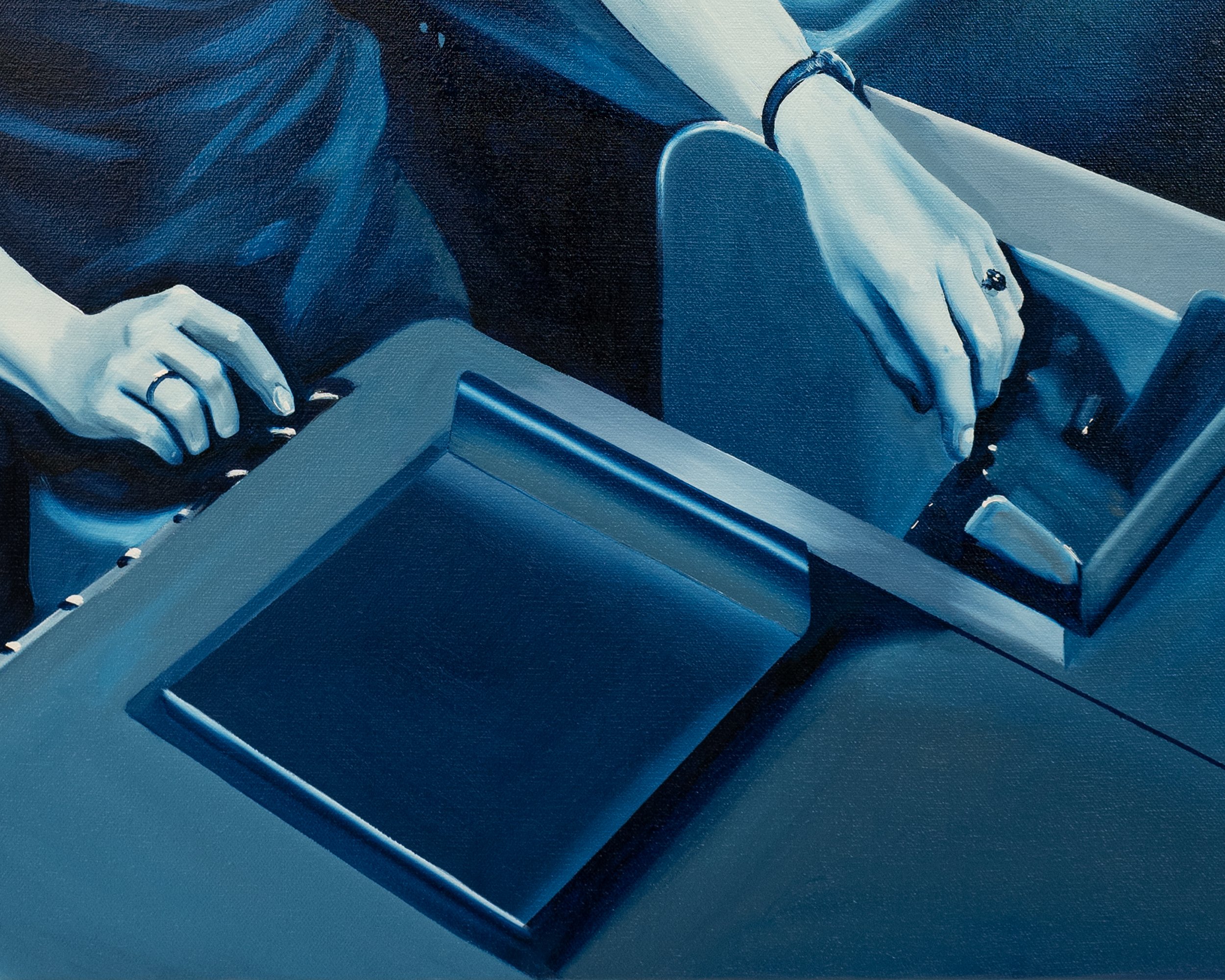
The Binary Dream is 76 by 46 centimeters, oil on linen, a vertical format that mirrors the proportions of the original photograph and the posture of the woman at the console, who sits upright with her hands extended toward the machine, her body vertical against the horizontal expanse of the IBM 704's faceplate. The painting is executed in a monochromatic blue palette that ranges from near-white at the highlights on the woman's face and hands to deep navy in the shadows of the machine's interior, with every intermediate value of blue rendered in thin, translucent layers of oil paint that allow the weave of the linen to show through in the lighter passages, creating a surface texture that reads simultaneously as the grain of a photographic print and the flicker of a cathode-ray tube, the two media that produced the image that Tan Mu is translating, the photograph and the screen, the analog and the digital, the moment captured on film and the moment displayed by phosphor, both of them blue in the painting because Tan Mu chose blue, because blue is IBM's color, because IBM was called Big Blue, because blue is the color of rationality and institutional authority, because blue is the color that the company used to brand its machines and its offices and its advertising and its identity, and because blue is also the color of the screen that displays data, the color of the interface through which the human speaks to the machine, the color of the medium in which the binary dream becomes visible, the blue of the IBM 704's console lights and the blue of the monitor that would replace them and the blue of the data that would replace the punch cards and the blue of the cloud that would replace the room where the woman sat with her hands on the switches, the blue that encodes the entire history of computation from the moment when the machine required a human body to operate it to the moment when the machine required nothing but electricity and a network connection, the blue that connects the woman at the console to the server farm on the other side of the planet, the blue that makes the painting feel like it is being stored or processed rather than looked at, the blue that Tan Mu describes as placing the image inside a computational atmosphere.
The woman's face is rendered with the most specific detail in the entire painting. The machine behind her is painted in broad planes of blue that suggest its mass and complexity without resolving its individual components, the way a dream suggests a room full of objects without clarifying what the objects are, but the woman's face is specific, the angle of her jaw, the set of her mouth, the direction of her gaze, which is directed downward toward the console, focused on the task of reading or setting a switch, not looking at the viewer, not performing for the camera, not aware that she is being photographed or painted, simply doing the work that the machine requires, the work that the machine cannot do without her, the work that is physical and manual and demanding in a way that the subsequent history of computing would gradually make invisible by moving the physical operations behind screens and beneath keyboards and inside protocols that no human hand ever touches, until the work disappears entirely and the user types a query into a search bar and the result appears as if by magic, as if the machine had generated it on its own, as if there were no woman at a console, no hands on switches, no body in the room, no labor that the computation required in order to become the thing that we now call computation, which is the thing that we now call intelligence, which is the thing that we now call artificial, which is the thing that makes us forget that it was once physical, once manual, once performed by a woman in a blue room with her hands on a machine that she understood because she had to, because without her understanding and her attention and her hands the machine was a piece of furniture, an expensive piece of furniture that could not compute anything at all.
Lorna Simpson's Waterbearer, completed in 1986, is a photograph with text, or more precisely a pair of gelatin silver prints mounted on felt, each print showing a Black woman in a different pose, accompanied by a text panel that reads: "She saw the city from the river and the river from the city. She carried water from the river to the city and from the city she carried water to the river." The woman in the photographs is carrying water, a plastic jug in one hand, a stainless steel container in the other, and the water is the medium through which she connects the two domains, the natural and the urban, the river and the city, the source and the destination, and the text makes explicit what the photographs imply: that the woman is a medium, a carrier, a body that moves something from one place to another, that performs the labor of connection that the city requires in order to function, the labor of bringing water from its source to the place where it is needed, and that this labor is invisible, unacknowledged, uncredited, performed by a body that the city does not recognize as essential to its operation even though the city would collapse without the labor that the body performs. Simpson's work has always been concerned with the erasure of Black women's labor from the official narratives of American life, with the way that the work that Black women do, the work of caring and carrying and connecting, is rendered invisible by the systems that depend on it, and Waterbearer is one of the clearest articulations of this concern, a photograph that shows the labor and a text that names it, and the gap between what is shown and what is named is the space where the erasure occurs, the space where the city forgets the woman who brought the water.
The parallel to Tan Mu's Binary Dream is direct. The woman at the console is a waterbearer for the digital age. She is carrying water from the river of human knowledge to the city of computation, translating mathematics into punch cards and punch cards into electrical impulses and electrical impulses into results, and her labor is invisible in exactly the way that Simpson's waterbearer's labor is invisible, erased by the system that depends on it, forgotten by the history that records the machine's achievements without recording the hands that made the machine achieve, and Tan Mu's painting, like Simpson's photograph, makes the labor visible again, places the woman at the console in the foreground of the image, renders her face with the specificity that the machine's faceplate does not receive, and surrounds her with blue, the blue of IBM, the blue of the computational atmosphere, the blue that encodes the entire history of the transformation from physical to digital, from hands-on to hands-off, from the body in the room to the body erased from the room, and the painting asks the viewer to see the erasure and to see the woman who was there before the erasure, to see the labor that the machine required and the hands that performed it and the attention that sustained it, and to understand that the dream that the machine enabled, the dream of artificial intelligence, the dream of computation without human intervention, the dream that we are living inside now, was always a dream that a woman made possible by sitting at a console and operating the machine with her hands.
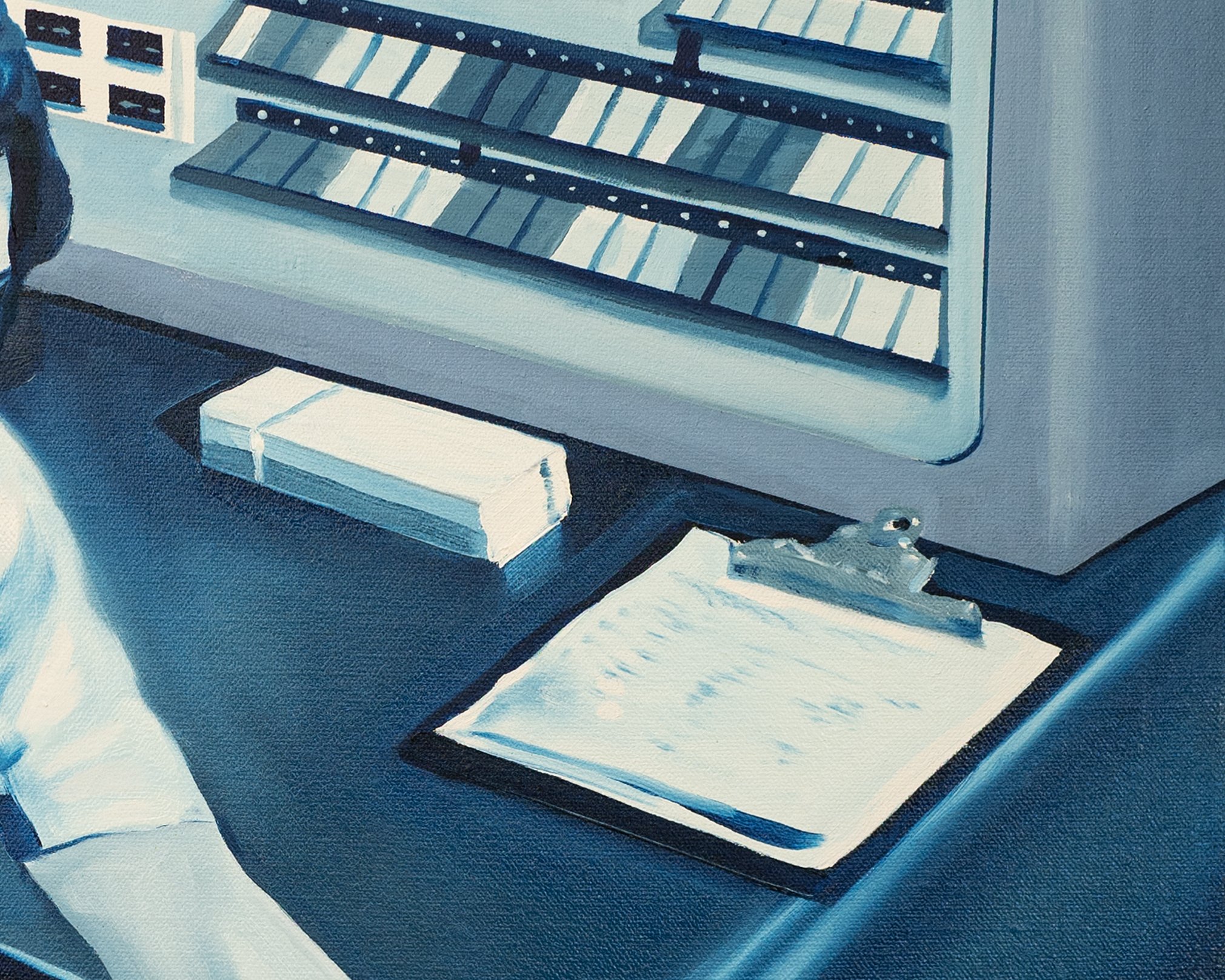
The IBM 704 was introduced in 1954 and remained in production until 1960. It was the first mass-produced computer to support floating-point arithmetic, which meant that it could perform the kind of calculations that scientific research required, the kind that involved decimal fractions rather than integers, the kind that NASA needed to calculate orbital trajectories and reentry angles and launch windows with sufficient precision to send a spacecraft from one point on the earth's surface to another point on the moon's surface and back again, a problem that required the machine to perform millions of calculations in sequence, each one depending on the result of the previous one, each one requiring the machine to hold a number in its memory and perform an operation on it and store the result and retrieve it and perform another operation and store that result, and so on, for hours, for days, for the duration of a trajectory that a human being could not calculate by hand in a lifetime but that the machine could calculate in an afternoon, provided that a human being was present to feed it the punch cards and set the switches and read the output and correct the errors and restart the machine when it failed, which it did frequently, because the IBM 704 contained thousands of vacuum tubes that generated heat and consumed power and failed without warning, and when a tube failed the machine stopped and the woman at the console had to find the failed tube and replace it and restart the calculation from the point where it had stopped, and the finding and the replacing and the restarting were also part of the computation, also part of the labor that made the dream possible, also part of the work that the machine could not do without the woman who was there to do it, and the woman's presence in the room was not incidental to the computation, it was constitutive of it, because without her the machine was a pile of metal and glass and wire that could not compute anything, and with her it could compute the trajectory of a spacecraft, and the difference between the two states was not the machine, it was the woman, it was her hands and her knowledge and her attention and her willingness to sit in a room full of machines and operate them, and the history of computing has mostly forgotten her, and the painting remembers her.
Tan Mu's Q&A addresses the erasure directly. "Women were essential to early computing, particularly in data input, programming, and calculation," she states. "In many cases, they were the ones operating and maintaining these complex systems. The woman in the photograph represents a broader, largely unacknowledged history of female labor in technology." The acknowledgment is not incidental. It is the painting's central argument, and it extends a line of inquiry that Tan Mu has pursued across multiple works, including The Note G (2022), which references Ada Lovelace's algorithm for Charles Babbage's Analytical Engine, and Punched Card 1 (2022), which references the punch cards that women operators used to program the machines. The Binary Dream is not an isolated painting about a single photograph. It is part of a sustained investigation into the history of computing as a history of human labor, specifically female labor, and specifically the labor that the history of computing has consistently omitted from its own narrative, the labor of the women who sat at the consoles and operated the machines and fed them the data and corrected their errors and kept them running, the labor that the machines themselves could not perform and that the official histories of computing have attributed to the machines rather than to the women who made the machines work.
Kerry James Marshall's Portrait of a Curator, completed in 2009, depicts a Black woman standing in a gallery, dressed in professional attire, holding a clipboard, surrounded by the works of art that she has selected and arranged and interpreted for the public. The painting is part of Marshall's decades-long project to place Black figures at the center of the genres from which they have historically been excluded: the history painting, the portrait, the landscape, the genre scene. The curator in the painting is not an assistant or a subordinate. She is the figure who makes the exhibition happen, who decides what the public sees and how they see it, who performs the intellectual and organizational labor that the gallery requires in order to function and that the public rarely attributes to a Black woman. The painting does not depict her as a symbol or a representative of her race. It depicts her as a professional doing her job, with the specificity and dignity that the history of Western portraiture has traditionally reserved for white men, and by doing so it makes visible a labor that the art world has consistently failed to see, the labor of the curator who selects and arranges and interprets and who is nonetheless absent from most accounts of how exhibitions come into being, erased by the same institutional structures that depend on her work.
Yiren Shen, writing in 10 Magazine about Tan Mu's Signal series, observed that the artist's paintings "make the viewer aware that they are looking at a machine that is also looking at them." The observation applies with equal force to The Binary Dream. The woman at the console is looking at the machine. The machine is looking at her, in the sense that it is receiving her input, processing her instructions, producing output that she will read and interpret and correct. The painting is looking at both of them, the woman and the machine, and it is asking the viewer to look at both of them, and to see what the history of computing has made invisible: that the machine was never autonomous, that the computation was never artificial, that the intelligence was never purely computational, that the dream was never binary in the sense that the word implies, a choice between one and zero, between machine and human, between the automatic and the manual, because the binary was always a pair, always a woman and a machine, always a body and a console, always a hand and a switch, and the dream was their dream, and the intelligence was their intelligence, and the computation was their computation, and the history that has forgotten the woman has forgotten half of what made the computation possible, and the painting that remembers her remembers the whole, the woman at the console, the machine behind her, the blue that surrounds them both, and the hands that made the dream human.